 signatory
USA has one more radar design in the works often forgotten about. It’s the Swedish-American AESA built by Raytheon and Ericsson Microwave Systems.
And it’s unlikely Israel would gain access to it any other way than as part of a complete jet. The technology used to build it will be transferred to the US for new radars that will significantly outperform existing ones.
Why? Because Ericsson is reducing the size of the T/R modules with their patented technology and the net effect will be many more modules in the same space. Especially important for the Gripen fighter with limited space and why AESA is not already offered on this jet. With current tech the antenna would be too weak. You could say this is the next generation AESA and the manufacturing technique will stay in the hands of Sweden-USA for a long time.
For system integration and flight evaluations on the Gripen jet there has been demonstrators using existing Raytheon antennas. The program started in mid 1990’s in Sweden and Raytheon came online in 2001. The same year the US made Sweden part of the Defense Trade Security Initiative. Israel is still out in the cold on that one.
“The transaction contained in the attached certification involves
the export of technical data, defense services and hardware to
Sweden for the development, test, supply and integration of two
Active Electronically Scanned Array (AESA) Antenna Subsystems for
the Swedish NORA III Program” – http://www.pmdtc.org
signatoryGripen was never ment to be exported.
Export sales is a bonus. And so far it’s successful.
signatoryI just have some lingering doubts regarding this new Gripen-N…
a) What will these extra stores will do for the little planes drag, flight performance and radar cross section?
b) The landing gear changes seem to me as a very demanding and expensive engineering feat, the whole wing and lower fuselage will have to be redesigned, retested and recertified… who’s paying for it? I dare say: not Norway…
c) This new model seems only to make sense if other countries besides Norway decide to join into a major single purchase. Where and who are these other countries?
d) Hasn’t Norway just declared that they’d be sticking to their JSF commitments?
Lots of questions, but few good answers for SAAB…
Comments?
Hammer
Lingering doubts you say? If you had followed the information regarding the status of the Gripen project your questions would already have been answered. To sum up.
The Swedish military is paying for development under their export support programme. SAAB is of course adding from their own pocket too. Norway didn’t commit to the JSF, they have no commitments at all in fact they only participate in the development fund. A small sum btw. As staying on the outside would mean they would lose their priority rights on deliveries. Basically they pay to make sure they get jets if they do chose the jet.
And Norway clearly stated they have not made a choice which jet to buy.
It’s not such a big reconstruction anyway. Money is no problem, it will be built before Norway is to make a decision on it.
signatoryA combined order from Norway and Denmark would make some sense – ~40 for Denmark, and a further ~60-80 for Norway. That would certainly help Saab, especially if they can get a few more customers to buy up the used JAS-39As.
Right now we have to go by much of what SAAB tells us so the info is a bit partial but well that’s the jet business… Lockheed is very good at PR too..
Saab is getting 40 of the surplus J39A jets and can do whatever they want with them, so they can for instance modify them to NATO standard or convert them to Gripen N and offer as export product.
This Swedish news from the delivery of jets to Hungary got some info too.
http://www.svd.se/dynamiskt/inrikes/did_12251215.asp
It quotes a man from the Hungarian department of economy that they already by time of first delivery had 72% of offsets delivered sooner than expected, and had visits from Romania, Bulgaria and Croatia to hear how SAAB is keeping their promises and was told only good things.
(Romanian airforce chief flew Gripen this week in Sweden btw, anyone want pics let me know or go to mil.se)
Also, Saab is talking to 15-20 countries about Gripen sales so they have lots of options now with the current jet, new jet design, and updated 39A.
 Czech, Hungarian, Swedish Gripen C/D 🙂
signatoryI beg you pardon, but I remember having read in an old Air Forces monthly issue that the Gripen’s internal fuel capacity was of 3000 litres… :confused:
And Note that 5000 litres is close from the Rafale’s 5325 litres of internal capacity which is a twin engines aircraft. Are you sure of thoses numbers ? I’m really and honestly asking, because I fell somewhat confused, here…
You are most likely right! I thought it sounded too much too… I’m not used to typing it in liters (I use kg or gallons) and used a bad google result 😮
signatoryWill the added weight give the Gripen N the same structural problems as the F-16. Is the Gripen platform designed with weight increase in mind ?
That will be resolved by moving and changing landing gear. Also the current version C/D which this one builds on is already much stronger than the old A/B. The Gripen C/D also have refueling prope installed.
What they have yet to mention is anything about the engine to support the extra external fuel and weapons, but for a patrol scenario that’s not an issue as the pilot would just drop the tanks when he engages the threat.
signatoryThis sure looks interesting!
Now, on the subject of Norways new fighters:
Do you think the dual engined Eurofighter is more suitable for Norways large territory of water?
I mean, its better two have two engines when you patrol huge areas of ocean.Of all the previous fighters operated by the RNoAF, only one of them have had dual engines, the F-5A/B (atleast what I remember), so I’m not sure if this realy is a problem.
Right… Norway use F-16 today (with not the best record in engine MTBF) so that’s clearly not an issue for them. Also the JSF is one engine.
And two engines also mean more risks, that’s why the F-15 and F-22A has a titanium board in between them and why the russian jets have big space between the two.
signatoryThis jet will be able to carry 8 AMRAAM’s (or 8 METEOR) + 2 IRIS-T.
The new internal fuel capacity will be at least 5000 liters (compared to 4365 today) and the add-on EDTL tanks carry 1135 liters each and can be put on 4 stores. (compared to 3 today) So total combined fuel is 7770 liters today vs. 9540 liters on the Gripen – N.
As seen on that pic, the Gripen sales team is also flirting with Norway’s specific requirement of Naval patrol and plenty of Kongsberg NSM missile 🙂 (Whilst with the JSF, they get a jet like everyone else, not tailor made for their requirement. And have to pay for NSM integration themselves)
Both the Gripen C/D and Gripen -N is receiving dual-pylons and the -N two extra hardpoints so it’s growing quite significantly in capability.
signatoryHow to bring down a B-2…
I would build a giant Big Mac and watch the B-2 dive for it.
j/k
signatoryAbout the SAAB/EriEye system I can add two points.
The aircraft does not carry controllers (although it’s large enough to do so), but functions as an an airborne radar integrated with the total air defence network.
The planes called S100B in Sweden does not have operator station.
The planes called S100D does have 2 operator stations.
(For independent air command. It’s based on the temporary solution Sweden built for the Greek airforce when they leased planes while waiting for their own EriEye jets.)
Another thing to note is, the range of the radar and number of objects it can track etc might be limited in the software depending on who is the receiving state. Probably not, but it’s possible.

Operator station for EriEye onboard Saab 340B. a.k.a S100D.
signatoryadding a few……
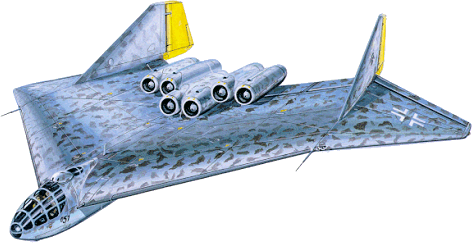

Arado 555. Germany. Design start 1943

Focke Wulf 1000x1000x1000b Germany Design start 1944


Lippisch P13 jet and DM.1 ramjet glider design start 1944
…
signatoryIn 1995 when Swedish HQ did a more cost calculated study of attack helicopters they used the AH-64 as the example. Now the talk is of 12-20 choppers but they used 40 units (2 battalions) and put them at a combined price of just under 5 billion Swedish Crowns, in addition they identified simulator, swedish manuals, support systems etc what would have to be imported and what’s locally available, as a result another 2.5 Billion crowns were needed to integrate the choppers into the Swedish military. So a total of 7.5 billion which in today’s currency is roughly 1 billion USD.
The ‘service charge’ of 2.5 billion is unlikely to be any smaller even if they go for only 12-20 choppers. But like I said, this was a budgetary study 10 years ago and things have changed. Anyway, now the large bulk of procurement money is spent on fighter jets and the wish list for other equipment is large. After 2007 all Gripen jets will (should) be delivered. Last year they spent 11 billion on equipment (~$US1.5B).
signatoryMy bet is in 10 years India still haven’t decided what the heck they want.
signatoryWhen South Africa bought Gripen I really hoped that Sweden would buy the Rooivalk in return. In the late 90´s we tested a bunch of helicopters in Sweden (IIRC Tiger, Apache, Mi-28 and Ka-50, can´t remember if Rooivalk was here to) but the decision on however we even should buy attackhelicopters have dragged on.
A month ago I read that SAAB is thinking of buying parts of Denel (mainly aviationsupport and missilessections). Maybe this can open things up a bit and we in the near future can see a swedish Rooivalk?
(BTW a little off topic: the recent years Sweden has opened up their eyes a bit on the southafrican armsindustries. We just purchased RG-32M and I have read rumours that we are interested in the Umkhonto-IR on the Visby-corvettes)
Hi M 🙂
Yeah, Rooivalk is a contender for the Swedish attack helicopter requirement. Denel build parts for SAAB today so they definitely eye those
business areas you mentioned.. There’s also a chance the Westland WAH-64 is of interest as it’s better prepared for winter climates. As a result of the UK’s winter testing of the British WAH-64 in Sweden they added anti-ice protection on the blades.
(The Swedish military apparently liked the american AH-64 especially since laser targeting for Swedish rb17 ground-based hellfire system worked smoothly, but concluded as with the other choppers it just won’t work good under Swedish conditions. Perhaps the WAH-64 is the ‘fix’ and the other UK-Swedish defense cooperation in the works on land systems might play in, but we shall see.)
SAAB bought the South African company Grintek ( http://www.grintek.com/ )last year. Now called SAAB Grintek…
signatoryAny more photos of F-22 with wing-mounted bombs, drop tanks, missiles, or other ordnance?
http://forum.keypublishing.co.uk/attachment.php?attachmentid=115647
Blocking the landing gear.


 Sign In







