lauriebe
There certainly are!
Here’s a shot of XB259 taken in March 1968 also with rear doors removed and a shot of XB261’s cockpit at Newark in September 2004 – just after arrival.
Thanks for those.
Actually got inside XB261s cockpit when I was back home last May. First time inside the ‘pit of the Bev. Walked the back end several times in the dim and distant past. First time was when one flew into my home airport, Plymouth/Roborough, in the late 50s. Was then, and I believe still is, the largest aircraft ever to operate into and out of there.
Unless someone knows different…. 😀
lauriebeHave just established contact, via another forum, with the present day Historian of the Air Movements School at Brize. I gave him a link to this discussion and he has just replied to me. I post that reply below:
Laurie
Am not a member of the forum so cannot post. Just read it through
though. Can you post that I am looking into it on the school (as school
historian) and will read through the F540 for that time today (better
than doing work).
My thoughts are starting to turn to the frame with ATDU Abingdon as they
were close to our school when it was there. Could be we inherited that
frame.
I will ask if there are any other, clearer, photos than the one in the original post on this thread.
Regards,
Laurie.
lauriebeI have just been using MSN Messenger/Webcam to talk to my brother in the UK and mentioned this thread and posted a link to him.
After looking at the photo, he believes that the RAF Police School at RAF Newton had a similar fuselage in a hangar at Newton during the early 80’s. He is almost certain that it was a Britannia fuselage and it was used to train Police students on methods of searching aircraft.
He is going to check with some contacts who were at the School at that time and get back to me.
lauriebeAs you say, judging by the wing root, its probable it was one of these mock-ups. However the only 300’s with cargo doors were conversions (the first being G-ANCF in 1964, which is now sitting forlornly outside hangar A1 at Kemble looking for a new home….) so why would the mock-up have been converted? Further pressure tests?
Still needs more sleuthing!!
cheers,
Andy
Was the mock-up converted at Brize?
If it had been made available to the Movements School and there was no cargo door, which was needed for the purposes of teaching their students to move freight into and out of RAF aircraft including the Britannia, would the simplest solution not have been to make one?
The cargo door area in the Brize dump photo does not look quite right to me. I would have expected to see more metal around the inside edges, locking latches, etc. In the photo, this area is very flat, almost as if it had been boarded up to disguise a cut. I have been trying to find a photo of another Brit with its cargo door open to compare. No luck so far though.
BR
Laurie.
lauriebeLooking through the Air Britain RAF Aircraft XA100 – XZ999, shows that 22 of the 23 Britannias supplied to the RAF were sold on during 1975/76. The only aircraft not disposed of in this way was XL638, Sirius. There is no mention of its fate, other than it was not repaired after the incident at Khormaksar. Have you tried to obtain a copy of XL638’s Movement Record Card from the RAF Museum?
Your assumption that it could be a mockup might indeed be right.
BR
Laurie
PS: Have just read through the record of the Khormaksar incident in Colin Cummings’ ‘Lost to Service’. It states the following for XL638:
“Overshot into sea after power applied on landing instead of reverse thrust. The wreck could not be removed easily and so was blown up in-situ”.
So the photo cannot be of XL638 either. That seems to be all the RAF’s Brit’s accounted for.
lauriebeIf you have AFCAD installed, you can set up your own start points in the water at airfields on the coast. Lee on Solent is a good example. It’s fairly easy to do using slew mode and then insert start location. Name these Water 1, Water 2 etc so that you can set up your flight at the start.
I have used AFCAD to add several start locations in the water at Seletar in Singapore. This was an old Sunderland base and I use a Sunderland model from there.
lauriebeI got a tug and a dude on my download in old Transavia colours? It only appears when you reverse out.
Yet another senior moment! 😮 😮
I have just discovered the Shift P + 1 or 2 option for pushback! All has been revealed. I had been using the slew mode until now.
lauriebeThanks, Skytrain, now we know which one is in New York.
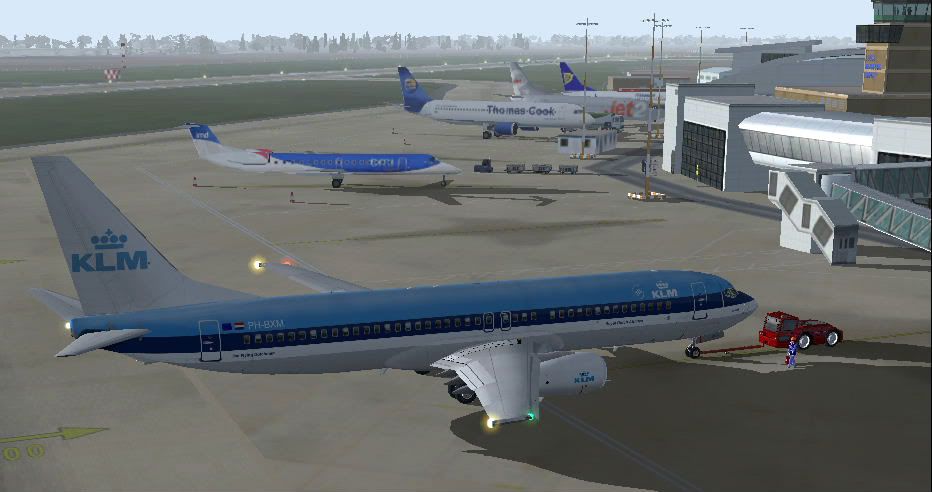
lauriebeHere she is. Posky new B737-800 in KLM old colours. See more shots of this KLM aircft on the screen shots thread. Here http://forum.keypublishing.co.uk/showthread.php?p=839841#post839841
Although the write-up on AvSim mentions “a push-back truck and a man walking”, I cannot see this on any of the three versions (KLM, Virgin Blue & China Southern) that i have downloaded.
Am I doing something wrong, or, do I need additional downloads?
lauriebeThanks guys.
I believe that the Tattershall Thorpe site was pretty well cleared out some time ago and was wondering where HC went from there.
The Wings of Eagles site just mentions a stored Whirlwind without giving details so I have emailed and asked the identity.
BR
Laurie.
lauriebeYou can now download them from the avsim website. It took me several times to get the download of the Virgn Blue B737-800 to work due to overloading on the site.
Now I’m off to test fly the thing to see if its as good as the other Posky models and all the other Boeing 737’s out there.
Screen shots coming up later.
I downloaded mine this morning my time when the site was quiet. No problems on the download and have been using it this afternoon.
Impressive!
lauriebeThis system was introduced in 1947. AMO 498/47 brought in the ranks:
Master Aircrew –
Aircrew 1 (Pilot 1, Nav 1, etc)
Aircrew 2
Aircrew 3
Aircrew 4
There was also a cadet element in this structure.
It was never very popular and was replaced in late 1950. At that time the Master element survived , Aircrew 1s were reclassified as Flight Sergeants and Aircrew 2 – 4 became Sergeants.
The badges shown in your photo are of Aircrew 2, or Pilot 2, in this case.
BR
Laurie.
lauriebeI’ll go dig out the July 05 magazine and have a read.
Thanks again.
There are a couple of photos of the Seafires involved that I supplied in the ‘Flypost’ section of August ’05 issue as well.
BR
Laurie.
lauriebeHi,
Does anyone know where HMS Perseus carried out the trials on steam catapults in the early 1950’s?
I caught a clip on a TV show last week of them test firing the catapult with pilotless Seafires, which were then left to crash into the sea. They even test fired the carriers piano for a laugh at the end of the trials!
Just wondered if these aircraft had been located or are just sitting at the bottom of the sea. It looked to be in a harbour, so maybe sheltered from harsh tidal action, but I would think that the salty water will have done its worst if they are still there.
Thanks.
See ‘Flypost’ (P87) in the July 2005 issue of ‘FlyPast’ for a detailed account from N T Wintrip who was onboard HMS Perseus at the time of the trials. The ship was modified at Rosyth, from where the trials seem to have been carried out.
Later tests, with heavier aircraft, were carried out from the Harland and Wolfe Shipyard, Belfast. Shortly after that, Perseus sailed for the US.
I am still trying to identify which Seafires were used on these tests. If anyone can throw further light on the subject, I’d like to hear from them.
BR
Laurie.
lauriebeDog House Ldr,
Try this link for starters:
There is quite a bit of info there. If you need more, post again with specifics.
BR
Laurie.


 Sign In