Phaid
PhaidThis story has shown up in the mainstream press as well. No reason to doubt that Israel did this; they have the means and the motivation.
As far as your quote, not sure what they mean by “The raid would have degraded Iran’s ability to retaliate for a potential Israel or US attack.”
PhaidThe template/requirements map is the same (this is the time/cost driver). It is then autocoded and complied and regression tested.
:rolleyes: As someone who has done software development for defense contractors, I can only say that I wish what you say were possible.
Phaidpercentage of software reuse is extremely high, the big difference is ADA (F-22) v C++ (F-35)
You realize that the above statement makes no sense, right? If they are written in different languages, the percentage of software reuse is zero. They may share some software design principles but that is it.
PhaidPeople who tested TVC don`t share your opinion. There are many benefits from TVC, not just in post stall region.
True, for example the F-22 has TVC primarily to offset supersonic trim drag, not so much for maneuverability.
When we talk explicitly about maneuverability the thing you say pilots should avoid whenever possible (post stall) is the only thing that helped X-31 to dominate F-18/16/15. Without TVC X-31 was toasted. It had worse T/W ratio and worse turning rates.
Russians came to the same conclusion, you just need to read the link above.
Perhaps, but the X-31 tests were also exclusively gun dogfight simulations. The X-31 dominated its opponents because the opponents were fighting in the single regime where the X-31 is superior, and not given the option to do otherwise. Also, due to its small size and light weight, the X-31 is the optimal airframe to benefit from TVC — airframes that are actually tactically useful will not benefit as much. All of which means that the real reason you don’t see that many fighters equipped with TVC for maneuvering purposes in real life is that it is an expensive optimization for an exceptional situation, and therefore not cost effective.
PhaidAll that is true, so I wonder why we spend so much time comparing aircraft A with aircraft B on this forum when there are so many other factors to take into account?
Because jet fighters are phallic symbols. End of story.
PhaidAre you sure?
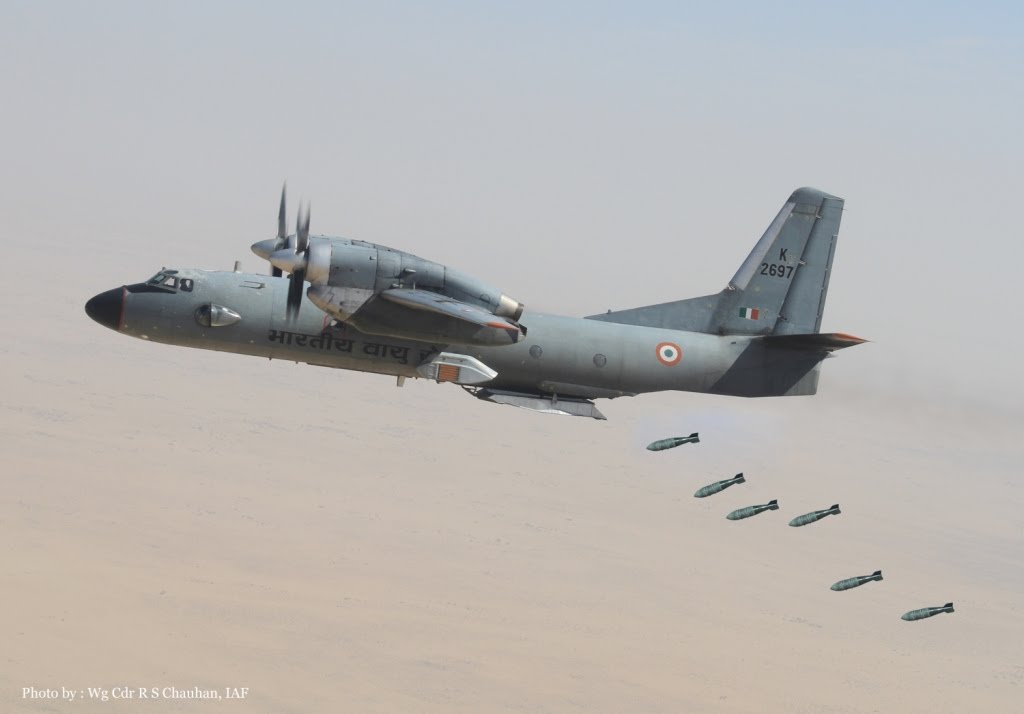
Looks like the photo is Vayu Shakti 2010 exercise, in fact there is a video on Youtube of a night bombing from an An-32
The An-32 exercise was at night, this photo is not. I am not denying it took place, but that photo is clearly photoshopped.
PhaidWhich is what it all boils down to.
Isn’t it also often the case, that an older two seater aircraft will out perform a
more modern single seater, purely by having an extra set of eyes and being
able to share the work load ?
Depends on how much older. It is certainly the case that, all else being equal, two sets of eyes (and hands and brains) are better than one. For air to air combat this is not really true any more, since offboard aids to situational awareness make up for the extra set of eyes, and the weight and fuel penalty of a second crew can be put to better use.
In multirole aircraft however, two seats are still the preferred option due to the workload; thus the Su-30MKI, the fact that the USN has purchased more two-seat Super Hornets than single seaters, the AdlA’s preference for two-seat Rafales, etc.
Phaid
1Saludo
That is so obviously photoshopped it makes my eyes hurt.
PhaidAgain and I cannot reinforce this enough – MBDA (formerly Matra) – integrated Meteor onto Gripen first. That is not something that is done if it is the most complex of integrations… not when a significant degree of company & program prestige is resting on it.
Technically they integrated it onto Tornado F3 first. Gripen is just the first type to be integrated that will actually use it operationally.
As far as the whole question of MBDA heritage being evidence of MICA compatibility, that is simple speculation. The MICA uses older technology and its datalink includes compromises to allow it to work with the Mirage 2000. There is no guarantee that this is “just a software problem”, there may be operating mode or frequency issues to deal with as well. In short, until it is confirmed, there is no certainty at all that it is compatible, simple as that.
PhaidThat, put with MBDA (building the Meteor) being formerly Matra, who built the Mica – using the Gripen as a launch frame, is enough to convince me that there is compatibility.
It may be “compatible” to a limited extent. The question is whether the radar supports the MICA datalink for midcourse updates. If it does not, then compatibility would have to be achieved via a bolt-on antenna system, like on the Mirage 2000-5, or through modifications to the radar if the radar can support it.
PhaidThis is what the USAF had to say on these WVR BFM’s:
“It sounds as though we have very different recollections as to the outcomes of the BFM engagements that were fought,” one Raptor pilot says. USAF sources say that the Typhoon has good energy and a pretty good first turn, but that they were able to outmaneuver the Germans due to the Raptor’s thrust vectoring. Additionally, the Typhoon was not able to match the high angle of attack capability of the F-22. “We ended up with numerous gunshots,” another USAF pilot says.
But hey, maybe the Eurofighter guys can make a patch like the M2K guys did.
PhaidNo point other than for small carriers.
In theory they offer better persistence / faster reaction times due to austere forward basing. Reality does not bear this out. To keep them in supply at austere bases means supplies must be trucked in or flown in by helicopter, which is more costly and dangerous than at a major air base behind friendly lines. And the fuel cost of numerous short takeoffs and landings is much higher than that of hitting a tanker.
About the only real advantage they have is that they could in theory be rearmed faster and so maintain greater persistence, but in reality it is more efficient to simply use a larger number of conventional aircraft — which is easy to do from a large airbase.
This is not to say that there aren’t some specific cases in which they happen to work out well. But over the lifetime of the aircraft, these situations are few and far between, and the capability tradeoff is simply not worth it in the long term.
PhaidThe Austrian Air Force was forbidden from using any type of guided missiles from its creation in 1955 (the “Raketenverbot”). In the early 90s the Austrian parliament amended the constitution to lessen this prohibition so they could purchase AIM-9s for their Drakens. So they don’t really have a long tradition of using AAMs, and it is possible they are still prohibited from operating BVR AAMs.
PhaidThe Phantom Eye only uses a cart for takeoff, not landing. The landing gear dug into the dry lakebed on landing, and it is the gear that was damaged.

PhaidThe term « Omnirole » was chosen as a differentiator with mech scan radar aircrafts that could perform only one task at a time.
But by that standard, the Rafale is not “omnirole” either. The RBE2 does not provide full interlacing between air/air and air/ground modes, otherwise the UAE would not have needed to ask for that to be added on.
I believe the RBE2 does provide interlacing between air-to-air and terrain following mode, but not simultaneous air to air and air to ground targeting.
If this concern has already been addressed, I’m sure someone can provide a reference.


 Sign In