Where did you read it?
Not qhoting you ;). tw, soon going to “commit” an article on our website about technical issues during F-35 program AND fixes (permanent, momentary, satisfying or not. Hope you’ll help me BIO 😉
Those are not rivets but access latches. They are treated and are flush to the surface of the skin.
This is what I was referring too.
Look on the upper left panel on the photo i posted (closed panel). Btw, hard to find close up photos of F-35 skin.
which is why shaping is important
Ok with that, but canted will be more susceptible to reflect radar waves from the ground (eg) than vertical. On the opposite, for radars at same level…
Btw, i read “no rivet etc. really? see the panel above the mech…
[ATTACH=CONFIG]249995[/ATTACH]
All Lockheed has to convince their prospective customers of is the internal bay expansion that is already planned for future capability drops. You can go from 4 to 6 internal missiles without any impact on drag due to external stores or pylons etc. Overall affect on performance should be minimal.
Furthermore you could have a system “Ã la F-22” to carry sidewinder internally.
Why did he write Dassault to the presentation then.
Make a minimum effort. Go to their website and read articles.
Where did they get it from?
As i told you, their test pilot extensively tested Rafale, Gripen and F-18. And established the charts. All articles are available on their website.
Dassault created the slide, the information came from RFI to the F-X2 tender. Not to mention it correlates well with the 1500 km max combat radius (1300 km with 30 min on station) with 2 450 gallon tanks and 1 300 gallon tank.
No, they didn’t. Slide is from Defesanet.
And you know that your “with two 450 gallon tanks the combat radius 1230 km” data comes from Dassault.
Wrong. They come from Vianney Riller, a test pilot that flew the three types and is atm advisor to brazilian MoD
I don’t think obligatory has any solid grasp of fluid dynamics. Ideal shape is that of a water drop? What? Oh, and I’ve seen obligatory rave on and on about the Sear-Haack body without even fully understanding what it means. A true supersonic aircraft would not have it’s volume distribution symmetrical, the peak would actually be towards the rear because you calculate area through Mach-plane cuts. Sears-Haack volume is strictly for transsonic.
An F-35’s area ruling isn’t the most ideal or have the greatest fineness ratio, but the question is whether it’s good enough for its intended role and provide reasonably good air combat maneuvering capabilities. Some of this eyeball conclusions is laughable to say the least.
Of course, obligatory is also fond of repeatedly citing a “NASA study” (it’s actually a contract paper done for Boeing for their JAST configuration study) to show that the F-35 is “moderate observable” based on a preliminary configuration chart that doesn’t even detail RCS ranges for its classifications, and then concludes that GaN can then “nullify” it. And then he gets into nonsense like this.
And here’s a hint why that’s a load of crap and why shape is still the most important aspect of LO.
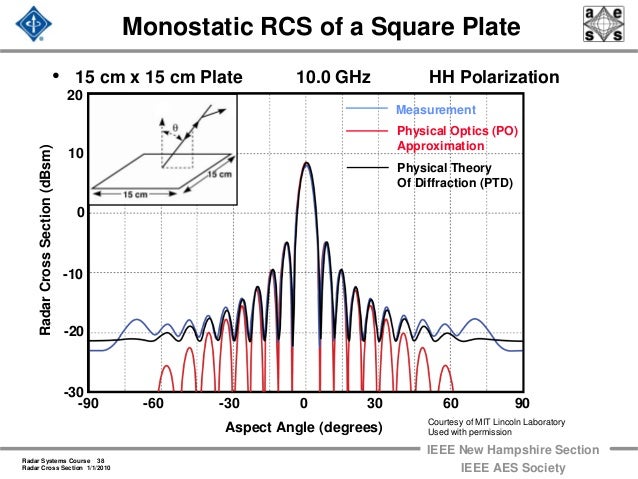
Enjoy your gain of 20+ dBsm. :highly_amused:
I’m sorry but when someone shows so much technical ignorance it’s hard to give him much credence. If he wants credibility, he should first read some books on fluid mechanics and electromagnetic theory.
What your graph shows is that a flat surface will have a larger. reflection depending on aspect angle. Coma.

The F-35B or F-35C are just as capable of dispersed basing as the Gripen or Super Hornet.
ALIS dispersed???
It is good to see France trying to get into the game, but there is only so much that can be done in the way of upgrades to an older system like Spectra. It will be interesting to see if they can keep to their schedule or if this ends up like the AESA equipped Rafales.
Develop please?
Marcellogo makes a valid point though eh? As one of the people who commented (I don’t think I was whiny) on the smoke from a modern warship, I haven’t dared to say anything about the snapped wire in part because I assumed the problem would go away.
As an observer from the UK though, I won’t make any smart comments about having to use a carrier as a helicopter landing ship;)
😉 UK with Brit humour!
To its credit SPECTRA fuses the IR spectrum data as well, and from what I can see EPAWSS is strictly in the RF domain. The point with the new hardware is that when coupled with the new mission computer that is also being swapped with the upgrade, it enables possibilities going forward. Additional capability then becomes a function of simply funding further development of software, testing and evaluation and not needing new hardware or modifications tot he airframe since all of this would have been covered during the EPAWSS switch. The choice of choosing to go for GaN components in the active portion piggy backs on BAE’s demonstrations to DARPA and AFRL and they have been the main vendor for both the F-35, and F-22A EW efforts. In the end it all boils down to how long they may wish to keep this aircraft. If indeed they want to keep these aircraft well into the late 30’s, or early-mid 40’s you will most definitely see upgrades to the radar, EW and other mission systems. We aren’t talking about a few dozen aircraft here but a fleet of 400 F-15 C’s, and E’s so there is plenty of scale to fund incremental development and roll out of capability over time.
101% Agree.
More like SPECTRA 2.0…
GaN, towed decoy, an all-new system some 20 years newer than SPECTRA.
GaN on F3-R standard SPECTRA antennas. (2018). Launched decoy also (LEA) and towed decoy on Indian Rafale.
BAE EPAWSS ( (USAF F-15C/E) – Gallium Nitride (GaN) Based replacement for the TEWS
SPECTRA (minus geolocation etc.) on F-15? Nice!







