Imagine if it had been an Iranian spy drone/aircraft that had been shot down/brought down/crashed over the USA…….
Apart from being the cheapest option, perhaps Gripen was also the easiest choice from the point-of-view of Swiss internal politics, in that it is not French or German or Italian, so no section of the population can be said to be favoured.
So Norway is buying the F-35 primarily as an interceptor?
Curious development
Hawker Beechcraft protests over USAF decision to dismiss AT-6 bid
…..The government has confirmed that it now envisages routinely deploying only twelve JSF aircraft on the carrier for operations, compared to the original thirty-six. And the requirement for daily sortie generation has been reduced from seventy-two to twenty. This suggests that the government could now be envisaging a total JSF buy of no more than fifty aircraft…..
Those numbers appear to make a complete nonsense of the size of the new carriers. What a shambles!
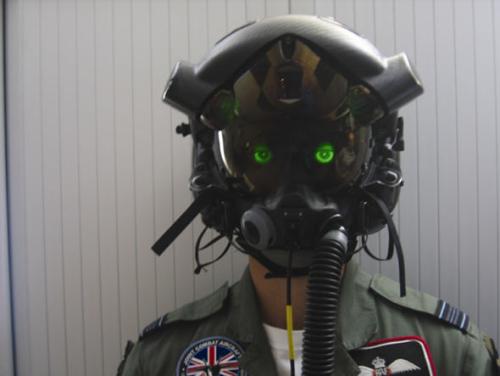
In 20-30 years they’ll be able to bypass the eyes altogether and feed sensor imagery directly to the pilot’s brain, but of course in 20-30 years there won’t be a need, because there won’t be any combat pilots. :diablo:
So was this a technological ‘bridge too far’?

According to flightglobal.com,
“US defence chiefs raise alarm on cost of three F-35 variants
BY: STEPHEN TRIMBLE WASHINGTON DC 2 hours ago Source:
The new chairman of the joint chiefs of staff has raised concerns about the cost of building three variants of the Lockheed Martin F-35 Lightning II.
“I am concerned about the three variants and whether we can go forward in this fiscal environment with all three, but I am eager to learn more about that,” said General Martin Dempsey, speaking at a House Armed Services Committee hearing on 13 October.
“Three variants create some fiscal challenges for us,” he added………”
As a matter of interest, (i) what would the F-35 have looked like if they hadn’t been obliged to produce a STOVL variant?, and (ii) what will replace the Harrier II if the Marines lose the F-35B?
The only thing that looks sure at the moment is that the USAF will get some F-35As.

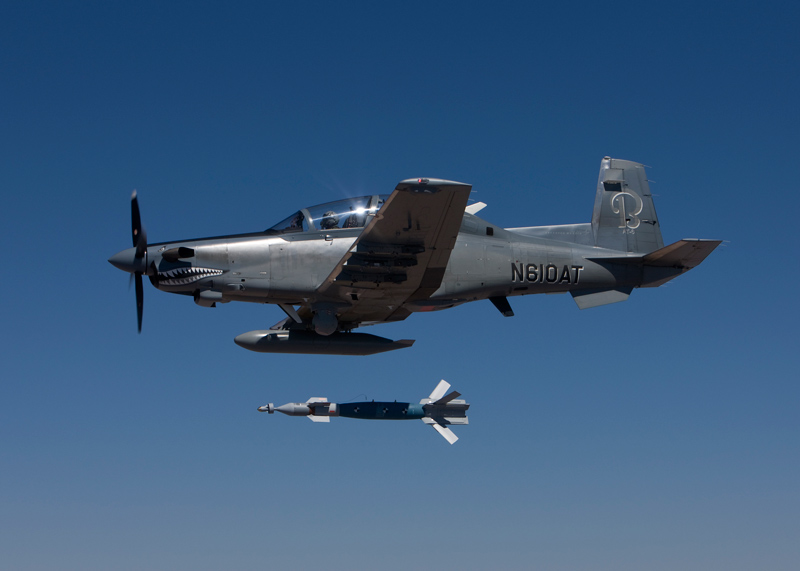
Light Attack AT-6 Successfully Deploys Precision-Guided Munitions
Wonder would it take much to convert one of these or a Super Tucano to take-off and land on a carrier?
Interesting. Re-raises the debate which briefly flared in the US when the CVF design, capability and costs first became known to the USN.
Would the USN be better off with 30 CVF type vessels than 10 Ford Class. Capital and through-life costs would be broadly comparable (I think slightly cheaper for CVF but I may be wrong).
Would give you
– greater flexibility
– greater total sortie generate rate
– wider coverage
– achieveable force capability is more resistant to effects of attack, accidents etc
– More options for building, maintenance etc
– no restrictions on ports due to nuclear power
Same arguments would apply to the RN having 3-4 operational carriers of 30,000-35,000 tonnes, instead of just one 65,000 tonne underutilised monster.
Actually, that $13.5 billion* is total cost for “first-of-class”… which includes design & development and shipyard adjustments for the new systems and equipment, as well as the actual ship.
The actual “per-ship cost” is ~$9 billion*, which is what is budgeted for the second “Ford-class CVN”… CVN-79 JFK.
Yes, this IS rather more expensive than the ~$5 billion* per ship for the last couple of Nimitz-class CVNs (CVN-76 & CVN-77), but not what your cost quote tries to convince us of.
Additionally, the new equipment and other changes mean that, if things work as planned, CVN-78 will cost about $5 billion less in “life-time operating costs” than will CVN-77 (in part by reducing the ship’s crew from 3,200 to about 2,200)… so the “total-life purchase & operating cost” of CVN-78 should be about $1 billion less than CVN-77!
* FY2009 dollars
$13.5 billion is the current Navy estimate of the cost of CVN-80.
But how many countries in the real world can afford naval air on that scale?
The efficiency of an aircraft carrier, i.e. it’s overall ability to operate aircraft increases exponentially with the size of the ship, which is why carriers get bigger whenever the opportunity arises. As ship steel is relatively cheap compared to other aspects of warship design, you save little and cause problems for your crew by making the ship smaller, but gain greatly at little cost by making the ship bigger. The US CVNs are capable of simltaneous launch and recovery as a by product of their size and design, not because it was an important design requirement. If a notional 65,000 tonne CV costs say £2 Billion, reducing the size of the ship to 40,000 tonnes will not save a third of the cost, you will be lucky if it saves 2-5%. For that miniscule saving, you get a far less capable ship with reduced potential for future developments. American carriers designed and built in the early 50s (Forrestal class) were able to adapt without major modification to aircraft that were not even concieved when they were. If they were still in service today they would have no difficulty operating the current and future generations of naval aircraft. The smaller Essex class could not do this, and the Midways (at least CV 42 and 43) would struggle. Size matters with carriers
According to the Congressional Budget Office, the latest US supercarrier (~100,000 tonnes) will cost $13.5 billion. If you can get a 65,000 tonne carrier for £2 billion (~$3 billion), that’s less than a quarter of the price!
The key question is affordability. Even the American are baulking at the cost of carriers these days.
Once again the ‘Simltaneous Launch and Recovery’ red herring raises it’s head. Yes, USN CVNs can do this, but in practice they don’t. There is no operational need for this capability, and it is only practiced during inspections. The RN and MN have never possessed CTOL carriers capable of simltaneous launch and recovery, and it has never caused a problem. …..
Why have separate launch and landing deck areas, in that case? Would it not be more efficient to use the same (smaller) deck for both, if it’s never going to be simultaneous?
Why 36-40 aircraft?