flanker30
Why would the US want to support a totalitarian state that is run by a dictator where voting is rigged and the people are kept under control by a repressive secret police that use torture among its methods? If this were China or Russia, the US would be actively supporting the protestors. So why not Egypt? Would American people accept life in a society run like Egypt’s?
flanker30Exclusive: Military police investigate £6bn privatisation deal
January 27, 2011 7:41 pm by Alex Barker
Military police have been called in to examine allegations of improper conduct during bidding for the £6bn privatisation of the search and rescue helicopter service. It has brought the deal to the brink of collapse…. The main elements are:
– MoD police are investigating the access to information given to bidders and the relationship between a military officer, who has since left the forces, and CHC, a Canadian helicopter operator that is part of the Soteria consortium chosen as preferred bidder.
– Royal Bank of Scotland have pulled out of the Soteria consortium because their concerns over the allegations. It will make it much harder for the deal to be revived, even if the concerns over improper conduct prove to be unfounded…..
So maybe the SAR Sea Kings at least will be around for a few years more.
flanker30They did a study on that in the 70s, moving to ships about the size of CVF but twice as many of them. One of the major problems was that no matter the size of the ship, the escort requirement remains about the same. Having 20 battlegroups with smaller carriers would have required a substantial enlargement of the escort fleet.
1. That’s assuming each battlegroup had only one carrier.
2. If a smaller carrier was assigned to an Amphibious Ready Group, it could avail of the existing escort protection?
3. I’m not suggesting replacing the CVNs – or certainly not all of them – but it does seem that putting all your eggs in one giant and extremely expensive basket does lead to deployment and operational constraints. Which is why it might be advantageous to supplement the CVNs with smaller carriers.
4. There are currently 11 carrier strike groups, each of which has six (?) escorts. Surely the US Navy has a lot more than 66 cruisers, destroyers and frigates?
flanker30Sorry, in many cases Carrier and Land Based Aircraft will not be available. Especially, in the case of the former. As the USN will not operate Larger Carriers in or close to the Littorals for any period of time.
As a matter of fact the F-35B will be the only options in many cases. To provide continues Air Cover for Allied Amphibious Forces.
Two questions:
1. How far out do “the littorals” extend? Even if a CVN was a couple of hundred miles offshore, would its aircraft not still be able to provide cover for the Marines?
2. Part of the problem is that the USN only has “Larger Carriers”. Maybe it should also operate a class of light/medium carriers (20,000 to 40,000 tonnes), rather than exclusively 100,000 tonne nuclear supercarriers, to provide greater flexibility of deployment and operation?
flanker30Absolutely.
The RAF has a habit of keeping a large number of spare aircraft, far more than most air forces. As you point out, 107 is the number in squadrons for 5 squadrons, with the inevitable extras (OCU, Falklands flight . . . ). With normal RAF spares holdings, all the 160 currently in service & on order would have to be kept by the RAF to maintain that front-line strength.
Why?
flanker30You mean like this?

flanker30Looking at the Navy end of the argument, is part of the problem the fact that the USN only operate a certain number of massive supercarriers? Is there a case for supplementing those with a number of medium-size carriers (~ 40,000 tonnes), one of which could be included as part of an Amphibious Ready Group, if necessary?
flanker30A more affordable alternative to the P-8

8 x C-295 Maritime patrol aircraft (with ASW capabilities?) – cost approx. £400 million in total?
flanker30Indian airline IndiGo is to order 180 Airbus A320s, and the Indian Air Force will order another 42 HAL-built Sukhoi Su-30MKIs, according to http://www.flightglobal.com today. In view of the Machiavellian political nature of major arms purchases, could this an indication that an American aircraft will win the MMRCA contract?
flanker30Something of the size of a CVF if there is to be efficient deck management. This of course was I understand what the USMC wanted first off, as the RN did, the failure of the F35B to meet a number of important project milestones etc meant that the RN changed to F35C and CATOBAR.
The message to me is that if you want an F35B to take off with a decent fuel and weapons load you need a CVF sized vessel with a ski jump. If you want your F35B to be able to land back on without having to jettison unused weapons you need a CVF size vessel, to allow for rolling landing.
So if you need a CVF sized vessel for an F35B to operate efficiently from, or to have an arrestor wire setup on, remembering that if you are going STO this cannot be across the whole deck. It would seem far more sensible to just have CATOBAR F35Cs or F18s, simpler aircraft, ability to cross deck, longer range and cheaper.
Wouldn’t your deck management requirement depend on the number and size of aircraft and the required sortie generation rate etc.? Smaller and mid-size nations may just want a dozen or so fighters aboard.
You have to add the cost of the catapult systems to enable the operation of aircraft such as the F-18 and F-35C. Short take-off using a ski-jump avoids this extra expense. (The Russians can launch Su-33s and MiG-29Ks this way, both much heavier aircraft than the Gripen.)
Are the F-18 and F-35C “simpler aircraft” than a Gripen?? Cheaper?
flanker30Funny, on how nobody has come up with any viable soultions….;)
Apart from the Marines….. Would a STOBAR naval version of the Gripen NG be the next best option if there’s no pure STOVL aircraft available and a conventional CATOBAR carrier/aircraft combo is unaffordable? Gripen has pretty much the same empty and max. weights as the Harrier II, similar engine thrust also. So it could launch from a ski jump and catch a cable on landing. Any idea what size of deck would be required?
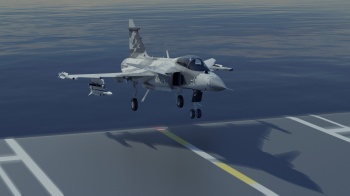
flanker30How about one of these with some rocket pods?
Why?? Might as well go back to these (proven technology, carrier-capable, cheap….:diablo:)

flanker30There is clearly a niche requirement for a ship-based VSTOL/STOVL fixed-wing combat aircraft. The F-35B is the only game in town at the moment, but it continues to be plagued with design, delay and cost issues. Is there any possibility that an alternative aircraft could be designed and produced to meet the basic requirement? For example, delete the stealth and supersonic requirements. Back to a Harrier III? Or a STOVL version of a basic aircraft like the A-4? New design or adaptation of existing aircraft? A post-Typhoon market opportunity for the European defence industry?
flanker30Interesting arguments about Marine procurement policies in this Flight article on the AH-1Z attack helicopter:
For example, (referring to the UH-1Y/AH-1Z programme) “..The H-1 programme originated largely because the Marines wanted to avoid ever taking any [Sikorsky] H-60s,” says Richard Aboulafia, an analyst at the Teal Group, a Washington DC-based consultancy.
“Taking H-60s would have been enormously sensible in terms of costs, capabilities and intra-service commonality, but it would have jeopardised the [Bell Boeing] V-22 requirement, which was the Marines’ highest priority,” Aboulafia says…”
flanker30This sounds pretty fundamental:
“…Describing the discussion as “my day in court,” Gen. Amos said his briefing was “received positively” by Mr. Gates. But he acknowledged the F-35B has technical issues, particularly in the transition from horizontal to vertical flight….”


 Sign In