Indeed. Which is why I’m baffled that so many people are leaping in to contradict those of us who point out the silliness of what the article says.
When responding to an argument, one should pay attention to the argument one is responding to. It is legitimate to expand the discussion to other, related, matters, but not to do so as if replying directly to the original argument, which is what some here have done. Clearly, there are people here who really are confused. It’s nice to see you aren’t one of them.
Now that’s just lawyer-talk…. The essential point is that the F-35B may damage decks. No-one is disputing that – whether the damage is caused by the lift fan or the engine exhaust is a relatively trivial issue. (If I were the suspicious type, I would think that some people are latching on to a minor error in the article and trying to discredit the whole argument on that shaky basis. :rolleyes:)
Whatever. Having read their “messages” over the years and looking through the latest one it’s “same old, same old”. Sorry if I don’t feel like spending the time to refute it for the umpteenth time. However, as I already pointed out, the lift fan doesn’t produce an excess of heat as they claimed. Did I “prove” it doesn’t? No, it should be obvious to anybody with a glimmer of understanding that if there is no combustion going on the only heat that is going to be present is that from the two fan stages beating the hell out of the air and compressing it which is a FAR less amount than that from combustion. But hey, go ahead and believe their claim that the lift fan is going to melt a carrier deck if you like.
I think this confusion between the lift fan in the forward fuselage and the engine exhaust directed downwards at the rear of the aircraft has been discussed already. It’s the engine exhaust that is going to damage carrier decks. While the US Navy are trying to find a bolt-on modification that will cool their flightdecks, the Royal Navy are said to be devising a ‘rolling’ landing procedure – for a STOVL aircraft! – to cope with the excessive engine exhaust heat of the F-35B.
(BTW, maybe this thread should be renamed? It’s the F-35B that’s being discussed; the F-35C is the US Navy version, the one that may or may not be cancelled in the next couple of years.)
The authors of that original article clearly made a mistake by talking about the temperature of the air from the lift fan. Compared to the blast from the engine at the rear of the aircraft, 100% of which will be directed downwards in a vertical landing, the heat from the lift fan blast will be insignificant.
The engine exhaust will be hotter than a Harrier’s, because the engine operates at much higher internal temperatures, and stronger, because the engine is more powerful.
The US Navy is concerned about this problem, so much so that it has solicited proposals from industry for cooling systems that can be retro-fitted to carrier and amphibious ship decks.

That’s just typical of the quality of their “facts”. The lift fan doesn’t even have any combustion going on and is very cool compared to the engine exhaust……
Yes, the lift fan itself just blows cold air, but it only provides about a third of the lift in vertical mode, the rest coming from the engine exhaust – directed downwards by the swivelling nozzle – which is very hot. The lift fan is of course driven by a shaft from the main engine.

Any pics/videos of the F-35 hovering over any surface other than concrete?
Well, one example I noticed was when they wrote “….Nor will the STOVL capability, a Marine Corps do-or-die requirement, ever let the F-35B operate impromptu close to the grunts in the foxholes. It can fly only from prepared concrete landing pads; a landing in the dirt close to the troops is sure to destroy the engine every time. Even flying off Marine/Navy ships may never happen: right now, the heat of the lift fan exhaust buckles the deck of any existing carrier or amphibious warfare ship….”
Anyone know if that’s true? The whole STOVL thing seems to be pretty useless if that’s the case. And isn’t this the version the UK is getting?
Sprey is a senile idiot. /thread
Hey, rather than just shooting the messenger, I’d be interested to see some engagement with the facts or allegations in the article quoted. Is it all lies?
You don’t need Type 45s for counter-narcotics work or fishery patrolling and anti-piracy missions. A basic OPV (H) could do those jobs at a cost of around €25 million per unit.
This new Chilean OPV has a raised heli-deck, with a working deck below. About 1,800 tonnes, it’s a Fassmer design, also being built for the Argentine Navy.

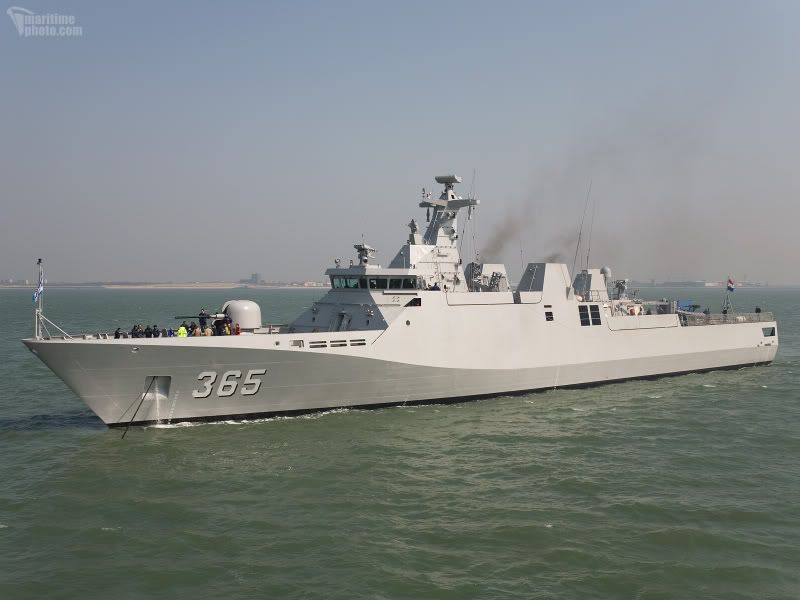
Beautiful boat, Dutch Sigma corvette for the Indonesian Navy,

Why AW149s? Why not NH90s?
Careful now lads, next thing you’ll be talking about an EU Navy, that wouldn’t do now, would it?….. Hang on, when you think about it…..
The BBC did a good television drama called Tumbledown – http://en.wikipedia.org/wiki/Tumbledown – but it focussed on just one part of the war.
Probably be extremely expensive to make a movie covering the whole war, but maybe a film about 2 Para’s battle at Darwin and Goose Green?
Country your carrier is for: Australia
Type of carrier: CATOBAR
Weight: 40,000 tonnes
Length: 270m
Width: 65m
Power supply: Integrated Full Electric Propulsion (IFEP)
Number of Aircraft: 24 F/A-18Fs 2 Hawkeye AWACS 2 Seakings
Type of Aircraft : As above – using the 24 F/A-18Fs bought recently
Defensive weapons : 2 RAM launchers
CATBAR
Seakings? Not much future-proofing there.
This report dates from a few years ago, but it’s interesting nonetheless,
http://www.defense-aerospace.com/dae/articles/communiques/FighterCostFinalJuly06.pdf