Yes, IRIS-T is advertised with that capability
So an aircraft with a missile warning system and IRIS-T is immune to attack from medium/long-range air-to-air missiles, such as the AIM-120 (assuming of course that the detection/warning system and the IRIS-T are functioning correctly)?
If so, does that mean that the F-22 cannot shoot down such an aircraft at long range, regardless of whether or not the other aircraft can detect it or not?
I wonder if the BAe 146 was originally designed for ‘rough’ landing strips such as highways? Impressive improvisation of the rebels though. I’ve always thought that there should have been a full military spec version of the 146, perhaps with a rear ramp door, revised carriage for rough landings and extra fuel tanks. Would have made a great little tactical transport.
Now available at a bargain price!
-Libyan rebels have been coordinating their attacks using a Canadian-made, unmanned surveillance aircraft.
David Kroetsch, the president and chief executive of the manufacturer, Aeryon Labs of Waterloo, Ontario, said in an interview that his company was first approached by a representative of the Libyan Transitional National Council early in June, after members of the group searching the Web saw the company’s surveillance aircraft — essentially a tiny, four-rotor helicopter dangling a pod carrying stabilized-image day- and night-vision cameras.
http://www.nytimes.com/2011/08/25/world/africa/25canada.html?_r=1
Bring back camouflage!
I hope this isn’t a stupid question, but is it possible for a small, short-range IR missile to shoot down another AAM such as the AIM-120?
The F-35A will survive. The F-35B is looking very dodgy, given the costs and complexities and doubts about the requirement. And I wonder how committed to Navy are to the F-35C? Sometimes you get the impression that they’d be happy enough sticking with the F/A-18E/F, and eventually moving directly to UCAVs. The timelines seem to suggest the F-35C is being squeezed.
Bronco’s a classic alright, but it’s just old age, they don’t last forever. That’s why Indonesia, for example, is replacing its Broncos with Super Tucanos. Boeing proposed a modernised Bronco – the OV-10X – a couple of years ago, but seems no-one was interested.
….. I suppose for a carrier that will be in service for 50 years (as claimed0 then even if we don’t get it right first time, we will at least have the chance to get it round for subsequent cycles
That’s something I always wondered about: how come the carriers will last for 50 years, when the normal lifespan of a warship is just 30 years? Are the carriers being built to higher standards? Or better quality steel?
Those fixed-wing aircraft are faster than helicopters, have longer range, and much greater endurance. They can get to whare the fighting is faster, and remain overhead in support for hours instead of minutes. So forward-basing with the troops is less of an issue, even though the AT-6B and Super Tucano can operate from unprepared airstrips with minimum ground support. In any case, look at Afghanistan for example, where attack helicopters are based at airbases such as Camp Bastion, Kandahar, Kabul etc., not rough-and-ready FOBs.
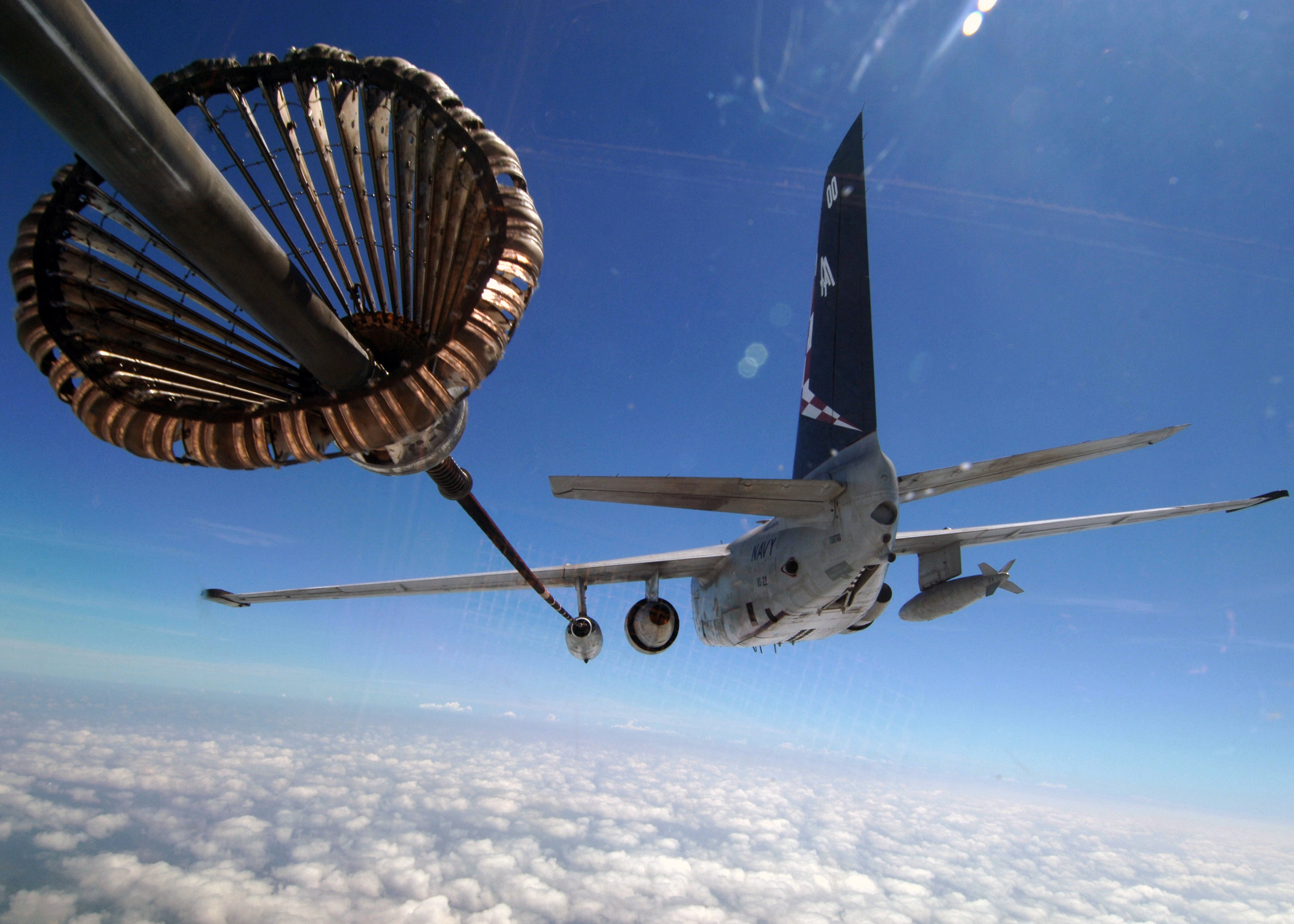
Or the S-3s, if there are any available,

I would have thought so, but then I am continually amazed by the costs involved in developing the F-35. For what it’s worth, our old friend Sharkey Ward says this on his website:
“It is understood that the MoD has asked the manufacturer whether a buddy-buddy tanking capability can be fitted to some aircraft specifically for the use of the Queen Elizabeth class air group. This would entail major design modifications and development work and would most likely negate the stealth qualities of the aircraft so modified. Further, the cost of such a “one-off” venture is likely to be extortionate. A figure of US$1.6 billion was mooted in Whitehall for the development costs alone and, unquestionably, the cost of each modified aircraft would be substantially more than that of the basic F-35C (now estimated to be more than US$150 million per unit).”
Even if turns out to be just half that, it’s still a pretty substantial additional cost.

Is the UK going to have to pay all the costs of developing a buddy-tanking capability for the F-35C? How expensive will that be?
Is that true Flanker? I don’t know for certain but I thought the reason we went for F35 was to get a carrier borne aircraft. From the earliest days of CVF, it was undecided whether to go cat and trap or STOVL. And for financial and performance reasons F35 made most sense, partly admittedly because it gave us flexibility over that decision.
Even if one of the driving rationales is gone, why do you think superhornet would be better for UK? ….
Super Hornet (or Rafale?), because by the time they declare full operational capability for the F-35C, UAVs will have made them redundant. And even now, that ‘first day of war’ argument is a sham, because if there is a serious defensive threat, the initial attacks will not involve manned aircraft.
@ppp
My post was explaining why we bought F35 rather than Rafale or Superhornet. You took issue my statement that F35 was better for UK purposes but we can’t discuss why on an open forum…. .
The main reason Britain got involved in the F-35 programme was to provide a STOVL successor to the Harrier. Now that the F-35B has been dumped by the UK – and may not survive at all – the rationale behind British involvement in, and acquisition of, the F-35, has gone.
It will be interesting to see which helicopter is selected by the Indian Air Force (not the Army?). The decision is due within the next couple of months, according to Boeing. The candidates are the AH-64D and the Mi-28NE.
Random firing and shelling of areas to target individual snipers, is not being questioned by journalists. I think they gone “native”.
Just look at videos. I watched a live bbc report showing rebels launching RPGs, indirectly, like artillery.
Oh well.
Isn’t that why NATO went after Gadaffi, because he was firing indiscriminately at rebel-held areas?