It will indeed all be in The book … together with over 270 others.
Watch this space 🙂
Doesn’t the Science Museum have one already down in Wroughton?
Its now displayed at South Kensington – suspended in a rather dramatic fashion thanks to Skysport Engineering.
My apologies for dragging up an old thread but I have recently updated the entry for MH350 in “The Book” and I have come across a reference which suggests that some of No. 485 Sqdn’s Spitfires had their armament changed “just before D-Day” from the standard 2 Hispano cannon and 4 Browning .303 inch machine guns to the “e” configuration of 2 Hispano cannon and 2 .5 inch Browning M2 machine guns.
MH350 started out life as a standard L.F.IX when delivered to No 485 Sqdn in August 1943 but by the time it went to Norway in May 1945 it was sporting the “e” type armament which it still has today.
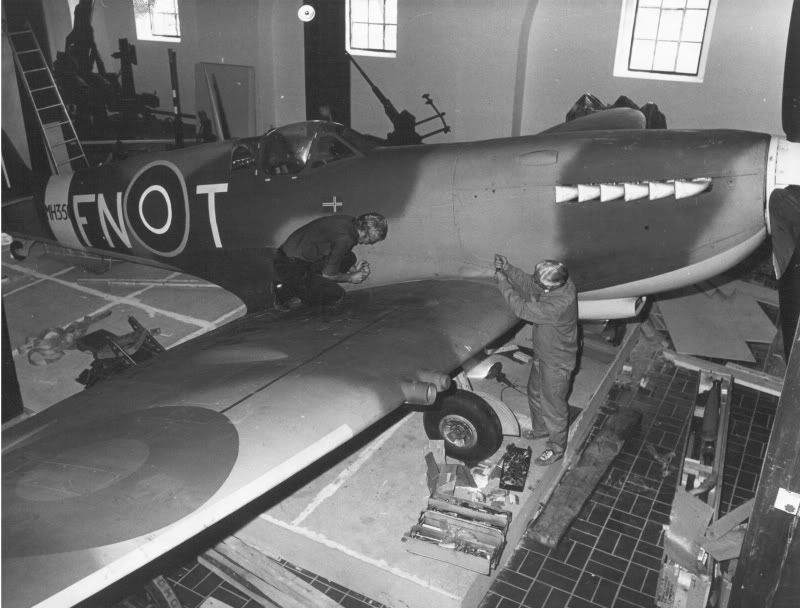
MH350 was on strength with No. 485 Sqdn during June 1944 but was transferred to No. 84 Group Support Unit, 2nd TAF, at Aston Down, Wilts, on 15 June (paperwork date?) and the remainder of the squadron is said to have converted to the L.F.IXe following their move to Coolham, Sussex, at the end of June 1944.
I’m wondering if anyone has a copy of the ORB for No. 485 Sqdn for June 1944 which may shed some light on this?
Was MH350 converted in June 1944 or later in its career?
Thanks!

Lincoln Festival at Tupholme Manor Park near Bardney
24 July 1971
Here’s the list of Artists:
Ralph McTell
Steeleye Span
Tim Hardin
Pentangle
Dion
Incredible String Band
Buffy Sainte Marie
Sonny Terry and Brownie McGhee
Tom Paxton
The Byrds
Sandy Denny
James Taylor
Dave Swarbrick and Martin Carthy
£2 a ticket!
That’s very interesting Cranswick – thanks. Is there any indication of how the change was to take place? I’m wondering if the aircraft were converted on site, at an RSU or exchanged for different aircraft.
ML407 also served with No. 485 from April – December 1944. It was, I believe, a “standard” L.F.IX upon delivery which became an L.F.IXe later in its career but it now has Trainer wings – with extra tankage of course! During its Irish service it had no cannon ports which would suggest a wing exchange / rebuild during the conversion.
Trainer nomenclature
One interesting point is that in all Vickers’ documentation the terms T.8, T.9, Tr.8, Tr.9 – and their Roman equivalents – simply do not exist.
The documentation simply refers to the two seaters as “Spitfire Trainer” – with “Trainer” ofter appearing as “TRAINER”.
It’s a dilemma when I’m writing “the book” … as are the L.F.IXb and c … which never existed …
(Running for cover)
Hold on G-ORDY for a minute as I raise my head slightly.
Vickers documents in relation to the Irish Air Corps contract used the following terms,
1/ SPITFIRE TRAINER AIRCRAFT (all capitals)
2/ SPITFIRE MARK IX TRAINER – EIRE (all capitals)
3/ Spitfire Dual Control Trainer Aircraft Mark 9 ( written in that form)
4/ And under general states….The aircraft will be converted from Mark IX Spitfires Ex RAFHTH
darrenharbar
Spitfire 160 was CBAF 1721 ex MK721Regards
Tony K
Thanks for the clarification Tony – I probably oversimplified my original comment, which was to say that the currently used “T.9” etc was not a term used by Vickers at the time of manufacture.
I always assumed that the Type 502 only covered MT818/G-AIDN and that all of those converted from Mk.IX Spitfires were Type 509?
Gordon
Well, I haven’t had the chance to do that, BUT…
I did an analysis using the individual histories, bob
Just as a matter of interest can you confirm the movements of MH350 and /or ML407 during May-June 1944?
I’m still wondering about this change of armament, we know that MH350 was changed to “e” configuration without doubt. Could this have been the reason why it was sent to No. 84 G.S.U. ?
I have also noted several apparently brand-new aircraft (e.g. MH603) were transferred from M.U.’s to units such as No. 405 A.R.F. before they were issued for squadron service. Now I can’t see a logical explanation for this – what could an Aircraft Repair Flight do which an M.U. couldn’t – unless it was for something like Mod 1029 to be carried out ?
Anyone seen the ARF files at Kew?
…but Ray Sturtivant in “RAF Flying Training and Support Units” 1997 edition lists ARF as ‘Aircraft Repair Flight’.
Mark
And if anyone is going to Kew they can find the relevant files at:
AIR 29: Operations Record Books Miscellaneous Units
Subseries: REPAIR AND SALVAGE UNITS
AIR 29/810 No. 405 Heston and Detling
1943 July-1944 Aug.
Wasn’t EN145 found stamped in a fueltank cover during restoration?
Mark should know, or is it all in the book?
😉
Cees
As Mark is away in sunnier climes at present it falls to me to confirm that EN145 was found on a number of panels when this Spitfire was examined at Carmiel in 1989. The clinchers were the cockpit plate (6S-240837) and firewall plate (HAI/6S-223490).
Yes Cees – it will all be in the book!
And if all goes to plan it will be at L…. 🙂
AA……………
Sorry I cannot help you with the provenance of the Pobjoy that powers G-LCGL. Just as a general comment, engines have a habit of surviving better than airframes: more valuable, take up less space, can be reused probably explains part of why they survive. Several hundred Pobjoy engines were built, as you know they were used to power a range of pre-war light aircraft and not so light ones: see below. Over the years several PFA ( whoops should that be LAA ) members acquired / found Pobjoy engines for just such replicas. Needless to say the expression….”hens teeth” comes to mind in the connection !!
Of course should anyone have four Pobjoys secreted away we could think about a Scion Senior replica or even a scale Stirling replica, yes one original was built………..!!!
I have no info on the projected power plants for G-ECTF or G-OBUU.
Planemike
IIRC the late Viv Bellamy had several Pobjoys down at his hangar at St Just back in the 1980’s when he was building the replicas for Leisure Sport. I don’t know what happened to them.
There is a Gipsy Twelve displayed at Salisbury Hall
The Shelley Collection owned the Six R from Ruth Fontes’ Hawk Speed Six G-ADOD. The entire collection was bought by a single collector when auctioned a few years ago, the one at Old Warden is “said” to be from Henshaw’s Mew Gull, G-AEXF, if so it was originally installed in the DH88 Comet G-ACSS.
I’ve never seen numbers for either of these R engines before, the provenance of Ruth Fontes’ engine has never been explained – unless it was a spare engine that Phillips & Powis scrounged from Hatfield?
It would not be in the internet archive as it wasn’t scanned. Unfortunately the Flight Archive pdfs are somewhat hit-and-miss, some years have several months missing, others have odd pages from other years mixed in with them – it’s always the page you are interested in that’s missing!
Maybe!







