 G-ORDY
We’ve all seen today’s aloominium toobs (aka airliners, be they of the Hairbus or Boewing flavour) with lights illuminating their tails – it is such a common sight, we barely notice it. This is often through to be done for A; a way for the publicity department to get some cheap advertising or B; a method for the Driver and Slave to discover which one is the one they SHOULD be flying!
This started me thinking – when did this first happen? As usual, I discovered an ‘answer’ of a kind when I was looking for something else – and, unless anyone knows differently, it’s a bit of a surprise!
The first recorded instance of this I have been able to discover was back in October 1970 in a report about the highly modified McDonnell DC-9-30 N950PB called ‘The Big Bunny’ and owned by the Playboy Corporation and operated for them by Purdue Airlines Inc of LaFayette, Indiana with three Jet Bunnies looking after passengers needs. The all gloss-black aircraft with a huge Playboy logo on the fin in white was, it seems, very much ‘one of a kind’ being modified to Corporate President Hugh Hefner’s requirements by Pacific Airmotive Corp in Burbank California. Apart from a luxurious corporate interior it had a very comprehensive flight deck, supplemental fuel tanks in the wings and fuselage making it the longest-range DC-9 then in existence, and, and I quote: ‘ Seventy-five thousand candlepower lights are installed in the trailing edge of the wingtips to illuminate the rabbit head of The Big Bunny. Aviation experts report that the system greatly enhances aircraft identification and may be the forerunner of future aircraft lighting requirements’.
Was this the first – or was there something earlier?
There was an article about the Playboy DC-9 in an early issue of Aircraft Illustrated, (I’m not climbing in the loft again!). IIRC the article said that this was the first use of the system and that several airlines were interested in taking it up.
G-ORDYEdgar Percival
Prickly guy – I remember the tingle that ran down my spine when I came home from work one evening and my wife said “An old gentleman has been on the phone for you” – yep, none other than EWP himself, after a copy of “Vintage Aircraft” magazine in which I’d published a photo of the prototype Gull under construction at Lowe-Wylde’s workshop in Maidstone!
I’ve scanned his obit from The Times for you:
G-ORDYI don’t believe it – my wife and I were only talking about Jerry the other evening, what with Alan Hall passing away a few weeks ago and now Jerry I’m starting to get worried … I’m the only one left from the three-man editorial team we had on Aviation News back in 1972-73.
Having moved out of aviation journalism many years ago I lost touch with many of my old contacts.
There are lots of crazy memories I still have from those days in New Plaistow Road – like the tale of Alan’s trousers … which I won’t recount now … but I remember listening to Radio 1 in the office one afternoon and Jerry saying “There’s cousin Mick again” – his cousin was Mick Jagger!
Godspeed Jerry.
G-ORDYAfter being contacted by Dustyone I did some searching on the net regarding the old Nazeing/Broxbourne airfield.
The only thing that kept on popping up was Leslie Kimm’s books “Wings over Nazeing” vol 1 & 2 and no other information or history.
So this looks like a trip down the library next year.
Brian.
Try the Stapleford Flying Club at Stapleford Tawney – they took over the assets of the pre-war Herts & Essex Aero Club. When I learnt to fly with them back in the 1970s they had some magnificent scrapbooks which were packed with photos & cuttings from Broxbourne in the 1930s – they may still have them.
G-ORDYumm I did find a reference also for Carlisle and Fife?… that said Heston was where the LA3 made its ‘official’ maiden flight!
could somebody from Heston (BP or who ever owned the Miles) flown to Barton? :rolleyes:
Sorry T-21, I recognized it as a Miles (from the ATA pics) and never checked.. slapped wrists. 😡
The Martin Monoplane was test flown from Heston after it was rebuilt with the new spruce & ply fuselage in 1937.
The anonymous Minor wings are dark blue – but there was no trace of a registration on either of them.
G-ORDYA few Minors from 40 years ago!
Just scanned some of my slides for you – where did the last 40 years go?
Minors plus one Major.
(I’ve posted some Martin Monoplane stuff on the Barton Aerodrome thread – PM me if you want the full story.)
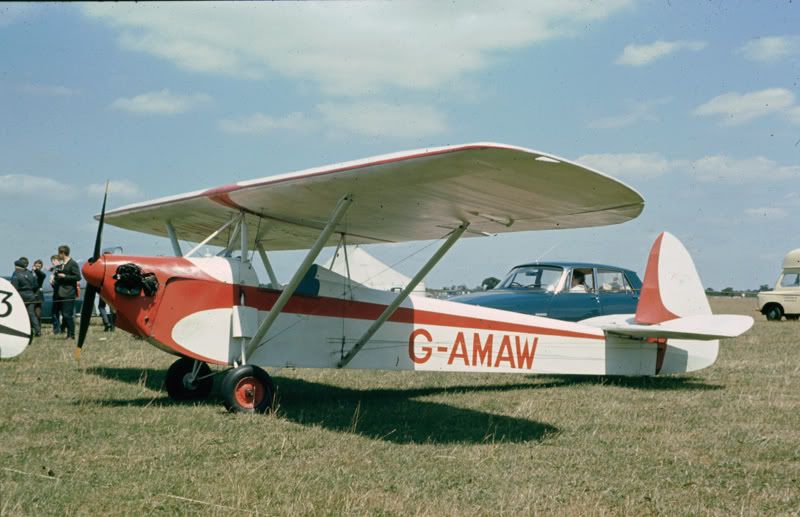
G-AMAW, Flying for Fun, Sywell, 11 July 1970
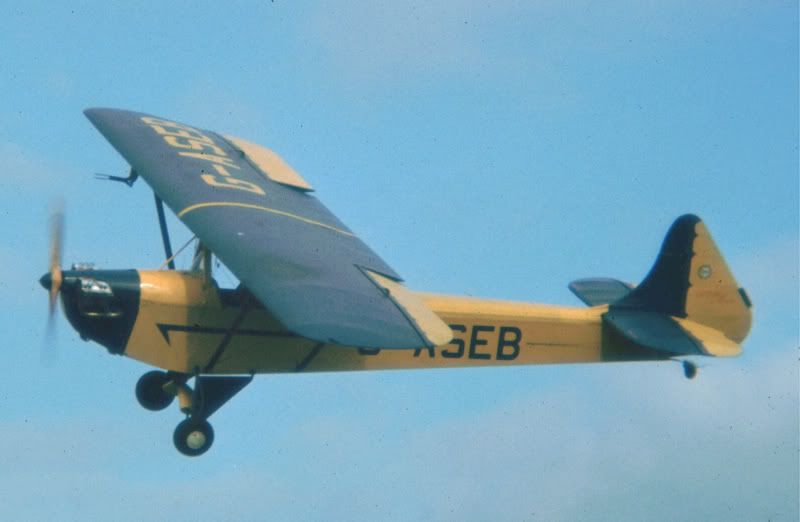
G-ASEB, Old Warden, 31 August 1969
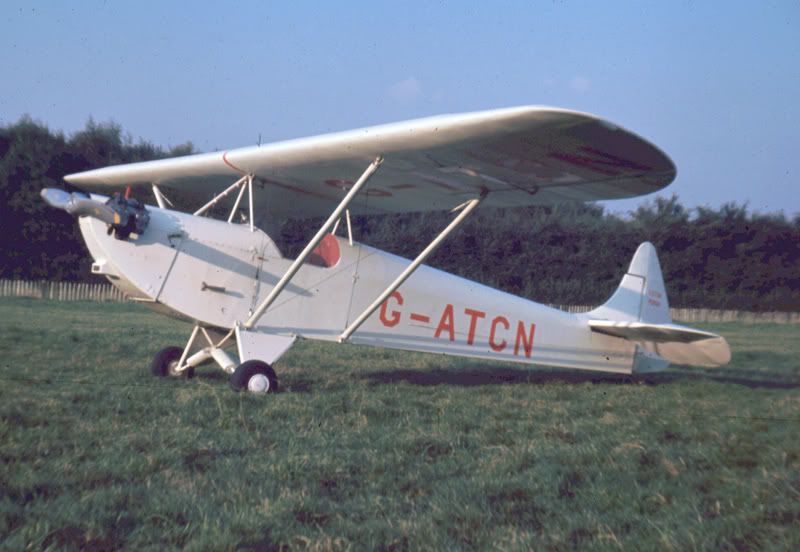
G-ATCN, Old Warden, 25 August 1968
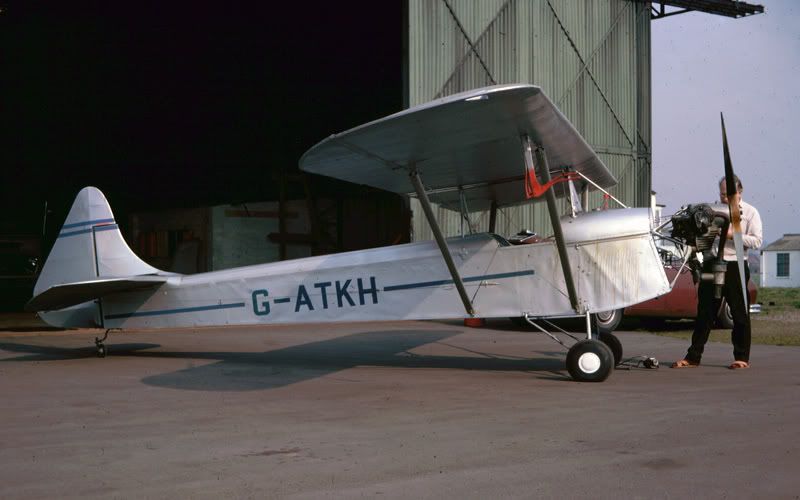
G-ATKH, Wolverhampton, 21 April 1968
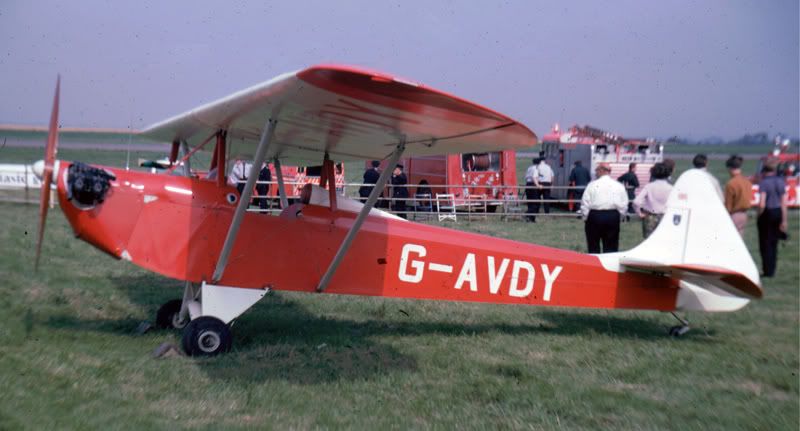
G-AVDY, Tollerton, 24 August 1968
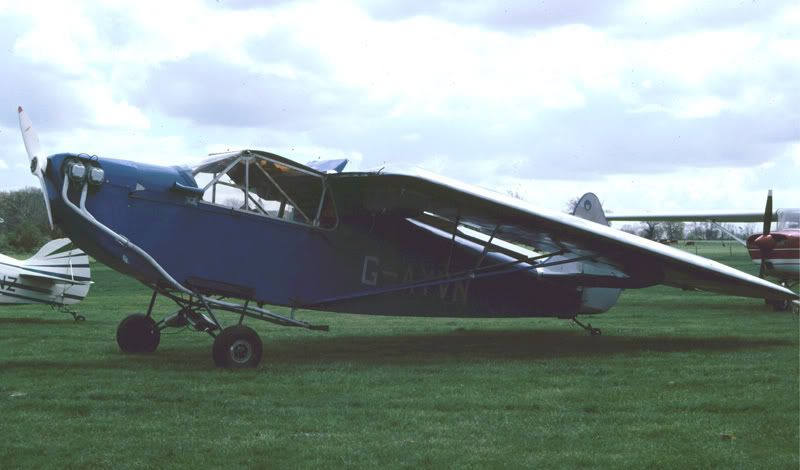
Luton Major G-AYVN, Old Warden (?) some time in early 1981
G-ORDYJenna – the photo I posted of the Wikner/Marendaz was taken by Geoffrey Wikner himself, it is not a “Flight” photograph. I agree that it is very probably taken inside the Maidenhead premises previously used for car manufacture, this would have been taken in early 1936 before Geoffrey stopped work. I note that Marendaz had several law suits filed against him at the time so it may be that the money dried up and Geoffrey walked!
G-AFGG was registered as the “Marendaz Mk III” and bore c/n 2. All published sources state that c/n 1 was destroyed by fire before completion – the question is was c/n 1 the aircraft shown in Geoffrey’s photo or was there another aircraft built? Odd that fire seems to keep coming up in connection with both Marendaz and Luton Aircraft … was it the same fire and AJJ just assumed it was at Maidenhead?
Another conundrum is if the Wikner aircraft was the “Mk I” and G-AFGG was the “Mk III” what was the “Mk II” ?
G-ORDYSpelling !
Please Mods – can you correct Mike’s surname in this thread title?
G-ORDYlinks for the above.
Flight Archive:
flight1: G-AFGG
flight2: G-AFZXG-info:
ginfo: G-AFGG
ginfo: G-AFZX
Jenna – your first link describes the Wikner-built unfinished two-seater, not G-AFGG. The article states it was under construction in Maidenhead and as it is dated Feb 1936 it ties in very nicely with my supposition that Geoffrey Wikner built it in the sports car factory – confirmed by A.J.Jackson’s reference to the Cordwallis Works (sic)
G-ORDYfrom the info I have, I agree its doubtful that the Martin physically ever came near Barton(beds), there is a reference that the design was ‘drafted’ at Barton in a byline so that could well be red herring!….
wiki puts Wikco at Southampton (Eastleigh) Airfield in 1937 so could AEGG have been built there then? where was the fire?…
Geoffrey Wikner built the first prototype of the Foster-Wikner Wicko (G-AENU) in Lusty’s Works, Colin Street, Bromley-by-Bow, London E3 and test flew it at Stapleford Tawney in Essex in July 1936. This was after the Marendaz project. The Southampton production line was not established until 1938.
A.J.Jackson states that the unfinished first prototype (c/n 1) of the Marendaz was built at the Cordwallis (sic) Works, Maidenhead, but lost when the factory was destroyed by fire in July 1937. As Maidenhead is very near Woodley (where Geoffrey Wikner had been in charge of the experimental shop) it is quite possible that Wikner built the first Marendaz in a corner of the car factory premises, it was probably stored in its unfinished state until lost in the fire in July 1937. Again – this is all supposition.
What was the reference to the Martin being “drafted” at Barton? Harold Best-Devereux was responsible for the design and construction (he was an engineering & design student apprenticed to Latimer-Needham) and he said Gerrards Cross when he corrected my original typescript (which I still have – together with his covering letter).
G-ORDYMarendaz & Martin
Hi Jenna
I’m afraid that I have little more to add to what I’ve already said on the Marendaz project. I was in contact with the late Geoffrey Wikner (cousin of Edgar Percival) back in the 1970s and he sent me photos of his work in England during the 1930s. The unfinished Marendaz project was one of them but all he said was what I have already mentioned. I suppose – and this is just supposition – that the incomplete and un-registered Wikner-built aircraft may have been c/n 1, which would explain why G-AFGG was c/n 2. Presumably the Wikner-built aircraft was the one lost in the fire … insurance job?
On the subject of the Martin Monoplane I have dug out my correspondence with Harold Best-Devereux (who built it), Mike Russell (who acquired it in 1977) and A.J.Jackson (Author and Historian) – all now dead I’m afraid.
This photo was taken at Denham aerodrome (H.B-D is seated in the cockpit) and shows the original Martin Monoplane in October 1937 shortly before it’s abortive delivery flight to Barton (Lancs). A plug worked loose in one of the two cylinders of the 32hp Bristol Cherub III and the aircraft was badly damaged in the ensuing forced landing. Close examination of the lower line of the fuselage shows a distinct kink – this was the Clarke Cheetah fuselage.
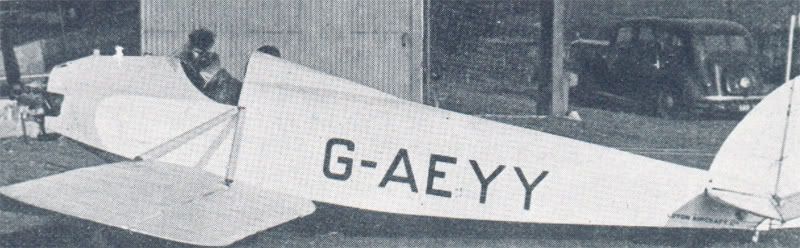
H.B-D designed and built a new fuselage in two weeks and this is the one seen in the earlier post and which is extant today. The newly rebuilt aircraft was test flown from Heston before delivery to Barton.
All references say that the aircraft was built at Gerrards Cross and the only Barton involved is Barton in Lancashire – I very much doubt that the Martin Monoplane in either form ever visited Barton in the Clay.
H.B-D said that the rudder carried the serial from one of the two airship Humming Birds (J7375/6) but he couldn’t remember which. Inspection dates in the wings pointed to one of these aircraft too. Mike Russell chose the identity “G-EBQP” because he belived it’s C.of A. had expired in 1929 and it would be a likely candidate for parts to go into the Clarke Cheetah. A.J.J. pointed out that G-EBQP was complete at Heston on 29 March 1934 and it was destroyed in a fatal accident at Hamble on 21 July 1934 so there is no way that the aircraft currently registered as G-EBQP has any connection with the genuine article … although that is not to detract from the fact that it does have the rudder from one of the airship Humming Birds – we just don’t know which one!
G-ORDYThe Martin monoplane fuselage was painted red the last time i saw it a few years ago. It still had a few bits with DH 53 marking’s on, which surprised me. I thought they would have been used on the G-EBQP rebuild.
Dave
That’s right Dave, it carried three different colour schemes during its life:
1: Light (silver?) with dark registration (still with the wire-braced Clarke Cheetah fuselage)
2: Green fuselage/silver wings (reg’n letters in silver outline) new ply/spruce fuselage
3: Red fuselage/silver wings (solid reg’n letters in silver)
When it arrived at Henham it had the red fuselage but you could see traces of green under the red.
(I love this thread!)
G-ORDYMartin Monoplane
Hi Jenna
I’ve just emailed you a PDF scan of two articles I published on G-AEYY back in 1977/78. There was no mention of Barton in connection with the Martin at that time – is there any hard evidence that it was ever there or is it an assumption?
Harold Best-Devereux told me at the time that it was test flown from Denham and (after he rebuilt it with the new fuselage) Heston.
Hopkinson based it at Barton but that was Barton near Manchester not Barton, Beds. He lived in Audenshaw and served in the RAFVR at Sealand.
He flew over 250 hours on it until he damaged the u/c during a precautionary landing near Stoke on Trent in early 1939.
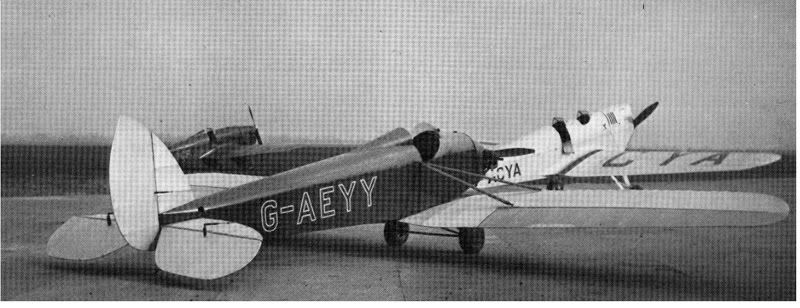
This photo shows it at Barton (Manchester), colour scheme was green fuselage with silver wings (R.P.Howard)
G-ORDYYes they are two of my photos taken at the time, we had just got them down.
That might even be G-ORDY whose face is obscured by Jim Titford’s head in the second photo (were you on that trip Gordon?) 🙂
Roger Smith
Not me Roger – although I recognised Jim’s leather elbow patches!
BTW – G-INFO lists G-BAPC as still being registered to the two of us!
G-ORDYWhat am I bid for this then?

DM said “Come back when you’ve got the money and I’ll build the rest!”


 Sign In







