Hi.
After the recent discussion on the RBL Poppy Appeal and the interest it so obviously caused. I thought I might start a small thread of bits and pieces relevant to the coming Remembrance Weekend.
Post whatever you want, but don’t start any arguments, you can do that elsewhere.
Here’s a few from me to start.
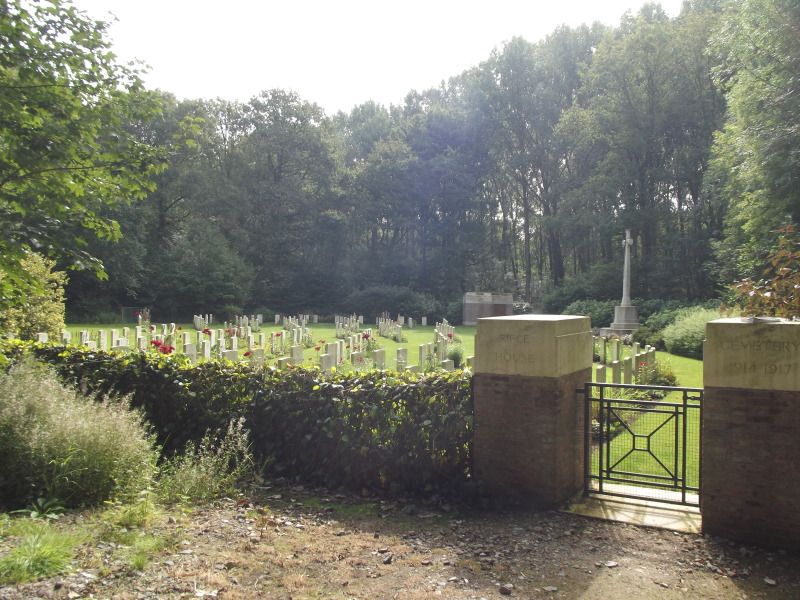
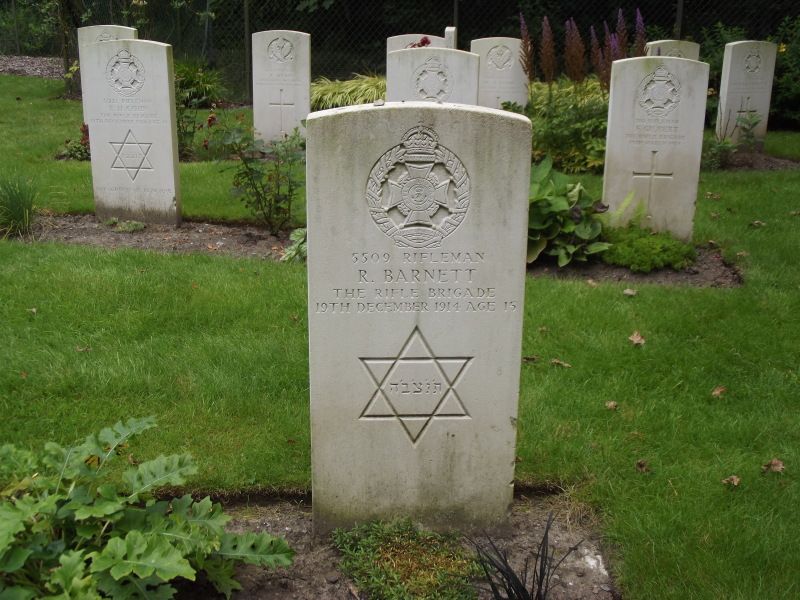
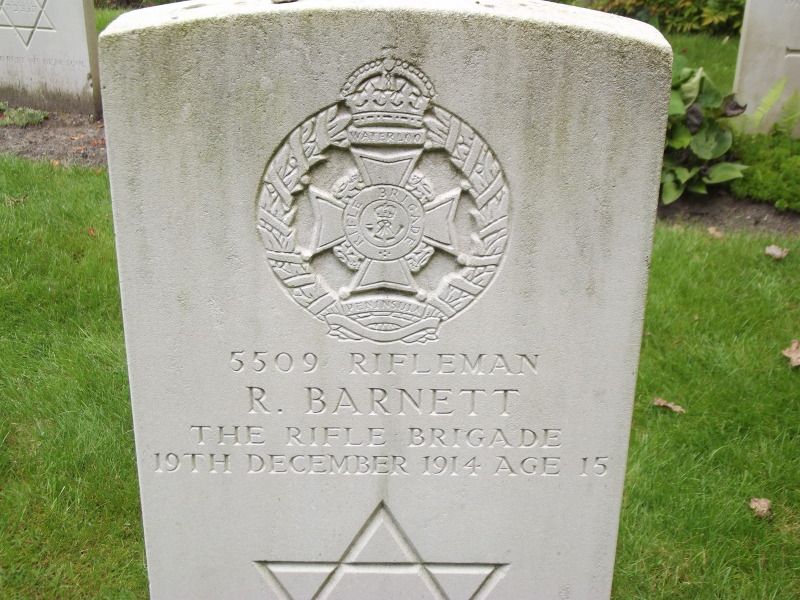
Firstly a few from Belgium. Back in August, I took a Sunday morning walk in Ploegsteert Wood (Plugstreet to the average Tommy) and came upon Rifle House cemetery. Contained within is the grave of Rifleman R. Barnett. Died December 19th, 1914, age 15 years.
I love these smaller, slightly obscure locations. One has to leave the car and walk to many of them and therefore they tend not to get many visitors.
Secondly I found this piece in the Daily Telegraph.
It made me think–much does sadly. I wish sometimes things didn’t.
Finally, a bit of poetry (oh God, not again I hear you say).
The Second World War this time
Keith Douglas.
Vergissmeinnicht:
Three weeks gone and the combatants gone
returning over the nightmare ground
we found the place again, and found
the soldier sprawling in the sun.
The frowning barrel of his gun
overshadowing. As we came on
that day, he hit my tank with one
like the entry of a demon.
Look. Here in the gunpit spoil
the dishonoured picture of his girl
who has put: Steffi. Vergissmeinnicht.
in a copybook gothic script.
We see him almost with content,
abased, and seeming to have paid
and mocked at by his own equipment
that’s hard and good when he’s decayed.
But she would weep to see today
how on his skin the swart flies move;
the dust upon the paper eye
and the burst stomach like a cave.
For here the lover and killer are mingled
who had one body and one heart.
And death who had the soldier singled
has done the lover mortal hurt.
Right, now it’s down to the rest of you.
Andy.

By: Robbo - 10th November 2012 at 01:48
The faces of some of the uprights have traditional New Zealand symbols, some ships and aeroplanes and some verse.

New Zealand War Memorial – Hyde Park Corner by shuttleworthpix, on Flickr

New Zealand War Memorial – Hyde Park Corner by shuttleworthpix, on Flickr
By: Scott Marlee - 10th November 2012 at 01:41
oh right, what an interesting effect, the text i was reffering to, was the stuff seen in your first picture of the 2nd set you just posted
By: Robbo - 10th November 2012 at 01:40
Here’s one from 2009

Trafalgar Square 11th November 2009 by shuttleworthpix, on Flickr
By: Robbo - 10th November 2012 at 01:38
Scott, that’s the Australian War Memorial. It’s a stunning creation.
The small text is the home towns of those lost in war. Individual letters of the towns have been emboldened to spell out various campaigns/battles. There’s usually water running down the face of the right-hand portion, which adds another texture to the memorial.

Australian War Memorial – Hyde Park Corner by shuttleworthpix, on Flickr

Australian War Memorial – Hyde Park Corner by shuttleworthpix, on Flickr

Australian War Memorial – Hyde Park Corner by shuttleworthpix, on Flickr
By: Scott Marlee - 10th November 2012 at 01:30
Robbo those are very excellent powerfull shots
what does the white text say on the NZ memorial (the one using the clear text to spell something
By: Snapper - 10th November 2012 at 01:24
Do you remember finding Percy Moxey?
Yep, certainly do. I think that’s where it started, for me at least. I suppose there’s no reason for me not to go and drop by again in the next few days.
I repossesed Francois’ bench early in the year, must go and spruce it up as it’s at my parent’s house, that could be my task for Sunday. Even if it is just sitting in their garden (where it’s not wanted).
This will be the first Remembrance after George died. He came with us to Duxford for the service the one year. It was eerie standing, looking over the airfield where Francois died, during that two minute silence. I’d have gone there this eyar was I not on shift either side.
By: Robbo - 10th November 2012 at 01:01
Animals In War Memorial, along-side Hyde Park

Animals In War Memorial_6631 by shuttleworthpix, on Flickr

Animals In War Memorial_6636 by shuttleworthpix, on Flickr

Animals In War Memorial_6674 by shuttleworthpix, on Flickr

Animals In War Memorial_6679 by shuttleworthpix, on Flickr
By: Robbo - 10th November 2012 at 00:59
The New Zealand War Memorial, Hyde Park Corner

New Zealand War Memorial_6485 by shuttleworthpix, on Flickr

New Zealand War Memorial_6724 by shuttleworthpix, on Flickr
The Australian War Memorial, Hyde Park Corner

Australian War Memorial_6709 by shuttleworthpix, on Flickr

Australian War Memorial_6715 by shuttleworthpix, on Flickr

Australian War Memorial_6717 by shuttleworthpix, on Flickr
By: Robbo - 10th November 2012 at 00:56
At this time of year I usually have a wander around some of London’s memorials. Some of them look particularly moving after dark, the light and shadows lend a different atmosphere. Here are the first few photos I’ve processed from this evening’s wanderings.
Bomber Command Memorial, Green Park

Bomber Command Memorial_6736 by shuttleworthpix, on Flickr

Bomber Command Memorial_6750 by shuttleworthpix, on Flickr

Bomber Command Memorial_6786 by shuttleworthpix, on Flickr

Bomber Command Memorial_6783 by shuttleworthpix, on Flickr

Bomber Command Memorial_6765 by shuttleworthpix, on Flickr

Bomber Command Memorial_6772 by shuttleworthpix, on Flickr

Bomber Command Memorial_6763 by shuttleworthpix, on Flickr

Bomber Command Memorial_6764 by shuttleworthpix, on Flickr

Bomber Command Memorial_6779 by shuttleworthpix, on Flickr
By: Richard gray - 10th November 2012 at 00:21
Talking about the 14-18 war.
How many people born in your town or village served in the Australian Army?
Kev, just for you 83 were born in Walsall.
Go here.
http://mappingouranzacs.naa.gov.au/map.aspx?d=vic
click on overseas then England and pick your area.
Then pick your man and you can read his Army record.
Its absolutly fasinating reading.
By: kev35 - 9th November 2012 at 19:56
Mark (Snapper) has done much to ensure many people are remembered and it’s thanks to him that Babe Haddon and Johnny Wiseman come to mind. It’s through Marks perseverance in telling their story, and creating a lasting Memorial to them, that I had both the honour and privilege of meeting a number of 609 Squadron Veterans, not least among them Pinkie Stark and Jimmy Stewart. he also introduced me to George, another Veteran who remains etched in my memory. I’ll never forget Steve at the unveiling of the memorial to Babe and Johnny. I really think that was one of my proudest and happiest of days.
Do you remember finding Percy Moxey? I visited Norman Crabtree’s grave again yesterday. I added a couple of photo’s to the Percy Moxey thread on Historic but it’s slipped down to page two now.
Andy.
I also think Edwin was where he wanted to be. I suspect he would have been mortified had he known of his Aunt’s well intentioned efforts to bring him home.
Regards,
kev35
By: Andy in Beds - 9th November 2012 at 19:08
Kev.
It’s only a guess on my part but I reckon he had no intention of leaving his mates and a friendly/helpful officer or NCO obscured things just enough.
Thanks for posting.
Andy
By: kev35 - 9th November 2012 at 18:41
And now for part two.
Edwin was posted to the 18th Battalion, Durham Light Infantry on the 2nd of January 1917 and went to France with them a day later.
On the 12th of February 1917, Edwin’s Aunt, Mrs. Houlston, wrote the following to the Army Pay Office No 2 in York…..
Sir.
I have received a field postcard from my nephew, Private E A Swinnerton of the Durham Light Infantry. I cannot tell you his Regt’l. number or Company for when he first joined the army he was in the Sherwood Foresters and since he has been transferred I have not heard from him until I received the P C from France.I am sorry to say he has no mother and his father is no scholar, the boy was only 16 years of age last Dec ’16. I have his Birth Certificate if you should require it, I do not mind him being in the army but am quite sure he is too young to be in France and should be very grateful to you if you do your best to have him brought back again to England.
Hoping you will see into the matter.
On the 16th of February the Army were asking Mrs. Houlston to supply his name and address by return so they could try and trace his present whereabouts. On the 20th of February the Army replied thus…..
It is suggested no. 33677 is the Regimental number of the man referred to but the address of the next of kin is stated to be 29 Market Street Walsall not 29 Margaret Street as you quote, however, will you please ask his Father to forward his sons birth certificate to this office and on receipt of same his application will receive attention.
It is here that the correspondence peters out without coming to any conclusion. Edwin remained with the Battalion and on the 30th of April 1917 he died of wounds received in action. He was 16 years and 130 days of age. he is buried at Bailleul Road East Cemetery, St. Laurent Blagny.
Were the Army guilty of obfuscation in preventing his return home? It’s possible, some might even say likely. His Will, filled out on the 4th of January 1917 stated his father’s correct address of 29 Margaret Street. The Telegram informing the family of his death went to the right address, as did his medals, memorial plaque and scroll. His possessions at the time of his death, a few letters and some photos were also returned to the correct address in September 1917.
But despite the tragedy of the death of this 16 year old, I am sure he was where he wanted to be.
Regards,
kev35
By: Andy in Beds - 9th November 2012 at 18:27
Hi.
Right, after a day of building a Honda V4 I’m back to read all your thoughts.
While not wanting to tie the thread down just to Rifleman Barnett, I will just say that in December 1914, the chances are that he would have been a member of the regular army. Hundreds, if not thousands of very young men rushed to join up in 1914 and 1915 but they wouldn’t have been out to France in 1914.
The regular army did have very young drummers and buglers.
Now to move on.
The day before I went to Plugstreet we went up to Diksmuide, which is north of Ypres.
In October 1914, the Germans attacked and a mixed force of Belgians, two battalions of French Marines and an assorted collection of Brits held the town for about two weeks. When it finally fell, both sides were reduced to a point of exhaustion.
Just outside Diksmuide is the Vladslo German war cemetery. Contained within is a sculpture (well two actually) called ‘The Parents’–sometimes ‘The Grieving Parents’ by Käthe Kollwitz.
Käthe Kollwitz lost her son Peter in the battles of October 1914 and his grave is immediately in front of the father figure.
I will say this, the silence of ‘The Parents’ is deafening and the silent eloquence of the pair says more to me about the absolute stupidity of war than anything else I’ve seen.
Käthe Kollwitz was banned under the NAZIS, but now her work is recognised both in her own country and internationally. So much so that the German authorities would quite like to have ‘The Parents’ back. In my honest, I think a quiet Belgium cemetery is by far a better place than a sterile art gallery somewhere.


Moving on to the Second World War again we took a day trip up to The Democratic People’s Republic Of Yorkshire.
Some of you who know me will also know that I’m quite interested in Bomber Command. My Father’s school friend Sgt Derek Bell was killed while serving with 76 Squadron at Holme On Spalding Moor.
There’s a window dedicated to 76 in the village church.


Again, those who know me on Planetalk will recognise my signature line. It’s taken from this window.
“I said to the man at the gate of the year, Give me a light that I may tread safely into the unknown.
And he replied, Go out into the darkness and put your hand into the hand of God. That shall be to you better than a light and safer than a known way!”
And finally, on that day, we went onto Elvington to view the Halifax.

Keep posting.
Andy
By: Snapper - 9th November 2012 at 15:44
My Great Grandfather was a professional. A Sergeant in 16th Lancers, a riding instructor (he taught Gough’s daughter to ride) and regimental scout to boot. He left for France on 14th August, the day his son was born and less than a month later he took a 3 inch bit of jagged shrapnel in his thigh that crippled him for the rest of his life.
A year or two later his brother in law was injured too, was stooped for the rest of his life (I think he was the man reffered to as being stitched across the belly by a machine gun by my Grandfather’s sister). I guess in the current day he would have been signed off work but no, he made ends meet for his wife and himself as a cobbler.
Both had their lives saved, I guess you could say they were lucky. My grandmother’s uncle wasn’t. He lies near St Quentin and has since 1917.
So I shall remember Frederick (Jim) Crame , (Uncle) Johnny Stark and Oswald (Uncle Ossie) Roe when that bugle plays. And then I’ll remember (Grandpa) Stanley Crame who never really talked about his war very much. I’ll remember too some pilots I never met who died long before I was born and some of their fellow pilots who I did meet in later life and have now passed, and my friend Jim who was groundcrew and George who was an armourer and I shall remember eorge who didn’t come back from Afghanistan and i’ll remember my mate Steve who never forgot.
And my daughters and my father will be alongside me.
By: Snapper - 9th November 2012 at 15:33
One of the greatest failures in judging history is in the evaluation of current eyes or geographical values.
My Grandfather started work as a teacher at the age of 14 and this would have been between the wars. Rifleman Barnet would more than likely have been earning his keep by the time he enlisted and was very likely to have been more mature than a huge proportion of our current generation of 15 year olds; I dare say that he was as capable as the older soldiers he stood alongside. Child soldiers fight in many parts of our world today, some very capably too I’m sure; how old is the person who made your clothes? Life was more harsh in britain in 1914 than now and less doting, people grew up quicker, were more responsible (factual statements). Though Rifleman Barnet’s death, and that of Private Condon, and that of the young lad from my town who was killed in an engagement at sea(I forget his name temporarily, I think he may have been the youngest British casualty though, lived in Haward Street, Lowestoft) and all the other boy soldier’s deaths are tragic I’m afraid they are no more or less tragic to me than the father of young children, the husband of the poor widow, the heir to the estate or any other of the casualties who died serving, by action or accident. No one life is worth more than another.
Musing, and only vaguely related, when we die these days it’s either a good innings or too soon. If I die tomorrow it’ll be too soon but I’ve had a good innings. I sometimes wonder why we temper things into black and white.
By: charliehunt - 9th November 2012 at 15:22
Amen to that!
By: John Green - 9th November 2012 at 15:08
Whatever one’s national allegiences, the calamity of WW1 is heartbreaking.
By: charliehunt - 9th November 2012 at 14:54
This was very interesting. Did anyone watch it? Part 2 next week, I think.
http://www.channel5.com/shows/ww1s-tunnels-of-death-the-big-dig/episodes/episode-1-476
By: Lincoln 7 - 9th November 2012 at 14:48
Hi Jim.
Has it occurred to you that many of these young lads not only wanted to go but felt it was their duty to? …
The remainder of this lengthy ‘quote’ snipped by the moderators as should have been done in the first place by the poster.
Thanks for all that information Kev, I suppose, as with many others of his age, his heart was in the right place, but, if only those young, brave lads were only to know what, “Going over the top” involved, I wonder if they would have volunteered?. I know from different posts, when you have described certain battles, what was involved.
On a personal note, and I cannot explain why, but WW1 is by far and away, the most interesting to read and research about.I look forward to reading the next bit. I was only reading the other day about, Flechets, a sort of metal dart that they dropped from an aircraft, along the trenches, and on Cavalry positions. Modern warfare has certainly come a long way since then.
Jim.
Lincoln .7


 Sign In








 November 9, 2012 at 8:29 am