mattmatt
Wow i am suprised this thread hasnt been flooded by BR wariors.
I guess from the outside it seems as if there was no accountability to the project and it was treated like a university study..
Constructively i would say make the 40 LCA MK1 but instead of wasting time on the MK2 and trying to save the current frame just go strait for the MCA.
mattThe video here looks interesting.
http://news.sky.com/story/984322/bae-confirms-advanced-merger-talks-with-eads
Does this give EADS even better access into the US to fight boeing with on its own home turf?
mattAny news about the engine upgrade?
mattthe debates seem interesting but seem to pre-suppose that the destroyers or frigates are completely replaced in a Navy structure, but maybe read them wrong?
mattIt least this article cotains certainly not even a slight indication that my statement could be wrong 😉
It is talking about the possibility that Iranian FACs could attack and this could cause a war.
The last time the US Navy was attacked by Iranian ships ended with sunken Iranian ships (FACs and corvettes)… and today the US Navy is even better equipped against them…
Yeah i wasnt trying to prove you were wrong, was just adding references onto here of US concerns of small boats..
mattReally funny blog! related to the Royal Navy, Armed Forces of the UK in general and specifically the Type 26..
A snippet below
http://forbesblog.dailymail.co.uk/2012/08/index.html
Do you understand your Prime Minister?
“Do you understand your Prime Minister?” the General asked me. “Have you seen the news from BAE Systems? It’s a picture of his new peaceship. The First Sea Lord says it’s designed for ‘humanitarian and disaster relief work around the world’, but just look at it. It’s not built for the North Atlantic, not with that hull it ain’t, look at the flare, but it’s painted North Atlantic grey to seem stealthy. If it’s to run around the world doing good as the SDSR tells us, the Prime Minister will want people to see it, won’t he? So it shouldn’t be coloured for stealth – it should be painted vividly in highly saturated fluorescent red, white and blue.”.
.
“Yes,” I said, “but this is the Type 26, the new Global Combat Ship. It’s going to be in combat against pirates and drug runners. That’s why it’s grey. Not exactly stealth, but ‘low observability’. Look, it has a gun.”“A gun!” he said. “You call that a gun? When I was a toddler I had a cowboy suit with a bigger gun than that. Matelots used to know how to cover their rear, but they can’t here with that, can they? A Somali in a skiff with an RPG could approach from astern and sink it.”
“Yes, if it could get near enough to use an RPG, but there’s a helicopter to look after the rear.” But only one, I thought, and that might be a Merlin even if they plan on an updated Lynx. And how often would a Merlin be serviceable in 2020?
“Five years ago, in the Gulf, HMS Cornwall had a chopper but it couldn’t even defend the cabin boy’s iPod. D’you see there are no rails? A rough sea swamping the deck and stealth will be destroyed by a trail of sailors washed overboard. No davits for the lifeboats. No lifeboats. I can see only two cells for launching missiles – perhaps there are more astern – but it really doesn’t look like a warship, does it? It’ s a peaceship. What’s it actually for?”
“I don’t know,” I said. “They plan on it coming into service in 2020, so …”
“2020!” he interrupted. “It’s a BAE Systems contract commissioned by the MoD, for heaven’s sake. And it’s for the Royal Navy, which is still governed by tradition. That means it will be years late, vastly over budget, and too expensive to fully equip. We’ve been sending ships to sea without their missiles ever since that lunatic Brown decided missiles were unnecessary so long as our ships were actually capable of putting to sea with missiles if they had any, so having no missiles because we have no money is the new tradition we must follow. Forget 2020. That was chosen for PR reasons because the first new carrier is due to go to sea then – without aircraft, of course, because we can’t afford the ones for which it was designed, and those will be tactically useless anyway.”
mattI have explicitly stated that in modern warfare usually those wins, which have a better industrial capacity. Therefore there is no option for a weak navy to win against a strong, well funded one – doesn’t matter which ships they bought. But the idea of an FAC as an equalizer is that it can help a weak navy to win – which is an illusion.
Is this always true?
oh found this excerpt from the washington post.
Retired Adm. David C. Nichols, deputy Centcom commander in 2007, recalled in an interview last year that Fallon “wanted to do a freedom-of-navigation exercise in what Iran calls its territorial waters that we hadn’t done in a long time.” Nothing wrong with that, per se, but the problem was that “we don’t understand Iran’s perception of what we’re doing, and we haven’t understood what they’re doing and why,” Nichols said. “It makes miscalculations possible.”
Todd feared that the Iranians would respond, possibly by launching fast-attack missile boats into the gulf or unleashing Hezbollah on Israel. Then anything could happen: a collision, a jittery exchange of gunfire — bad enough on its own, but also an incident that Washington hawks could seize on to justify an all-out response on Iran.
mattOne hour and a half to two hours, but that question is a bit irrelevant, a swarming naval attack is preceded by literaly dozens and dozens of small craft leaving ports at the same time, that kind of movement is detected by a number of other means.
Cheers
Hmm good point, so the only way to hide it or to make it effective would be to have the “swarm” already in the waters? like patrol boats that can go to a certain location?
mattStaying power and sensors (lack off).
An interesting side discussion is whats the utility of this class of ships in today´s world?
They are entirely green water pieces of hardware, in open waters their utility is zero, the staying power is almost nill, and the word “Fast” could be well aplied to 1912, but in 2012, 40 or 50 knots is snail speed. Doesnt this entire class utility been entirely taken by flying pieces of hardware?
And before someone thinks something like “but in WWII…”, the obvious answer is in WWII there were not PGM´s (well, sort off).
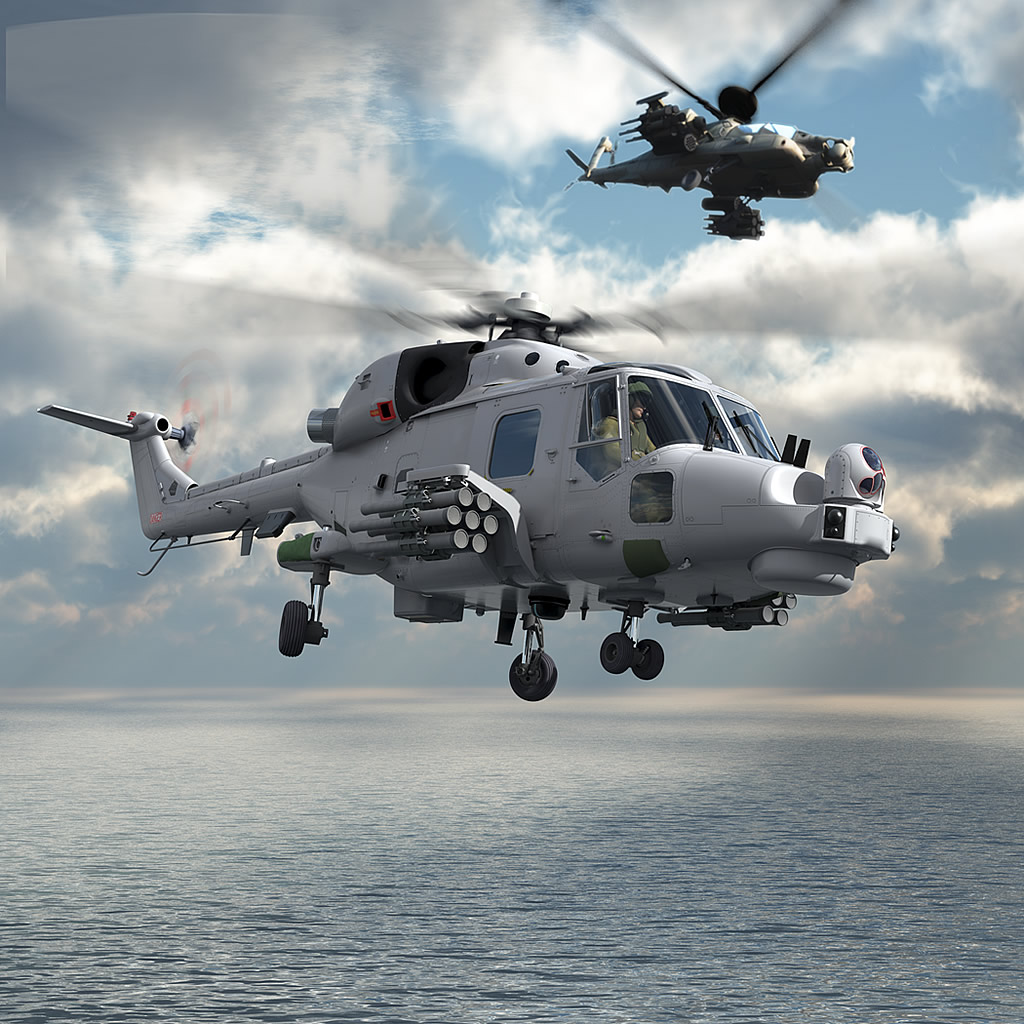
For all the bruah that Lt. Gen. Paul K. Van Riper got at “Millennium Challenge 2002” with swarming tactics, i can only imagine how that scenario would end up with only a few of these (below) at hand:
Cheers
What would the range of the missiles on those helicopters be? how many surface combatants could they track do you think?
Also how long could they be on station to find a bunch of boats spread out over a few tens of miles
mattBut you said “green water” navy. Generally speaking, so-called green water navies are expected to be have some sort of operability on open seas, if not oceans then at least large inland seas like Mediterranean. By contrast, brown water navies are purely coastal defence and Baltic/Black Sea etc are maximum where they are expected to operate over the entire body of water.
Fair point Yama, I was basing my initial description on what i know happned in 1971 with the attack on Karachi, i got things wrong because for me i thought that was a attack across a large distance so could equate to a green water…mea culpa
mattYes – because they usually had only limited chances of success against bigger warships (even though there are some examples, e.g. also the sinking of HMS Manchester).
Ok, on this we agree. Matt’s idea was to use FACs in the open sea instead of cruisers 😉
Not so leon, please read the main post again…
How feasible would it be to use a swarm of fast attack craft in green waters to take out a larger more powerful better funded Navy?
mattCan a swarm of fast attack craft replace large escorts?. I’d say the answer is yes they can, but, its entirely contingent on your definition of what makes a Fast Attack Craft and what you class as a swarm.
All the problems have been well covered on the thread already….such as self-deployment…FAC’s traditionally dont do too well anywhere above Sea State 4….open ocean transit is right out. UK rules dictate 90m minimum hull length for tolerable pitch response in oceanic waters. Then there are the problems of weapons or sensors but not both in the hull and rotary air, the invaluable asset for looking OTH, is right out. Then you have endurance, habitability and even things like durability. Small hulls tend to suffer from pounding effects more heavily than larger hulls so you have increased shock loads on electronics, missiles, nerves etc!.
There is a way around this though…..that would be semi-SWATH and the Fast Sea Frame. The US’s FSF-1 Sea Fighter. Even modified (as per diagram below) you have a hull thats at most tipping in at ballpark $180mn if built in numbers. Seeing that a major fleet unit like a Flight IIA Burke averages about $1.8bn according to the US Congress you are looking, rule-of-thumb, at a 10-1 ratio of Sea Fighters to Burkes. I’m not sure is 10 is exactly a swarm, but, you would likely deploy more than a single Burke at a time so, if you were deploying three Burkes, that makes 30 Sea Fighters!. Much more swarm-like!.
It is stretching things calling a 79m hull a fast attack craft I suppose but if modified similar to this:
http://img19.imageshack.us/img19/5545/fsf1x.png
…its definitely got the potential to take the sensor and weapon fits required. The diagram there has it with a very limited modification moving the bridge superstructure forwards to add a raised VLS deckhouse. New kit is a pair of Millennium guns forward, 4 self-defence length VLS modules and a pair of Hitrole-G turrets on the aft quarters. A new 3D TI radar and directors for the guns would be spotted otherwise its the same as the experimental hull on trial now.
Dependent on role the missile decks either side of the VLS deckhouse could take angled SSM launchers or IAI Jumper or MBDA Sea Spear missile packs etc. Plus you have the mission bay to garage a pair of 11m USV’s or even, perhaps, a pair of Finnish NEMO mortar LCP’s and still have room for couple of radar-carrying MQ-8B’s.
With 10 hulls in your per-Burke flotilla you could have 2 with an ASW fit with a 2087 type towed array containerised deploying out of the bay door with operator vans in the bay itself. Maybe this mission role has an RN Bay style aircraft shelter and supports an organic Merlin class helicopter. You have 2 configured for surface action with two or four quad SSM mounts, a pair of 11m USV’s and a pair of MQ-8B’s in the bay, plus another 2 configured for anti-swarm with 4 6-pack Sea Spear launchers in place of the SSM’s on each beam. Then the final 4 in the flotilla embarking the mortar LCP’s plus 4 Jumper missile packs per side in place of the SSMs.
There is not much chance of doing area air defence without the kind of radar array that these size hulls wont support. What these hulls can embark though is an Artisan class 3D TI radar and FLAADS or a point weapon like VL MICA/Umkhonto. FLAADS offering quadpack and horizon range coverage, but, even VL MICA is going to put 32×10 active SAMs in the immediate region of the flotilla. Thats going to soak up a lot of antiship missile fire.
With FLAADS, conceivably, thats 128 missiles per ship and, over the 10 Sea Fighters replacing the one Burke, means that you are deploying 1200+ horizon range SAMs instead of 80 or so SM-2’s. Long range area air defence perhaps a bit irrelevant?.
So you have, instead of your Burke, a self-deploying 4000nm-ranged flotilla of vessels capable of deploying a pair of large ASW choppers, at least 8 radar-equipped MQ-8Bs for persistent theatre surveillance, 8 11m USV’s, 8 NEMO-LCP’s, up to 32 medium SSMs, 96 short range SSMs, 250+ short range land attack missiles and, at least, 300 potentially over 1000 short range SAMs plus 20 Millennium guns and another 20 50cal gatlings. Team all that up with an UNREP vessel with a decent sized flight deck and hangar for 3 or 4 more large helo’s and I think there is an interesting expeditionary capability there!.
Out of my depth here jonesy…
Can you land systems such as iron dome for protection to these ships? I mean considering that the boats would be significantly smaller than a larger cruiser and that they can be spread out hard to detect etc could that linked within MQ-4’s or MQ-8s be enough ? couple with something like the granite missile system.. I was also wondering if these boats could be place as the LCS is in friendly ports close to potential aggressors and used from the harbour. I could also imagine using some “drone” boats to act as the cheese for any given trap…
mattWell, it seems we are in a much more confortable situation
http://www.defpro.com/news/details/38069/?SID=62544e359351630914a02db584c7496aSince the cooperation on the neuron looks fine, Dassault should try to capitalize on that instead of trying to work with .. whom exactly ?
What will India or Brazil can bring us ?
I know that SAAB can bring something.
Cheaper Labour for manufacture of the less added value items and also for doing the number crunching for checking stress etc.
This would allow Britain, France, Sweden etc to concentrate on the more added value items
mattAre there example of successful use of FAC or similar craft except the one I had already mentioned?
One additional point: small boats probably cannot use some weapons systems, because they are to heavy and would impair sea-keeping – which is certainly a general problem of FAC.
Not exactly this example however Fast Attack Craft have been used in the past to good account, and i know economically it may not exactly be cheaper but i think the above mentioned form of swarming or distributed attack brings a new dimension to stealth .. http://en.wikipedia.org/wiki/Osa_class_missile_boat
is one example..
Here is another example although it looks a bit smaller and has not yet seen combat from my understanding..
http://www.youtube.com/watch?v=z6zzNGHc78A
http://www.uskowioniran.com/2010/08/irgcn-launches-fast-attack-craft-in.html
http://iranprimer.usip.org/resource/irans-military-doctrine


 Sign In