 planeman6000
C1
5000 tons semi-SWARTH trimaran (so physically larger than typical 5000 ton warship)

Mostly the same features as my C3 designs but on a C1 scale. Strike depth VLS would be amidships. COGAD (note the order ;)) with two gas turbines and one deisel for quite running. A small stock of sub batteries for silent running (say 30 mins?). All-electric twin RR waterjets. Engines above waterline. Hanger for 2 EH-101s. Launches and TAS at rear under flight deck. Teliscopic comms mast at rear with sat-comms either side. Soft-kill would also mainly be here (not drawn).
Cut the CIWS to two Millennium 35mm but with two FCR/EO. Two 30mm or similar can be fitted beside bridge.
planeman6000Trimaran C3 hull with forward structure influenced by Vispy.
Helipad compromised by large work deck aft for minehunting/sweeping. Also ASW etc.
This requires hetlipad and hanger moved further fowards. Hanger is offset to starboard.
planeman6000Mk.8 has been used successfully for shore bombadment from the Falklands through to Iraq in 2003, if it was too short ranged for shore bombardment it either would have been replaced or had new ammunition developed. Its also the cheapest option for giving the C3 a medium caliber gun that does not involve purchasing new 155mm guns or introducing a new weapon caliber. Plus i’m fairly sure i saw an article saying the 155mm gun may be fitted to T23’s as well as the T45’s.
Remember the Exocet the RN got in the Falklands? – that was quater of a century ago. Or the C-701 or C-802 the Israelis got off the Lebanon coast… Even a ‘cheap’ OPV shouldn’t be put 10km off an enemy coast in 2010.
A 57mm or 76mm gun would be more than adequate for anti-piracy etc plus it’d be a lot better AD.
Artisan looks like becoming the standard air/surface search radar for the fleet, plus remember these are just outsized OPV’s so you could probably even get away without an air search radar as long as you could fit one later. If you ever had to fit those 8 Sylver VLS cells with quad packed CAMM, remember they are active missiles and you just have to put them in the right spot for their own seeker to do the hard work.
I think we can all agree that CAMM looks excellent, although why UK is duplicating a multitude of similar MBDA products (Mica-VL being the obvious) is open to question. AR is definetly an advantage but tracking/FCR are still needed for optimum results out to the full envelope of the missile surely, which undermines the idea that Artisan is the cheap solution.
If you compare this alll to the new Dutch OPVs with their integrated masts, blimey we’re selling the RN short.
This is actually one of the plus’ I see of the Skyshield system. It’s FCR/EO unit could be used for the main gun and for the SAMs, plus the EO could be used as a GP devise (EO is increasingly standard on modern warships now). Plus Skyshield has minimal deck penetration.
planeman6000Planeman6000,
Can you have a play with your computer for me and try make something along the lines of the following?
-Flight deck for one merlin, hanger for one Flynx only though.
-Crane and space for 2 containers on a lower deck placed behind the flight deck.
-Either Artisan, or a cheaper air-search radar above the bridge, not in the middle of the super structure. Leave space behind the bridge for a pair of harpoon launchers “just in case”. Space for an 8 cell VLS in front of the bridge, though it doesnt need to be fitted. Surplus Mk.8 Mod.1 from a T22 or T23 as the main gun.
No CIWS, though (a non-penetrating CIWS such as phalanx or RAM) one could be fitted above the hanger.
Either monohull or trimaran.You could probably base it off the leander class frigate (113.4m x 13.1m), which started at 2,500t with the first ships, though it rose to 3,300t for the later broad-beamed ships. Or off the slightly smaller Rothsays which were 2,150t (113m x 12m).
Stevo
almost
The Mk8 is a waste of space IMO, too short ranged for shore bombardment and not capable of using existing developments of guided/ER rounds such as Volcano.
Artisan also seems a bit limited when it comes to FC.
planeman6000Jonesy mate, you’ve got to look for solutions not problems 😉 Britain wasn’t made great by people being conservative 😉
You see the contradiction in what you’ve just written there?. Multihulls have ‘more volume’ than monohulls but you have to give over precious centre hull volume to fuel bunkerage!?.
In reality multihulls have less useable volume below decks and more above when compared to a monohull…which is how you get to the general greater volume!. Fuel bunkerage MUST be contained in the centre hull lest you end up with trimming and seakeeping issues from differentially displaced outriggers…this puts a huge constraint on range…unless you are willing to place your engines in the outriggers and just accept that maintenance will be a pig and that you are discarding the advantage of having the outriggers screen IR and help to screen vibration (accoustic sig) from hull mount engines.
Not necessarily a contradiction. Agree fuel should be in central hull preferably below waterline. But that’s not such a big problem re engines placement as you make out. For starters the engines could be in central hull on the decks immediately above the waterline as per the sketch below (not to scale just a sketch):
Also, especially turbines, could be over the outriggers, again venting between the hulls. You’d still have room for a strike length VLS.
In traditional engine layouts with shaft drive the engines and gearboxes had to be aligned to the shafts, but with electric drive you could align the turbines across-ship with the comparatively heavy electric generators over the central hull.
Screening and vibration are not automatically worse, it’s just a questioning of floating mounts etc etc. And venting the exhausts between the hulls is an obvious advantage as far as IR signature goes plus it frees up a lot of deck space and avoids the top weight of the funnels.
Not saying these are the ultimate answers but I think you’re over-stating the problems.
Why go to the expense of having a ‘war-fit’ on your patrol asset when C2 is a patrol asset intended to enter higher threat environments?.
Mission creep. As I said I’m not a fan of the whole C1/2/3 concept; it’s a peacetime orientated idea. C3s will inevitably be deployed in harms way. As soon as there is a war or an operational need to be ‘war ready’ the C3s will be found very lacking. Using Falklands as an analogy, you can imagine C3s being left in much the same position as the Leanders were, and with an equivalently inadequate defensive fit.
Adding a new weapons system like the Bofors 57 or OTO SR is much more involved than buying the mounts. Adding a new ammunition logistics line, maintenance training requirement and sparing the fleet all cost as well. For a C3 that needs to be delivered as cheaply as possible there is no value in it.
. There is huge value in it because unlike the Mk8 it is credible for air-defense. Mk8 is too short ranged for shore-bombardment so really I don’t see the need for a Mk8 in the modern navy at all!
How would a gas turbine installed in a container provide extra propulsive force to an all-electric ship with rated electric motors providing propulsion?. You could design the vessel with over-rated motors from the start but that’s additional expense class wide just for the off-chance that a vessel that needs a bit of extra performance is able to receive a GT module in time for it to be useful. Lot of effort and expense for little return.
Why assume the motors would be underrated? In my line of thought speed is one of the biggest problems with C3. It’s not really fast enough to operate as part of a CBG or as a shadow of Russian/Chinese/Indian CBGs. I am sure that C3 will find itself in these roles simply because the RN commanders will view it as another combatant. Hell if C3 is going to be so impotent you might as well give it a civilian crew and mark it up as Customs or CG because it’s just a crew burden as soon as the game gets upped.
Herkules is a full-up passive phased array with dual axis electronic beamsteering in the same vein as Arabel or SPY-1. ARTISAN is a mechanical rotator for azimuth sweep with electronic ‘sweep’ in elevation similar in type to TRS-3D or SMART-S. Essentially Herkules is whats known as a Multi-Function Radar (MFR) wheras ARTISAN is a much more simple surviellance/TI set. Herkules would also be far too expensive to find a home on C2 or C3.
So the C2/3 with Artisan still needs FCR etc.
Which war are you suggesting the RN should be setup to fight though Planeman?. The Falklands?, WWIII as per Red Storm Rising, Desert Storm??. We will never have a Royal Navy that is comprehensively equipped for any possible threat scale and scenario. Even the USN with all its lavish funding was found out in 91 as having a deficiency in MCMW. With the budget we have the best we can hope for, IMO, is to have a service optimised to cover its main taskings, patrolling in various threat environments, whilst preserving the core warfighting capabilities of AAW, ASW, ASuW and Exped warfare.
In that case scrap the carriers. Britain can’t play with the big boys by only spending its lunch money. Britain is the world’s 5th largest economy.
planeman6000Planeman,
…and £200mn a copy with, probably, range on the order of 4000nm rather than the 7000nm specified and a hullform that is not yet proven over a meaningful service life. Plus its already been designed…see VT’s Cerberus!!.
Not sure if you can be so sure on the range mate. Multihulls have comparatively more interior volume for a given displacement (especially if alloys or composites are used) so relatively more tonnage can relate to fuel. It’s a difficult game adding a massive amount of liquid storage to a multihull so I’d suggest putting the tanks in the central hull and most of the accommodation and whatnot on the outriggers and below the bridge.
Re being over-armed. The above pic is pretty much the ‘war fit’. In peace time it’d have DS-30B instead of the Skyshield (say two mounts forward and 1 aft) and the VLS would frequently be empty. The 57mm is a worthwhile buy IMO although I’m a big fan of OTO-Melara Strales also. Personally I wouldn’t care which.
Flexible decking does not add much cost at all, we are talking bolt-down glorified lorry containers. It’s a trend with VT OPVs anway with the designs sold to Oman and Trinidad both having similar areas (see beside crane):
One possibility for containers might be a gas turbine and generator. Because the ship is all-electric drive the engines are essentially modular. So you could turn a CODAD patrol frigate into a CODAG light escort frigate overnight. In the case of the multihull designs I’m advocating the exhaust would be between the main hull and the outriggers so the engine module’s exhaust is shown venting down through the deck.
Agree re Artisan, but how does it compare to say Herkules?
Here’s my thoughts on C2 & C3 (latter with “peace time fit’):
C2 would only be about 3500 tons though physically more comparable to say a 4-5000 ton monohull. There would be a lot of commonality between C2 and C3 but C2 would be more like a GP frigate. It’d be CODAG with exhaust venting between the hulls for IR suppression and to free up the spacious ‘flex deck’. The forward VLS would be as per the C3 so 8 cells for CAAM or my personal choice, MICA-VL, preferably quad-packed (i.e. 32 missiles). There would be a 16-32 cell strike depth VLS amidships. Ships launches would be in rear-launch position. Hanger would be capable of 2 EH-101s (squeeze) although 1 would be routine fit. CIWS would be 4 Skyshield with 2 FC units (I do not approve of the RN’s disregard for CIWS, especially with the 155mm being useless in AD).
In general I am not too comfortable with the whole C1/2/3 concept mainly because I fear mission creep. It’s designed around peace-time needs not wartime needs. From a budget perspective that makes a lot of sense but when a shooting war starts you can bet your life everyone will start wondering why they cut corners on the CIWS fit, etc etc.
planeman6000If the Yak 38 is in the frame then surely the Airacomet is also. It’s only excuse, like the Forger, was that it was a “first”.
planeman6000
planeman6000C-3, 2000 tons, CODAD, 1 EH-101 or Lynx, 2 Skyguard CIWS, 1 57mm, 8 cell VLS (32 missiles?). Excess ‘flex’ deck. Provision for additional weapons positions at forward end of outriggers (normally HMG but can be SSMs etc). Provision for TAS or MCM fits.
planeman6000100% failure rate. Nice idea though.

D-21 drone
At least it looks good though!
planeman6000Blackburn Roc, which was even more spectacularly unsuccesfull then the Defiant.
Matt
Edit- soo slow on the trigger….
I disagree on the success factor, if only because the Roc almost certainly incurred fewer losses (anyone got figures?).
Hawker also built a prototype called the Hotspur based on the Hurricane. That was generally better than the Defiant and at least had one forward firing machine-gun. Fortunately it was never put into production because the Hurricane was rightly seen as more useful and production concentrated on that.
planeman6000yes, Blackburn Roc

Fortunately they were never employed in their intended fighter role!
planeman6000Yeah Defiant and Battle are close contenders but I think Defiant has the advantage:
Battle was crap because it was outdated almost immediately it entered service and was employed in poor tactics. But the Defiant was crap by design. Fundamentally flawed (no forward firing weapons and the turret made it under-performing).
The only thing the Defiant succeeded in defying was common sense!
planeman6000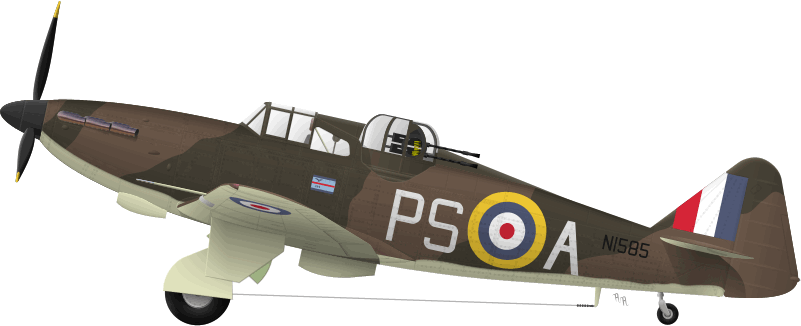
&

planeman6000MiG-29 with IRST and HMS+AA-11 surely.


 Sign In







