plawolf
It really makes one wonder which Indian official thought it was a good idea for Indian made planes to be trucked in and assembled on the spot.
What kind of message is that sending when all the other planes are flying in under their own power? Its not like the LCA is still a paper weight and can’t fly, but that entrance sure makes it seem like it.
Also, that photographer seem to have an unhealthy interest in the two topless guys erecting the stands. :p
Edit,
On closer inspection, that LCA looks like a mock up, or at least I hope it is.
plawolfThe issue is less what was actually disclosed, but rather the principle that the US seems ready and willing to give sensitive information that the British government considers as ‘classified’ to the Russians without telling the British.
It might be something small and non-consequential this time, but what guarantees does the British have that next time it won’t be something that actually matters?
Britain still awaits the day it gets a Prime Minister with the wisdom to realize the UK’s real bargaining power with the US and the balls to use that to demand decent treatment from the Americans. We are probably in for a very long wait by the looks of things. :rolleyes:
plawolfOver engineered aircraft?
Of the ones not already mentioned, the Japanese F2 springs to mind. Staggering cost escalations to re-invent the F16 airframe with questionable benefits over the original design.
F15 Silent Eagle. Massive increased cost for reduced RCS that has questionable real world benefits.
V22 Osprey. Unique capabilities yes, but is it really worth the costs to make a prop plane able to hover and VTOL when a large helo could do the same job even if it is slower?
plawolf:diablo::dev2::cool:
all of them are dwarives?
notice I was not talking about that man who carried bag aside the wheel.
Hate to burst your snide little bubble, but if you bothered to even look at your own oh so straight lines, you would notice that on some of them, a guy is levitating about half a foot off the ground.
That’s just a plain example of the difficulty you would get in trying to guess dimensions from a picture when the picture was taken from an elevated position from who knows how far away, and the person you are using as a measuring stick is at a different distance from the plane itself.
With just those factors at play you would expect a sizeable margin for error even if you knew exactly how tall the person you were measuring the plane against was. Since you do not, that adds even more variability to the mix.
Finally, when we mix in your own strong pre-conceptions coloring everything you see, it all adds up to a very questionable conclusion.
I have no idea why you are getting so defensive and dismissive of fair and honest advice on how you could try and eliminate any questionable assumptions or techniques you are using so we can get the most accurate estimate of this plane’s dimensions. That is what this is all about, right?
plawolfYou can make them from 1.70~180, which won’t change point significantely.
What if the guy was 1.50m?
You cannot choose only the tallest possible size the guy could be and ignore the possibility that he might has been on the small side.
If you look at this picture

The rear wheel only seems to go up to the guy’s crotch.
What I done only is set a low limit.
Well that just a classic case of circular reasoning.
Why have you set the flanker’s rear wheel as the lowest possible size the J20’s could be? Because you have already decided that the J20 is bigger than the flanker.
All you are doing is shaping the available information for fit this pre-conception you already have formed.
It is highly improbable that diameter even smaller than AL-31. I will wait to see a smaller engine gained more powerful thrust done by them.
Improbable but far from impossible.
All you are doing if making assumptions that has no basis other than your already pre-formed idea that the J20 is bigger than the flanker.
As anyone who even knows the most basic things about scientific research will tell you, nothing can be taken for granted, and as soon as you start making baseless assumptions, the credibility of you work goes down.
You have similar misinterpretation with Starikki. What I did barely is prediction, if those data are unveiled, why shall I do this?
I have no idea what you are saying here I’m afraid.
plawolfMaking a 1.75m assumption for the height of the man is baseless. You cannot just randomly pick a number out of the air.
The assumption that the wheel is the same size as a Su27’s is also a guess at best.
Its the same thing with the engines. We know that it is NOT an AL31, so assuming it to be the same size as an AL31 is clearly a leap of faith at best.
Using the intakes would also be a none-starter since the J20 is designed to have more powerful engines, so that will affect the inlet size.
What you need is a common constant that is known to use as an estimate.
There have been pictures of the little tow cart dragging the J20 alone. There are photos of the same cart dragging J10s, and the cart will be the exact same distance as the planes in each instance.
All you need to do is wait for a picture of the j20 being towed from an angle that matches a picture of the J10 being towed, adjusted it so the cart is exactly the same size on both pictures, apply the known size of the J10 to work out the dimensions of the J20.
plawolf
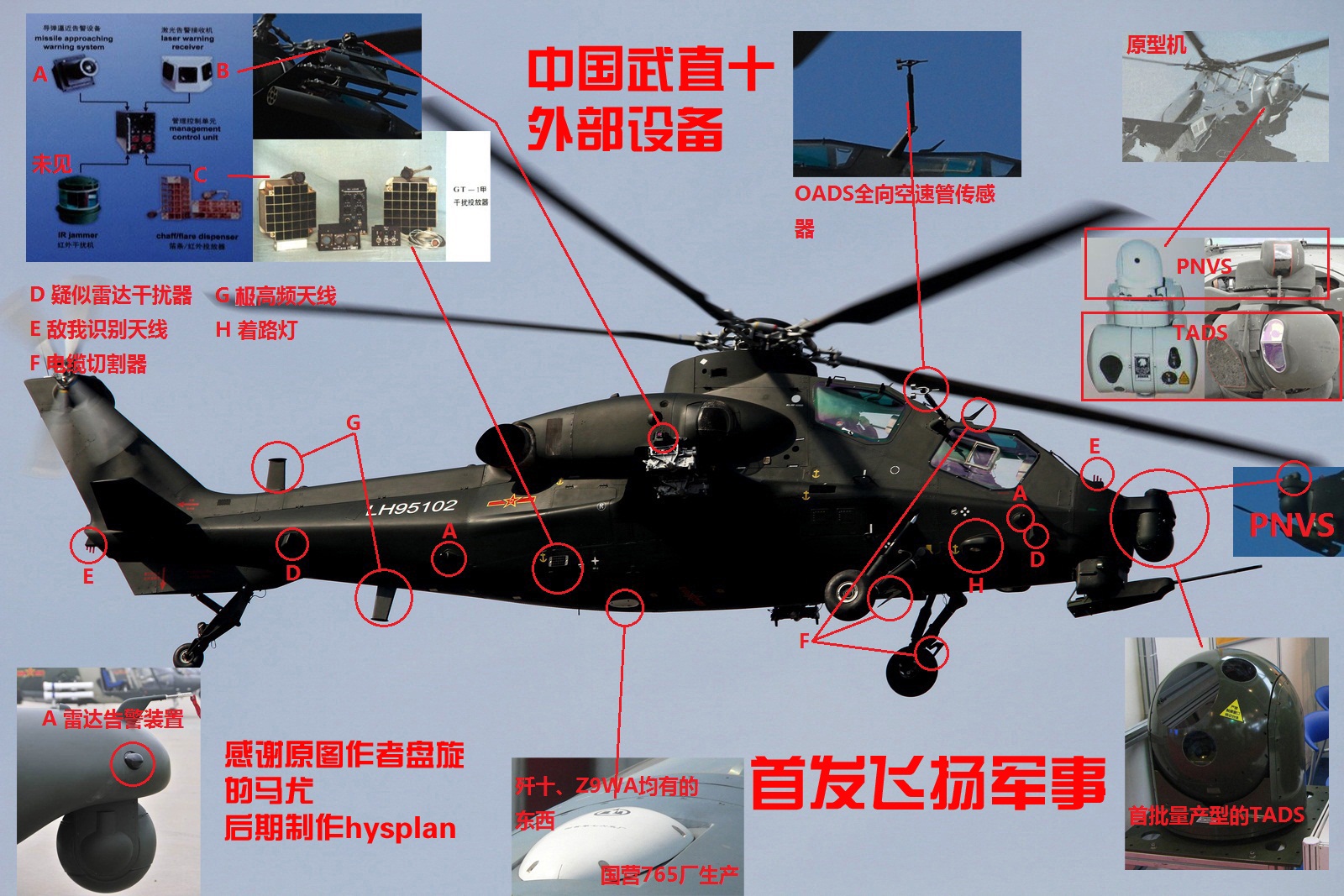
http://alert5.com/2011/02/01/wz-10-defensive-aids-sensors/Can somebody translate this into English?
A: Radar warning receiver in the caption (but the cut-out from what looks like a brochure says its a MAWS, which I believe is right)
B: Laser warning receiver
C: Decoy launchers
D: Suspected radar jammer (which I am unconvinced about, looking again at the cut-out it would appear that the only component missing from that list of self-defense suit is an IR jammer. Maybe they will add a discoball later, but on an attack helo, IR jammers would be a lot more useful than radar jammers, and given the apparent lack of a discoball, I suspect that these are IR jammers instead. The position in relation to the MAWS would also seem to back this up, as there is a jammer able to get line of sight on anything one of the MAWS picks up and jam it)
E: IFF antenna
F: Cable cutter
G: UHF antenna
H: Landing light
The arm sticking out is an all aspect airspeed sensor
The little white disk thing has been highlighted as similar to whats on the back of the J10. My personal view is this would seem to rule that out as some kind of SATCOM antenna as first thought in the J10, maybe a datalink antenna instead?
plawolfWhy did you start a new thread when the mods haven’t closed the previous one and is only half way through its lifespan of 1,000 posts? :confused:
Because he is so desperate to get his name in the title. :rolleyes:
plawolfThe Z19 looks like a heavily modified WZ9, which gave up its transport capacity in exchange for armour protection and possible better payload and/or range.
However, it is still not a purebread attack helo and will not be as capable as the WZ10 in pretty much any regard.
What it has going for it would be a lower purchase and operation cost because of the commonality with the Z9.
It would make a nice supplement to the WZ10 and can help fill the numbers but will never be a substitute for the WZ10.
plawolfThe Italian AMXs flew 250 sorties over Serbia and they turned out fine
When did NATO ground troops go into Serbia/Kosovo?
Those AMXs would have been flying precision strike or interdiction missiles, just like all other multirole fastjets.
CAS often involves getting your hands a lot ‘dirtier’. For example, if your forward ground advance runs into serious organised opposition, that would be the perfect time for CAS planes to come in.
I am not convinced how effective unarmoured planes would be in such situations where you can expect heavy AA fire from small arms and HMGs, and where your own grunts might be calling in danger close fire missions that may well require the pilots to visually ID targets.
A fast jet CAS plane relies on its speed to zoom in and drop ordinates on a well identified target and be gone before the enemy can properly respond.
An armoured CAS plane like the A10 or Su25 can have the flexibility to stay on station over the combat zone for a while to use their own initiative to engage targets of opportunity your own guys on the ground might not have been able to see coming.
The job of a CAS plane can be very similar to an attack helo, and there is no question whether a dedicated armoured attach helo is better or a armed transport?
also we cant really tell how armored or even what engine it will use. All we can tell the nose has been enlarged and slightly canted downwards.
Well if you are going to base the design on an existing plane there is only so much modification you can do before you are better off starting from scratch.
Also, almost all armoured vehicles are aircraft has a distinctive angular feel to them.
Based on those two factors, looking at the design, its hard to see how they could have incorporated a decent level of armour protection.
For attack aircraft nowadays, we can see from experience in Yugoslavia and Georgia that for jet powered attack aircraft, unlike COIN aircraft, the major concern is SAM missiles, there should be emphasis on electronic countermeasures in that case
Well bare in mind that CAS planes will be facing MANPADs most often, and most MANPADs carry a relatively small warhead and relies of proximity fuses.
Adding armour is not an alternative to having decent countermeasures, so I don’t see why you need to give up one to get the other as you seem to be suggesting.
If we take two planes with the same level of decoys and jamming equipment, but one is armoured and the other isn’t, the same MANPAD missile might get through the jamming and decoys of both. But while a close range proximity hit might bring down the unarmoured plane, an armoured plane might easily be able to shrug off the impacts and not only be able to get home later, but could continue to fight in the meantime.
Even if the hit doesn’t bring down the unarmoured plane, armour plating is still a hell of a lot easier and cheaper to replace than having to patch up dozens or hundreds of holes in your plane.
plawolfJust a few issues here:
-you’re giving far too much credit to the accuracy of long wave radar
Long wave radar might not be accurate enough to guide a radar homing missile, but with and IR missile, all you need to do is get it into the ‘ball park’ and its own onboard sensor should be able to do the rest.
and the range that an IR seeker in an AAM can detect a fighter.
-you’re ignoring IR reduction on the stealthy target
-you’re ignoring defensive aids(I.e. DIRCM)
And you are ignoring current developments in IR technology and treating a massive long range SAM as having the same limitations as a tiny WVR AAM.
Currently available IRSTs such as those fitted to the Typhoon and Rafale are claimed to be able to detect the F22 at something like 20, 30km(miles? I forget which unit but that is not important here, 20, 30km/miles is well within the accuracy of ground based long wave radar). A big long range SAM like the S300 could easily fit a IR seeker larger than the IRST fitted to the Eurocanards.
-you’re ignoring the fact that at long range, the SAM can be defeated by change of direction/altitude
What makes you think you would have any idea that a missile is on its way until maybe your MAWS picks it up? With a passive missile, you are not going to get the benefit of a radar lock to warn you someone is taking a shot at you.
plawolfI wonder how long it will be before someone does away with the radar homer and puts a good IR sensor onto of a long range SAM.
Use long wave radar to get an approximate location for the stealth to get the missile close enough for the seeker to take over.
Best way to counter stealth is to not try to beat it at its own game.
plawolfthe (usually) reliable huitong has updated his site with this small picture
http://cnair.top81.cn/attack/Q-6.jpg
now there’s really nothing more to this new picture other than scale model from…. something but it looks like Hongdu has finalized their Q-6 design based around the L-15 which would probably put it in the same class as the similar sized AMX ground attack aircraft.
Call me old fashioned, but I always feel a good CAS plane needs some good armour. I know that’s only a model, but the rounded design does not look like it is well suited to being heavily armoured, especially not if its mainly based off of the L15.
While I can see the sense in having a CAS plane that share a lot of parts with your advanced trainer, I can’t help but feel you risk regretting the penny pinching if the planes actually need to go to war.
plawolfI’m quite surprised there is that much rivalry between CAC and SAC. I would have thought that considering the importance of the J20 to the broader national security of China, such rivalry would be put aside, and in particular, the PLAF or Chinese government at least forcing them to work together for an important project. Having some competition is fine to drive innovation and new technologies, but not at the cost of an important project, doesn’t sound like the Chinese way of doing things.
I don’t think the CCP or PLAAF is in the business of micro-managing companies any more. Especially not ones like CAC that seem to be doing such a bang up job.
So long as CAC can deliver on their promises on time and on budget (and probably even to a degree if targets slide), Beijing and the PLAAF couldn’t care less about CAC and SAC’s petty rivalry.
The most they would get involved is to ‘suggest’ that CAC sub-contract some work to SAC, but that’s on par with what happened between LockMart and Boeing after the F35 won.
Obviously they might step in if things started to really get out of hand and national interests were actually put in jeopardy, but we are far far from that point just yet.
At the end of the day, if CAC says they can delivery the J20 as promised without SAC’s help and looks likely to be able to do so, no-one is going to force them into partnering up with SAC, as doing so may well actually damage the programme by causing unnecessary disruption.
plawolfWell, aren’t the “electronic guys” (possibly Nanjing Research Institute of Electronic Technology or whatever the leading radar design house) independent from both SAC and CAC?
I mean, even if SAC was the winner, radar would have come from Nanjing. So J-11B might be a test bed too.
You don’t just submit an airframe design, the J20 is supposed to be a complete system. So the radar and avionics firms will need to have a very close working relationship with CAC.
In addition, with integrated systems and sensor fusion etc becoming ever more important, the degree to which a radar is enmeshed in the whole avionics architecture of a plane is increasing all the time.
If its just about testing a radar by itself, that could be done just as easily on the ground or using one of the dedicated converted Y8 radar test planes.
The biggest issue with be to make sure the new radar can work together with all the other avionics systems as efficiently as possible. That could be best done by designing everything from the ground up to support each other, and ultimately putting all the pieces together to see how they all fit in the end. That involves a great deal of sensitive information.
Even if SAC made a J11 available, it would be very counter-productive and time consuming to try to integrate a new radar and avionics suit into the plane without direct input and consultation with the aircraft maker. Not sure CAC wants that level of access by SAC to their J20 project.


 Sign In