 MiG-23MLD
For the benefit of the others.
The SM-12/3 was a deep modification of the MiG-19. The fixed inlet was replaced with an nose cone. At first to have a place for a radar and second to rise speed from installed thrust by a regulated inlet. The Sorokin R3M-26s were experimental engines and did never see front-line service.
Maximum speed did rise from 1430 km/h of the MiG-19 to 1930 km/h of the SM-12 as did service ceiling from 17500 m to 18000 m. Most important were the climb-time gains, when the guns had to be sacrified.
The intended service variant, the SM-12PM was down to 1720 km/h and a service-ceiling of 17400 m . Not a good outlook for a high altitude interceptor.
So for the SM-12PMU a rocket engine was added. The maximum speed was still 1720 km/h or Mach 1,69, when the top speed with rocket boost was not recorded. Non is surprised to read that, when still fitted with experimental engines and related limitations for the inlet and rocket-thrust is hard to adjust.
The booster was tested on further MiG-19 variants for better time to height gains from that. The main role of the MiG-19 was an interceptor role. 😉
That is correct however you forget the Russians by 1959 had already the R-11, by 1968 the R-13-300, by 1974 the R-29, by 1979 the R-35.
The thrust increase of these engines were far greater than any Soviet design copied and modified in China.
What you are forgeting is the SM-12 gave way to the MiG-21 in the same way the MiG-21 gave way to the MiG-23PD and then to the MiG-23M.
The R3M-26 was not the only engine Russia had in the cold war, however China had to content with the copied R-11 and R-13 you are not seeing the Russians were always ahead in fighter design and the Q-5 Fantan is not the first MiG-19 upgraded derivative.
Saying the Chinese developed the ultimate MiG-19 is not acurate, the Chinese did design a simple bomber from the MiG-19 and their engines were not outstanding in 1979.
MiG-23MLDI don’t think you read any Chinese reports to make claims on what their viewpoints are as well as the reasons for doing this and that. Their issues are much like everyone else though; the MiG-21 has some serious drawbacks, starting with a very short range that permits far too little loiter and station time. Unlike the Russians, which is facing their potential enemies with nothing but a land border, the Chinese is facing a sea. Another problem is the propensity for the aircraft to commit into flat spins, and the way it departs from controllability is sudden.
Experimental aircraft is very far from an operational aircraft because the latter has at least a minimum requirement of reliability. There is a reason why the engines you mentioned remained experimental.
That is not true, the USSR advanced very fast in engine designs, by 1961 they already had the R-15, so your theory is not accurate.
The MiG-19 in the SM-12 guise was far more advanced than any chinese MiG-19 built in 1960, however the Russians settled for a MiG-21 type.
You know perfectly that the SM-12 is half way to a MiG-21, already has the inlet, the Ye-2 had the engines but not the wings, the Ye-6 already is a MiG-21
China built from 1970s to the 1980s the J-8 a very simple fighter even not a dogfighter, Russia experimented with such aircraft in the late 1950s too. by 1964 they already had the Su-15.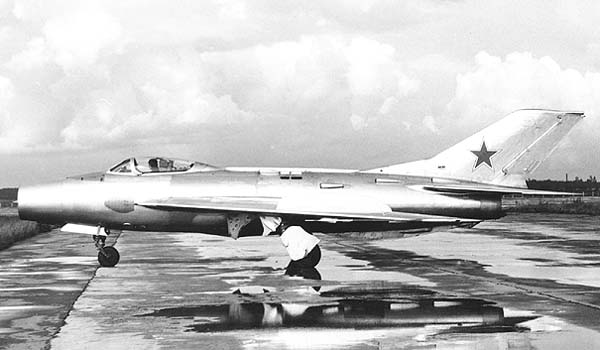
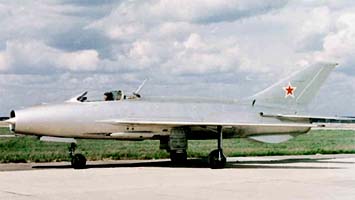
source of the picture http://www.airwar.ru/enc/fighter/sm12pm.html
However as the article mentions both the MiG-21 and MiG-23 were not really very advanced dogfighters, the LERXed F-5 was more agile at low subsonic speeds.
The MiG-19 lacks any advanced feature seen in the F-5 too in terms of wing design.
China was not ahead of Russia in MiG design because russia built more advanced designs and only probably now they have catch up with russia if russia does not built the PAK FA and China builds something better but still the MiG-29OVT and Su-35 are super agile.
But in 1965, the MiG-21 was the best fighter Russia had
MiG-23MLDFor the benefit of the others, the R-25 is still the basic R-11, but built by better materials, which did justify the claim for a new designation.
Similar to the R-13 it has a more advanced AB-system.R-11F2-300:
65 kg/sec – 8,72 Pr – 6120 kp by 2.19 sfc 3950 kp by 0.94 sfc – 1211 K TiT
R-13F-300:
65,6 kg/sec – 8.9 Pr – 6490 kp by 2.09 sfc 4070 kp by 0.93 sfc – 1233 K TiT
R-25-300:
67,9 kg/sec – 9.55 Pr – 7100 kp by 2.25 sfc 4100 kp by 0.96 sfc – 1330 K TiTAll that did stop in the 70s, when the Chinese did just start to gain experience with their Wopen and will have surpassed the Russians in that later on. Be it the basic RD-9 or the R-11 from the 50s.
That is because you do not know the TRD R3M-26 that powered the SM-12 it was a design of the late 1950s 20 years before any Chinese design, this MiG-19 derivative almost reached an speed of 2000km per hour and had a total thrust of 7600kgf with engines of 3800kgf of thrust each
Тип двигателя 2 ТРД Р3М-26
Тяга, кгс 2 х 3800
Максимальная скорость, км/ч 1926
source http://www.airwar.ru/enc/fighter/sm12pm.html
MiG-23MLDThe MiG-19 and J-6 was certainly difficult to fly. No less than General Han Decai admitted it adding “extremely” to it. On the other hand he finds the MiG-17/J-5 and the J-7 delightful to fly. For some reason the Q-5 managed to correct the J-6’s flying quirks, and today still remains a popular plane to fly in the PLAAF.
The PAF had J-6s for forty years. When they first had J-7s, the J-6s were not replaced, and kept the J-6s simultaneously going with the J-7s for two decades, and they were not replaced until this decade.
Likewise, the J-7 failed to replace the J-6 in PLAAF service despite having several hundred J-7A/B built and there was resistance in changing to the J-7 prior to the -E version which had the double delta wings and the R-13-300 derivate engine. Pilots loved the power, its fast turn rate at low altitudes, and the multiple cannons, as many as three while the J-7 only had one, though it should be noted that the PLAAF was probably among the last major air forces in the world to discard the dogfight mentality, if not the romantic idea of it. The J-7C/D based on the MiG-21MF was the most unpopular one of all, criticized for its high wing loading.
During the sixties during the Vietnam War, a number of US aircraft were shot down by J-5s and J-6s, including Phantoms. The most celebrated kill was an RF-104, or reconnaissance Starfighter. Not an easy plane to catch, it was done by a J-6. Pilot survived and returned to the US when the US broke the chill with China when Mao and Nixon met.
The Russians did experiment even before any chinese model with advanced engines in the MiG-19, in the late 1950s already the MiG-19 SM-51 had engines of 3800kgf of thrust, China never surpassed the russians in the design of MiG aircraft.
Some MiG-19 experimental variants got to speeds of almost Mach 1.9 with the use of MiG-21 styled cone inlets

source of the picture
http://www.airwar.ru/enc/fighter/sm12pm.html
http://www.airwar.ru/enc/fighter/sm12pmu.html
The MiG-19 SM-12 variant was fast and the predecesor to the Ye-2 and Ye-4 from which the Ye-6 or MiG-21 was derivated.
The Russians admit the F-5 was more maneouvrable than their own MiG-23M and MiG-21Bis at speeds below 750km/h, and due to the aerodynamics integrated into the F-5, but at speeds of 800km/h the F-5 was not better therefore the testing of the F-5 in the former USSR was the based for the MiG-29 and Su-27 since the F-5 has LERXes.
However the reason China was not satisfied with the MiG-21 was simply they dragged too long with an old aircraft and they did not design anything better until they took the J-10 design enterprise.
MiG-23MLDFor the benefit of the others, the R-25 is still the basic R-11, but built by better materials, which did justify the claim for a new designation.
Similar to the R-13 it has a more advanced AB-system.R-11F2-300:
65 kg/sec – 8,72 Pr – 6120 kp by 2.19 sfc 3950 kp by 0.94 sfc – 1211 K TiT
R-13F-300:
65,6 kg/sec – 8.9 Pr – 6490 kp by 2.09 sfc 4070 kp by 0.93 sfc – 1233 K TiT
R-25-300:
67,9 kg/sec – 9.55 Pr – 7100 kp by 2.25 sfc 4100 kp by 0.96 sfc – 1330 K TiTAll that did stop in the 70s, when the Chinese did just start to gain experience with their Wopen and will have surpassed the Russians in that later on. Be it the basic RD-9 or the R-11 from the 50s.
According to this article, when the Russians tested captured F-5s, and flew them against their MiG-21s and MiG-23Ms, found the F-5 to be superior at low speeds below 700 km/h. see:
Я понимал, что F-5 далеко не самая современная модель и по своим характеристикам уступает даже МиГ-21.
Here the Russian pilots admit the MiG-21 was not even as good to even the early F-5 version the Russians tested against the MiG-21Bis
Here they say that even after they defined the basic F-5 flying characteristics they started flying both aircraft against each other, the MiG-21 was found less maneouvrable and agile.
They admit that the MiG-21Bis has even better thrust to weight ratio than the F-5 they tested
После определения основных лётно-технических характеристик мы приступили к сравнительным воздушным боям с МиГ-21БИС. Я воевал на своём “родном” МиГ-21, а Николай Стогов — на F-5. Ближний манёвренный “бой” начинался в равных условиях на встречных курсах. Все полёты заканчивались с одним результатом — МиГ-21 проигрывал, хотя и имел значительно большую тяговооружённость
Further more they say the MiG-23M was not better than the MiG-21 and basicly the F-5 had a little bit more trouble shoting down the MiG-23 but the end result was the same
Зато мы ему такого “перца всыплем”, — высказался заместитель главного конструктора МиГ-23М, в предвкушении реванша потирая руки.
“Перца”, конечно, всыпали, только сами себе. Результат оказался тот же, с той лишь разницей, что агония продлилась до 4-5 минут.
Source
MiG-23MLDThe US evaluated Pakistani J-6s during the sixties when the planes first came in. After that, they raised the threat value of the aircraft. Of all the early MiGs, the MiG-19/J-6 came out with the best (meaning relatively not so embarassing kill to death ratio) of all the MiGs in all its historical confrontations. PAF J-6s and Q-5s also acquitted themselves well in low level dogfights on exercises with F-16s.
The 9900kg boost on the -bis is an emergency one that scraps the engine.
Crobato, Your statement might be true or not but saying a statement of this engine will broken if used at its max thrust is something, that needs a good source, it is not i say it or he says it.
personaly i feel it could use it regularly and since the MiG-21 flies higher it does not need all the thrust to fly faster than the MiG-19.
That is the reason with less thrust the early MiG-21s fly faster, besides their inlet design is optimized for high speeds.
Up to what i know it could use the 9900kg thrust only for no more than 3 minutes, its regular thrust was 7100kg thrust but a special thrust of 9900kg was allowed.
If the pilot did not use it for more than the allowed time, it was okay to use 9900kgf of thrust at Mach 1 and at altitudes of 0-4000 meters
а также новый двигатель Р-25-300 (1х4100/7100 кгс, создан под руководством C.A. Гаврилова), имеющий режим ‘Чрезвычайный форсаж’, при котором тяга кратковременно (не более 3 мин) может быть увеличена до 9900 кгс (при М1, в диапазоне высот 0-4000м).
http://http://rusweapon.far.ru/print.php?url=plane/fighter/mikoyan/21/1.far
If you read this article it proves you the the Q-5I was powered by the improved WP-6AIII turbojet only after it made its maiden flight in August 1979, so the aircraft China flew were not 1960s.
http://www.sinodefence.com/airforce/groundattack/q5.asp
MiG-23MLDFrom CDF:
What beautiful aircraft are the J-10Bs, from my point of view the most beautiful chinese aircraft i`ve ever seen
MiG-23MLDThere you go yet again inventing things. Where have I ever posted that any MiG-23 was carrying R-24Ts? All I have stated it that the MLs were in service before the events in 1989.
The videos/audio was released for a specific purpose. Why is that so hard for you to understand? The images taken are not for the purpose of aviation enthusiasts. In my 22 years in the military I’ve seen hundreds of intercept images and vidoes that have never seen the light of day in the public eye. The situation for Russia, and other nations, will be the same. They exist in the archives at extremely low classification, but simply have no requirement to be published. Why is that so hard to understand?
Whatever the intention of the MiG-23 pilots they simply were in the wrong place at the wrong time. Regardless of MiG-23 variant, was their intention simply for a bit of sparring? Who knows? Regardless of type/variant it quickly went pear-shaped for the MiG-23 pilots. Their search and rescue services were out for several days, but nothing was apparently ever recovered.
TJ
Seems you are not even satisfied with the supposedly original head up sight images taken from one of the tomcats, the reality is very difficult you prove the MiG-23s shot down by those Tomcats were MiG-23MLs and not MiG-23MS.
If they were MiG-23MS as Firebar says and i also believe they were, their AA-2s were not match for a F-14s AIM-9s and the only chance they got was getting very close to the F-14 if they did indeed have hostile intent.
That also explains why they did not fire any missile at longer ranges and all the pictures show MiG-23MS

It is possible they got the MiG-23MLs much later, but i throw you a challenge prove with a russian source Libya got those MiG-23MLs before January 1989.
MiG-23MLDNo you did not for all to see and you have a “good” reason not to translate the related text and symbols. :diablo:
I think here the only denying realities is you, the fig 5.5 says very clearly allowed speed mach 2.35 with the wing swept at 72 deg and two R-23 at a weight of 12700kg MiG-23ML
the graph is for the relation between altitude and speed related to the thrust available, very clealy the max speed allowed at 15 km is Mach 2.35 and the aircraft is armed with two R-23s;)
So even if you deny that Firebar and the manual say that and are correct
MiG-23MLDSo you have problem to translate the Russian words along-side the graphs and the symbols given into English?! 😉
I already told you what the graph says, no point in argue that, in fact in the MiG-23 manual says the MiG-23 can reach Mach 2.6 and most of the graphs presented in the manual give basic weights with weapons not clean as you are claiming.
Definitevely Firebar is right in what respects the MiG-23 carrying two R-23s at Mach 2.35, also he is right when he says for a Mach 2.85 fighter the MiG-25 is agile, certanly is more agile than any western Mach 3 aircraft and is more or less comparable to other dedicated interceptors at high speed and altitude
in fact see this MiG-25 Video and enjoy its agility and flight get inside its cockpit
http://video.google.com/videoplay?docid=1451251665776525653&ei=YY3BSKGdDIHKwgPi5qG8CQ&q=%D0%9C%D0%B8%D0%93-25&vt=lf&hl=en
MiG-23MLDFor the benefit of the others.
What does R.A. Belyakov the general designer claim?
p 362 MiG-23S/23-11
Max speed in clean configuration (72° sweep), 2405 km/h or Mach 2.27 at 12800 m (1298 kt at 42000 feet); max speed with four R-3S missiles (72° sweep) 2100 km/h or Mach 1.98 (1133 kt); max operating Mach number, 2.27;
p 374 MiG-23MLD/23-12
Max speed in clean configuration (72° sweep), 2500 km/h or Mach 2.35.Some fanboys or websites have no problem to ignore such degrading details, when the they do point to that to Western designs only.
Firebar is right the MiG-23ML if you see this original MiG-23ML manual page it clearly states the MiG-23 with R-23s can reach Mach 2.35
MiG-23MLDThe final version of the RD-9, the RD-9BF-811, had an afterburner thrust of 3750kg.
Combined that’s like 7500kg of thrust.
The Chinese were packing their J-6s and Q-5s with an engine of 36.78kn thrust with afterburner.
Still can not compete with the R-25, it was an engine of almost 10000kg of thrust. This was in 1972, after that the MiG-23 made totally obsolete the MiG-19, and the Mig-29 still even more.
China did not have any decent fighter until the J-10, the J-7 was an archaic design in 1995 and the J-8II only comparable to early MiG-23Ms at best and that already when the Flanker was flying in Russia.
Portraiting the MiG-19 as a super fighter in the 1960s is absurd, the MiG-19 only deserves to be called a good aircraft simply because the F-4 was not armed with a gun, it was simply the lack of a gun what made the MiG-19 a better fighter in General terms a well flown F-4E or a MIrage III were better, that is the reaon the Vietnamese regarded their MiG-21s as the jewel of the crown of their air force and Israel made good use of their F-4Es and Miraeg that simple eliminated the MiG-19 threat.
MiG-23MLDlook i frequently read this forum and i dont wanna argument with you since even if i am right i would seem wrong looking to the volume of links and bs in your answers.
Its my knowledge that the 19 and the 21 have different types of engines.
Offcourse they were chinese made but the engine were different copies of Tumansky RD9b and R-11-300.R-25 was the engine of just “21bis” with 7500kg in forsazh.If u look at datas you’ll see that from first engine R-11-300 of F-13 to R-11F2SK-300 of the MF the maximal thrust is pretty much the same.they augmented the forsazh but all we know that it comes to an expense-sucks much fuel.
I also happen to read that the 9900kg thrust seems to be reachable under very limited conditions and just for 3 minutes,so i dont really understand why you mention it.Maybe another 2 minutes and it was out of fuel.however to stay in the topic i would say F-16,Mirage III,Mig 21
independently if you like or not the links, the fact is the MiG-21 by 1966 had almost the same thrust to weight ratio and by 1972 it was even more powerful, Albania with all due respect never operated the best Soviet fighters, and China never got the R-25 that powered the MiG-21 and Su-15bis, you like it or not the Russians built more advanced MiG-21s than China until they stopped the assembly lines of the MiG-21.
MiG-23MLDThe Farmers engine is called Rd-9b sir(from manual)and the forsazh output of 2 engines is 3250×2=6500kgs
Talking about engines it would be interesting to look at radius,since in Albania the F-7a managed to stay in the air roughly 20 min less than the F-6.F-6 engines were quoted to consume 55l/min on maximal and they switched to forsazh just doing the engine run before take off
Niether me or you are wrong, what happens is the MiG-19 like the MiG-21 were powered with different types of engines.
Russian built MiG-21s had the R-25, an engine that China never got, Russian built MiG-21s differed a bit from the J-7s so you camparasion should not be totally accurate.
check by your self
MiG-19
http://www.airwar.ru/enc/fighter/mig19sm2.html
http://www.airwar.ru/enc/fighter/mig19p.html
http://www.airwar.ru/enc/fighter/mig19.html
MiG-21
http://www.airwar.ru/enc/fighter/mig21sm.html
http://www.airwar.ru/enc/fighter/mig21b.html
http://www.airwar.ru/enc/fighter/mig21m.html
By 1972 the RD-25-300 had a Max thrust of 9900kg, three times more than a single engine RD-9B
MiG-23MLDChinese J-6 we had in Albania were tuned on 2650kg each in maximal and 3250kg in forsazh so Crobato is right
The Chinese for many years had to content with early MiG-21s, the Russians did not, by 1966, the Russians had engines powering the MiG-21 with twice the thrust of a AM-9.
By 1971 already they had the R-25 with more than 2.5 times the power of an AM-9, the engine that powers the MiG-19.


 Sign In








