 MiG-23MLD
Su-34 is the only modern F-111 equivalent.
But i don’t see how it is actually superior to the good old F-111.
It must be somehow superior to the F-111D.
May be Schorsch can tell us?
Most bizarre to me is the max war load of Su-34 only 8t! It schould be at least 16-18t if F-111 could ferry 14t. May be russians never push their designs to its limits, but even smaller F-15E can carry 12t.
There is one reason why the Su-34 is a great aircraft, and that is because it has a toilet in its cabin, while this might sound unimportant having a toilet in a long flight over 7 hours is a real convinience for a pilot and his WSO
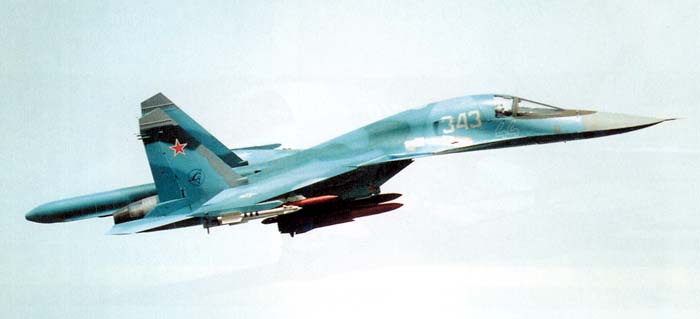
in many ways the Su-30MKI is not very different from the Su-34, however the Su-34 is designed to fly for long hours and its pilots do not need diapers:p , this makes it a really well thought design.
It has enough space for a pilot to stretch and relax his muscles
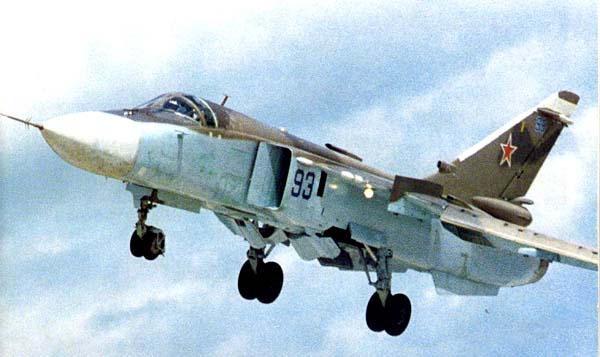
MiG-23MLDThe Su-24 has a similar range capability to the Su-17. The main difference is only, that it can carry more than double the warload of that and heavier weapons.
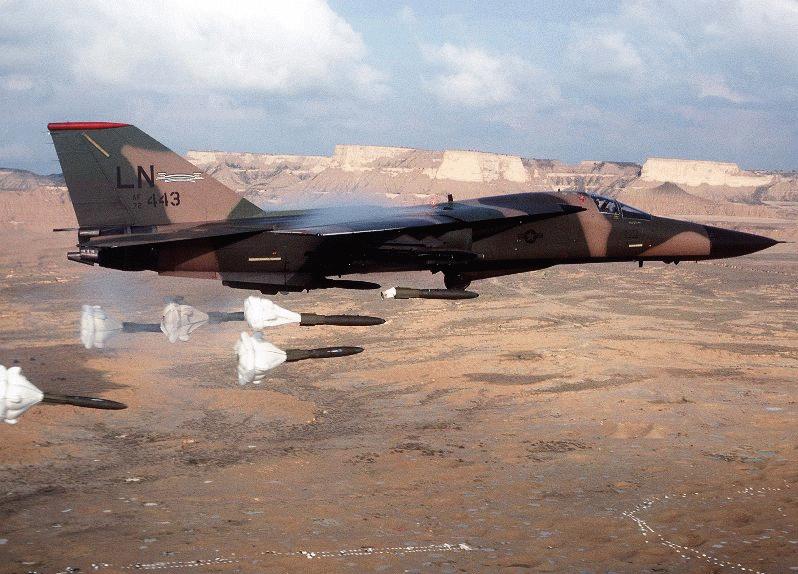
The Tornado IDS is a class ahead in range capabilities and the F-111C-F did go even further.
Non is surprised by that, because Russian were limited to Tj engines.That Cold War time behavior does become boring, when people do stick to wishfull thinking and do not even realise the shortcomings every design has.
During Glasnost it was an open secret that the Su-24, Su-15, MiG-31 and many other types did not fullfill the range specifications for several reasons. Nothing other at hand and series production did started early, the producer did promise to deliver a solution for that later on. To the anger of the armed forces, that promises were never fullfilled. That is not limited to the East of cause, but the wishfull believers of eastern design are still unable to accept that.
The F-111 and the Su-24 are basicly the same concept but while the americans wanted to make of the F-111 a long range bomber; the Russians just wanted to make of the Su-24 a medium range bomber, why? well the Russians had the Tu-22M and Su-24s filling the same roles the F-111 had been tasked to fill.
The Su-24 nevertheless has an inflight refuelling probe meaning it can have its range extended even beyong the 5070km it has with one inflight refuelling.
The F-111 can not fill the Tu-22M roles, it need tankers and four external fuel tanks to fill the Backfire`s role, it will carry fewer weapons and fewer SRAM type missile..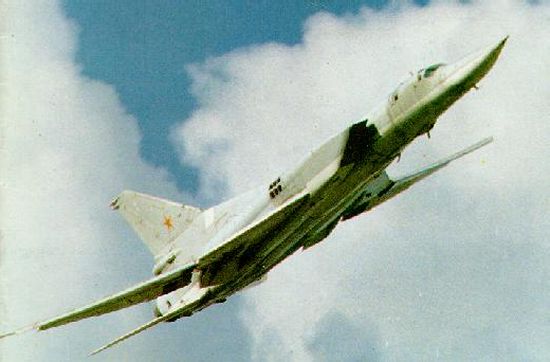

The Russians built more Su-24s than the americans F-111 and the Su-24 is still in service in large numbers.
At the end the americans understood the B-1B is the type of aircraft they needed to fill the role the FB-111 was tasked to do
The Su-34 is a modern F-111 type bomber but far more capable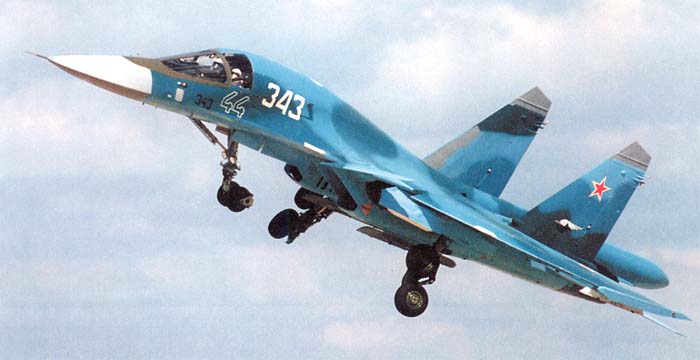
MiG-23MLDThe Russians actually considered turbofans themself, but obviously there was no engine avalaible and so they sticked to turbojets. Actually one of the worst design decision one can make. The TSR.2, however, had a similar design solution. Maybe a reason for its cancellation. Although the TF30 is never popular with fanboys of military aviation, it was a rather revolutionary design at the beginning of the 60s.
The SFC of TJs is up to 50% higher than for turbofans of the class of the TF30 (which itself is no optimum fighter engine). The TF-30 had a bypass ratio of 1, the engines of the B-1B even 2. The RB.199 of the Tornado stood at 1, too.Actually, the range capability of the Tornado remains a mistery to me. I have never seen it without wing tanks. Has anyone numbers for a typical profile for the “bomb-the-Oder-bridge” mission: (low, low, low; tanks drop when empty; subsonic ingress & egress)?
The Sukhoi Su-24 is not a high altitude bomber but a low altitude Mach 1+ bomber, it does not even need fixed inlets, it does not need very extrict requirements for its AL-21s.
MiG-23MLDStill unable to read carefully?!
The FB-111A was part of the SAC and tasked with an atomic mission. From free fall atomic-bombs to SRAMs for stand-off attacks.
The first Tu-22M were built as replacements for the Tu-16 in the anti-shipping role as prime task.
Over 90% of mission-time was subsonic with a short high-speed dash to overcome defences, by shortening the reaction time to that threat.
Different roles but a similar demand related to flight profil.
The empty equipped Tu-22M was heavier than a MTOW FB-111A, but did generate a similar radius of action. Cost is related to weight (empty equipped!) and can not be ignored. The Russians did so, by twisting economic. The second question is, what amount of energy is in need to push it around. You can ignore that for political reasons too, but it does not relief you from the economical impact related to that.
The other variants of the F-111 and the Su-24 did share similar missions.
The basic Su-24 was 21,2 tons empty equipped up to 22,3 tons for the later MK.
The first one had an radius of action 600 km and the MK of 560 km. (Data from OKB Sukhoi). MTOW for both is 39,7 tons.
The F-111F was 21,6 tons empty equipped and the F-111E was 23,5 tons.
The MTOW was 45,4 tons for F and 41,5 tons for the E.
The Tornado IDS with 60% of the weight did similar performances compared to the Su-24 and much higher range capabilities. (MTOW 30,5 tons 1991)
The price to be payed, when powered by a Tj compared to a Tf. The wrong engine for a low-level striker. The Su-24 is infamous for that even in Russia.
To call that differences slightly is a lack of reality to stay polite!
The F-111/FB-111, like the B-58 and XB-70 before it, had cost overrun problems and bad publicity. Of the planned 210 aircraft, only 76 were built. It was billed as an interim bomber to provide a better, low-level penetration capability until a B-52 replacement was built.
The incorporation of new avionics is further restricted by a weight limitation on the crew escape module
The two engines of the FB-111A can be started quickly, and it has a shorter takeoff roll than its predecessors. Further, the payload is not as limited as the B-58 since the FB-111A can carry up to 24 conventional bombs. However, this requires external carriage which restricts the wing sweep and degrades the range. The nuclear payload is two internal SRAM/gravity bombs and up to four external pylon-mounted weapons.
The combination of development cost overruns, bad publicity’ high unit cost, and range/payload limitation stacked poorly in comparison to the B-52 and the new B-1 on the drawing boards.
it should be pointed out that even with these improvements, the FB-111 could not match the range or payload of the long-range B-52 or the B-1.
See this is from http://www.globalsecurity.org/wmd/systems/fb-111.htm
To fly 4000 nautical miles the FB-111 needed to fly like this
In this configuration it could only carry two SRAMs while a typical Tu-22M can carry six X-15 and two X-22 and does not need any external fuel tank at all
MiG-23MLDI disagree… the Backfire was not a naval antiship strike plane by design. In fact its standard armament would be a nuclear tipped Kh-22M with the ability to fly to a general coordinate or anti radiation tipped Kh-22Ms for the land based theatre strike role. It was never designed or intended for a strategic role. It was a very deep penetratation system to take out a command centre (with a nuke) or a major radar base (with a super ARM). It was also used by Naval Aviation for an anti carrier strike role to supplant and then replace the Tu-16 but that was a rather secondary design consideration.
Exactly. A laser battlestation launched in one hit… imagine the offensive power of MIR 2 with 4 of those hanging off it… :diablo:
No it wasn’t. It was a bomber to replace the failed Tu-22, which had several roles but the Tu-16 was the medium range maritime strike aircraft of choice, not the Tu-22 or Tu-22M. (The Tu-142 was the long range choice)
In many ways a strike on a land based major radar system is like an attack on a carrier… both are well defended by SAMs and airpower…
The adoption of the Assault Rifle. The M16 probably would not have entered western service had the AK-47 not been in widespread use… and without the M16 the west would likely still be using heavy battle rifles like the M14 and FN FAL, and G3. The M16s design was influenced by the AK in that it originally was fitted with a 20 round mag as standard. A 30 round mag was demanded to make it more competitiive with the AK which came with a 30 round mag as standard.
Yes, I know your reply… the germans invented the assault rifle. Would suggest you look at the terminology the Soviets and Russians use for their assault rifles. They don’t call them assault rifles… AK does not stand for assault rifle Kalashnikov, nor does it stand for automatic. Avtomat is the name of a weapon that has become synonomous with this type of rifle and it is the Federov Avtomat of 1916. Much the same way Hoover is synonomous with vacuum cleaners because they made very early models so you can talk about doing the hoovering… the Federovs Avtomat was the first Soviet and first in the world Assault Rifle… it just took another 30 odd years for the Germans to name it. It had a 25 round curved mag, capable of single shot or full automatic fire. Firing a 6.5 x 50.5mm Japanese rifle round that fired a 120 grain projectile at about 670m/s which is less powerful than the current AK round (122 grain projectile at about 710m/s). It was not made of Stamped steel, but then neither were the early production AK-47s.
You are right, it was armed with the X-22, but as a bomber was not exactly a very capable one in the Tu-22M2 variant it was not until the X-15 that the Tu-22M3 became a more complex machine.
It was more a naval strike aircraft, the Soviets had Tu-22Ms in the long range bomber units armed with rockets and in the Naval units.
However until the X-15 was deployed the Tu-22M was more of a naval aircraft in the sense it had more weapons to attack carrier groups rather than a cruise missile carrier that later became.
Some of the missile that can be carried by the Tu-22M


The Tu-22M can fire the KH-65 but it does not use it
MiG-23MLDLicence and ownership are … long range nuclear strike.
I do agree in your point but what i meant by category is even if the FB-111 had such mission, it was ill equipped to carry it out compared to the Tu-22M.
The Tu-22M without inflight refueling and external fuel tanks can carry the same mission doubling the FB-111 weapons payload.
The usage of external fuel tanks also reduces the number of weapons pylons and increases drag.
If the Russians would had been allowed to have refuelling probes on the Tu-22M well it will become a real strategic bomber.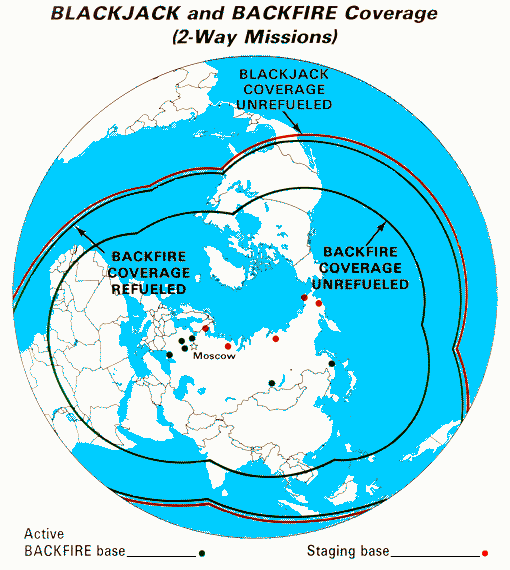
The F-111 is a medium range bomber that was used as a long range bomber but it does not make it an aircraft suited for the mission.
With Inflight refuellings and external fuel tanks the Su-24 can do the same, however the Russians do not need to do that when they have the Tu-22M
MiG-23MLDI’d think that the MiG-27s and Su-24s would have been dropping the nukes. The BACKFIRE was probably going to have one role in life: find carrier, kill carrier, and maybe kill other floaty bits in the area as well. It could perform other tasks, but that one was where it was probably going to be the most effective. Disregarding the hilarious argument over the supposed intercontinental range of the jet, it was highly regarded as a serious naval threat system.
…which is what they did with Polius Skif, albeit without an aerodynamic fairing IIRC.
The original Tu-22M2 was a dedicated maritime strike aircraft the Tu-22M3 can carry more variaty of weapons and cruise missiles
MiG-23MLDWhen you do compare something, you have to do the right choise.
The FB-111A and Tu-22M Backfire B from the similar time-scale.
The F-111F with Su-24 Fencer A.
None is a copy of each other, when the designer did stick to a similar technical solution for a similar mission.
It is more intresting to learn, where each team did push the limits of their design at a similar time.
The F-111 is not an equivalent of the Tu-22M, for several reasons first it is two times heavier, has four men crew (two crew more), its engines have two times more thrust and its weapons load is twice heavier.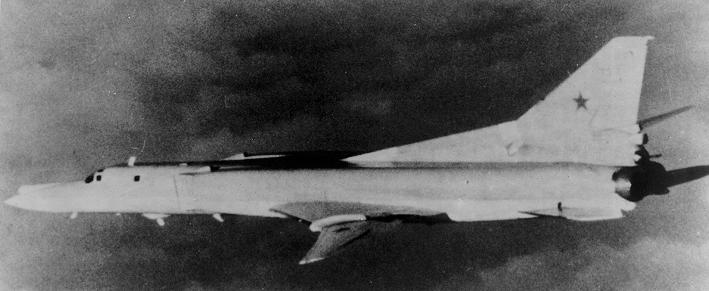
The Tu-22M is in a different category; for a FB-111, the ultralong range mission meant four external fuel tanks, with in flight refueling it was considered a transcontinental bomber yeah but the Backfire without external fuel and inflight refuelling has a range of 5100km.
Yeah the F-111 can reach 4000 nautical miles but only with four external fuel tanks. a more practical range was 4025km, this means yeah the F-111 can be fitted to do some missions but the burden in logistics is not small, that is the reason the B-1B is doing its mission.
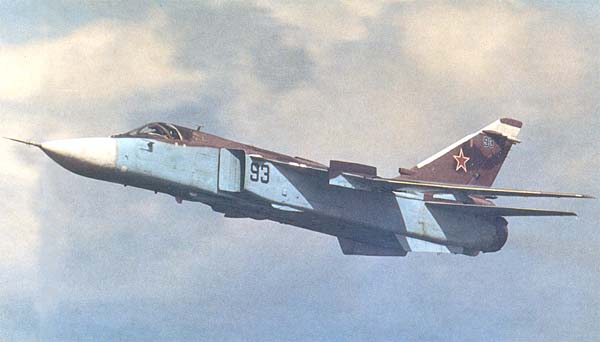
The Su-24 with two external fuel tanks has a range of 2500km and 1140km without external fuel tanks, with an inflight refuelling it gets extended to 4270km.
If it is true the F-111 has a slightly more range than the Su-24, it can reach slightly more than 5000km with external fuel tanks
MiG-23MLDIt is still a copy, no matter how you put it. “License” and “ownership” are maybe elements unknown to Soviet people & economy.
Still you will have problems showing me how Soviet design solutions made their way westward. I never heard/saw any report on the West copying/”get inspiration” by Soviet designs.
One reason is that the East was so clandestine.The Soviets just saw that whereever they invested the money to close a technology gap (or even created a little lead), two new gaps opened. And that was just military, the canyon-wide technology gaps on the civilian side were never addressed. Consequence: known.
The Soviet Union fell no doubt about it, but Russia is still alive and will continue alive for many years, to say the Russians and Soviet were not great is a lack of historical honesty, here are some example of Soviet technology that never were surpassed by the West before the collapse of the Soviet Union in 1990
Yak-141 in 1990 had no known western equivalent its cruise engine was completly ahead of any western design and was retaken in the JSF.
An-225 had no Western equivalent in the West and still has not any counter part in 2007, its closest equivalent was the C-5 in 1990 but the Galaxy still yields to the An-124, the An-225`s little brother

Mi-26 it had no western equivalent in 1990.
Ka-52 had no western equivalent
Tu-22M had no western equivalent and was a quit complex machine
in fact i will say that the Soviet Union collapsed but its technology was not behind the west in terms of aircraft, the Su-35 was in no way behind any fighter the west built up to 1990
If the Soviet Union would had not collapsed in 2000 they would had many increadible machines, a nuclear aircraft carrier with Yak-141s, several hundred Su-35s and some MiG 1.44s, however its collapse was a product of a revolution that at the end if well taken will make Russia a wealthy nation, if not turn Russia again in a super militarized nation.
And by the way this man is an example of Soviet Greatness

First man in space:
Yuri Gagarin made his historic flight on April 12, 1961
First space “walk” by a man:
A.A. Leonov, “Voskhod-2” – March 18, 1965
First space station:
“Salyut” – April 19, 1971.
First space “walk” by a woman:
S. E. Savitskaya, “Salyut-7” – July 27, 1984.
Longest space flight – more than one year:
V.V.Polyuakov – 437 days, 17 hours, 58 min, 31 sec (continuous flight); 678 days, 17 hours, 33 min, 18 sec (total flight time).
MiG-23MLDYou mean the legitimate purchase of a few hundred Derwent and Nene engines and their incorporation into the Soviet AF. With only a few hundred bought and fresh supplies drying up pretty quickly the engines bought were enough for testing and dismantled to make accurate drawings so spare parts could be created, they produced their own improved or just different versions of those two engines to suite their own needs and the availability of materials. The Nene and the Derwent never actually powered any in service Soviet aircraft… they just went into prototypes and were used as the basis for new engines which did power Mig-15s etc.
The Soviets often got a bad rap for being backward in technology but their first copies of the German engines were more powerful than the german originals and had longer lives because they were made of better materials. They were certainly not behind the west in general if the west includes the US, which also benefitted from access to Rolls Royce engine technology too.
And why wouldn’t they want to bypass having to develop their own stuff and borrow technology elsewhere. The Cold War was not a game, the consequences were real and not very pleasant. Why limit yourself to artificial rules regarding what is right or good… the west certainly never did.
The primary purpose of the F-111 and the Tu-22M was theatre range strike… most often nuclear. The Tu-22Ms used by the DA, or strategic aviation had different roles from the Tu-22Ms of Naval Aviation of course, but Aussie F-111s can carry harpoon.
And in Afghanistan the Tu-22M carried bombs through mountain ranges, though doing it at 200 ft would be suicidal.Oops as I see SOC posted…
Everyones favourite expert Carlos Kopp has shown graphs describing the Tu-22M3 as the equivelent of 2 x F-111s with tanker support, with both delivering 8 cruise type missiles to a specific range.
The fact is that the Backfire was a theatre strike bomber, as was the F-111. The B-1B was a strategic bomber.And that is without inflight refuelling, which would have a significant impact because to carry the full 24 ton weapon load it flys on reduced fuel load… topping up after takeoff should extend range considerably.
I have seen the data and i agree with him, the Tu-22M is far far from a F-111 equivalent, the Su-24M is more in the same league

MiG-23MLDAlong with having some ideas of their own, it’s well known that the Soviets regularly tried to copy most things Western, from Concorde to the B1.
I’m scratching my head trying to think of the Soviet equivalent of one of the most iconic US machines of the 70s and 80s, in the shape of the F111.
There seems to be no direct copy in this instance. IS there a Soviet type which comes remotely close?
The Su-24M is the closest equivalent to an F-111, the Tu-22M is in another different class, it is a bomber between the F-111 and B-1 in terms of range and weapons load, in few words the Tu-22M surpasses the F-111 by a handsome margin.
The original Su-24 was faster aircraft than the production models that have fixed inlets, however in technological terms and over all capabilities the Su-24M is the closest equivalent to the F-111.
The Original T-6 had no VG wing and looked more like a side by side twin seater Su-15 with shoulder mounted wing, it had direct lift engines but at the end it was found that VG wing offered better performance.
No doubt the F-111 influenced the Su-24 design and the late product looks quit similar to the General Dynamics machine.
The Tu-22M has a max 24,000kg weapons load surpassing what the F-111 can carry by a handsome margin, and it has a very long range of at least 7000km, however with full load its range is close to 3800km at supersonoc speed, this increses at subsonic speed to more than 5000km

MiG-23MLDThe colonies in South America consisted of mostly Europeans. The native habitants were quickly assimilated/killed/displaced. The effort needed for that was surprisingly low. People that compare Nazi expansion with European colonization of the “new” world lack basic intelligence.
Anyways, I didn’t make a point about morality but about the pure gain from colonies. And that is with few exceptions (India is one) negative. If Europeans had not colonized Africa, we had the same amount of wealth today. 95% of wealth in Western Europe was created since 1945.
No you do not understand history, the economic financial system created by Europe was done thanks to the gold they took from america, this allowed to many europeans to live comfortable lives, if you were a black or indian slave in the 1600s you would not have time to study and think in things such as Gravity or calculus, yeah you like it or not if you were an aztec or inca in 1600 and some one comes to your land kill the men of your tribe and enslave your family until they die of disease or slavery then you will understand that is the same to what the nazis did
In Russian memory hitler and napoleon are still alive as the excesses of comunism
MiG-23MLDIn the meantime UK had two “World Wars”, saw 15 battleships going to the bottom of the sea and was bombed for 6 years. That maybe consumed all the “gold”.
In fact the relation between colonies and wealth is more in a way, that countries with colonies became wealthy despite their colonies. For most European nations colonies were as profitable as the Iraq is for the USA: a big barrel without a bottom.
Especially in the 19th century transportation wasn’t up to really supply the European continent with resources from overseas except for some luxury products that didn’t have an effect on the economy. Much more important was the policy of the government, the acceptance of economical change and speed of transition (19th century saw most European nations start as monarchy).That some people have different views is due to wrong connection between facts (country was powerful and wealthy) and assumed reasons (colonies). I think it is due to a mindset comparable to that of GarryB: the West is bad, so wealth must be stolen and cannot be due to more innovation and creativity. Fact is, even if Russia had colonized the whole of Africa, it had suffered exactly the same.
Side effect for some development countries: they can claim that their miserable fate was – of course – caused by the bad bad West, and – of course – not by Dear Leader’s notorious taste in Mercedes Benz 600SEL (armoured) and mass shootings of “rebels” on odd Fridays. Bob Geldorf thinks pretty similar.
It seems you do not know a bit of latin american history and african one, Europe did terrible things there, many complaign about the nazis because they did the same things the Europeans did to the native americans and africans to fellow Europeans, but if you can not understand that seems you have not travelled a lot and lack reading
The Russians remember very well Napoleon and Hitler, if it is true Europe is also a great culture that has given great things to Humanity such as science and technology and many good political ideas, it is true it also has done bad things in the past claiming poor nations are poor because corruption alone is a simple way of denying responsability of the crimes commited against africa and latin america.
No empire is totally evil niether totally good, and when you see that you will understand why Russia has weapons and Europe too, power is kept with commerce but enforced with the gun.
MiG-23MLDAirbus, as with pretty much all aircraft manufacturers, the world over, has relied on government loans and subsidies, same as Embraer, Boeing, and indeed Ilyushin, Tupolev, Sukhoi and Antonov. The simple fact is that Airbus is a successful company – okay, many (including myself) disagree with their management methods, and project management in particular, but they are a successful company. In contrast, how many Tu-204s or Il-96s have been sold, despite overtures to gain western sales (western engines and avionics, and half the price of western rivals)?
In terms of Galileo, it is a project that has yet to be put into operation – how many PAK-FA are in service? Comparing a project in development to an established program is apples and oranges. Also, Glonass has been in a sorry state of affairs, after finally achieving global coverage in ’95, the system fell into disrepair, and it is likely to be 2009 before global coverage is restored.
With regard to strategic airlift, this is only a relatively recent concern for Europe, hence the A-400M project took so long to get off the ground. This is being addressed, and the overall strategic airlift available will improve a lot. Russia, on the other hand, has long needed its airlift capability, and therefore has inherited the old Soviet-era transport fleet. On the other hand, the replacement/renewal of strategic airlift in Russia has been mired in problems, with the An-70 cancelled after many years; now the emphasis seems to be on just re-engining old Il-76s. The money is available in Europe for strategic airlift, and is being spent, it just takes a while for the aircraft to become available.
As for your comment about Galileo needing to be launched by the Russian space launchers, this is a little misguided – the Russians had the lowest bid, hence the Russian launch. If Europe wanted, it could perfectly easily launch the satellites on an Arianne launcher, as they have with many other satellites. The Russian space program relies very heavily on selling launches – take that away, and the Russian space program could easily grind to a halt.
How on Earth do you come to that conclusion? Germany is fielding hundreds of cruise missiles, as is France and Britain. European nations have looked at supersonic anti-shipping missiles, but considering the fact that the Russian Navy surface fleet was largely a no-show during the Cold War, there wasn’t much need. There simply hasn’t been much of a surface threat for NATO countries, hence they haven’t had to buy into the huge range of anti-shipping missiles that Russia had. Russia faced a major surface fleet, hence put a lot of emphasis on anti-shipping – Europe placed far more emphasis on anti-submarine warfare, and rightly so.
It is quite simply untrue to say that Europe can’t afford to buy weapons – the money is certainly there (especially compared with the Russian economy!), but the need isn’t. Many of these countries could field supersonic or even hypersonic anti-ship missiles if they wanted to. Also, it should be noted that a lot of navies field the American Standard Missile, which is actually a highly effective supersonic anti-ship missile.
I suggest you look at the European economy, and realise that most of the countries are only spending between one and two percent of their GDP on defence at the moment. If they wished to, these countries could easily double, or even triple their budgets, without major impact on their economies. They just don’t need to at the moment, and are therefore rightly not wasting huge amounts of money on maintaining huge unnecessary forces.
EdLaw
Europe has a better economy because of several reasons, however only focusing in aircraft, Tupolev and Illyushin have not sold a lot of aircraft because of politics too.
Airbus and Boeing aircraft are not as different as many think in fact usually both companies power their aircraft with same engines and the same engine companies supply both aircraft companies.
Now Airbus has over Europe a lot of political clout as well as Boeing in the US, Japan and Latin America.
Another important aspect are niches;
The Tu-204 is just an equivalent of the Beoeing 757 and the Il-96 of the Airbus 340 and they are not exactly equivalents because of range, Russia lacks aircraft in the range of the Boeing 777, Boeing 747, Boeing 737 and Boeing 767 or Airbus A340-500, A330 and A321 and of course the A380
these reasons are why Russia`s Tupolev and Illyushin have not sold a lot of aircraft they simply lack the product.
The myth of course is Russia has no quality, no custumer service and so on.
The reality is modern Russian aircraft offer the same a modern western counterpart, however the Russian companies can not offer the wide range of seatings and ranges and lack the political clout in the most profitable markets of Western Europe, the US, Japan and up to a degree Asia

MiG-23MLDI have to seriously challenge that assertion Mig23, Airbus is an incredibly successful company, with thousands of sales. In contrast, the Tupolev Tu-204/214 and Ilyushin Il-96 have hardly sold anything, despite being much cheaper. The simple fact is that cheap labour is not everything – you need the build quality to match. This is what Embraer got right, they made the EMB-145 a good aircraft, and could build it cheaply, and they are now doing the same with the -170 series. Outsourcing may be a two-way street, but Russia is no China, and is not a rising giant, and is not suddenly going to start challenging Airbus and Boeing (Sukhoi Superjet possibly excepted, in part because of its affiliation with western partners). Also, Russia doesn’t benefit that much from outsourcing, with western airframers preferring to outsource to Eastern Europe, or certain parts of Asia. As for your earlier point about Russia being self sufficient on technology, so is Europe. Manned spaceflight is not much of an issue – Europe does have a manned spaceflight program, and launches astronauts, it is just cheaper to do so on Soyuz or the Shuttle. If Europe wanted to, it could have its own launcher, and indeed has expressed an interest in doing so, but there’s not much need. As for Russia, its launch program still relies on the old, reliable Soyuz, and seems likely to for the forseeable future. The simple fact is that Russia is still relying on developments from the ’80s, and even a number of their ‘new’ projects are no more than warmed-over ’80s projects. Not a great sign for the future…
Sferrin: On the issue of GLCMs, this is one area Russia really doesn’t want to go down. Europe is pretty well equipped when it comes to cruise missile programs, and could easily field thousands of cruise missiles. The unit costs of them can be kept down, and even the Eastern European nations could afford to field thousands of the missiles each. It also has to taken into account just how close the missiles would be now, making Russia itself a viable target, whereas during the Cold War, it was only really WarPac nations that were within range. There are also other systems, like Rattlrs, but also you’ve got to look at things like ATACMS, which can have ranges of 300km nowadays. Not a route that Europe would like to go down, but equally a route that Europe could comfortably afford to go down.
let us see the report
FRANKFURT (Thomson Financial) – EADS aircraft unit Airbus is looking into building assembly plants in the US or Russia to mitigate the effects of the strengthening euro, WirtschaftsWoche reported.
According to the magazine, the city of Mobile, Alabama is the most likely choice for setting up Airbus’s fourth assembly plant.
source http://www.abcmoney.co.uk/news/022007174992.htm
Now EdLaw
i do agree Embraer has gotten it right, alliances are part of the success of Embraer but Sukhoi is doing the same with the RRJ, Tupolev has sold aircraft as well as Illyushin, they have not sold many for several reason but i will tell you why.(Ldg)+SNN+(TV).jpg)
A) Tupolev and Illyushin lost their natural markets, Eastern Europe was one, now they have to content with few developing nations mainly China, Iran, Egypt, Cuba and few Russian airliners.
B)Tupolev, Yak and Illyushin can not survive purely upon Russian orders they need international clients.
Embraer is well accepted because it benefits everyone, from latin america to Asia or Europe, it has partners in 3 continents even facilities in the US
C)Lack of sales impact development of new aircraft and even upgrading, modern Tu-204s are well designed aircraft but also one model can not fit all the niches, you need different aircraft for several airline needs not only one jack of all trades
Russia still sells wide bodies some Il-96 have been sold, some Tu-204 have been sold, but now they understand they need a niche that requires cheap aircraft, cheap to design and build and more important you need to do offsets offering as Boeing does in Japan transfering assembly lines to japanese companies and securing the Japanese market to Boeing.
Sukhoi has done it with the RRJ and very likely they will recover some of the market they lost.


 Sign In







