 MiG-23MLD
At least we come closer. But why such side step again? It is not the fault of the F-4 design, when the Flogger is a little bit over-weight related to swing-wing design or limited in MTOW.
The F-4 has over 10 tons dry power and over 16 tons wet power (without overboost mode)
The ML has over 8,5 tons dry power and 13 tons wet power in overboost mode.
The F-4 has 5,9 tons of internal fuel, when the ML has 3,35 tons.
The F-4 has a wing-area of 49,25 qm without the flat underbody.
The ML has a wing-area between 34,2-37,5 qm related to sweep.
The fuel consumption of the J-79 in dry is noticeable lower and similar in wet, when compared to the R-35-300.
On half internal fuel the ML has 1700 kg of that.
On half internal fuel the F-4 has 2950 kg
Ignoring better dry sfc for the J-79, we have to bring both to a similar fuel ratio related to installed thrust to have a fair comparison about that.
1700 kg of the ML is 20% from dry installed and 13% from wet installed.
The same percentage for the F-4 are:
2000 kg for dry and 2100 kg for wet.
To field the same internal fuel load for installed thrust as the ML the F-4 has to carry 2100 kg fuel only. By that the F-4 is close to 16 tons only.
To find out the related data, we have to compare a ML at 13 tons with a F-4 at ~16,15 tons (two crew members + 4 AAMs) and not 19,4 tons or 42777 lb.
Mach 1 at sea level is 661 kt at a standard day.
Mach 0,9 is 1100 km/h
Mach 0,85 is 1040 km/h
Mach 0,8 is 980 km/h
Mach 0,75 is 918 km/h
To stay fair, the Mach 0,75 at 1000 m above s.l. is ~900 km/h.
But non is surprised to learn that a 200 km/h slower ML as a smaller turnradius with minimum sweep. The higher kinetic energy F-4 (speed*mass) can do a high Yo Yo and stay so inside a ML turn and still enjoy its speed or higher energy advantage.
The correct data from MiG do just show, that the ML is no real turning fighter. The Flogger-pilot can not exspect, that the F-4 will slow down to offer him the opportunity to make use of his lower corner-speed.
A lightly loaden Flogger is in advantage against a heavy loaden fighter bomber, no question about that. – That the ML superior to a F-16 is just a bad joke for every Flogger pilot, which had to struggle to survive against a similar loaden F-4. The best way to fight with a Flogger is to do hit and run attacks and to stay as fast as possible by that, when the AAMs do the turns in need.
It is more less true what are you saying, mach 0.9 is around 1100km, however its G loading capability is still higher at the same speed and by the way i said an approximation because the F-4 has a very difficult way to see if it is 7.5 nautical mile, 0.8 nautical mile or 0.85 nautical mile, however a nautical mile is 1852 meters and sea level can mean 100 meters of altitude in that case both graph do not give same altitudes and are not easy to compare but more to guess even more because at 1000 meters the F-4 turn radius will increase from the values at sea level and the sound speed will drop a few km/h , if you see that it can mean still the MiG-23 can have a smaller turn radius or at least equivalent, also you forget the MiG-23 is carrying mostly fuel a half of its weapon load only two R-23s, here you have to see that in same conditions two Sparrows do not weight more than two R-23s but more or less weight the same, so at 70% of their max take off weight it is mostly fuel not weapons.
Also consider that the F-4 is a twin engine fighter and it gulps more fuel and needs more fuel than a MiG-23, it means if you add only 2000kg of fuel as the MiG-23 might carry the twin engines will need more fuel perhaps 4000 kg to achieve same thrust to in both engines that is the reason the F-4 is more or less flying at same conditions.
however consider that the speed chances with the altitude
At sea level, the speed of sound is about 761 miles per hour (1,225 kilometers per hour). At 20,000 feet (6,096 meters), the speed of sound is 660 miles per hour (1,062 kilometers per hour).
source http://www.centennialofflight.gov/essay/Dictionary/sound_barrier/DI94.htm at 6000 meters the speed of sound almost drops 200km/h so by 5000 meters the data i gave first more or less match so this shows that the MiG-23ML is more or less in the F-4E class and below 5000 meters is either equivalent or slightly better in turn radius
in my humble opinion is possible that early F-4Cs are equivalent to early MiG-23Ms and late MiG-23MLs are equivalent to F-4Es, if you say the MiG-23ML is not a turning fighter, we can say the same about the F-4 since basicly both aircraft are equivalent
MiG-23MLDI just had a second look, when it is your task to do so about your sources.
You compare apples and pears to stay polite.
Let us even ignore the smaller fuel fraction of the MiG-23ML. The data given for tthe ML are with 50% internal fuel and 600 kg AAMs (2xR-23+2xR-13).The F-4E and a similar load (50% internal and 2xAIM-7+2xAIM-9) is ~ 17000 kg or 37500 lb. That in mind you can choose. Is the F-4E to ~90% of its internal fuel or to a higher weaponsload and 60% internal.
The problem is not with the Russians. They did quote the correct data about the ML. Who twisted the data of the F-4 to get the desired result?
Sens
Let us concentrate in real aspects and do not blame others for fact that are beyond our responsability, first i said the F-4 and MiG-23 manuals have different heights, second the MiG-23 is flying with only two R-23.
The MiG-23ML has more Gs available, however when it does turn it does not have a real advantage beyond when the F-4 flies at sea level and at Mach 0.9; and the MiG-23 at 1000 meters and 900km/h, when the F-4 flies at Mach 0.9 and at sea level its turn radius is around 0.7 nautical miles or 1200-1400 meters and the MiG-23ML when it flies at 900km and 1000 meters of altitude its turn radius around the 1200 meters.
It is very dificult to calculate the exact values and however it is possible the MiG-23 might have a relatively small advantage at heights below 5000 meters.
Also the F-4 is not flying as you say at heavy weight, the 42777pounds/18 tonnes equals a combat weight like the MiG-23ML at 12000kgs, because the max take off for a F-4 is 28030kg/61795 pounds
12750 kg is an equivalent of 70% of the max weight of a MiG-23 while the F-4 is flying at 69% of its max weight
MiG-23MLDNot to reheat the discussion, but for the sake of clarity:
The turn chart, “MiG-23MLD” is sticking to, shows what happens if the pilot fully applies the control stick to the limit allowed by the max. elevator deflection and by the SOUA stick stop device during the complete turn. At 5000m and 900km/h (IAS) the max available g-load is 7g, in this case limited by the max. elevator deflection (Please have a look at page 221 of the MiG-23ML manual you mentioned.). Which is not sustainable and bleeding energy/speed. If the pilot would start with about 4.5g the MiG-23ML could sustain the turn not loosing speed. For sustainable g-loads have look at page 240 of the ML’s manual.
For the F-4E the sustainable g-load is about the same, refering to the numbers of the F-4E manual (http://forums.airforce.ru/attachment.php?attachmentid=7569&d=1183809027).
Don’t know if the F-4F provides better numbers.
The max. 8.5 g-load doesn’t help the MiG-23ML at height 5000m. The is probably different at 1000m the Mig-23ML having the theoretically advantage pulling more instantaneous g compared to the F-4E. But the the speed is bleeding again.
Comparing the F-4E and MiG-23ML sustained turn performance they seem to be quite comparable, probably with a slight advantage for the MiG.
But I’m not an aerodynamic expert and this is oviously the wrong thread to discuss this. 🙂
here is the page 221 of the MiG-23ML
It says the MiG-23ML holds at 6000 meters and 900km/h that basicly equals 20000 feet a bit more than 6Gs while the F-4E at Mach 0.9 and 20000 feet around 4Gs i would not say it is a slight advantage in overload holding, at 5000 meters it holds 7Gs while the F-4 does not even get close to 5Gs not even at 10000 feet around 3000 meters will get close to 7Gs.
See that the F-4E is lightly loaded as the MiG-23, the MiG-23 weights in that configuration 13000kg and the F-4 42777pounds considering the F-4 gets to a max take off weight of 56000 pounds and the MiG-23ML gets to a weight of 17800kgs.
in fact the MiG-23ML is comparable to the F-4E at 6000 meters when it flies at 8000 meters, it is incorrect to say the MiG-23ML has not better G load capability since basicly it holds more Gs at any given altitude and at 1000 meters can even hold 8.5Gs while the F-4E is still a 7.6Gs fighter.
Now at page 240 when the MiG-23 is turning at 5000 meters has a max G load capability of 4.5Gs; the F-4 at 6000 meters barely gets to 4.2Gs that is only to say that both graph can not be compared without noticing they are at different heights consider that the MiG-23ML has a turn radius of around 2.5km when it flies at 900km/h and at 5000 meters of altitude, the F-4 at 20000 feet or 6000 meters has almost a 1.4 nautical miles turn radius or more less 2.6 km however what it is interesting to notice is the max turn rate for the F-4 in that graph is around 14.3 while the MiG-23ML has a max sustained turn rate of 14.1 and a instantaneous of 16.7 however at sea level both aircraft have similar turn radius of probably 1.3km in fact i believe these are more less comparable;)
MiG-23MLDThis is all irrelevant for our special friend, even as his own posted profiles show that more than clearly.
I think that’s clear to most of us here but as “some well informed Russian and Israeli sources” still tell the J-10 a Lavi-clone it has to be so.
So, no-one here still denies that the share a “similar” configuration (but not the same degree as the Mirage III/V and the Kfir) … but that irrelevant.Yes, but that doesn’t makes that true. When I would take everything for granted what’s written in some well respected German media like “Der Spiegel” the Eurofighter wouln’t be able to fly at least.
Why do You still think that a journalist at Haaretz or the Jerusalem post is better informed to that topic as all other journalists of popular journals, news magazines or newspapers all over the world. Maybe they didn’t know even the difference between an F-16 and F-16 so surely the Lavi looks like a J-10. You didn’t even noticed that in contrast to the original “rumour” regarding the J-10 sale to Iran the Israeli press changed the Kommersant note that the J-10 is a development of the Lavi into it is based on Lavi-technology … a very import difference, but surely not for You !
Not even the US department of defence calls the J-10 a Lavi-clone any more, so why don’t You quote still to such old sources and all recent articles about that topic are irrelevant to You: Jane’s, Combat Aircraft, International AirPower Review and FliegerRevue are surely less informed to that topic than Kommersant, Haaretz and the Jerusalem post.
And once again typical for You You will post a long list of “quotes” just cut & pasted from Your most favourite links, You surely will add some nice videos of an AIM-9X or whatever but You surely wont answer a question !
Therefore every additional discussion with YOU is senseless !
😡
Yeah Deino the Russians and the US do not say Israel passed technology to China :rolleyes: in fact all what you say to defend the J-10 is a oversimplified logic that tries to cover the sun with a thumb or dig the head on the ground, In Russia they sustain the J-10 has Israeli technology and in Israel some people acknowledges it, i do not care if it fits your agenda, you self promoted expertise or you history of Chinese aviation well or not, however outside this forum in the outside world in Russia and Israel they do not believe your theories or what people write here as much as you think, the Russians have their own experts and their own sources and in Russia the J-10 is consider a descendant of the Lavi and that it has israeli technology.
you can reject it, you can attack me or claim me crazy a loon or what ever but i will believe those sources because Russia does not need to follow or say the J-10 is a Lavi modified in China for a national interest, your like it or not In Russia they do not care about your opinion or history of the J-10 for their historians the russian sources that claim that are basicly their engineers that worked in China you can keep your history of the J-10 in reality i do not care, i only show you that in Russia they have another version much different than yours and Haaretz and the Jerusalm post supported it
MiG-23MLDHi Schorsch, please look into the related details more carefully. Otherwise you come to such curious claim about F-4 or MiG-21.
Well trained US or Israeli crews had no problem to deal with MiG-17Fs or MiG-21s. That design from the 50s had to deal with a bomber threat and the related stand-off weaponary at first. It was the first design to operate in all roles successfull and to engage all hostile fighters with a high chance of success. One of the main advantage of the design was the crew. They shared the work-load and did rise the SA. Israel stick to double-seaters and France too. Related cost rise does limit France to do so. The F-4 kicked out the intended F-1 for the IDF-AF, which itself is a very cost-effective design.
From Nov 69 till Oct. 73
There were 25 F-4E kills. Just four were with the gun. From seventeen AIM-7Es fired were 7 kills claimed – a ratio of 42%.
When WVR the AIM-9B/D were the preferred weapon. First cheaper and much easier to operate and so first choise to utilise limited fire-opportunities within split seconds against targets like MiG-21. Some crews did reveal, that they never did operate the firing sequenz of the AIM-7. When it spring to their mind, it was too late and some firing opportunities lost by that. To built-up confidence and expertise in that, there was a lot of training in need. During YKW the number of gun kills was limited too. The mayority of that was against Mil-8 helicopters and MiG-17F in CAS-work at very low level. After that war no gun-kills any more, just AAM ones.
In Israeli service the F-4s were credited with 116,5 kills between November 1969 till June 1982.
By 1970 it become obvious that the MRCA could not fullfill the superiority role.
The F-4F ordered are reduced F-4E from Block 51>. The GAF was not allowed BVR weaponary nor to operate close to the ADIZ, but that did change later except ADIZ ban till 1991.
The F-4 is a great design but i think it has been over estimated, by 1974 its design was already obsolete, even staying away from the MiG-23/F-4 controversy, its losses are quit high, it has been hidden by many writers the fact that many F-4 were destoyed, more than any other third generation fighter several hundreds in fact were destroyed in combat.
By 1977 in Europe and Russia aircraft like the MiG-25, Viggen, Mirage F1 and MiG-23 were already better that is the reason in the first place they designed all the teen fighters.
Israel lost several during the 1973 in fact the West acknowledges around 102 Israeli aircraft lost in that war, of those 39 fell to SAMs and the rest to AAA and in those are around 30 F-4s.
It is true it was modern and had many good attributes but its real reign does not go beyond 1973, its true between 1961 to 1973 it was the mainstay of the US aviation, and its aging took it to the late 1990s, but frankly, many air forces still fly them more for a lack of cheaper western fighters.
MiG-23MLDYes in steady 1G flight the flow is the same for a stable and unstable delta. But the unstable delta don’t need fly with as high AoA to create the same amount of lift, = less drag. And you don’t seem to grasp that an unstable delta/canard turns by pitching the nose, not by pushing down the tail. When in the turn no airfoil protrudes into the airstream, again creating less drag. And compared to the Gripen the F-16 and MiG-29 has MUCH higher TWR’s. But surely that can’t contribute.:rolleyes:
But the MiG-29 and F-16 have LERXes that give extra lift ahead of the center of lift and stability is a factor of the relative position of the Center of lift with the center of gravity, the delta wing has nothing to do with that and still will stall faster that other types of wings such as those of the Su-27.
Also the canard generates drag ahead of the main delta wing.
The Rafale, Eurofighter, J-10 and the Gripen have good instantaneous turn rates but they loose energy fast and their sustained turn rates are barely as good as the F-16 or MiG-29`s or worse as in the case of the Gripen and probably the J-10
MiG-23MLDThat is just a load of dung. The Gripen is an unstable delta with a fully movable canard, not a stable 2:nd gen Mirage III with bolted on supersized strakes. And a ~20deg/sec STR is excellent for a plane with a TWR far below any of the competition.
man why you do not understand that it is true static unstability helps however the swept of the delta has the same aerodynamics with or without static unstability, the canards do help but no one has said the Gripen is crap, i just said the true, the MiG-29 and F-16 have better sustained turn rates.
MiG-23MLDflawed logic is the argument of the 360º-36sec equal 10º/sec as sustained turn, funny that all this mess comes frome there
thats the reason why when comparing performances there are different values as sustained turn and turn radius, both are different, you wont expect to sustain the same turning at the whole circle, the sustained turn of the mig-23 at 5 km is more than 10º as said before around 12º that is the max sustained turn
again the turn -at least of the f-4e- at 15000 fts -4.5 kms- is around 9º/sec that number is well known, you fanboys can dig where come…, i would expect a bit less at 5kms, now bout the f-4f dont have numbers
😀 😀 i find hilarious that Vortex post of “if the f-4 dont works as AA”, then “the f15/16 as AA” then “the the f-4 as AG”,……if A>B, then C+Z….X is equal N…..and ends whit the magestic, obviously that dont have to do with the 23….lol
man i love this forum
I do agree with you the instantaneous turn rate and sustained turn rate are not given there it is just an aproximation since the aircraft is loosing speed.
however if you do not have the turn rates, the time spent executing a turn and turn radius might help to compare two aircraft,
MiG-23MLDCome on guy … why do You still try to discuss with him ???
It’s senseless … when a Kfir isn’t Mirage V related only because it has canards and the J-10 is a direct development of the Lavi because it shares a “similar” configuration … that says everything !
Deino 😡
Say that to Haaretz and to the Jerusalem post, or to the US department of defence or to the many russian media sources, stop listening to rumours and writing about it.
MiG-23MLDYeah, no. Go review the various Mirage III/V models. You’ll find canards in a lot of places.
That’s called hearsay and is not direct or conclusive evidence. The open press is the last place anyone should look for factual or accurate information.
Yet, Chengdu and/or IAI aren’t commenting on the J-10 – Lavi connection…I guess that means they aren’t, right?
I do know the Mirage III and MIrage V use canards but those are post Kfir deployment and a subproduct of it and most important not all the Mirage III and V have them and all are modifications done and none was a new build aircraft however all Kfirs have them since they were initially built except the Neshers which are not called Kfirs.
You are partially right IAI and Chengdu have not comment any thing, in that i agree with you, however Haaretz and the Jerusalem post have commented on it and have not denied the Russian sources because Israel never has denied to have done military deals with China niether IAI.
The Official Chinese statements usually have a very patriotic tone, almost denying any foreign involvement and praising the Chinese engineers.
yeah but Russian sources and american sources have never affirmed the J-10 is entirely domestic, to the contrary they affirm it is an IAI Lavi descendant.
here many can say his or her opinion nevertheless already in Israel some poeple are not denying the IAI technology was sold to China, to me that is enough evidence that the IAI Lavi technology was transfered to China.
MiG-23MLDThat is a wild guess from that source to stay polite.
In the late 70s some “older” Ms were reequipped with better combat-wings from the ML-modifications. Without the related wing-number given some claims are questionable. After the YKW the Nesher and Mirage mod were used in the A:A role, when the F-4s were kept for the strike role at first. The allweather A:A tasked ones were freed from that role from 1977, when the F-15A/B were introduced for that role. By the way, all Israeli fighters were tasked for A:G at first and the A:A role is secondary.
Well Sens i am not saying http://www.airwar.ru never is wrong simply i am saying by 1982 the F-4 was used as a strike aircraft and the F-15s and F-16s were used as scort fighters.
Now in the MiG-23 manual that you can downlod from http://www.airwar.ru, you can find the turn radius for the MiG-23ML at various altitudes, turn radius is one of the best indicators of turn rate in fact they even give you the time it takes to get the best turns at different altitudes and the time it takes to execute them..
Personaly i am open to hear the evidence the F-4 surpasses the MiG-23ML at 5000 meters and obviously the MiG-23M never will be better as an inference of that.
MiG-23MLDKen is not contradicting himself at all. All he is doing is pointing out that you are talking utter rubbish and humiliating yourself.:rolleyes:
Welcome to flogger land everybody.:D
Thanks flogger land is cool i like MiG-23s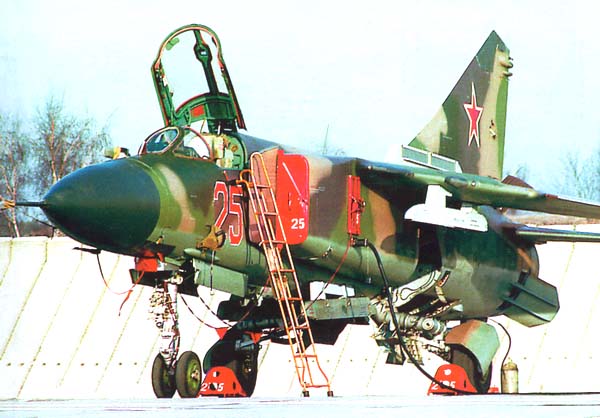
MiG-23MLDI calculated the inst. rate for the first ~5 seconds. I know that such data is variable with speed/altitude/weight/external loads/engine settings. Anyways, you are welcome if you have anything better or more precise.
The data is at hand, why don’t enlighten me?I am pretty confident on this specific issue.
here we go your expertise against Russian expertise
При ведении воздушного боя с F-4E на скоростях 800-1100 км/ч на малых и средних высотах при перегрузках, близких к предельным по тяге, МиГ-23М в горизонтальном маневре превосходил противника, уступая ему в вертикальном маневре. Превосходство МиГ-23М над F-4Е (самым массовым самолетом израильских ВВС), косвенно подтверждает и тот факт, что со второй половины 1970-х годов, с момента появления МиГ-23 на Ближнем Востоке, ВВС Израиля перестали использовать “Фантомы” для ведения воздушных боев.
When conducting aerial battle with F-4E at speeds of 800-1100 km / h at low and medium altitudes, with overload at max thrust, the MiG-23M surpassed the F-4 on the horizontally maneuver (turn rate and turn radius ) , however the F-4 surpassed the MiG-23 in a vertical maneuver ( vertical turning). The superiority of the MiG-23M over the F-4 E is (the most numerous Israeli Air Force plane), indirectly confirmed by the fact that by the second half of the 1970s, since the advent MiG-23 in the Middle East, the Israeli air force had ceased to use the “Phantom” for air combat.
source http://www.airwar.ru/enc/fighter/mig23m.html
One important aspect that can solve this issue is basicly turn radius i do know what are the turn radius of the MiG-23ML at given altitudes
MiG-23MLDExcuse me huh? I relate about trying to IFF something on the back when your IFF equipment is facing the front.
There is here the most important aspect of your fantasies, you think the Rafael engineers did not think about self attrition and of course the PL-9 is a smart missile that won`t kill J-10s.
The Helmet Mounted Sight (HMS) is the first thing that indicates to the missile where to direct its head seeker, since the Python seeker has a wider range of view it can scan and survey 220 degrees, or +110 and – 110, however if it wants to go beyond that it needs a databus system that indicates the target position with respect the Python carrier, full LOAL capability is only available to aircraft with a MIL-STD 1553B databus to transfer IMU alignment to the missile, using cues from the aircraft radar, a helmet-mounted sight, or off-board targeting data, the Python 5 can thus undertake engagements in a 360º radius around the launch aircraft. The IMU is also sensitive enough to adjust to the wing-twist effect suffered by the wingtip launchers on the F-16 and to align the missile for an optimum angle of attack on launch, in that the HMS still is used as several other sensors include off board ones , so it is not only one system but several.
The AIM-132 is the same in the Panavia Tornado that databus is absent so the Panavia Tornado of the RAF only can engage targets in a 180 degrees engagement angle .
This is not the same in the RAF Typhoon or in the Australian F-18s which can engage rear aproaching targets
The Russians also use the RWR to direct rear firing R-72 missiles as well rear looking radars.
MiG-23MLDFor other people’s benefit: I have quoted sustained turn rate of F-4F, while the values of the MiG-23ML show instantaneous. I could show that the MiG-23ML has 1-2G less sustained load factor by using the aerodynamic and thrust data from the given document, maybe I do it later (I refrain from investing time to get in prolonged foolish arguments with ignorant users).
humility and modesty are self evident, it is better to be humble and not have pride, if you know better show it i have the full Manual even the MiG-23U manual if you really show me i can acknowledge my mistakes like i did, however be humble that is the first sign of being right, pride and name calling or self proclaimed expertise show a lack of real knowledge.
if you debate people show proof i am not so stubborn to acknowledge my mistakes but while you prove the F-4 has more than 10 deg/s and turns in less time refrain to call your self the expert, the real experts never call them selves experts humillity is sign of greatness, pride is only a sign of lack of confidence.


 Sign In







