JoeB
JoeBDon’t forget the “other” side! The story of a Chinese Yak-9 downing a USAF F-80C in July 1950.
That one is certainly mentioned a lot less often, but it’s right there in USAF records: July 19, 1950, 8th FBG F-80’s claimed 3 Yak-9’s, but one F-80 was damaged, then destroyed and the pilot, Capt Howard E Odell, killed attempting to land at a fwd airstrip.
One quibble is that the opponents were North Korean not Chinese. No fighter opposition before Nov 1 1950 has been shown to have been other than NK. And in this case it’s known that two NK pilots, Kim Hi Gyung and Tae Guk Sung, were downed this day in a combat with F-80’s. Both of them survived though, and claimed 3 F-80’s each, according to No Gum Suk (the 1953 MiG defector). Strangely, NK propaganda accounts AFAIK do not mention this combat. They do mention most others in the same period, in distorted but recognizable form.
OTOH, straightwing (more or less, the Me 262) jet downed by prop was pretty common in WWII, this was just the first *US* jet downed in air combat.
Joe
JoeBThat would be ‘Furies and Fireflies Over Korea’ one of the most error ridden misleading, poorly written and disapointing books that I have read,
I try to keep as complete library as possible on Korean air war books so I bought it, even though it apparently mainly duplicated the topic of the already thorough “With the Carriers in Korea” by John RP Landsdown. I haven’t read all of Thomas, but from what I have read I agree it’s not as good as Landsdowne. A lot of the FAA operations in Korea were pretty repetitive and not terribly exciting, and if one is not strongly interested Landsdowne might be somewhat of a slog to get through, but I am interested and recommend the Landsdowne book over Thomas for anyone else who is.
Re: B-29’s in Korea see post above, they probably actually downed 3 or 4 MiG’s v 27 credited, a repeat of the WWII phenomenon of highly overstated bombers claims. UN fighter claims in Korea were OTOH pretty accurate, though of course don’t perfectly correlate to available accounts from the other side. So only Sea Fury, F4U and B-29 were credited with MiG’s in Korea among props. Victories can be confirmed in Communist accounts for the latter two types; no specific account from the MiG side of the Sea Fury claim has surfaced AFAIK.
Joe
JoeBHere’s an alleged photo of an F-86 in Soviet hands.
Here’s the photo of the plane the Soviets captured as they found it

F-86A-5 49-1319, ie FU-319, did in fact belly in on a mudflat off the NK coast the same day the Soviets said they found it, October 6, 1951. The pilot, Bill Garrett, was rescued but plane not fully destroyed. We only have to accept that the Soviets were able to return this plane to flying condition, which seems plausible. Although, I guess it doesn’t have to be the same plane as in the other photo.
Interestingly, James Jabara was flying this a/c when he reached 5 credited victories the previous May 20, first ‘jet ace’; in the West, since by further coincidence Fedor Shebanov claimed his 5th victory in the same combat (though not all 5 of either man’s claims to that date can be verified in opposing records).
Joe
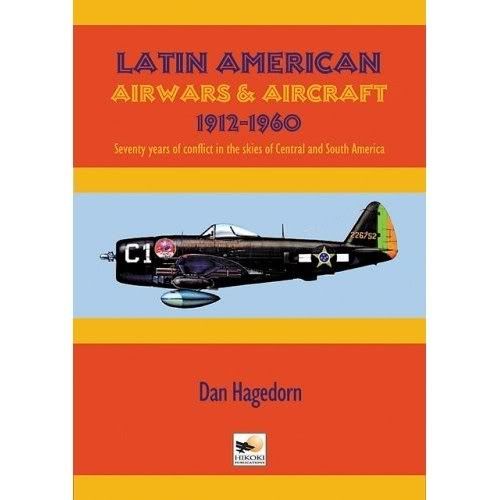
JoeBLatin American Air Wars is out! by Dan Hagedorn c. 2006.
p.s For those of you with deep interest in aviation across the pond/ South of the Border during the last 70 years this is the book! Dan at his best. Available in E-bay, Borders & Barnes & Nobles book stores.
What is the difference between that book and the similarly titled:
Image is a little small, same title except ‘1912-1969’, same author; anybody know? I just ordered the second one. I have his “Aircraft of the Chaco War”, an excellent book on an unusual topic.
Joe
JoeBWell. something is out of place………maybe the F-51 kills was a likely probable or at least at first?
I don’t think that article can be treated as historical fact wrt to that claim, for the reasons stated in first two paragraphs of the last post. I don’t think there’s much more to say about that article.
The F-51 prob/dam credits I referred to were in other incidents, not that one.
Joe
JoeBbrief overview.
That article turned into an embarassment for Airman. There’s no exact date given, but no evidence in reports for that period of any claim made at the time by that pilot (though he was a member of 18th FBW at the time), let alone officially recognized. The well known semi-official USAF author Robert Dorr wrote a highly critical letter to Airman about printing that article without more checking.
Separately, the only Soviet account in the period of engagement with prop fighters had them claiming several F-51’s (actually downing one) without loss.
Officially recognized prop *fighter* claims of MiG-15’s in Korea: just the Sea Fury one, and Jesse Folmar VMA-312, Sept 10, 1952. He was credited with a MiG, then his F4U-4B was downed by another shortly after, though he survived. That MiG loss is confirmed in a specific Communist account. See my post above, the Sea Fury claim is not confirmed in a known (so far) specific account from the other side, but appears very possible given the 2 losses suffered by Chinese MiG’s on fighter bomber hunting in that general period.
F-51’s got some official ‘damaged’ and ‘probable’ credits against MiG-15’s, but most can be found in Soviet accounts as to have been v their a/c, and they reported no losses in any of them.
Among all prop planes, B-29’s were official credited with 27 MiG-15’s destroyed in the Korean War. Study of those incidents from the other side shows the attackers to have been Soviet, and probably solely Soviet, in all but one case, and that 3 or 4 MiG’s were apparently actually destroyed; 1 of which was Chinese, with 2 of the Soviet ones in incidents *not* credited as victories at the time. As in WWII bomber claiming was much less accurate than fighter claiming. MiG losses to UN fighters were roughly 3/4 of what was credited as ‘destroyed’, but not counting ‘probable’ or ‘damaged’ at all.
Back to main topic, is there some article saying the Carmichael never fired on that mission? Can anyone just lay it out directly, and tell me the magazine and date, please?
Joe
JoeBProbably best not to go there……. 🙁
Sorry, no idea what you’re talking about, honestly. I search “Korea” on this forum time to time, as it’s a special interest of mine and have been doing for a while but missed any previous thread covering it. So my comments and questions are completely innocent:
Comment for the original poster:
The most detailed account in a book AFAIK is “With the Carriers in Korea” by John RP Landsdown, p 273-6, which excerpts directly from 802 Sdn’s diary. The account in Thompson, “Furies and Fireflies over Korea” is less detailed. There were also other encounters that day, including one where a Sea Fury was hit by a MiG and forced to belly in on Cho Island. For the first encounter, Landsdown says “although the diary suggests that all four members…claimed a share..from a confused situation Carmichael as flight leader got the credit”.
General comment: The diary says one a/c, obviously not a Sea Fury, was believed to have been seen crashing into a hill, but at least two other MiG’s were claimed hit, and at least one other was claimed hit in a later encounters. AFAIK no one has identified the MiG unit(s) involved or their actual loss(es). Even with the opposing account I doubt we could say
absolutely who shot what down.
The MiG’s were probably PLAAF. Zhao in “Red Wings over the Yalu” pg 190 notes “…the PLAAF sent flights of 4-8 planes under cloud cover to Chinampo [where the encounter occurred] and Sariwon…for four months, between July and October [1952] the MiG-15’s superior characteristics allowed the Chinese pilots to overwhelm USAF fighter bombers and conventional navy planes…the Chinese lost only 2 MiG’s while claiming 30 enemy planes…” he footnotes official sources. 30 is a large overclaim based on any UN fighter bomber air combat losses in that period, but there was in fact a rash of MiG attacks along the west coast in the same period, resulting in the loss of 2 Fireflies, a Sea Fury and a Corsair to MiG’s, not clear whether any jet FB’s were downed in this particular operation though. The 2 MiG losses potentially confirm the FAA claim, though we’d need more detail I think. There are also Chinese language accounts in detail of other encounters with Corsairs in this period where they claimed some, but not this encounter AFAIK.
The MiG’s were almost surely not Soviet AF. Their operations are known in day to day detail, and Soviet sources also state the west coast fighter bomber hunting was a “Chinese-Korean Joint Air Command” operation. The NK defector No Gum-Suk said his unit was involved in another one of the 1952 MiG-prop encounters, again v USMC Corsairs.
Question: what is the ‘other magazine’ with an article on this, and which issue, please? Does it have further info on the MiG side of the engagement?
Joe
JoeBWas this on 26th July 1943?
Combat between Fw200 and US B-24.
Both lost when they shot each other down.
Do you know the B-24 unit, and source?
I haven’t heard of one on that date, but there were several B-24 v Fw 200 combats. The USAAF 480th Antisubmarine Group based in Morocco in 1943 had their first encounter with a pair of Fw 200’s August 17 ’43 of which they claimed one while the B-24 ditched. They claimed 4 more just that month, per Morison. This would likely be the unit covering a convoy from Gibraltar to Sierra Leone as in the recollection of the Hurricane MSFU pilot Stewart in July.
The USN took over all ASW a/c ops from the USAAF during 1943. A VB-103 PB4Y-1 (basically a B-24) engaged an Fw 200 June 6 1944, inconclusively.
Combats like that in the Pacific were not rare at all. This list of all USN patrol plane aerial claims in WWII has many multiengine Japanese a/c, and in many of the later engagements with floatplanes the patrol plane was the aggressor. Especially for the more heavily armed PB4Y-2 (single tail, Privateer) late in the war, going after enemy recon and patrol planes was a normal part of the mission. Note too a VB-110 PB4Y claimed an He-177 December 28, ’43, confirmed in German accounts.
http://www.history.navy.mil/avh-vol2/Appen4.pdf
Joe
JoeBI just finished re-reading ‘Samurai’ a couple weeks ago. An interesting read.
From Sakai’s account during early August of 1942…He states he did give chase and shot it down (his 60th kill) the gunner being killed in the aircraft and the pilot taking to the silk.
That SBD was piloted by Lt. Dudley H. Adams of VS-71; he did indeed bailout and survive, but his gunner, AR3C Harry E. Elliot was killed. It was August 7, 1942, first air battles over Guadalcanal: US carrier air groups escorting the invasion force, v Sakai’s Tainan Air Group flying out of Rabaul.
Note that in “Samurai” immediately after that, it says Sakai attacked planes he thought were fighters from behind, but they were Avengers and he was wounded in the head by one of the tunnel gunners. In fact those were also SBD’s, probably the mixed formation of VB-6 and VS-5 which claimed a Zero of two (Sakai and his wingman per his later account) that attacked them from behind, no Avengers made any claim.
Source here is Sakaida, “Winged Samurai” which analyzed and revisited incidents in “Samurai”, with Sakai’s cooperation, to fill in information from the Allied side, as well as address certain details in “Samurai” that seem to have been embellishments by the real author, Martin Caidin. Caidin didn’t speak Japanese, and apparently never dealt with Sakai in person, but via notes of translated answers to written questions.
Joe
JoeBOn the second day of the Battle of the Coral Sea, Vejtasa was leading 4 of the 8 Douglas SBDs assigned anti-torpedo patrol duty. … He downed three Zeros that day; but when the dogfight was over, only half of the SBDs returned to the USS Yorktown.
As posted above, the 4 SBD’s were downed, but the 4 Zeroes (3 by Vejtas and one other) were not. The Zeroes were from Zuikaku’s fighter squadron, 6 of them, and they suffered no loss, per Lundstrom in “First Team”. He pretty minutely reconstructed the air combats in the ’42 carrier battles using both sides’ records; that’s 20+ years ago, not refuted by anyone else, but still the one sided claims are repeated.
However in some of the later 1942 engagements of Zeroes against unescorted SBD’s the SBD’s did seem to be more survivable than some other attack types v the Zero, or than other excellent dive bomber types against fighters they faced (Ju-87, Japanese Type 99 etc).
For example Hornet SBD’s strike on Shokaku at Santa Cruz in October 1942: the 15 SBD’s were attacked, unescorted, by 11 Zeroes of the CAP, fought them off shooting down two Zeroes (confirmed in Japanese records), losing 2 SBD’s, then hit Shokaku with several bombs. And in that battle too several lone [or pairs of] scouting SBD’s were intercepted by multiple Zeroes and survived, in some cases claiming Zeroes, though none of those claims correspond to real Zero losses. Still small numbers of other attack types were total cold turkey when caught by Zeroes. The SBD seemed more survivable than some contemporary attack a/c, though agreed: it was no fighter.
Joe
JoeBUsing scout bomber type a/c as anti-torpedo plane CAP was a leftover prewar tactic in the USN. It assumed the torpedo bombers would be going a lot slower than the SB could, especially in order to drop its torpedo without breaking it. The USN only used the tactic once in combat, in the first carrier battle at Coral Sea in May 1942. The actual outcome was disastrous, with the enemy B5N’s (Type 97 Carrier Attack Plane, ‘Kate’) getting past the SBD’s untouched, since they were almost as fast and didn’t need to slow down to avoid breaking their torpedoes, then several SBD’s were lost to the escorting A6M’s (Zeroes). That failure was somewhat mitigated at the time by claims of the SBD’s to have downed some Zeroes, including 3 by just one SBD crew, but those claims don’t check out in Japanese records (although the were only recently reenacted again, with computer graphics, on the History Channel “Dogfights” TV series; although to be fair that show has no monopoly on repeating overclaims years after they’ve been shown to be overclaims, it’s part and parcel of popular “air war history” worldwide, sorry to say).
In any case the SBD anti-torpedo CAP tactic was never repeated after Coral Sea. SBD’s claimed some Zeroes when intercepted by them on scouting and bombing missions; and a few of those claims correspond to real Japanese losses. One famous real victory, or sorts, by SBD’s was wounding the leading Japanese Navy ace Saburo Sakai, in the first air combat over Guadalcanal in August 1942. His ghost written English language autobiography said Avengers hit him, but it’s not certain he ever really said that, and in any case it’s obvious from recontructing the combat that it was a formation of SBD’s. One rear gunner was credited with a Zero destroyed, though Sakai miraculously made it back to base with a head wound.
Joe
JoeBI agree long range of Japanese a/c, especially the shocking (to the Allies) reach of landbased A6M’s early in the war, was mainly a matter of the relative weighting of design characteristics with approx the same technologies used in the West. Nothing was particularly revolutionary technically about the planes or technology in them, although the West had assumed it would be inferior and it wasn’t. Also the sort of long range flying techniques experimentation and training done in the USAAF in mid war, as mentioned for P-38’s, was done in the Japanese Naval Air Force *before* the war.
Before the Pacific War that is. One big institutional impetus toward long range design requirements and training in the JNAF was their experience in China. They, rather than the Japanese Army, had the main force of “heavy” (would later be considered mediums by WWII stds, Type 96 Land Attack Plane, ‘Nell’) bombers. They did well when escorted by their own fighters, which could dominate the intercepting Chinese (sometimes Soviet piloted) fighter opposition in general. But when unescorted raids were tried early on, or when the key Chinese political/strategic targets were withdrawn into the hinterlands outside the range of Japanese fighters from coastal Chinese airfields, those ops often proved costly. Drop tanks on their A5M’s (Type 96 Fighter, ‘Claude’ in WWII) were a partial solution, but even a small number of A6M1’s sent there for operational evaluation, in 1940, turned the whole situation around (in raids against Chongqing where the Nationalists had move their capital). IOW the Japanese Navy had already gone through some of the lessons the USAAF learned in Europe and Pacific about the key value of long range fighters in supporting bomber operations, prior to 1941.
Joe
JoeBOsprey… Maybe they are better on US aircraft though.
Maybe, but it’s a Brit publishing co. so I don’t know why that would be.
Across the whole spectrum, Osprey a/c books or military books in general, they vary in quality a lot, because they are written by a lot of different people (though some authors have written many). The production quality seems pretty standardized, the research approach less so.
Two random examples. I recently read “USN PBY Catalina Units of the Atlantic Theater” (don’t hold me to exact title). Really excellent research, the author had found just about every PBY action in German records. Even for attacks on U-boats not even claimed to be successful, he tells you which boat was the target. Photo’s, data, drawings all to the usual standard, just a very good book, despite the limiting format (size, no footnotes, etc).
The list above includes “P-39 Aces”. This is more generic, just presents the claims of P-39 aces and units not what really happened. It’s a little out of the ordinary in presenting details of Russian claims (the author is a Russian speaker, published Russian language works seem to be his sources). But that’s not *so* unusual anymore; what I want to see is what Soviet P-39’s *actually* achieved, not what they claimed. There can be a big, and unpredictable, difference between those two things. And same for US P-39 units, though in that case I could get check out the real Japanese losses in other books, at least in some cases. Again good photo’s and art, but info in the book basically the traditional generic one sided accout from that plane (or units flying it) POV. Just OK overall IMO.
Joe
JoeBSince Ethell and Price’s book was published in 1985 ,other authors have queried their figures. I would refer you to “The Royal Navy and the Falklands War” by David Brown which was published in 1987.
Besides Ethell/Price, Burden et al “Falklands the Air War” goes into minute detail of both sides’ a/c involved in the conflict. There’s a short history of each plane by type and serial number not limited to those lost. The losses of the Argentines aren’t really in much doubt, just the causes in a few cases as has been mentioned. And in the one case of nominal doubt between combat and operational loss, two A-4C’s May 9, there doesn’t seem much reason to question operational loss. Casco’s plane was found, by the RN, still with its bombs, having impacted the northwest side of South Jason Island well away from Coventry’s target that day; Farias was flying with him though his plane wasn’t ever found. It’s not an “Argentine counterclaim” that they crashed in poor visibility, they just failed to return from the Argentine POV. It just seems the likeliest explanation of their loss.
Brown on the other hand simply quotes RN claims and in a few places phrases unconfirmed kills as ones the Argentines “haven’t admitted”. I think that’s a regrettable practice by military historians generally, to quote one side’s claims and say the other side “doesn’t’ admit” them, without any evidence presented besides the claims themselves. We all know that good faith claims are usually overstated, though less so by the Brits in the Falklands than most other cases. That book is not an update or further scholarship on the particular issue of Argentine a/c losses. It’s a good book overall, a quasi-official RN history of the war basically, but with a bit of the slant you sometimes find in official histories.
Joe
JoeBD’you recall which museum? There’s only a couple, and I’m interested.
The poster said an aircraft museum at Melbourne airport. Googling for that I suppose he might meant the Moorabbin Air Museum near Melbourne, which has a Beaufighter. Their web pages don’t give any info however but generic statement the Japanese “called it the Whispering Death”. And come to think of it, the poster on that Japanese forum might have just been translating “Whispering Death” as best he could to Japanese as “囁く死” for the benefit of others on that forum, rather than saying the Aussie museum gave that as the Japanese version of the nickname. Anyway here’s both pages.
http://www.warbirds.jp/ansq/11/A2001891.html
http://www.aarg.com.au/beaufighter.htm
Joe


 Sign In