 BlackArcher
On that note.. how does the upgraded An-32 look like in the cockpit?
Can’t find any clear images of the upgraded cockpit but the old one looked like this
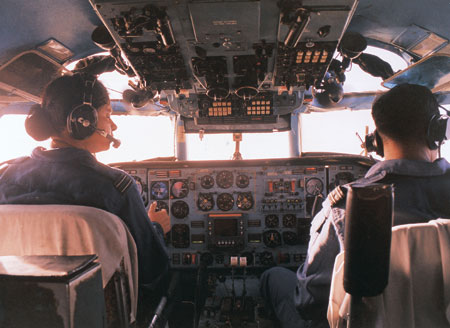

New one still has many dials and gauges

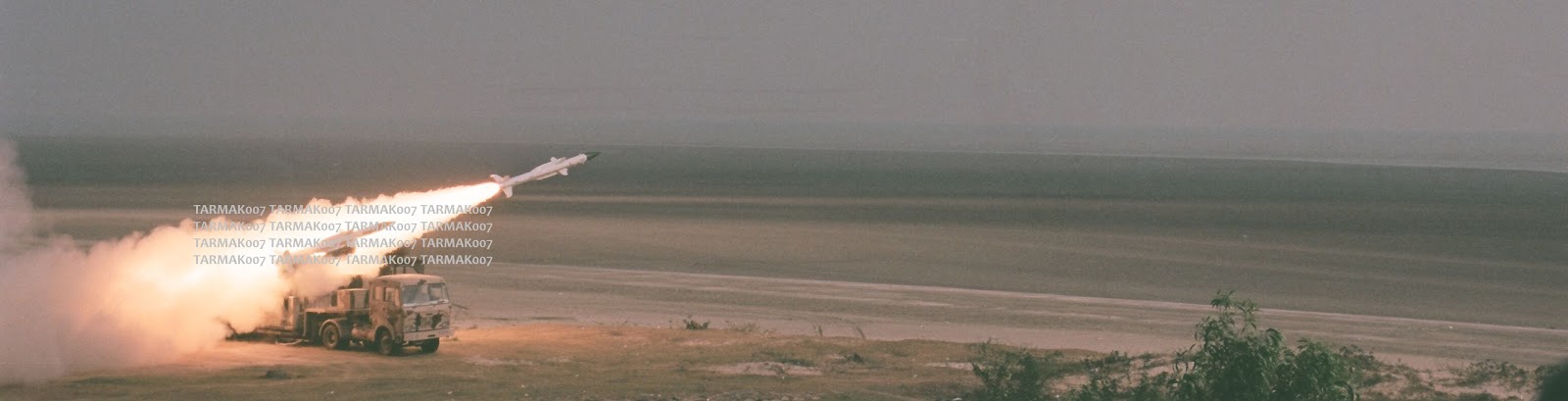
BlackArcherSome great pics of the Akash SAM…
2500 missiles, 112 launchers, 28 MPARS and 100 3-D CARS for massive Akash order


BlackArcherThey are probably more keen to integrate a F&F missile like PARS with Rudra then a laser guided hellfire.
The AGM-114L is a fire and forget missile that uses a millimeter wave radar seeker coupled with inertial guidance.
Missile (AGM-114L)
Range 0.5 – 8 km
Guidance Millimeter wave
Compatability Launch from multiple
platforms
Commonality Bus and warhead with
HELLFIRE II
Weight 108 lb (49 kg)
Length 69 in (176 cm)
Diameter 7 in (17.8 cm)
BlackArcherAre you sure? Maybe the pilots prefer the old “steam gauges” on the older aircraft? After all, it’s what they learned to fly on…
yes, it must be so much more difficult with digital instruments..:rolleyes:
BlackArcherAre these for the Air display teams as it was mentioned tagging on additional aircraft to re-equip the Air Display team ?
These are the ones for the Surya Kiran aerial display team.
BlackArcherThey’d get much the same from any reasonably modern aircraft.
This is a C-295 cockpit
did you read what I wrote before jumping to show the C-295’s cockpit? the IAF An-32 and Il-76 crews’ dream cockpit. I didn’t say that it was something never seen before.
BlackArcher😎
wow..were these “silly loads” meant to be used for promos to sell the J-10? 😉
BlackArcherHELINA ATGM fired from the Rudra gunship.
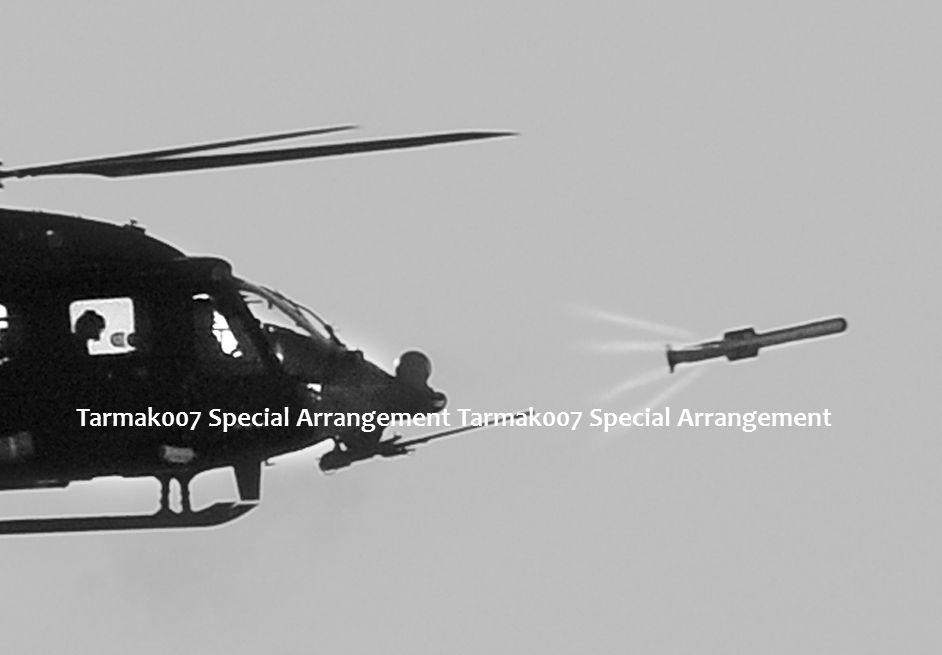
HELINA ready for full range ground trials
Bangalore/Hyderabad: Helina, the helicopter version of anti-tank guided missile (ATGM) Nag, being developed indigenously for Rudra – the Advanced Light Helicopter’s Weapon System Integration version (ALH-WSI) — will undergo full range trials next month. During this lock-on-after-launch (LOAL) mode trials, to be conducted from a ground-based launcher, Helina’s capability to establish full range in excess of 7 km will be tested. (In the LOAL mode, the gunner can correct the course of the missile mid-way after it is fired, update the target position and lock on to it through a two-way RF data link.)Around 60 scientists, including 12 directly associated with the project, are gearing up at various critical labs of the Missile Complex in Hyderabad for this crucial ground trials, to to be held at the Chandan firing ranges in Pokhran.
Sources claim that this could be the last trials for the air-to-ground missile Helina from a ground launcher. “We will have guided flight tests from Rudra against a tank-size later. Integration of the Helina’s Fire Control System (FCS) on Rudra is planned during the second half of 2012,” sources said.
Helina has been taken up as a fast-track mission mode project by Defence Research and Development Laboratory (DRDL) to extend the range of Nag from 4 km to in excess of 7 km.The Rs 55-crore project started in 2008 April, will initially help Army Aviation form one Squadron of Rudra choppers with Helinas in LOAL configuration. So far two missiles have been fired from ground launchers over a range of 4.2 km (K K Ranges in Ahmednagar, near Pune). At Pokhran, one Helina was fired from the out-board weapon station location on Rudra for the first time. The chopper was hovering at an altitude of approximately 25-meter above ground.
A stand-alone FC for Helina has been developed by Research Centre Imarat (RCI), Hyderabad and proven during the ground firing. The two-way data link has also been developed for the first time by RCI in association with Astra Microwave, Hyderabad.
Hindustan Aeronautics Ltd (HAL) sources told Express that, they as the system and other armaments integrators for Rudra, are part of a Ministry of Defence-appointed team, which is currently evaluating MBDA’s PARS 3 missile and Rafael’s Spike. “The team has visited the Rafael facility and witnessed the trials. They will now head for MBDA installation. The final call will be taken by the Defence Procurement Board, based on the team’s recommendations,” sources said.
HAL says that the pilots’ report of Helina’s Rudra trials have been sent to DRDL. “These are crucial inputs that will help the DRDL to fine-tune the missile. Services want proven platforms first and hence PARS 3 and Spike were short-listed. Helina will continue as an alternate and parallel ATGM programme as we are very keen to have an indigenous missile onboard,” HAL sources said.
If they wanted “proven and tested” missiles first, then they should’ve gone for Hellfires, not PARS 3 or Spike..what have these missiles proven in combat?
BlackArcherC-130J cockpit. For IAF’s An-32 and Il-76 pilots, this must be a true dream.

BlackArcherSo all, or the majority of Eurofighter are two seat like Block two Rhinos?
Who said that all Block II Super Hornets are twin seaters ?
BlackArcherMBDA offers the Mistral for the VSHORAD (Very Short Range Air Defense) systems..y the order is worth $5.4 billion and the RBS-70 is competing with it.
The French defense company, MBDA, is offering its Mistral system for the INR 27,000 crore (USD 5.4 billion) Indian tender for Very Short Range Air Defense (VSHORAD) systems. The company’s Corporate Marketing Director, Daniel Petit, spoke to StratPost about their proposal for the tender for over 800 launchers and 5,000 missiles.
Designed from inception for tri-service requirements, Petit says the system on offer is the second generation Mistral, developed in the last decade. The system has already been selected for India’s Dhruv Advanced Light Helicopters (ALH), something which could be an advantage for the company, in terms of logistics and ordinance management. “It means same logistic, same training – it’s a key advantage,” he points out, saying, “The Indian armed forces have selected already the system for the helicopter (Advanced Light Helicopter – Dhruv). Mistral is going to be – again the same missile. I’m talking about ATAM – it’s the Air-To-Air-Mistral.”
A company statement says, ‘With Mistral having already won a competition to arm India’s ALH Dhruv helicopters, MBDA has also been keen to propose all the advantages that the missile offers as a ground-based air defense weapon’, calling the ‘supply logistics’, ‘service and maintenance benefits’ of a ‘multiple use missile’ to be ‘an added advantage’. The statement cites MBDA’s representative in India, Loïc Piedevache, as saying, “This could of course be a single Mistral production line in India for both the Dhruv and for the surface to air requirement should it be selected.”
Imagining a scenario of a combat aircraft threat, Petit says, “With this system you have the possibility to activate, lock on a target and in less than a few seconds you are able to press the button and the missile will do the job.”
“When I said the missile will do the job it means the gunner doesn’t have to aim the system on the target,” he emphasizes, saying, “The missile is able to engage the target immediately.”Petit says that they’ve reached a success rate of ‘close to 98 percent’ after having ‘fired more than 6,000 missiles’. “By success rate, it is the number of targets destroyed – not technical (hits), I’m talking about target destruction – 98 percent,” he says.
Petit thinks the heat-seeking capability of the Mistral gives it advantages over other types of systems, like beam riders, upon which Saab’s RBS-70 offering is based. He says it might be difficult to engage small boats in rough seas with such a system. “Sometimes it is very difficult to aim or to lock on with a laser beam on the target. You can’t see it anymore,” he says.
He takes another example. “You engage a helicopter which is maneuvering at very low, close to the earth. Generally, the new generation of combat helicopter using pop-up maneuver to engage and fire anti-tank missile – to give an example – with this system you have time to lock on and engage the helicopter – you launch the missile. The flight format of this (Mistral) weapon system is not ballistic but the missile is making a maneuver like this,” he says, swinging his hand in a swaying motion, then adds, “The missile will continue to seek the target even if the helicopter is going down below a tree or below a hill – if you’re using beam-riding, you’re losing targets.”
The Mistral is a fire and forget, heat-seeking missile fitted with a ‘very heavy warhead’ weighing three kilograms, which Petit says is ‘quite heavy for this category of missile’. “At the same time it is fitted with impact and proximity fuse allowing the missile to be used against any type of target,” he says, explaining that the fuse allows the system to be used ‘against very low altitude, low flying targets’ and covers ‘all the spectrum for low altitude engagement against any air threat, including helicopter, combat aircraft, low flying cruise missiles, drones or bombs with engines’. The Mistral travels at a speed of Mach 2.5 and has a range beyond the Indian requirement of six kilometers.
MBDA says that the passive Infra Red seeker makes Mistral very hard to detect by the intended target and emphasizes that the fire-and-forget feature is vital ‘when more than one in-coming target has to be confronted’.
He says the Mistral can engage more than one target. “When having different firing posts, all the firing posts can be linked to the command post.” MBDA says it can also provide a mobile Mistral coordination post, MCP/IMCP to enable day and night coordination and monitoring of up to 12 various Mistral missile equipped ground based air defense units.
The company says the missile weighs 18.7kgs and its MANPADS system is easily portable by two operators, one carrying the missile and the other the firing unit. It also comes with an optional IFF (Identification, Friend or Foe) interrogator, which ‘operates while the target is being tracked’.
BlackArcherIAF grounds Sukhois till precautionary checks are over.
NEW DELHI/PUNE: A frontline Sukhoi-30MKI crashed near Pune on Tuesday afternoon soon after taking off from the Lohegaon airbase, forcing IAF to temporarily suspend flying of the country’s most potent and advanced fighters till “precautionary checks” are carried out.
Fortunately, the two pilots Wing Commander G S Sohal and Flight Lieutenant U Nautiyal managed to eject safely before the “air-superiority” twin-engine fighter went down in an open field at around 1.10 pm.
The pilots ensured the crashing jet would not cause casualties on the ground, said Lohegaon airbase chief, Air Commodore V R Chaudhari.
Added another senior officer, “The Sukhois have not been grounded…But yes, they will undergo some systematic technical checks now before they take to the skies again. The multi-role fighters have had a great safety track-record.”
..Though IAF ordered a court of inquiry to ascertain the exact reason behind Tuesday’s crash, what accentuated concerns is that preliminary reports held the mishap was due to “technical problems”, possibly due to the failure of “fly-by-wire (FBW) control system”.
“There was no engine failure or `flame-out’. It seems the pilots lost the controls of the fighter, leaving them with no option but to undertake planned ejection,” said an officer.
The main reason behind one of the two earlier Sukhoi crashes in 2009 was attributed to the FBW system (the other was due to “a fuel leak”), which led to summoning of Russian engineers to probe the crash and the entire Sukhoi fleet being grounded for three weeks.
Later, it emerged that one of the pilots had accidentally switched off the FBW system, located behind him in the cockpit, while trying to change the radar mode from one frequency to another.
“It was a combination of pilot error and a design flaw in the FBW system master-switch. Since then, all Sukhois have been modified to add a safety guard to prevent the accidental switching off of the FBW system,” he said.
The suspicion is again on the FBW system now. If the technical defect is major in terms of system malfunction or design problem, Russian engineers might once again be called to assist HAL and IAF in probing the crash. IAF itself is keen to clear the air soon, with plans already underway to base Sukhoi squadrons in Halwara (Punjab) and Jodhpur (Rajasthan) for the western front.
This backs up Kramer’s post on how it may be detrimental to have just 1 fighter as the mainstay of an Air Force. Any such technical issue can ground the fleet (as happened in the past with the Su-30MKI fleet) till the issue is resolved and may have dangerous consequences.
BlackArchermmW seeker successfully flight-tested on Nag missile
In a breakthrough in indigenous seeker technology for missiles, an RF (radio frequency) seeker was successfully flight-tested in anti-tank Nag missile in the Army ranges at Ahmednagar in Rajasthan on Sunday.
While the scientists of the Defence Research and Development Organisation had so far developed Imaging Infra-red (IIR) seeker, this was the first time that a millimetric Wave (mmW) seeker, having all-weather capability, was tried for a 2,000 metre range in a successful mission.
Chief Controller R& D, (Missiles and Strategic Systems), DRDO, Avinash Chander, told The Hindu: “this is a breakthrough for seeker capability in the country.” This would provide solutions for applications in surface-to-air missiles, air-to-air missiles, anti-tank missiles and air-to-surface missiles. It would also provide the technology base for changing to dual-mode seeker in future.
The mmW seeker was designed and developed by scientists at Research Centre Imarat (RCI), one of the key laboratories of the DRDO’s missile complex here.
..Nag Project Director S. S. Mishra said that in Sunday’s flight, the seeker’s capability to track the target in a ‘Lock-on-Before-Launch’ method, right from the missile’s firing and throughout the trajectory, was successfully demonstrated. In future, the seeker would be used in a system in ‘Lock-on-After-Launch’ mode for extension of the range.
..
The production of the third generation hit-to-kill Nag missile is expected to commence after the final user trials with deliverable version of missile carrier NAMICA are conducted next summer. Modifications and improvements have been carried out in NAMICA as per the Army’s requirements.
BlackArcherVictor Komardin, deputy director of Russia’s arms export agency Rosoboronexport believes that the MRCA deal will be cancelled due to the extremely high cost associated with both the Rafale and Typhoon.
LANGKAWI, Malaysia — Victor Komardin, the deputy director of Russia’s arms export agency Rosoboronexport, contends that the two short-listed candidates for India’s Medium Multirole Combat Aircraft (MMRCA) competition have effectively ruled themselves out by putting too high a price on their fighters.
India’s politicians told the local press earlier this year that the MMRCA contract was a $10 billion deal, but reports from India in recent weeks say the manufacturers of the two finalist aircraft, the Eurofighter Typhoon and Dassault Rafale, are each asking for around $20 billion to fulfill the 126-aircraft order, Komardin says.
“Against the backdrop of the [financial] crisis [sweeping the world], it is hard to see how any government would allow such a waste of money, particularly when there are social problems” to deal with, Komardin says. “And there is no imminent threat to India’s [sovereignty]. My prediction is that this tender will be canceled.” Komardin spoke to Aviation Week on the sidelines of the LIMA Airshow in Langkawi, Malaysia.
India and Russia are close partners on defense. Rosoboronexport’s MiG-35 was on the long list for India’s MMRCA competition. Komardin says the MiG-35 was withdrawn from the competition before the short list was decided. If India issues a new tender, it creates an opportunity for Russia and the U.S. to rejoin the competition.
He calls it a waste of money. One can bet that wouldn’t be something he’d be saying if the MiG-35 was in the running..and the last claim, that the MiG-35 was “withdrawn” from the tender before the short list was decided sounds bogus considering what we’ve heard from MiG earlier about the IAF giving reasons as to why the MiG-35 wasn’t shortlisted.
And I don’t think that he needs to tell us whether or not India faces a threat to its sovereignty. One could use that logic to question why India has other deals going on with Russia. Why spend $1 billion on an Akula lease? Why spend $2-3 billion more for the Super-30 upgrades? Why spend $35 billion or thereabouts on the FGFA? The list is long..
BlackArcherFirst 2 IAF Mirage-2000s reach France for the upgrades.
The Indian air force (IAF) has dispatched two of its Mirage 2000 fighter aircraft to France as part of a long-awaited deal to upgrade around 50 of the aging supersonic fighters.
The modernization will cost an estimated $2.4 billion under an agreement signed between India, Thales and Dassault Aviation in July.
The two aircraft were flown from their home base in Gwalior in central India last week to France, where they will be fitted with advanced avionics, electronic warfare suites and weapon systems, an IAF official said Dec. 6. The first two combat aircraft will be upgraded at the French facilities and the remaining at the Hindustan Aeronautics Limited units in India’s southern city of Bengaluru.
Touted as one of the most significant defense deals between India and France, negotiations stretched on for five years as New Delhi, Dassault and Thales had difficulty arriving at a mutually agreeable price for the work. The proposal was finally cleared at a meeting of India’s Cabinet Committee on Security on July 13.
Among the upgrades planned the for Mirage-2000 are a night vision goggle-compatible glass cockpit, advanced navigational systems, an advanced Identification-Friend-or-Foe system, advanced multimode multilayered radar, fully integrated electronic warfare suite and advanced beyond-visual-range capability.
As per the agreement, the French firms also will modernize the navigation systems, mission computers, electronic warfare systems and radars, bringing the aircraft up to the standards of more advanced Mirage-2000-5s. The IAF inducted the Mirage-2000 between 1982 and 1986.


 Sign In








