 BlackArcher
If you just wait a minute and have a look at the price difference of the two aircraft in the Swiss competition the difference is quite considerable…
how much was it ? Can you post the open source info on what each bidder’s offers were?
BlackArcherOne more article on the MRCA tenders to be opened on Nov 4
…
The ministry completed the formalities last week and sent letters Monday to representatives of Eurofighter and Rafale for opening the bids on the afternoon of Friday, November 4. The representatives would authenticate the tender packets as their own and as submitted by them earlier, in the presence of senior ministry officials, and then they would be opened by one of the designated officers.
Each bid would have a Summary Sheet and the Best and Final Offer, or BAFO as it is called, and both the bids would be read out to the Rafale and Eurofighter representatives. The ministry officials present would represent the the acquistion, technical and defence finance departments.Although the ministry’s initial assessment was that the deal could be worth around $10 billion, the Rafale and Eurofighter should cost somewhere around $15 billion.
It is perhaps safe to assume that if the difference between the two bids is 15 per cent or more, then the lower bidder would ultimately be the winner. But if the difference is only marginal, or around four to five percent, then the associated costs on spares, tooling, maintenance and operating costs per hour in terms of fuel, manpower, maintenance and lifecycle would play a role in determining the winner.In any case, the initial costs, which include spares and support for the first two years, as well as the associated costs would be computed and only then would the winner be declared.
….
BlackArcheryeah, if you assume Eurofighter is willing to make no profit on that stuff, but Rafale would insist on making a profit in those areas… Rafale is just as capable of making no profit on that stuff as is Eurofighter. Of course, if they think they are so far ahead, they may think they can make a bit more profit, but there is no real difference to Eurofighter in that area.
including weapons in operating costs just seems a bit questionable to me…
beyond that either jet can use any weapon if integrated, and integration costs are just negligible when you look at 180-ish jets x 40 years… if you assume Rafale uses MICA in addition to Meteor, would you really count using MICA and re-equipping it when it´s lifetime expires OVER 40 YEARS TIME? That´s absurd, obviously a new (but currently unknown) WVR missile would be integrated at some point within 40 years… and that is true for both platforms. Further, MICA can suffice as BVR armament… of course, that´s silly when Meteor is available, but on a purely COST basis that should be viable… even though on an operational basis, IAF would never go that way (passing on Meteor).If you accept that IAF would use either platform in a a similar manner (that is the basic concept behind the competition), they would presumably use identical weapons regardless of the platform… In which case, the maximum cost difference should only be the cost of integration, since IAF should logically procure the same (cheapest for capacity) weapons REGARDLESS of which platform they choose… But unless IAF already knows what weapons it is going to use (I haven´t seen any sign of that being officially decided), they don´t even know what weapons set to base their appraisal of what integration each platform will need.
With all due respect, from what we’ve seen of Dassault, they’re the least likely of any company to reduce prices. They’ve even refused to participate in tenders if they believed that they didn’t stand a chance of making profit in the short run itself. EADS hasn’t been so picky. Remember, most OEMs make more through long term spares and maintenance support than they do with up front equipment sales. The Mirage upgrade saga was as much a result of their own stubborn insistence on sticking to a price line as it was about the Indian MoD’s desire to reduce the price. And even prior to that I’ve read reports about the IAF complaining about very cost spares for the Mirages.
EADS would IMO, be very aware of their higher upfront costs which would have to be offset by some other factors – say for instance lower warranty costs and lower royalties. Both these would make their overall offer more competitive and would also tempt the IAF to convert its options (63 more MRCAs) which in the long run guarantees a higher revenue source for a longer period through spares and upgrade fees. Small profit up front, but in the long run, a sound bet. Plus the benefit of the good PR that such a big sale would generate. Many customers who might be on the fence could be pulled in seeing a large MRCA order going to Typhoon.
India has the right to include weapon costs alongwith the overall costs of acquiring the MRCA. I mean, if the Typhoon is already integrated with cheaper weapons (say AMRAAM, ASRAAM) as compared to the Rafale with the MICA, and hence if the overall cost of buying a certain number of missiles and bombs is less then it should be taken into account..after all, the IAF has to pay for that. the MBDA offers were also done together with the EADS and Dassault offers, so they will have to be assessed together as well. The weapons offers from MBDA for both contenders should meet the IAF’s requirements and if it entails additional integration costs for a given fighter- for e.g. say MBDA offers the Brimstone for the Rafale as well then it would need to include the costs of integrating it with the Rafale unless they offer to do it free of cost.
You argue that they may be re-equipped with new weapons after 20 years, so costs of integration and purchase don’t make sense- I agree, but that is after 20 years of service. the cost of the weapons (already on offer from MBDA) that will equip the MRCA for the first 20 years of service obviously have to be accounted for to arrive at the cheapest contender. At this stage, the IAF will feel that both the jets will meet its requirements adequately. Whether a Storm Shadow or a Scalp is available to it will be less important than the costs associated with either one- the costlier one will be more difficult to order in large numbers.
BlackArcherJanes recently mentioned the costings will be assessed as the lowest bidder under the Verifiable Cost Model (CVM) – calculated over 40 years or 6000 hour service life. CVM is further broken down to:
1) Direct aircraft costs including spares and weapons
2) Two year warranty
3) Royalties for local manufacture
4) Technology transfer
5) Initial training costs
6) Operating expenses such as fuel, etc
Thanks ! that is quite clear in how the costs will be assessed..seems like on this basis, the Rafale has an edge in points 1 and 6 (others can correct me if Typhoon operating costs are lower)..but the Typhoon can pull it back on the warranty, royalties and ToT costs as well as Initial training costs, then it might well end up being the lower bidder !
Exciting times!
BlackArcherAs i heard even thou the lowest bidder wins, the bid can be too high (over budget) and therefore skrapped. right? or am i delirious?
You’re right. The IAF will benchmark the prices based on what it has available data for. So, what might be the first problem could be that the IAF’s benchmark prices could be lower than those that Dassault or EADS have offered for this competition. If that happens, then the lowest bidder will most likely win outright but before final price is settled, there will be hectic price negotiations. And when that is settled, then the file will go to the Ministry of Finance to be approved. If they reject it as being too high , then unless the CCS (Cabinet Committee on Security) intervenes, the entire process may be scrapped and retendered. Now that is something that the IAF will look to avoid at all costs, and hence their benchmark prices will surely be suitably tailored to avoid the MoF from raising objections.
Considering the scale of this deal and the limelight it has gathered, I doubt that the MoF will try to put a stick in the spokes and topple it entirely. But it isn’t entirely out of the question either. So SAAB can still have a small glimmer of hope that they will get reinvited and possibly be able to get the IAF to evaluate the Gripen NG with the ES-05A Raven radar once again, this time it being more mature.
BlackArcherif you had only posted the relevant section of my post that you were replying to then the confusion would’nt have occurred.
BlackArcherCost? Effectiveness? Limits put on by the USAdmin saying that if the Indians buy the 64D then they will need to buy the US weapons as well? Or it maybe that the 64D’s are part of a FMS package and were refurbishes so all that india is getting is being transfered from a us unit?
What are your concerns about the cost or effectiveness of the AH-64D Block III vs the Mi-28NE ? Come up with some concrete issues you have rather than just your regular generic whines. The onus lies on you to prove that the AH-64D Block III selection was erroneous (how you can do that without having any access to the evaluation reports is beyond me of course) and that the Mi-28NE offered a more capable, cost effective and mature platform which would’ve met all of the anti-armour needs of the IAF/IA.
There is a reason that India is buying 1350 odd Hellfire missiles and additional spares which are increasing the cost of the purchase- it means that they have a large enough inventory to be able to keep the Apaches operational even if there are hiccups with the US Govt. And to date, no operational constraints have been imposed on the IAF operating its American sourced equipment, unlike some other nations.
Regarding whether they’re remanufactured or brand new, all I can see from your end is baseless speculation- no proof that these are remanufactured AH-64D Block IIIs. Till I see a concrete source, I will assume that these are brand new AH-64D Block IIIs. Boeing will confirm it anyway.
but this source clearly states that except for 56 AH-64D Block III airframes, the rest 634 will all be new-builds. Where could they spare 22 (+ a possible 22 options) remanufactured AH-64Ds from such a small number of remanufactured ones that they themselves have? And Taiwan’s AH-64Ds are already entering production, so I can see absolutely no reason why the IAF would opt for anything but new-builds.
The US Army is programmed to receive a fleet of 690 AH-64 Block IIIs over the next 15 years, with all but 56 aircraft remanufactured from previous models. The remainder will be new-build aircraft to replace helicopters lost in combat operations over the last decade.
BlackArcherA wise decision considering the technical issues that the Mi-28N has been experiencing..But I thought that this was one tender where the Russian helicopter stood a very good chance of pulling it off..I seriously feel that the Eurocopter Fennec will win the light heli deal and the Chinook will be selected for the heavy helicopter requirement, thanks to the poor maintenance issues the Mi-26 has seen in IAF service.
the huge number of Hellfires being ordered makes me wonder as to why the Hellfire isn’t the weapon of choice for the ALH-Rudra and LCH as well? Why look to the PARS-3 instead?
BlackArcherBids to be most likely opened on November 4th
link to IndiaStrategic article
New Delhi. India will open the tenders for the world’s single biggest combat deal yet for 126 to 189 combat jets in the first week of November.
Reliable sources told India Strategic that most likely, the tender should be opened on November 4.
Representatives of the two finalists in the fray, French Rafale International and European consortium Cassidian Eurofighter would be invited and their own bids, submitted earlier, would be opened in their presence. Senior officials of the Ministry of Defence (MoD) officials would be present on the occasion.
…The cost of the jet deal could range above US$ 15 billion, depending upon the numbers.
Finally some numbers that represent what is realistic instead of those $10 billion figures that have been floating around for ages.
BlackArcherHELINA missile has been tested on board a ALH-Rudra (the WSI variant). Right now, only a separation test, but a firing is to be done soon.
PARS-3 and Spike-ER to be tested for the ALH-Rudra as well in response to a RFP.
The field evaluation trials (FET) of MBDA Missile System’s Pars 3 LR fire-and-forget anti-tank guided missile (ATGM), shortlisted alongside Rafael Advanced Defence System’s Spike-ER for the Indian Army’s weaponised Advanced Light Helicopter (ALH) ‘Rudra,’ is slated to get under way soon.“We are waiting for the Hindustan Aeronautics Limited [HAL] to give us the schedule for trials. Hopefully, the dates will be finalised soon,” MBDA’s Peter Meuthen told a group of Indian journalists at the company’s facility at Fusaro, north of Naples, Italy.
MBDA is a four-nation European missile major eyeing a strategic partnership with India in defence development and production. Besides jointly developing a short-range surface-to-air missile (SR-SAM) with India’s Defence Research and Development Organisation (DRDO), it has offered close to a dozen of its tactical weapon systems to the Indian armed forces.
Pars 3 LR, according to Mr. Meuthen, is a high precision weapon system with a broad target spectrum. “It is highly effective against mobile and stationary targets equipped with latest armour protection; field fortresses; and bunkers besides other high-value targets,” he said.
Pars 3 LR boasts a maximum operational range of seven kilometres and is said to possess high jamming resistance. In salvo mode, it can fire up to four missiles in 10 seconds. The missile, in service with the German Army on its UH-Tiger helicopters, was live-fired at Vidsel in Sweden in April this year. “The successful firings matched all Indian operational requirements, but an Indian delegation could not witness it due to administrative reasons,” Mr. Meuthen said.
A Bangalore-based Indian company has been co-opted by MBDA to design and develop a twin launcher, a derivative of the quad launcher fitted on German Tiger helicopter, for the launch of the missile from ALH Rudra. “The twin-launcher has been developed by the Indian company and its production will be done there [in the event of the selection of Pars 3 LR in the competition].”Simultaneously, MBDA has come out with an eight-missile configuration for the under-development indigenous Light Combat Helicopter (LCH). Pars 3 LR is also in contention to weaponise the 22 attack helicopters being acquired by the Indian Air Force to replace its ageing fleet of Mi-25. MBDA has proposed Pars 3 LR for the Russian MIL Mi-28 helicopter which competes in the IAF evaluation with the ‘Hellfire’ anti-armour missile-equipped Apache AH-64 D manufactured by Boeing.
BlackArcherI was watching this NGC feature on Tejas.http://www.youtube.com/watch?v=4hvoZ0wfQ6Q
At 3:20 in the video, after baking, the composite panel is treated intensively with water jets. Does anyone have an idea on what that treatment is for ?
it checks the composite panel for flaws. if there are any flaws, any portions where the bond between the layers of composite fabric hasn’t fully cured, which might lead to disbonding, such a water jet will find it.
BlackArcherone more pic

BlackArcherSome interesting pics of the KF-X emerged from the Seoul Air show..seems strange that they are showing all weapons hung outside from pylons..what about internal bays ? Can’t clearly tell from these pics as to how large the internal bays are.
link to article on FlightGlobal blog
In a seminar today at the Seoul Air Show, South Korean government officials outlined the strategy and plans for the KF-X, a twin-engined stealth fighter with a design goal of achieving manoeuvrability, speed and range performance between a Lockheed Martin F-16 and a Boeing F-15.
South Korea wants to develop the KF-X over the next nine years, with mass production beginning after 2020. Indonesia has already joined the programme, and talks with Turkey are continuing.
If developing an all-new stealth fighter is not enough of a challenge, South Korea also intends to equip the KF-X with a set of all-new weapons, including indigenous missiles in the Raytheon AIM-9 Sidewinder and AIM-120 AMRAAM class, guided bombs and an anti-ship missile. South Korean officials have released a development budget estimate of about US$5 billion, which seems (wildly?) optimistic.
KF-X has previously been pictured with canards, but that concept was nowhere in today’s presenations. Instead, the KF-X appears to have morphed into a more conventional fighter. It appears similar a two-engine variant of the Lockheed F-35. This is Korea’s vision for the KF-X.

BlackArcherEx Eastern Bridge-2011 concludes at Jamnagar between Royal Air Force of Oman and the IAF..6 Jaguars and 115 personnel from the RAFO and Jaguars from No.6 Dragons (they have some Jag IM’s) and No.28 First Supersonics’ MiG-29’s based at Jamnagar participated in the exercise.
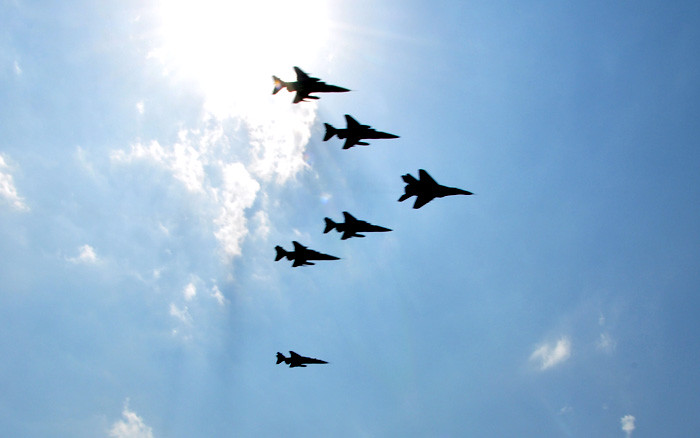
The first Ex between the two Air Forces was held in Oct 2009 at RAFO Thumrait, Oman wherein six Jaguars had operated and then the Omanis had expressed their keen interest and desire to fly over Indian terrain which has a vast variation quite unlike the Omani flatbed desert. As the RAFO pilots take off for various exercises from AF Stn Jamnagar, they would understand the challenges the IAF routinely encounters flying over the varying Indian landscape with deserts to the North and dense vegetation and hills towards South Gujarat.
After the familiarization of RAFO contingent with local flying operational procedures at the base, exercise commenced on 17 Oct 2011. The week long exercise involves a variety of flying missions from each other’s best practices in terms of operational, maintenance and administrative procedures. The exercise will expose the aircrew of RAFO and IAF, to missions involving long duration sorties with in flight refueling, large force strike packages, air to ground bombing and maritime strike roles routinely performed by the IAF both independently and in mixed operations.
Pictures from the last Oman-India Eastern Bridge exercise
BlackArcherIndigenous HUD on the naval Tejas produced by CSIO Chandigarh.
Chandigarh, October 18
Close on the heels of the naval version of the Light Combat Aircraft (LCA) Tejas, undergoing ground tests of its engines, another milestone has been accomplished by the Central Scientific Instruments Organisation (CSIO) here by producing a head-up display (HUD) unit for its cockpit.
Two units of the prototype naval HUD have been developed and it is expected to be tested by the Aeronautical Development Agency (ADA) shortly before being integrated into the Tejas’ cockpit.The CSIO had earlier developed the HUD for the air force version of the Tejas, which has been installed in prototype and limited series production versions of the aircraft. The HUD is an opto-electronic device installed above the cockpit’s instrument panel that superimposes vital flight parameters on the pilot’s vision of the outside world, giving him all requisite information at a glance and without having him to look down inside the cockpit, thus enabling him to fly with his “head up”. Air speed, altitude, weapon status, rate of turn and angle of attack are among parameters displayed on the HUD.
The HUD for the naval version has different technical specifications that the air force version and the operating parameters, cockpit configuration and the pilot’s field of vision are different. In addition, two HUD units have also been fabricated by the CSIO for the HJT-36 trainer developed by Hindustan Aeronautics Limited.


 Sign In







