 BlackArcher
In other news, the final price negotiations for the 73 Tejas Mk1A single seat fighters and 10 Tejas Mk1 trainers is almost complete with the unit price having being decided. The support package cost remains the only issue still being negotiated. Contract with HAL should hopefully be signed by MoD by year end.
Apparently, the Tejas Mk1A will cost $40 million per unit. Support package cost will be additional. Pretty good for an AESA radar equipped 4th gen light fighter. The total will be much lower than the benchmarked price if the unit price is $40 million. 73 Tejas Mk1As at $40 million works out to $2.92 billion and the 10 Tejas trainers may be slightly cheaper if they keep the same configuration as the current Tejas trainer with the existing Elta 2032 radar instead of whatever AESA radar is selected for the Mk1A.
Even with the same price, the price for 83 should be $3.32 billion. Add 50% of that cost for a support package and it works out to $4.98 billion..make it ~$5 billion.
“The pricing for 83 LCAs was finalised on September 3 in a meeting chaired by the Secretary Defence Production. Talks are now on for the pricing of the support package. Contracts for the LCAs and 15 Light Combat Helicopters (LCHs) will be signed in 3-to-4 months’ time,” Apurva Chandra, Director-General (Acquisition) in the Ministry of Defence declared at an international seminar on ‘Energising Indian Aerospace Industry: Flight Plan for the Future’.
Orders for the LCAs and LCHs will go the state-owned Hindustan Aeronautics Limited, which is controlled directly by the Ministry of Defence.
The procurement of 83 LCA Mk 1A fighters has been pending since an approval in November 2016 of the benchmarked price of 50,025 Crore ($7 Billion). The unit price is reported to have been negotiated around $40 Million.
BlackArcherWhich system are you going to eliminate so the MAWS can go inside? the radar? mission computer? display computer?
There is no such thing as a free lunch.
I don’t get you..why would any of those system need to be eliminated to accommodate a pylon mounted MAWS? Its a proven solution on F-16s (PIDS+) and the F-16 didn’t lose its radar, mission computer or display computer as a result.
BlackArcherThat would be waster of Pylon , For aircraft like Su-30 with more space they need to integrate 360 Degree MAWS inside aircraft something Malysia has done with Su-30MKM and Russia with Su-35.
For Tejas too they can integrate it inside why waste a pylon
Read it carefully. Its ‘pylon mounted’ meaning that it will be integrated to a pylon. It doesn’t mean that an entire pylon will be dedicated for a MAWS! And it is almost 360 deg even when mounted on the pylon. The bubble that each pylon mounted sensor views is only going to mask the area of the wing right behind the sensor.
Terma had a similar solution for F-16 pylon mounted MAWS
The MWS installation, which comprises a total of six sensors and one processor, offers a major modification to the F-16 self-protection suite to easily detect and decoy attacking missiles.
While the processor is installed in the right-hand pylon, three sensors are integrated in both the left-hand and right-hand pylon to deliver nearly full spherical coverage.
Terma pylon mounted MAWS brochure

Missile Warning for Belgian F-16
Similar indigenous DARE solution
BlackArcherTiger Apache and Zulu square off for Australian deal
Airbus is offering to replace Australia’s 22 Tigers that didn’t do a good job, had a bunch of issues and are being prematurely retired, with 29 more Tigers.
BlackArcherSo Zhukovsky-AE-AR only for the export MiG-35? VVS MiG-35s will continue to have the MSA Zhuk then?
BlackArcherVery interesting. Do you have any more details on that? DARE had been working on pylon mounted dual color MAWS for the Su-30 so it could be a possible variant for use on the Tejas Mk1A.
BlackArcherI guess the LCA SPORT will feature the AESA radar that will be used on the Tejas Mk1A. Anyway, the plan is to upgrade the 40 Tejas Mk1 jets with the same AESA radar as the Mk1A for fleet commonality at a later date as part of a MLU.
The Mk1A is going to be priced at around $35-$40 million or so, as per some of the latest reports that indicated that HAL would be reducing the price after the MoD and IAF refused to go ahead on the earlier price quotes.
BlackArcherThe displays are different for the proposed SPORT Trainer than the current Tejas trainer, which is identical to the single seater Tejas Mk1. I imagine that for the Tejas Mk1A and possibly even the Tejas Mk2/MWF, there will be no separate dedicated trainer, but rather the SPORT will be offered, with customizable cockpit controls and displays that reflect what is seen on those types.
But in all other respects, the SPORT is meant to be a combat capable supersonic twin seater, just like the Tejas trainer is a fully combat capable supersonic trainer. The primary goal is to set up a fleet of these trainers that take over the tasks of introducing rookie pilots to complex new technologies and their basic tactical usage, before they are sent to squadrons.
BlackArcherArticle on the LCA SPORT (Supersonic Omni-role Trainer) in a Brazilian publication
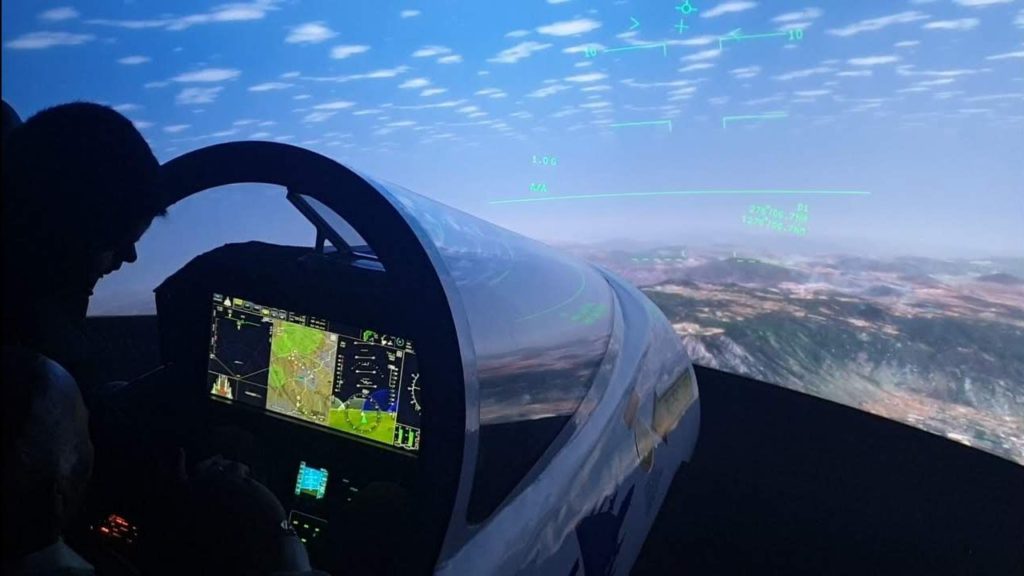
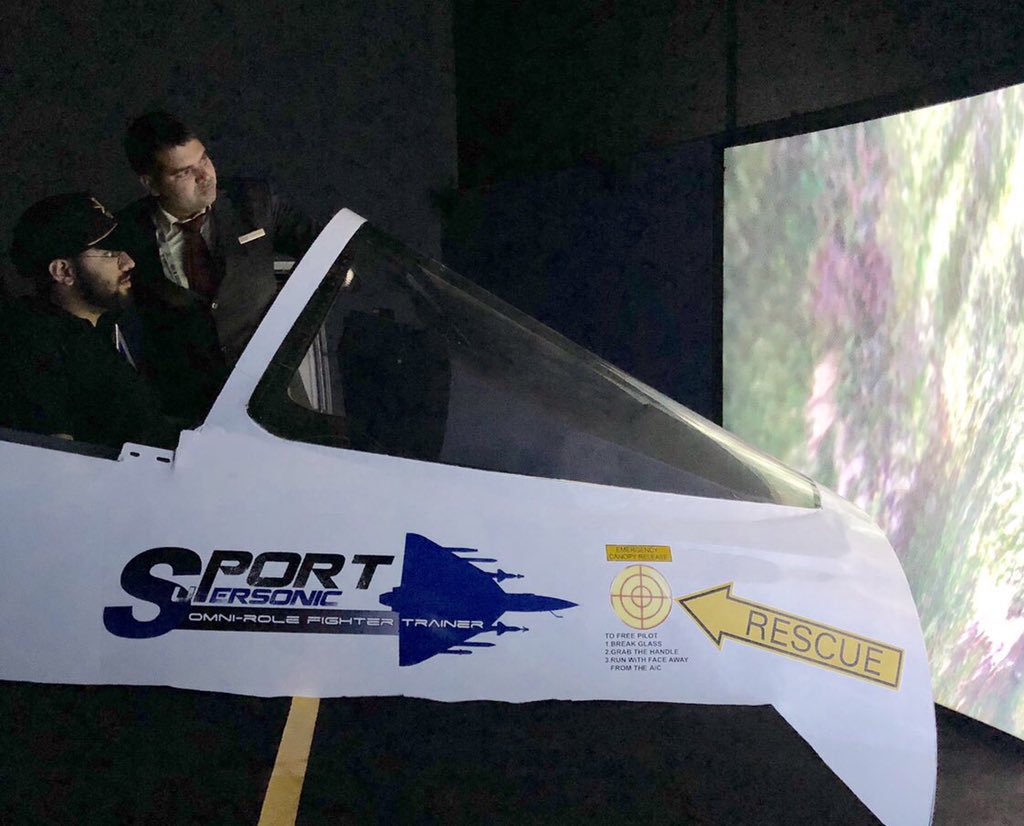
KEY SPORT CHARACTERISTICS
HAL’s Supersonic Omni Role Trainer Aircraft (SPORT) based on the two-seat LCA will enable training in the following areas:
1. Combat Training Dedicated to Large Force Engagement Groups
2. Tactical and Operational Level Concepts and Training Net Centric Warfare (NCW)
3. Shooting Control Radar (FCR) Concepts and Operations Training
4. IRST Search and Tracking Concepts and Operations Training
5. Helmet Mounted Display System (HMDS) Concepts and Operations Training
6. Dedicated BVR Combat Training
7. Dedicated EW (Electronic Warfare) Concepts and Training
8. Laser Environment Concepts and Laser Designator (LDP) Pod Training
9. Exposure to air-to-air missile launch (BVR and CCM)
10. Exposure to ALCM, ASM release
11. PGM launch practice (with and without target designation by parent aircraft)Jaguar MAX and SPORT will use common subsystems such as avionics, LRUs, etc. developed for them specifically.
BlackArcherA series of tweets on the Tejas Mk2/ Medium Weight Fighter, by Harsh Vardhan Thakur, HAL Test Pilot.
LCA Mk-2, not MWF, is indeed the project approved by GoI. Prelim QRs issued. t’s an LCA++ with larger size, more fuel, more payload, more range, more thrust, better maneuverability, newer features, newer sensors & newer weapons. Dev time expected 5-7 years. Concurrent production.
LCA Mk-2 is MWF. Not yet changed. May be retained as per original GoI approvals.
Not like MWF is not approved. Mk-2 is an ongoing & approved project. MWF aspirations are absorbed into Mk-2 specs. It’ll entail more budget & time, but at the end there’ll be a more potent aircraft. Challenge is our capability & efficiency. We’re taking enough potshots for that.
and most of all, confirmation of the Mk2 aka MWF’s goals
Mk-2 is not rebranded. It’s an old name. Thrust/weight & payload better than M-2000. Payload & Life doubled. ROA increased. Definitely big bump in perfo. IRST, MAWS, sensor fusion, side stick, LAD, AESA radar, AESA SPJ, Digital RWR, ODL+SDR, twin-launcher. A huge jump over Mk-1.
He’s talking about the MWF having double the payload and fatigue life of a Tejas Mk1, increased radius of action, big bump in performance. Plus other avionics and features like IRST, MAWS, Sensor Fusion, side stick instead of center stick, AESA radar and SPJ, digital RWR, Operational Data Link (ODL) and Software Defined Radios.
Basically an evolution very similar to that of the Gripen E over the Gripen C/D.
There is a new SQR with significantly different specs, suiting present requirements. It’s issued this year. Not same as old ASR of 80s.
new set of Staff Qualitative Requirements that differ from those that were issued for the original Mk1 in the 1980s. This is just to set the confusion right about the Mk2 being designed to meet Mk1 ASR requirements that could not be met.
BlackArcherThank you! I have watched almost all the AirCrew interviews on Youtube and thoroughly enjoyed most of them!


 Sign In








