 BlackArcher
just a thought, jaguar was never known to be a performer even in its heyday, let alone in this age,
why would IAF spend on this one ?
Well, the Jaguar is seen in the IAF as a dependable, capable strike aircraft and with upgrades, the airframe and avionics have been kept quite relevant. As another poster mentioned, what HAL and the IAF have found is that despite the rigors of low level strike profile type sorties that Jaguars mostly conduct, most of the airframes have not seen much fatigue related issues during overhauls. 1 in 5 show some signs of fatigue, but with the fleet going through upgrades, and HAL being able to support them well, it makes sense to keep them in service as long as is feasible.
Only each 5th airframe is reportedly showing issues of fatique or cracks, when they are inspected about every 10 years. That is seen as “an encouraging fact, given the stresses of mainly low-level work they are used in” a shop-manager underlined to ACIG. Not stressed beyond 8g with a design maximum of 12g, airframe-life was originally calculated at 3.000 hours for single-seaters and 6.000 for two-seaters. “Therefore it makes truly sense to invest in further improving and upgrading of the Shamsher”, the engineer said.
At least 10 (of 12) IM-Jaguars had their Thompson-CSF ‘Agave’ attack-radar replaced by an IAI Elta EL/M-2032 set some years ago, which was said to originated from the shelved ‘Lavi’-project. A first new indigenous radome-nosecone for these was handed over to HAL by Bangalore’s National Aerospace Laboratories (NAL) in April 2010. One such platform was accessible to ACIG in early February, the dark-grey shipping-strikers are awaiting their BAE-‘Sea Eagle’ to be replaced by either ‘Harpoon-II’ or ‘Exocet-III’. These, 40 earlier and the ‘latest’ 37 HAL-built IS-Jaguars are currently on the level of the previous DARIN-II (Display Attack Ranging Inertial Navigation) digital nav/attack upgrade.
Soon there will be three generations of DARIN-modernisations, since in early 2010 HAL secured the order for ‘DARIN-III’, worth INR 3.100 (EUR 505 mill.). In the following, 68 so-called ‘deep penetration Jaguars’ are earmarked or currently in the pipeline of getting the DARIN-III kit while on overhaul at Bengaluru. The programme “will substantially increase survivability and efficiency of that strike-planes”, ACIG was explained to on site. It should also be taken in mind, that the type is the IAF’s primary nuclear-weapons carrier.
The so-called ‘D-3 Jaguar IS’ are featuring the same HUD as on LCA ‘Tejas’, along with three MFD-55 AMLCDs supplied by THALES-Samtel Display Systems and full HOTAS controls, all utilising a MIL-STD-1553B digital databus. The core avionics computer – reportedly the same as in the MiG-27UPG upgrade at HAL-Nasik – is the OSAMC (Open Systems Architecture Mission Computer) originally developed by DARE and now produced by an India-US joint venture involving HAL, ‘Edge Tech India’ and US-based ‘Edgewood Ventures LLC’. An integrated defensive aids suite (IDAS) is coming from DRDO and Cassidian, including the D-3’s to be equipped with RAFAEL Litening-3SU laser designation pods for all-weather standoff-attacks using precision-guided munitions. Undecided in DARIN-III are the EW escort-jammers/towed-decoy systems, with offers from Raytheon (ALQ-184(V)9), BAE-Systems (ALE-55), IAI/ELTA (EL/L-8251) and RAFAEL (‘Sky Shield’ escort-jammer / ‘X-Guard’). The fibre-optic towed-*decoy is to produce a full range of noise- and deception-signals be*tween 4.5GHz and 18GHz
..
The Jaguar IMs tasked with maritime strike had been equipped with the Elta 2032, and have been tested with the Harpoon AShM.
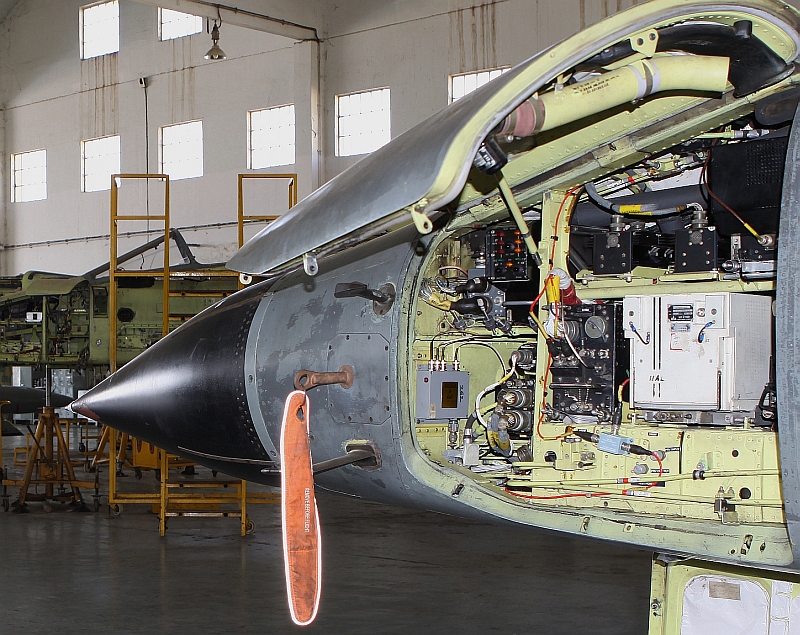
Jaguar IM
And now the DARIN III upgrade will see those upgraded Jaguars all flying with the new radar, an Elta 2032

BlackArcherIAF Chief blames UPA for procurement delays- spells out schedule for boosting fighter squadrons
Raha blamed the United Progressive Alliance (UPA) government’s preoccupation with procedure for the IAF’s current aircraft shortfall — it has just 33 fighter squadrons instead of the sanctioned 45. “I think all our procurements have been more or less process driven and not outcome driven. [Now] there is a change of perception and now most of the procurement processes and policies are being amended so that it is (sic) outcome driven.”
“We have planned up to 2027 and if the inductions had been timely, the IAF’s capabilities, certainly in terms of combat aircraft, as of now it is good, but it would have been better.” The IAF has not yet closed the Rafale chapter. With Dassault, the Rafale’s French vendor, believed to be readying a proposal for building 80 more Rafales in India, Raha said: “We would like to have more, but the decision will be taken in the near future based on capabilities and the desirability of having [more] fighter aircraft of this class.”
Second fighter line
The air chief indicated that a new Make in India fighter production line could come up soon, based on “unsolicited offers” from Lockheed Martin, Boeing and Saab for building their fighters in India —the F-16 Block 70, F/A-18 Super Hornet and the Gripen E, respectively. These offers are conditional on the IAF buying and operating the fighter in question.
“This is very much on the table and I’m sure whoever gives the best deal [will win]. All the aircraft are very capable, so it will depend upon who provides the best transfer of technology; and, of course, the price tag. It’s on the table; nothing is decided as yet.”
Said Raha: “This will not be just licensed manufacture. It will be proper transfer of technology. Also, India will become a hub for manufacturing, as well as maintenance, repair and overhaul (MRO) for other air forces in the region.”
Jaguar
The IAF chief also flashed a green light on modifying and upgrading the Jaguar fleet, the IAF’s key fighter for deep penetration strikes. As Business Standard had reported, the six Jaguar squadrons (120 aircraft) will be rejuvenated with new Honeywell F-125N engines for $3 billion, a modern Airborne Electronically Scanned Array (AESA) radar, indigenous DARIN-3 navigation-attack systems and will carry the smart CBU-105 “sensor fuzed weapons” that India bought from Textron, USA.
Said Raha: “To exploit the Jaguar for the next 15-20 years, we are upgrading the aircraft with better weapons. I think there has been slow progress in the past but I’m sure this is going to pick up steam, and very soon we’ll see progress.”
Raha also said upgrade programmes were progressing well in the three Mirage 2000 squadrons (cost: Rs 12,100 crore); and three MiG-29 squadrons (cost Rs 6,400 crore).
Indo-Russian FGFA
The tortuous negotiations holding up the Indo-Russian Fifth Generation Fighter Aircraft (FGFA) have been resolved, Raha confirmed. The two sides are believed to have agreed on a $4-billion “R&D Contract” that could see HAL and Sukhoi co-develop and build up to 250 FGFAs for the IAF.
Said Raha: “[Earlier, the IAF] found gaps in information on transfer of technology; how they (Sukhoi) have achieved these 5th generation technologies, and in visibility of the total cost. So these issues were flagged… and now a lot of clarity has come on these issues. Hopefully things will be decided sooner rather than later on the FGFA.”
Tejas LCA
For the first time, the IAF chief spelt out a detailed commitment and road map for inducting 120 Tejas fighters into the IAF in a decade.
Raha said the first squadron, which will have 20 Tejas with “initial operational certification” (IOC), will have four fighter this year, with HAL boosting production to eight fighters annually from next year. “So in another year and a half’s time, we will have a full squadron of LCA’s – the IOC version.”
Raha revealed the long-delayed “final operational certification” (FOC) of the Tejas was imminent. “I’m sure in another five-six months FOC would be cleared and production will start as soon as [HAL] finishes producing the IOC version. So we expect that the FOC version [of the Tejas] will be operationalised in an IAF fighter squadron in another three years’ time.”
Meanwhile, the Tejas Mark 1A, with improved radar, weapons, electronic warfare capability and maintainability would fly in three-four years. “We should be able to start production of this aircraft by 2020-21; and in another five-seven years [i.e. by 2025-28], we’ll have 80 Tejas Mark 1A fighters,” said Raha.
BlackArcherLittle more information on the Dassault and Reliance JV to produce parts for the Rafale
Dassault and Reliance to form Indian JV
..
Reliance and Dassault said on 3 October that their new JV company would be named Dassault Reliance Aerospace. Details about the joint investment were not disclosed, although the equity split of the JV is likely to be 51:49 in favour of Reliance in line with domestic foreign direct investment rules. The JV is expected to be formed within a few months.
In a statement, the two companies said the new JV would be focused on winning defence offset contracts attached to the IAF’s EUR7.9 billion (USD8.8 billion) deal to buy the Rafale fighters.
..Offsets linked to the Rafale deal have not yet been finalised but the Indian government has already stipulated that related obligations in the programme must be worth at least 50% of the main contract value. Accordingly, Reliance and Dassault said the Rafale offset package would be the “largest-ever offset contract in the history of India”.
..
IHS Jane’s understands that the JV will be positioned to support the IAF’s Rafale programme through the production of aero structures, electronics, and components for the aircraft’s Snecma M88 engines.The JV will be fronted by Reliance subsidiary Reliance Defence Limited (RDL) and will be based at an aerospace industry park that the group is developing in Nagpur, central India.
..
BlackArcherBlackArcherhttp://www.aviaport.ru/digest/2016/09/23/396509.html
EDIT:
Latest Su-30SM for the VMF:
one question that has had me wondering for a while. Why is it that Russia paints the radomes on its Su-27s and Su-30s white, whereas on almost all export variants, one sees gray radomes.
BlackArcherThere’s a saying:
“even the prettiest girl can offer only what she has”
LM can propose everything they want, the intellectual property remains in the hands of US governement and it is, in the end, the US congress that would allow any export of these F-16s, or not… once the production facilities in place, god only knows how much a Rafale made in India would cost, but if you can plan to have F-16s 20% cheaper than their price “made in USA”, why wouldn’t that apply to the Rafale?
We’ll see how everything unfolds soon enough, anyway
Back when Rafale manufacturing by HAL was being examined, it was Dassault that claimed that HAL lacked the level of automation and manufacturing technology that was used on the Rafale assembly line, which meant that more labor hours would be required, which would in turn lead to the Indian built Rafale costing upto 20% more than the French built Rafale. Of course, they suggested that Reliance Aerospace do the job instead, which was patently ludicrous given that Reliance Aerospace hadn’t even assembled a bi-plane or microlight before that, forget having any experience assembling/building combat fighters.
Perhaps the manufacturing technology for the Rafale is a generation ahead of what HAL uses for its Su-30MKI and Tejas assembly lines. Not sure, but Dassault cannot seriously turn around now and show that assembling the Rafale in India will all of a sudden be economically sound.
Regarding the F-16, to a certain degree, things have changed when it comes to sharing technology. Whether or not it is to a degree that gives the Indian manufacturer the rights to go ahead and modify the avionics, or integrate new weapons on their own, we’ll find out I guess, when this MII program goes further ahead. If the US is not able to compete with Saab or Dassault on the ToT front, they will lose, pure and simple.
What does go in Dassault’s favor is the setting up of JV’s like the one with Reliance, to discharge offsets on the basis of the current order. They have the advantage of being the incumbent (sort of) but their prohibitively high price tag is a barrier.
BlackArcherSomething is definitively off with the amount of investment for Indian custom rafale. How about the hypothesis of a 3 bands type agreement . Could UAE somewhat be a stakeholder in this indian deal. After all they are potentially looking for buyer of their – 9 ?. Those could make up part of the numbers in relative short time for India. This without stressing too much the logistic and given an M2000 extension / upgrade line is already operating , which could probably switch to the -9 if necessary. Part of the payment could come in form of investment for additional features to rafale for the benefit of both india and UAE and explain the level of investment for current 36 airframes. Would that really be a stretch ?
yes, too much of a stretch. Such a complicated contract structure would never get past India’s bureaucracy.
BlackArcherAs expected, IAF will want the Litening integrated for its Rafale
Rafael and Reliance Defence negotiate systems provision for Indian Rafale
BlackArcherAW paid subscription article snippet
U.S. Army Not Seeking MBDA Missile For Apaches
The U.S. Army has no interest in arming its Boeing AH-64E Apache gunships with the MBDA dual-mode Brimstone ground attack missile, even as the UK defense ministry pursues integration for its Apache fleet.
MBDA and Boeing recently concluded a series of test launches from an AH-64E at Yuma Proving Ground in Arizona. The effort was funded by the UK government, and could boost MBDA’s Brimstone sales campaigns in the U.S. for rotorcraft and fighter jets.
But outgoing U.S. Army Apache Project Manager Col. Jeff Hager said at the Association of the U.S. Army symposium in Washington on Oct. 3 that right now there is no interest in integrating Brimstone with American Apaches. Instead, the Army is fully committed to the JAGM missile, which entered development in July 2015 for initial deployment around 2018.
“For right now, no. Right now, our requirement leans us toward JAGM,” says Hager, speaking after his last media briefing as the Apache program manager. “JAGM answers all of the capability questions we have today. Really, it’s the UK looking at the Brimstone missile for their user needs on their side. The UK did the testing. All we did was support them. They paid for the range. We just provided the components.”
…
BlackArcherthe thing being, with the US you can forget about any significant ToT, as it’s been demonstrated in brasilian market for example, where Hillary said “appropriate” ToT, which means, they’ll allow you to get very little, and pretty much what they consider either useless or outdated. On the other hand, the Gripen, besides having US content inside, is in a league under, more comparable to the Tejas, and I doubt that India will introduce a competitor to its own aircraft, unless they plan to cancel the whole Tejas project.
Now, if you get back to rafale, the cost proposed for 126 aircraft in MMRCA was quite appealing, while including ToT and setting a production line in India… with the 36 fighters deal, it looks like part of that has been paid for indirectly (through offsets).. the price Dassault may be able to propose could very well be very competitive per aircraft as most if not all infrastructures needed may be built or in th emaking from the previous deal… something other competitors can’t spare in their offers
Now, I don’t say “it is a done deal”, but that there are indications that Dassault may have gotten its way through to a bigger market in India
Affordability is the key factor here. Another 90 jets cannot be bought for the price that the IAF paid for those 36 Rafales. Even if the initial deal included things like setting up infrastructure at 2 bases to support this small fleet, a larger investment would be required to support 126 Rafales. and the unit price that’s been mentioned alone would mean that getting 90 Rafales would cost India another $10 billion. Add maintenance, warranties, support and training and French weapons and the cost will be unaffordable, unless the IAF lets go of the FGFA program or postpones it by several years.
We’re seeing this happening all around now, even with countries looking to buy F-35s. The per unit cost being so high and with budgets being finite, the only way to be able to go ahead is to shrink the original order. Now, either the IAF will have to agree to shrink its “tip of the spear” Rafale force to a number like 56-72, and fill the numbers with an affordable solution like a mix of Tejas Mk1A/Tejas Mk2 fighters and go ahead with the 114 planned FGFAs or it’ll have to find another affordable fighter to fit into the mix, just so that combat fighter numbers don’t shrink anymore.
As for ToT, the Brazilian example is not very relevant. What LM is supposedly offering is to shift the entire production line to India (akin to what Dassault offered with the Mirage-2000 before the MRCA saga started). They are proposing to build F-16s in India and also offer them for export to other nations, hoping that cheaper labor costs will drive down costs by another 20%. And if the IAF commits to the F-16 Block 70, rest assured that they will seek and get all the source codes that will allow them to continually develop and support the fleet for another 40 years. If not, the Gripen E will be in pole position.
Either way, a more affordable single engine fighter is needed here without which there is no way the IAF can arrest its falling numbers, forget growing to a larger number of squadrons. If not the Tejas Mk1A/Mk2 for all sorts of other reasons which can be debated, then the F-16 Block 70 or the Gripen E.


 Sign In








