 danrh
danrhScoot, mate what will it take to prove this to you?
Hmm, well lets see. Maybe this will do it
when she sails into Pier 19 on a good will visit to the US which is actually a show of strength and to rub it in the face of the world that they now have a carrier.
Until she sails I think quite a few folks will reserve judgement.
Daniel
danrhfrom JMR Dec 2005
Pakistan develops air-bursting RPG-7
Doug Richardson
Pakistan Ordnance Factories (POF) has developed an air-burst anti-personnel round for the locally produced derivative of the Russian RPG-7, writes Doug Richardson. The new RPG-7AP has a warhead that contains 850 steel balls packed around a high-explosive charge. It has a maximum range of 1,500 m and, according to the POF, is designed “to kill soldiers and damage equipment within 15 metres’ radius”.
In general configuration, it closely resembles the Type 69 40 mm air-burst anti-personnel grenade that China has developed for its Type 69-1 40 mm anti-tank grenade launcher. Like the Chinese round, it is propelled upwards by a jump mechanism when it strikes the ground. Once it reaches a height of about 2 m, the warhead detonates, scattering its steel balls.
The main difference between the Pakistani and Chinese rounds is that the muzzle velocity of the former is 95 m/s, slightly lower than the 102 m/s of its Chinese equivalent. Projectile weight is slightly higher – 2.85 kg rather than 2.8 kg – while the payload contains 850 steel balls rather than about 800.
Although the POF cites a calibre of 40 mm compared with the 75 mm of the Chinese round, in practice the Pakistani figure refers to the calibre of the launcher rather than the diameter of the warhead. The latter is about 75-80 mm in diameter.
danrhfrom JMR Dec 2005
India orders submarine-launched Exocet
The Indian Ministry of Defence has awarded MBDA a contract to supply its Exocet SM39 anti-ship missile to arm the Indian Navy’s newly ordered Scorpène conventional attack submarines. Signed on 6 October 2005 in New Delhi, the contract covers the supply of the SM39 missile for the six new-generation submarines to be built by Armaris, a joint-venture company owned by French shipyard DCN and Thales.
India is the 34th customer for the Exocet anti-ship missile system. First flown in 1970, it has undergone continuous improvements culminating in the air-breather Block 3 variant that is currently under development. MBDA and its predecessor companies have sold more than 3,300 Exocet missiles in various configurations since the missile first entered service.
Most of the exported systems are ship or air-launched. Until now, the only known customers for the SM39 have been France, Malaysia, and Pakistan.
The Exocet SM39 variant is stored in a VSM (Véhicule Sous Marin), a self-propelled and guided container. After being ejected from the submarine’s torpedo tube, the VSM will manoeuvre before surfacing so as not to reveal the position of the submarine. Once in the air, the Exocet missile leaves the VSM and proceeds to the target like a normal surface variant of the missile
danrhfrom JMR Dec 2005
South Korean missile goes into production before live-fire testing
David C IsbyA member of South Korea’s National Assembly has claimed that a 150 km-range anti-ship missile developed by South Korea was ordered into production before any live-fire testing could be carried out, writes David C Isby. This claim was based on information submitted on 22 September 2005 in a report by the South Korean Ministry of National Defence.
South Korea’s Agency for Defence Development, which manages the anti-ship missile programme, is developing indigenous weapons capabilities in a number of areas, including missiles. The development programme for the anti-ship missile was publicly announced in November 1998 but is reported to have begun in 1993. The September 2005 report apparently indicates that two missile configurations have been developed, one using foreign-supplied components and the other Korean-produced components. It is not clear whether these are two versions of the same design or two separate designs.
A missile identified as the SSM-700K had a well-publicised test launch in August 2005. It is reported to be based on imported technology and hardware, including the weapon’s jet engine. A programme cost of KRW686.9 billion (USD650 million) has been reported, but such cost figures have been criticised in the past by the local press as being inaccurate.
According to Seoul press reports, the missile that uses Korean-produced technology was ordered into production in 2004, following the assembly of pre-production rounds in 2003. Production was speeded up during 2005, and “dozens” of missiles have been produced. The first live-fire testing of this weapon will not take place until sometime after November 2005.
Nex1 Future (formerly LG Innotek) is involved in producing at least the indigenous-technology version. It is intended to arm the KDX-1/2/3-class destroyers and the PKM-X patrol craft. A land-based coast-defence version is also reported to be under development. According to press reports, the design is similar to the US-designed RGM-84 Harpoon, with a length of 5.7 m, a diameter of 0.54 m and a maximum range of more than 150 km at high subsonic speed. It uses a GPS-aided inertial navigation system (INS) for mid-course guidance, then active-radar terminal guidance.
danrhfrom JMR Dec 2005
Chile wants to adopt Harpoon Block II
Chile has requested a possible sale of 20 Boeing RGM-84L Harpoon Block II missiles to maintain the anti-ship warfare capability of its frigates purchased from the Royal Netherlands Navy. The RGM-84L Harpoon Block II offers an upgraded targeting capability that significantly reduces the risk of hitting non-combatant targets, and so would improve the Chilean Navy’s operational flexibility. The proposed sale would also help the Chilean Navy to develop and enhance standardisation and operational capability with the US.
In addition to the 20 missiles, the proposed deal would also include containers; training devices; spare and repair parts; supply/technical support; support equipment; personnel training and training equipment; technical data and publications; US government and contractor engineering and logistics support services; and other related elements of logistics support. The total value of the sale could be as high as USD50 million if all options are exercised. US government or Boeing personnel may have to be temporarily based in Chile to handle technical and management oversight and support requirements, but would not be needed permanently.
On 26 March 2004, Chile signed a contract with the Netherlands to acquire two Jacob van Heemskerck-class air-defence frigates and two Karel Doorman-class multipurpose frigates. Deliveries were to begin in November 2005 and be completed in April 2007. Both classes are equipped with two quad launchers for Harpoon Block 1C missiles. Chile is not a Harpoon user and it was not clear at the time of the contract signature whether it planned to adopt the weapon.
The Jacob van Heemskerck class is also armed with the Standard SM-1MR surface-to-air missile (SAM) system. In 2004, Vice Admiral Juan Illanes, head of the Chilean Navy’s Materiel Directorate and acting commander-in-chief of the navy, stated that the acquisition of the two Jacob van Heemskerck-class frigates and their Standard armament would remedy the Chilean fleet’s chronic lack of long-range air-defence capabilities.
Chile will be the first South American naval force to possess this capability; although it procured two County-class guided-missile destroyers from the UK in the early 1980s, these vessels were modified to install an enlarged helicopter flight deck in the location formerly used by the obsolete Sea Slug SAM system
danrhfrom JMR Dec 2005
USAF shows interest in long-range anti-ship missiles
David C IsbyThe US Air Force (USAF) is showing increased interest in air-launched missiles with long-range capabilities against maritime targets, writes David C Isby. This follows recent US Pacific Command (PACOM) exercises, including the well-publicised ‘Resultant Fury’, in which USAF aircraft were committed to missions – including live-fire exercises – against such targets.
Previously, the 2003 USAF Transformation plan has included “assisting the [US] Navy against maritime anti-access threats” as among the USAF’s future objectives. The potential for such maritime targets being part of the anti-terrorist operations has also led to this increase in emphasis.
The USAF believes that a capability to engage maritime targets is a critical part of its desired ‘global reach’ capability and that in many instances an air-refuelled bomber from a forward base may be better able to reach and engage a maritime threat that constitutes a time-critical target than would a naval unit.
This increased emphasis has not yet been matched by a requirement for an enhanced missile capability for USAF maritime missions nor by increased funding, although this latter is considered possible in Fiscal Year 2007 and subsequent years. A classified Request for Proposals (RFP) issued by Air Combat Command headquarters in June 2005 is understood to have asked for responses identifying ways to enhance long-range strike capabilities. However, it is uncertain whether this RFP will lead to the emergence of a formal requirement.
The USAF and US Navy (USN) are believed to want to be able to target future long-range anti-ship missiles against a precise impact point on the target vessel and are said to be seeking a variable warhead-effects capability that could minimise collateral damage. This has led to an interest in capabilities developed by US industry to meet a Royal Australian Air Force requirement for a similar weapon. The latter requirement has resulted in versions of the AGM-84H SLAM-ER (Surface Land Attack Missile – Enhanced Response) and AGM-158A JASSM (Joint Air-to-Surface Standoff Missile) being proposed by Boeing and Lockheed Martin respectively.
A datalink-equipped version of the JASSM-ER (extended range) or JASSM-XR (extra extended range) with a variable effects warhead could be integrated initially with USAF B-1B and B-52H bombers to meet any official requirement that may emerge in the future. Such a weapon would reflect the USAF’s continued commitment to the JASSM programme despite Congressional criticism and the USN’s withdrawal.
The USAF Air Combat Command is considering launching an advanced concept technology demonstration (ACTD) in 2007 that would increase air force capabilities to destroy maritime targets at long ranges. The objectives and programmes that will be funded under this ACTD, if approved, have not been announced.
If approved, the ACTD could help develop technologies that could be integrated with a range of platforms, sensors and missiles, including the USAF-funded Lockheed Martin AGM-158 Joint Air-to-Surface Standoff Missile extended-range (JASSM-ER) and the Lockheed Martin-funded 1,000 n miles-range JASSM-XR.
Such an ACTD could also fund development of an improved JASSM terminal seeker and datalink developments. These are among upgrades that have been proposed by Lockheed Martin for the potential export of the JASSM to Australia.
Other potential upgrades that may be funded under this ACTD could build on developments in the current Air Force Armament Center’s Weapon Data Link Network (WDLN) ACTD. This programme addresses the US Department of Defense’s desire to network together future precision weapons using a universal datalink.
danrhfrom JDW 16 Nov 2005
Nex1 Future shows fast attack craft systems
ROBERT KARNIOL JDW Asia-Pacific Editor
SeoulSouth Korea’s Nex1 Future, formerly LG Innotek, has unveiled two systems under development for the Republic of Korea Navy’s PKX fast attack craft.
The navy plans to acquire up to 40 of these vessels to replace ageing assets. Thought to measure 56 m in length with Hanjin Heavy Industries and Construction as the lead shipyard, the PKX is due to enter service from 2007. Nex1 Future displayed models of a 3D surveillance radar and an anti-ship missile due to equip the PKX shown at October’s Seoul Air Show. The new fast attack craft should also be armed with a 76 mm main gun. Few details were released on the X-band radar system, with range and the number of targets that can be tracked simultaneously left blank on the display. It is described as providing 3D measurement to the command and fire- control system “by rapid and accurate detection of air and surface targets”.
The system can also provide raw video and processed video generation and has electronic countermeasure capabilities. A company official told JDW that the radar contract was concluded in 2003, with operational testing due in the first half of 2007. “It is now in the final phase of development,” he said. The radar may work in conjunction with the SaabTech CEROS 200 multisensor director system. The Swedish company in 2004 confirmed receipt of an order from South Korea’s MteQ, worth USD14 million, for the initial supply of CEROS 200 trackers to form part of the PKX command and fire-control system. The contract includes a technology-transfer programme for establishing production resources and test facilities in South Korea.
The as-yet unnamed medium-range anti-ship missile shown by Nex1 Future is described as having a ‘Harpoon-class’ warhead with impact/ penetration fuse. Development began in the 1990s and was undertaken by the company in conjunction with the state-owned Agency for Defence Development.
The documentation states that the missile has terminal guidance with active radar homing and a strapdown inertial navigation system with GPS support. It is an air-breathing low-altitude sea-skimming missile and can conduct evasive manoeuvres. Speed is in the ‘high subsonics’ range, which suggests about M0.85/M0.9 and maximum range is said to be more than 80 n miles.
danrhDutch Parliament Supports Purchase of Tomahawk Cruise Missiles
(Source: Radio Netherlands; issued Nov. 17, 2005)
Defence Minister Henk Kamp is expected to receive parliamentary support for his plan to purchase 30 Tomahawk cruise missiles.
The Christian Democrats, who until now said the money was needed to replace Chinook helicopters which crashed in Afghanistan, have changed their minds now that Finance Minister Gerrit Zalm says he will advance the money for the Chinooks.
The left-wing opposition is shocked by the sudden majority in favour of buying cruise missiles and accuses the government coalition of horse-trading.
-ends-
danrhnot really anything to do with the whole one v the other thing but a couple of great pics nonetheless.

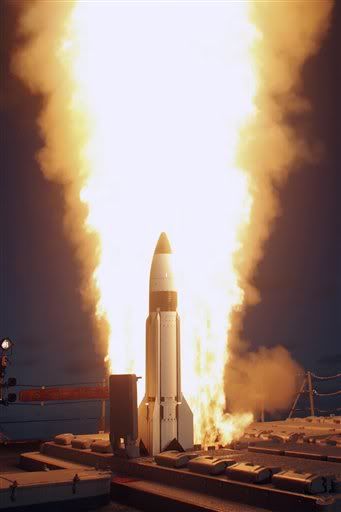
I believe they are originally from the milphotos forum
danrhI think basically that both methods are quite viable with known, reliable and potent examples of both in service around the while. The pros and cons may have been a bigger issue 30 years ago but today it seems to be more a matter of established preference and perhaps instituational inertia that tilts decisions one way or another.
with cold launch you can preserve your launching platform. ….and see in this movie how the missile guidence system is safe from the motor blast.
This is just a matter of design. There have been many hot launch, vehicle mounted SAMs with integral radars etc that don’t see all that sensitive equipment burnt up with the first launch.
Daniel
danrhYou are completely mistaken, Goshkov was no conventional aircraft carrier.. It was a STOL aircraft and helicopter carrier, more like HMS Ocean…
The amount of remodelling for 1143.5 class aircraft carriers Admiral Kuznetsow or Varyag would have been considerably smaller, almost none..
The large SSM battery of the Kuts class vessels takes up a lot of space that could otherwise be used for fuel or stores that would allow for much better sustainability of air ops. Against a similarly sized carrier (the new RN CVF design for instance) the Kuts class vessels would find it difficult to sustain flight ops at a similiar intesity and/or duration. Of course they might be able to finish any engagement with a single volley of SSMs but that is a fundamental difference in carrier philosophy.
Daniel
danrhThe problem with things that decide not to to work is that they can sometimes change thier mind. If you are unlucky enough to have your cold launched missile fall back to deck because something in the mechanism that fires the rocket failed, well it is always possible that the act of slamming back down onto the deck might just jolt whatever failed back into life. Excpet now that missile is not pointing skywards but rather at your bridge or possibly some other sensiive part of your vessel that doesn’t usually agree with runaway missiles packed with fuel. At least if your hot launch missile decides to do things in its own time it is contained. Obviously though the designers of cold launched system have already though of this stuff and designed thier products in such a way as to make the whole “falling back to deck” scenario rather unlikely.
Daniel
danrhSo pretty much the same dilemma and same solution made by the USN. Drop the big capable aircraft for the crap… hey the cold war is over… we don’t need anything better… but how can we make it more expensive…plane… sub par whore net.
Perhaps by now they would be testing the Yak-43 with a 25 ton class main engine and a max takeoff weight similar to an Su-33 (though presumably less performance due to the dead weight and space of lift engines and puffer jets and piping).
Well the Yak-141 would have filled the role it was intended and allowed the ships to fill thiers. These vessels were not intended to be the instruments of power pojection in the way that the US Navy’s CV/CVNs are. They were intended to carry a limited number of air defence fighters that could protect the major fleet units until they could close within range of their heavy SSMs. Seocondarily they carriers and thier air groups could provide air cover for the SSBN bastions. The later switch to the MiG-29 and Su-27 derivative fighters has allowed the vessels to become somewhat more versatile but they are still not perfect for the classic aircraft carrier role. The amount of remodelling required for the Gorshkov to suit India’s needs are indicative of just how different the original role of these vessels was from that of the conventional carrier.
Daniel
danrhWhy would a missile explode after being catapaulted into the air and landing back on the deck?
I think the point is that a hot launch requires the missiles rocket motor to burn in the launcher cell to generate the thrust for launch. In the early days particularly, solid rockets had a tendency to blow up due to less than adequate QC during manufacture. IIRC one of the major hypothese for the Soviet (Russian) use of cold launch systems rather than hot launch was the fact it took rather longer to get thier solid propellants to a sufficiently reliable stage.
Daniel
danrhMost Russians think whole state dishonest
MOSCOW (Reuters) – More than half of Russians think everyone in power is dishonest, a survey showed on Monday, from the president and parliament, to government and the courts.
“This goes a long way to explaining the colossal level of political apathy in society,” said Alexander Konovalov, president of the Institute for Strategic Assessments.
Just under one in three of the 1,600 people surveyed by ROMIR Monitoring called President Vladimir Putin honest, and the figure fell to just 5 percent for the government and 2 percent for the State Duma lower house of parliament.
The Duma is packed with members of the pro-Kremlin United Russia party and critics say many deputies rubber-stamp legislation while enjoying the perks of office.
Corruption is also endemic at all levels of Russian society, from traffic cops to tax officials. Transparency International ranked Russia joint 126th on its list of cleanest countries, on a par with Sierra Leone, Niger and Albania.
“People have faith in very little. That is the reality of our way of life,” Konovalov told Ekho Moskvy radio.
10/31/05 09:52


 Sign In







