 blackadam
Electronic Countermeasure (ECM)
March 29, 2016
Gif1
Brief
Ever since radar being used in battle in an attempt to gain superior situation awareness and guide weapons, various techniques were created to reduce the effectiveness of those sensors. Whiles passive countermeasure such as Stealth techniques were invented to help military assets hide and stay invisible from enemy’s sensors, electronic countermeasure techniques were invented to confuse, overwhelm adversary sensors so that they are unable to track or attack friendly assets.This article will introduce and explain some common countermeasure techniques used by military aircrafts.
Physical Configuration
Radar countermeasure devices on aircraft take various shape and forms.Each configuration styles has their own advantages , disadvantages which will be explained below.
Chaff:
The most basics electronic countermeasure device, was invented in War world II and used by all military aircraft nowadays.Chaff consists of extremely small strands (or dipoles) of an aluminum-coated crystalline silica core. When released from an aircraft, chaff initially forms a momentary radar reflective cloud and then disperses in the air and eventually drifts to the ground. The chaff effectively reflects radar signals in various bands (depending on the length of the chaff fibers) , the effective frequency bandwidth of a single chaff length are varied by ±5% , but various chaff length are often mixed to increase chaff effective bandwidth . Immediately after deploying chaff, the aircraft is obscured from radar detection by the chaff cloud which momentarily breaks the radar lock. To maximize the effectiveness of chaff before release them pilots often perform beam maneuver ( fly at the direction perpendicular to adversary radar to reduce doppler effect).The effect of chaff to radar is similar to a smoke screen to naked eyes.
Example: photo of RR-188 a single cartridge containing 400,000 chaff dipoles, each in 8 cuts, a plastic end cap, piston, and felt pad.
cutaways
RR-188
Advantages:
small in size, can be carried in large number without affecting carried aircraf’s weapon load
decoys deployment doesnot affect aircraft maneuver in any way
Disadvantages:
Chaff decelerated quickly after being released, as a result there is a great difference between speed of carrier platform and chaff thus Doppler radar reduce effectiveness of chaff significantly.
ECM pods:
As internal space on fighters is limited , they often carry their jamming system inside pod outside the airframe. Jamming pod confuse/suppress adversary radars by sending out radio wave at the same frequency as the radar .The main component of ECM pod are receivers , techniques generator and transmitters , powerful ECM pods sometimes have ram air turbine to generate their own electrical power instead of relying on aircraft’s generator . Jammer pods are often carried on aircraft centerline station, some dedicated support jamming asset such as EA-18G may carry more than 1 jammers in which case the pod can be carried on wing stations too.
40120-120ac-23646060-m750x740
48d5961a4ca70-1
48d5961a4ca70-1
Advantages:
Aircraft can carry more than one jamming pod , mix-match difference kind of jamming pods to satisfy missions requirements allow higher flexibility compare to internal systems .
Jamming pod components such as receivers , TWT , technique generator can be independence of aircraft processor, allow old fighters to carry same jamming systems that the newest aircraft capable of.
Due to bigger size, jamming pod often have bigger transmitting antenna and more power available compared to FOTD decoys and air launched decoys ,as a result they have higher effective jamming power and better directivity ( gain ).
Disadvantages:
Increase aircraft radar cross section and drag when being carried
Reduce aircraft agility
Depend on location ( pylon or centerline station ) , jamming pod often have blind spots above or under aircraft.
Transmitters are located on aircraft , thus, missiles in HoJ mode can be a threat
Internal Jamming System:
To free pylons for weapons and fuel tanks, some fighters have jamming system integrated inside their airframe , with processor and TWT placed completely inside fuselage while receivers and transmitters are located along vertical tail fins or on aircraft nose ( in some rare case jamming system are located inside aircraft pylons).
p0092871
x095YZ
1024px-RafaleSpectra
alq-128
Advantages:
360 degrees coverage (most internal jamming systems do not have any blind spot)
Internal systems thus do not affect aircraft’s weapon load, radar cross section or drag.
Impact on aircraft’s agility is small ( due to weight )
High power available for transmitters .
Disadvantages:
Systems upgrade depending on aircraft’s development cycles , thus slower upgrade rate and less flexible compared to off-board jamming system.
Limited space available leading to small transmitters/receivers aperture , thus lower gain compared to sophisticated ECM pod like ALQ-99 or NGJ or fire control radar.
Transmitters are located on aircraft , thus, missiles in HoJ mode can be a threat
Active Electronically Scanned Array Radar as Jammer:
Unlike traditional mechanical scanner array radars which have a single transmitter and receiver ,an active electronically scanned array (AESA ) radar composed of numerous small solid-state transmit/receive modules, this allows the AESA to produce numerous simultaneous “sub-beams” at different frequencies .An AESA radar steer it’s beam by sending separate radio waves (with appropriate delay) from each T/R module so that they interfere constructively at certain angles in front of the antenna aperture , this method help it focus the beam better (higher gain ) than traditional parabolic radar ,and because everything are done electronically , AESA radar have much higher scanning rate too. Due to AESA radar unique characteristics , on some fighters (F-35 , F-22 , F-18E/F) , their fire controlled radars are used not only to locate and track enemy forces but also to jam enemy’s radar , attack enemy’s network and stream data at high speed.
Using fire control radar as jamming system is a unique case of internal jammer , the main different from a normal internal jamming system set up is transmitters aperture size.
nevok5
an_apg-81
Advantages:
More power available to transmitters compared to others configuration (ECM pod or normal internal jamming system )
Superior aperture size to others configurations leading to much better directivity ( better focus of jamming power )
All components are internal thus do not affect aircraft’s weapon load , radar cross section or agility
Disadvantages:
Jammer has limited coverage : mainly frontal direction ( equal to radar coverages )
Limited frequency coverages : mainly X-band ( from 8-12 Ghz )
Transmitters are located on aircraft , thus, missiles in HoJ mode can be a threat
Towed Decoys:
The towed decoy was developed by the Naval Research Laboratory in the early 1980s. The core of towed decoys is a transmitter that amplified and retransmit all signal it received thus it appear like an attractive target with high RCS on adversary radar. When deployed, the decoy is towed behind the host aircraft, protecting the aircraft and its crew against RF-guided missiles by luring the missile toward the decoy and away from the intended target. In layman term , towed decoys are small transmitters being drag behind aircrafts.
2iu9bbs
2iu9bbs
Advantages:
Decoys are towed behind aircraft with a cable so they move at the same speed as parent aircraft , as a result doppler effect does not help distinguish decoys from the real target.
Towed decoys are often stored within wing pylons ,wing tip pod or aircraft fuselage thus do not affect aircraft weapons load
Disadvantages:
After deployment decoys stay at a distance and connected to aircraft by a cable , thus limiting aircraft agility to low G maneuver.
Decoys are towed thus it will always stay behind the real platform hence, missiles with 2-ways datalink or command guide can render towed decoy ineffective (because adversary SAM operator, pilot can choose which target for missiles to attack).
Towed decoys rely totally on it’s own internal component ( processor, battery,and antenna) thus lacking the processing , jamming power , and directivity of ECM pod or aircraft internal ECM system.
Fiber optic towed decoys (FOTD):
Fiber optic towed decoys are upgraded variants of towed decoys. While traditional towed decoys rely totally on it’s own electronic components to response enemy threats, fiber optic decoys have a fiber-optics connection allow it to rely on aircraft on-board radio frequency countermeasures system.Aircraft onboard electric warfare (EW ) system is designed to receive radar signals from potential threat emitters via antennas on the forward and aft sections of the aircraft and to generate an electronic countermeasures response to the threat. Jamming may use either onboard transmitter ( jamming antenna on aircraft ) or the off-board transmitting capabilities of the FOTD decoy. For the off-board response, a jamming signal is generated by onboard EW equipment and provided to a decoy towed behind the aircraft for amplification and transmission. To reach the decoy, the signal is converted to light and transmitted down a fiber-optic link to the decoy. In the decoy, the light signal is converted back to RF, amplified, and transmitted using antennas integral inside the decoy. While antique towed decoys often only capable of amplifying and retransmit adversary radar signal , modern fiber optic towed decoys can transmit any and all signal that the aircraft’s onboard countermeasure system capable of generating ( from simple noise jamming techniques to complex deceptive jamming techniques )
Example diagram of FOTD systems:
bla
decoy-highlight-1
00idecm
Advantages:
Decoys is towed by aircraft thus cannot be distinguished by Doppler effect
Thanks to the fiber optics link with aircraft’s onboard electric warfare system , the decoys is capable of generating very complex jamming signals
Provide safety for carried aircraft when facing missiles in Home on Jam mode
Disadvantages:
After deployment decoys stay at a distance and connected to aircraft by a cable , thus limiting aircraft agility to low G maneuver.
Due to small size ( antenna and TWT ) , FOTD lack the jamming power of ECM pods and aircraft internal jamming systems
About HOJ : For modern radio guided missiles , if at any point during the missiles time-of-flight the target starts to use electronic counter-measures , the missiles can switch its tracking mode to home-on-jam , When this occurs the missiles homes in on the direction of the jamming signal, guiding it to the point where the onboard radar ‘burns through’ the jamming and re-acquires the radar. When in the home-on-jam mode the missiles interlace the active pulses of the radar with passive guidance from the home-on-jam equipment.The HOJ mode does not provide as good a Pk the normal active guidance however because missiles cannot determine target velocity or distance from target , they are unable to perform lead intercept ( missiles range in this mode is limited too because missiles cannot follow a ballistics arcs to conserve energy ) .
Air Launched Decoys:
As radars getting more sophisticated and powerful , it get harder and harder to trick or overwhelm air defense with electronic jamming alone.Thus air-launched decoys were created to clutter up a radar screen with false targets making it easier for an attacker to get within weapons range and neutralize the radar.The concept is fairly simple , air launched decoys are small unmanned aerial vehicles , they carry signature augmentation subsystem such as Luneberg lens to mimic radar cross section of military aircraft along with GPS or inertial navigation system to help them follows pre-planned route (most decoys can be programmed with around 100 way points or more ) .Decoys are intended to deceive a radar operator into believing that they are actually aircraft .Early air launched decoys such as ADM-141 TALD lacking internal engine thus they can only glide and have easy to predict trajectory.However , modern air-launched decoys such as ITALD , ADM-161 MALD are equipped with a turbojet engine ( or rocket engine in case of AQM-37) , helping them reach much longer distance distances , cruise at high subsonic speed , climb and perform low G maneuvers.Latest air launched decoys such as MALD-J can even carry active jammer and 2 ways datalink system .Most modern air-launched decoys are compatible with MIL-STD-8591 14 Inch (35.56 cm) suspension lugs , 1760 interface connection or unpowered thus, they can be carried by a wide range of military aircraft ( any aircraft capable of carry M-82 bombs ).
1280px-A-4B_Skyhawk_with_AQM-37_target_drones_in_flight_1965
AGM-37-02
21431921236_b1af346530_k
21271202789_560d1ea56e_k
decoy-highlight-1
dbtgallery (1)
Advantages:
Distinguish between air launched decoys and real aircrafts is a challenging task for every radar but the latest one, and even with the most modern radar, it is impossible to discriminate between the decoys and cruise missiles.
Can be programmed with high number of way points , and fly completely independent of launching platform after deployed thus allow flexible mission planning
Very long range ( around 400-900 km )
Some decoys can carry communication and jamming system allow them to perform cooperative blinking jamming with others decoys or aircraft to deal with HoJ missiles.
Compatible with a wide range of platforms and weapons racks , a single fighter can carry as many as 18-20 decoys using triple and multiple ejector racks
Disadvantages:
Occupied weapons station thus reduce missiles-bombs load
Increase aircraft total drag and radar cross section when carried on pylons ( not apply to aircrafts with internal weapons bays )
Non-Cooperative Target Recognition (NCTR ) techniques such as jet-engine modulation used by modern radar (most radars after 1980s) can distinguish decoys from real aircrafts.
Reduce platforms agility when carried in large number
Electronics Countermeasure Techniques
Radar countermeasures are often divided to electronic (active) and mechanical (passive) types. Mechanical countermeasure systems reflect radar waves passively no transmitting antenna or receiver required , some example of passive countermeasure are chaff, air launched decoys. By contrast, active electronic countermeasure (jamming) involves systems that transmitting radio waves to reduce the effectiveness of enemy radar ,an example of active electronic countermeasure system are ECM pod , FOTD .
barrage_jamming
Some common jamming techniques will be explained below.To begin with , jamming can be categorized into two general types: (1) noise jamming and (2) deceptive jamming.
Noise Jamming
noise
Noise jamming is the form of electronic countermeasure where jammer transmit an interference signal ( white noise) in enemy’s radar direction so that the aircraft reflection is completely submerged by interference.This type of jamming is also called ‘denial jamming’ or ‘obscuration jamming’. The primary advantage of noise jamming is that only minimal details about the enemy equipment need be known . Within the general class of noise jamming, there are three different techniques for generating noise-like signal.
Spot Jamming:
kl2
In this type of jamming, also called “point jamming” or “narrow-band jamming”, all the
power output of the jammer is concentrated in a very narrow bandwidth, ideally identical
to that of the radar. Spot jamming is usually directed against a specific radar and requires
a panoramic receiver to match the jamming signal to the radar signal.
Counter-countermeasures:
Because the jammer can only jam one frequency,a frequency agile radar would hardly be affected .Hence, frequency hopping (radar change operating frequency randomly ) is the usual method to deal with spot jamming
HoJ missiles
Barrage Jamming:
kl
In this type of jamming, all the power output of the jammer is spread over a bandwidth much wider than that of the radar signal. In other words, it involves the massive and simultaneous jamming of the whole of the frequency band.
Counter-countermeasures:
Barrage jammers have to spread energy over a wide frequency spectrum ,so it is less effective again high power radar.
Increase radar duty cycles ( duty cycle is the time transmitter runs for one out of 100 microseconds , higher duty cycles increase range ) , higher duty cycles reduces jammer effectiveness
High gain radar ( gain describes how well the antenna converts input power into radio waves headed in a specified direction , higher gain mean radar beam is narrower and it convert more percentages of it’s energy in specific direction )
HoJ missiles
Sweep Jamming:
noise
This is also similar to barrage jamming. In this case,the power output of the jammer (jammer frequency) is swept back and forth over a very wide bandwidth, sometimes as much as an octave (a 2: 1 band). It is generally true that the bandwidth of sweep jamming is wider than that of the barrage jamming, but the relative bandwidth is often determined by the hardware used.The actual difference between barrage and sweep jamming lies in the modulation techniques and size of the frequency band covered. Barrage jamming often uses an amplitude-modulated signal covering a 10 percent frequency band (i.e., bandwidth equal to 10 percent of the central frequency). Sweep jamming often uses a frequency modulated signal and the frequency is swept back and forth over a wide frequency bandwidth. Both barrage and sweep jamming are used when the exact frequency of the enemy system is not known.
Counter-countermeasures:
Frequency hoping
High gain , high power radars
Increase duty cycles
HoJ missiles
Deception Jamming
Deception jammers carry receiving devices on board in order to analyze the radar transmission, and then send back false target-like signals in order to confuse the radar..This is in contrast to noise type of jamming,whose objective is to obscure the real signal by injecting a suitable level of noise-like interference into the victim system.Techniques like “noise jamming” are useful for taking a radar installation out of commission, but more sophisticated deception jamming can make the enemy think their radar is still working when it is actually reporting incorrect target range and velocity information With deception jamming, an exact knowledge of not only the enemy radar’s frequency, but all other transmission parameters is required. Deceptive jamming, in a way , is spot or point jamming of a more intelligent nature, HoJ mode of missiles are often less effective again deception jamming because missiles often do not know they are being jammed ( It important to note that , if jamming is detected then HoJ can still be used ).
In recent years capability of radar deceptive jamming has been enhanced significantly with the development of Digital Radio Frequency Memory (DRFM) techniques .Jammers with DRFM technology are widely reported in literature , for example ALQ-187(v)2 , ALQ-131 EA PUP , Falcon edge , ALQ-211(V)9 , ALQ-214(V)3 , Spectra , ASQ-239.DRFM is a technology in which a high-speed sampling digital memory is used for storage and recreation of radio frequency signals.The most significant aspect of DRFM is that as a digital “duplicate” of the received signal, it is coherent with the source of the received signal. As opposed to analog ‘memory loops’, there is no signal degradation caused by continuously cycling the energy through a front-end amplifier which allows for greater range errors for reactive jamming and allows for predictive jamming.
Within the general class of deceptive jamming, there are also a few different techniques:
blackadamSM-6 vs DF-21D
I’ve heard of SM6, capable of defeating DF21D (according to the US Navy ad)
However SM6 has some drawbacks:
Depend on AWACS to increase range (>400km with E2D)
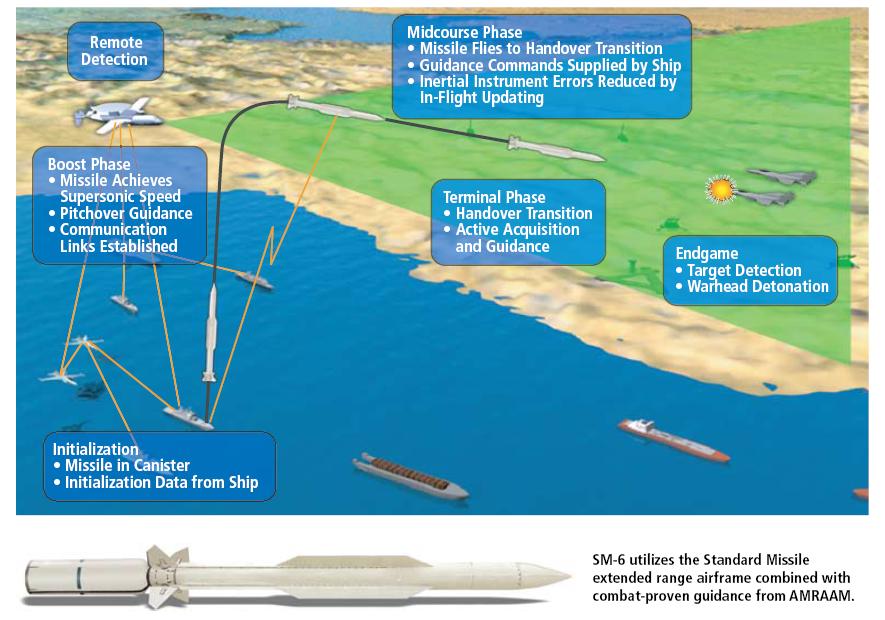
E-2D is a big target (RCS) easily downed by AWACS Killer missile, like K-100, PL-15, R-33/37/37M
blackadamThough gaining operational experience on the Sukhoi Su-30SM and Su-34 is likely an important aspect of the Russian deployment, the Russians might have another objective in deploying their latest jets to the theatre. “It may be a way for them to ‘characterize’ the F-22’s radar emissions on their radar warning receivers (RWR) in a real-world environment,” the senior Air Force intelligence official said. “Not traditional intelligence collection per se, but could be a way to see how their RWRs receive and display an F-22’s radar emissions.”
More disturbing is the Kremlin’s deployment of aircraft to Syria allows it to observe advanced U.S. aircraft operating in Syria such as the Lockheed Martin F-22 Raptor. Kremlin aircraft can track the stealth jet’s radar emissions. Russia is using its air campaign in Syria as an opportunity to gather intelligence on U.S. forces. According to one U.S. Air Force official, Russia is using its newer air-to-air assets as a form of “operational testing” in an actual combat environment. Russia wants to do this with the Su-34 (NATO reporting name: “Fullback”) and Flanker-C while the U.S. is doing the same with the F-22. These Russian aircraft characterize the F-22’s radar emissions on their radar warning receivers (RWRs). Russia’s Flanker-Cs and other air superiority fighters (ASFs) may also be present to ward off Western intelligence assets from spying on Russian forces.
blackadamAlong one mode of operation similar to the passive sensor
The Kolchuga (Кольчуга Chainmail) passive sensor is an ESM system developed in the Soviet Union and manufactured in Ukraine. Its detection range is limited by line-of-sight but may be up to 800 km (500 mi) for very high altitude, very powerful emitters. Frequently referred to as Kolchuga Radar, the system is not really a radar, but an ESM system comprising three or four receivers, deployed tens of kilometres apart, which detect and track aircraft by triangulation and multilateration of their RF emissions
That Kolchuga can detect US stealth aircraft by their radio and radar emissions. Whilst technically possible. Kolchuga is sufficiently sensitive to detect US stealth aircraft from unconventional sources of RF emissions, including radiation from exhaust trails and electromagnetic interference from the engine
blackadamThe Russian UAV goes a step further by integrating a sophisticated electronic warfare suite onto the aircraft. According to Flight Global, “Mikheev says KRET is providing a deeply-integrated electronic warfare system that not only provides a protective electromagnetic sphere around the aircraft to counter air-to-air missiles, but also cloaks it from radars.” Thus, if true, Russia’s new UAV would be able to detect America’s stealth aircraft without itself being detected. That could be a deadly combination.
blackadamMany parts that supersonic missiles are vulnerable to detection by infrared signature. I suppose this is true but major shortcomings
– It’s easy to be detected, but at close range (10km<), the electronic-optical system of the CIWS can detect large IR signature, if the target speed as the YJ-18, PJ-10 reached Mach 2 or more.
+ However in scope 10km <, it is difficult to intercept the target Mach 3
+ Large infrared signatures only used to detect ICBM, does not apply to supersonic sea-skimming anti-ship missiles
blackadamU.S. Navy destroyer nears islands built by China in South China Sea
http://news.yahoo.com/u-navy-send-destroyer-within-12-miles-chinese-175837956.html
China expresses anger at US warship entering South China Sea, sends own destroyers in response
What if: DDG-82 (Lassen) against both of warship Type 052C (Lanzhou) & Sovremenny (Taizhou) ?
DDG-82 strength
VLS mk41: 96 x SM-2ER missile
SPY- 1 D( V) radar: SPY-1D(V), the Littoral Warfare Radar, was an upgrade introduced in 1998 with new track initiation processor for high clutter near-coast operations, where the earlier “blue water” systems were especially weak. The wave form is coded and signal processing is improved (but just useful in Aegis system for Carrier battle group)
Speed: exceeds 30 knots (56 km/h; 35 mph)
DDG-82 weakness:
No add anti-ship missile: Harpoon, NSM, LRASM….
High radar reflectivity, similar Sovremenny class
No add ESSM, Sea RAM
The strength of the Type 052C mixture (Lanzhou) & Sovremenny (Taizhou):
Radar’s Sovremenny farther than range radar AN / SPY-1, however it is not a 3D radar, Type 052C is equipped with AESA radar. However, with a shorter range than the AN / SPY-1D (V)
Anti-ship missile: P-270 and YJ-62, both of missiles a range of over 200 km, Mach 0.8 (YJ-62) and Mach 3 (P-270)
blackadamupdate 2015
Although Russia is behind the United States on the use of cruise missiles, but in Syria Russia showed their ability, have more points than the US:
1. Russia used the small vessels, frigates and corvette to launcher Klub missile. TLAM only used by large ships, such as cruisers (CG47), destroyers (DDG51) and battleships (Missouri)


2. Klub is a range of effective advertising than previously Klub for land-attack only about 1000km, TLAM in the Gulf War was not fired from a range as advertised (1000km), the USS Missouri was attacked by the P-15 or HY-2 shore-based anti-ship missile of Iraq fired from coast (about 100km)
blackadamWeakness: J-10B
Delta-canard (RCS head-on increases)
ECM useless against AAM-4B
Quality WS-10A engine is unstable and weaknesses of China’s aviation technology
Weakness: F-2
No IRST
RCS larger than J-10B because no design DSI, RAM no paint
FCR (J/APG-1) and AAM-4B seeker with a narrow scan angle, short-range (comparison with PESA, pulse-Doppler), they have weaknesses of AESA technology
blackadamJ-20 is not stealth
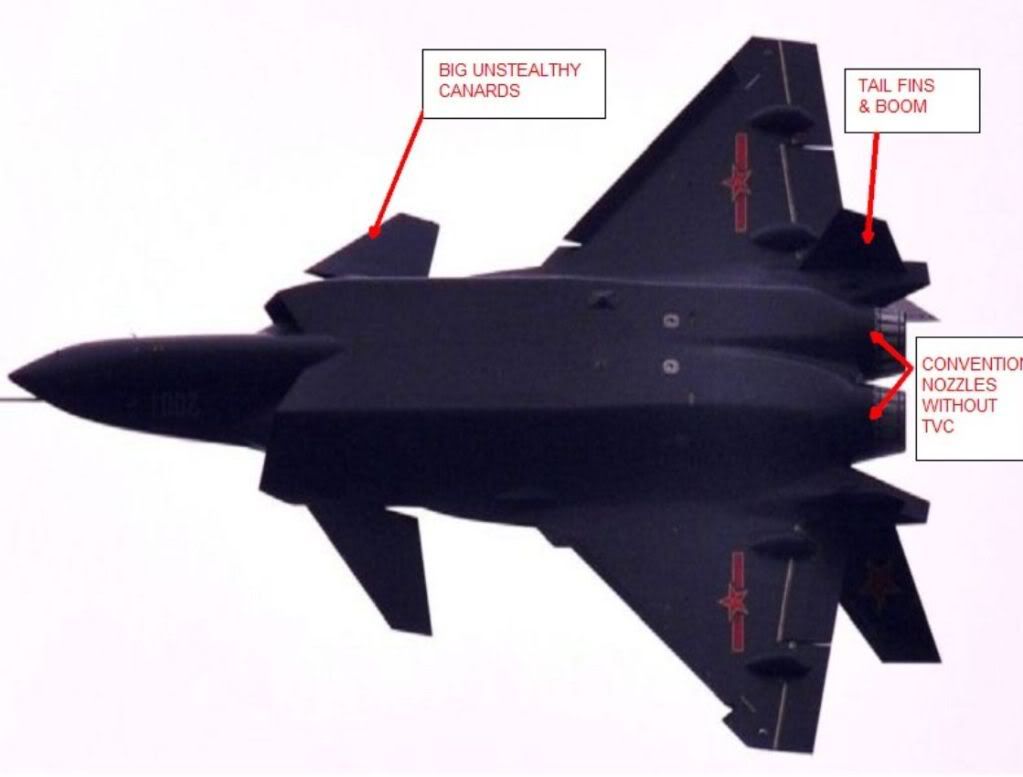
blackadamSorry, but please check at least the basic facts.
J-11/J-11A = basic Su-27SK
J-11B = modernised J-11B + Chinese Systems (avionics, engine, weapons)
J-11D = MLU-program …J-11BS = Su-27UBK combined with J-11B-upgrades
J-15 = Su-33 clone if You like to tell it this way !
J-16 = Su-30MKK clone if You like to tell it this way !Deino
J-10 = F-16A, Mirage F-1
J-10B = F-16C, Mirage 2000-5
J-11A = Su-27SK/F-15A
J-11B = Su-27P
J-11D = F-15C
J-16 = Su-30MKK
J-15 = Su-33
China has no aircraft comparable to the latest models such as Su-27SKM / 27SM, Su-30MKI, the F-16E, F-15SE, F / A-18E / F, the MiG-29K, the Rafale, Typhoon. China only produce models compared with the older generation
blackadamI was referring to Su-27 with the first part. The F-22 has a higher TWR compared to all variants of the Su-27 incl. the Su-35S (assuming the same fuel fraction). If we go with public figures (which I’m very sceptical about), the F-15 has a greater g-limit in at a specific speed and altitude (its roughly achieves corner velocity there). But across a broader span of flight regimes, I don’t see it keeping up with the F-22 with its lower effective wing loading (body-lift) and TVC.
Anecdotal, but comes from the other side – Ex. Taufan: Turning and burning with the best. Most other accounts of BFM against the F-22 run on a similar theme.
The Rafale/Su-30 can perhaps match it in the subsonic region, F-15 in the transonic and the F-16/EF would come close when flying Mach 1.2+. But as a whole, its only peer will be the PAK FA.
No way:
Apparently along with the Rafale, one aircraft which proved to be a real threat for the F-22 is the Eurofighter Typhoon: during the 2012 Red Flag-Alaska, the German Eurofighters not only held their own, but reportedly achieved several kills on the Raptors.
Even though with don’t know anything about the ROE (Rules Of Engagement) set for that training sorties and, at the same time, the outcome of those mock air-to-air combat is still much debated (as there are different accounts of those simulated battles), the “F-22 vs Typhoon at RF-A” story, raised some questions about the threat posed to the Raptor by advanced, unstealthy, 4th Gen. fighter jets.
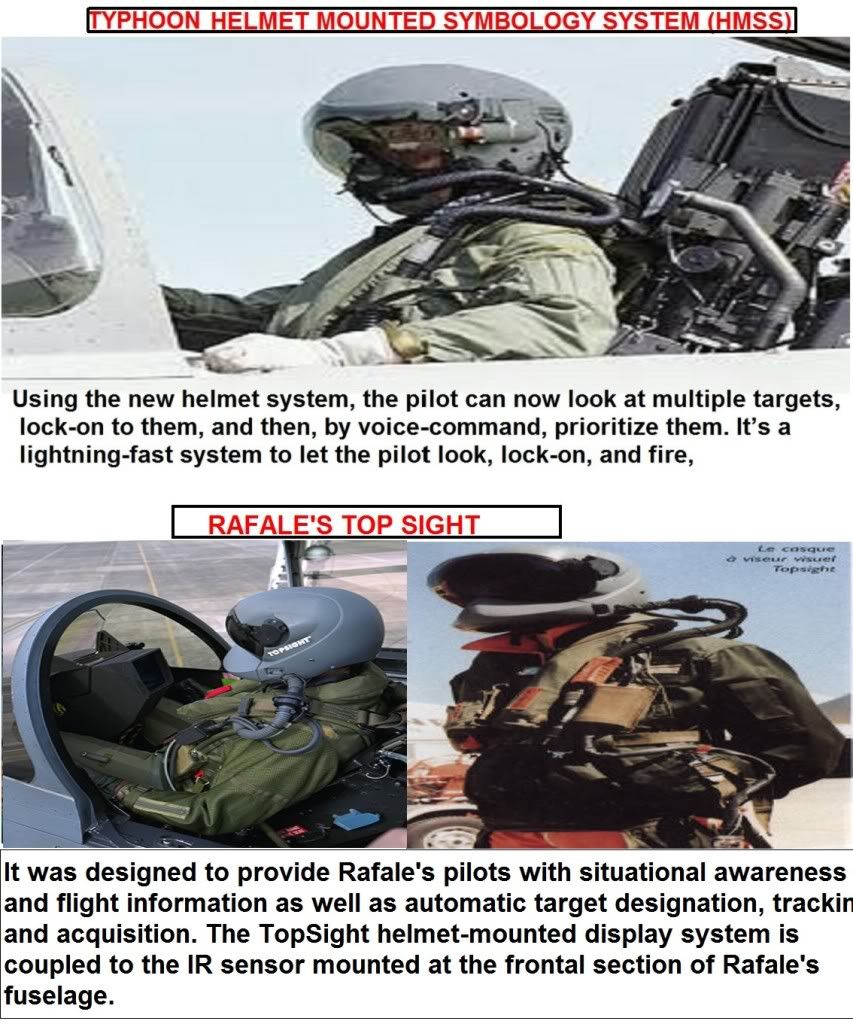
In fact, even though these aircraft are not stealth, Typhoons are equipped with Helmet Mounted Display (HMD) systems and IRST (the Infra-Red Search and Track), two missing features on Raptors.
The Typhoon’s HMD is called Helmet Mounted Symbology System (HMSS). Just like the American JHMCS (Joint Helmet Mounted Cueing System) which is integrated in the U.S. F-15C/D, F-16 Block 40 and 50 and F-18C/D/E/F, HMSS provides the essential flight and weapon aiming information through line of sight imagery. Information imagery (including aircraft’s airspeed, altitude, weapons status, aiming etc) are projected on the visor (the HEA – Helmet Equipment Assembly – for the Typhoon) , enabling the pilot to look out in any direction with all the required data always in his field of vision.
The F-22 Raptor is not equipped with a similar system (the project to implement it was axed following 2013 budget cuts). The main reason for not using it on the stealth jet is that it was believed neither an HMD, nor HOBS (High Off-Boresight) weapons that are fired using these helmets, were needed since no opponents would get close enough to be engaged with an AIM-9X in a cone more than 80 degrees to either side of the nose of the aircraft.
Sure, but the risk of coming to close range with an opponent is still high and at distances up to 50 km an aircraft equipped with an IRST (Infra-Red Search and Track) system, which can detect the IR signature of an enemy fighter (that’s why Aggressors at Red Flag carry IRST pods….), could even be able to find a stealthy plane “especially if it is large and hot, like the F-22″ as a Eurofighter pilot once said.
Summing up, the F-22 is and remains the most lethal air superiority fighter ever. Still, it lacks some nice features that could be useful to face hordes of enemy aircraft, especially if these include F-15s, Typhoons, Rafales or, in the future, the Chinese J-20 and Russian PAK-FA.
We—the U.S. [Department of Defense]—haven’t been pursuing appropriate methods to counter EA [electronic attack] for years,” a senior Air Force official with extensive experience on the F-22 told The Daily Beast. “So, while we are stealthy, we will have a hard time working our way through the EA to target [an enemy aircraft such as a Russian-built Sukhoi] Su-35s and our missiles will have a hard time killing them.”
The problem is that many potential adversaries, such as the Chinese and the Russians, have developed advanced digital radio frequency memory (DRFM) jammers. These jammers, which effectively memorize an incoming radar signal and repeat it back to the sender, seriously hamper the performance of friendly radars.
Worse, these new jammers essentially blind the small radars found onboard air-to-air missiles like the Raytheon AIM-120 AMRAAM, which is the primary long-range weapon for all U.S. and most allied fighter planes.
That means it could take several missile shots to kill an enemy fighter, even for an advanced stealth aircraft like the Raptor. “While exact Pk [probability of kill] numbers are classified, let’s just say that I won’t be killing these guys one for one,” the senior Air Force official said. It’s the “same issue” for earlier American fighters like the F-15, F-16, or F/A-18.
Another Air Force official with experience on the stealthy new F-35 Joint Strike Fighter agreed. “AMRAAM’s had some great upgrades over the years, but at the end of the day, it’s old technology and wasn’t really designed with today’s significant EA in mind,” this official said.
Like boxers, every missile has a reach, a range, a limit to how far it can hit. In the not-too-distant future, the AMRAAM might also be out-ranged by new weapons that are being developed around the world. Particularly, Russia is known to be developing an extremely long-range weapon called the K-100 that has far better reach than anything currently in existence.
The problem is not a new one. Historically, the Pentagon has always prioritized the development of new fighters over the development new weapons—it’s a uniquely American blind spot. During the 1970s, the then brand new F-15A Eagle carried the same antiquated armament as the Vietnam-era F-4 Phantom II. It wasn’t until the 1990s that the F-15 received a weapon in the form of the AMRAAM that could take full advantage of its abilities. The same applies to short-range weapons—it wasn’t until the early 2000s with the introduction of the AIM-9X that the U.S. had a dogfighting weapon that could match or better the Russian R-73 Archer missile.
AIM-120C5/6/9M not good as AIM-120C7/8/9X, they has a short range and medium range about 100km, is not designed to combat the ECM and DRFM with newer technologies.
Until this point, the F-22 had no HMDS and AIM-9X / 120D. It would disadvantage when against MiG-35, J-11D, Rafale, Typhoon, Su-35S is equipped with missiles R-77-1, R-37M, R-77M, Meteor, PL-12D / 15.
blackadamPLA needs both J-11D and Su-35 fighters: Sina Military
J-11D with an anonymous AESA radar, obviously not about performance, missile PL-15 and PL-10 have not been integrated for J-11D. Also similar to radar, missiles China often exaggerate the range. China still needs Su-35S, technology of China motor is unstable, the flexibility of the line J-11 is normal, not outstanding compared with Rafale, Su-30MKI India or F-15K / J of Japan, South Korea
http://www.wantchinatimes.com/news-subclass-cnt.aspx?id=20150503000118&cid=1101
blackadam1. F-22 is not a stealth aircraft world number one. F-35 has RCS smaller than F-22
I have serious doubts about this.. The Raptor is the only fighter giving emphasis on rear aspect RCS reduction. There might be discrete angles where the F-35 has smaller RCS, but overall value is hardly anywhere near the F-22.2. The F-22 is not the aircraft avionics world number one. F-35, Typhoon and Rafale have even better technology on F-22’s systems
That’s not exactly news. The architecture of Raptor’s systems is two and half decades old3. The F-22 is not the most maneuverable aircraft world. Su-27/30/35, Rafale, F-15C, F-16C/E, Typhoon even J-10/11 are the maneuverability aircraft F-22 higher
BS, IMHO.. The F-15 or J-10 don’t even come close.. I believe that Raptor excels in hi-speed maneuverability over pretty much anything, at low speeds it’s debatable.4. F-22 in the duel with Typhoon, EA-18G, Rafale ….! F-22 are intended to fail.
Is that an argument? 🙂5. F-22 aircraft is the only 5th generation no HMDS system, Typhoon, Rafale even MiG-35 are equipped with this system.
Last time I checked, Rafale did not have any HMDS.6. F-22 aircraft is the only 5th generation without using materials RAM
F-22s fly without RAM? Who told you that?7. F-22 is struggling to upgrade avionics and weapons. Expected in the period 2017-2020, the F-22 can use the AIM-9X, AIM-120D and HMDS was put on equipment.
That’s true.. Even worse, the various Blocks are not directly compatible with each other, the earlier ones being harder to upgrade than the later ones.8. F-22 is a 5th generation aircraft first encounter many accidents.
How many is many accidents? There is the well known asphyxia problem, what else?9. F-22 does not have the ability to use anti-ship weapon.
I don’t think it was ever intended to use one…10. The maximum speed of the F-22 is inferior to the MiG-21 and F-4
Irrelevant.. What matters is the range at the max. cruise speed.11. Until the present time, the F-22 only use AIM-9M, AIM-120C5/6 (unknown F-22 can use version AIM-12C7)
True.. And Su-35S only can use R-73 and R-77 and R-27s. Rafale only can use MICA and Magic. What’s wrong with that?
F-22 does not have RAM like F-35, F-35 to apply the latest technology, it’s entirely a RCS smaller than F-22 is a certainty
F-22 processor system is less than iphone 6. F-22 just as the technology of the 1990s
Is that an argument?
EA-18G Smokes An F-22

http://www.strategypage.com/htmw/htintel/20090301.aspx
Last time I checked, Rafale did not have any HMDS.
Really ?!

F-22s fly without RAM? Who told you that?
F-22 project recently using the F-35’s RAM. Previously it absolutely no RAM
F-35 Stealth Coatings Applied to F-22
Shane McGlaun (Blog) – April 7, 2011 10:32 AM
– See more at: http://www.dailytech.com/F35+Stealth+Coatings+Applied+to+F22/article21321.htm
Rafale with meteor missile

http://www.airforce-technology.com/news/newsfrench-air-force-rafale-missile
R-77-1 (RVV-SD) on Su-35S

http://topwar.ru/82725-raketa-vozduh-vozduh-sredney-dalnosti-rvv-sd.html
The missile R-77-1, Meteor offers greater range AIM-120C5 on F-22
With no equipped AIM-9X, AIM-120D. F-22 completely inferior to the 4+/4.5 generation aircraft
blackadamScoop :very_drunk:
It is merely one integrated projects, the current F-22 can not use the entire AIM-9X


 Sign In








