 blackadam
Which supercomputer? There are many in China. Fastest use Xeons + accelerators, but not all.
Dawning 6000 (Loongson 3#) : 300 TFLOPS, Projected Peak ~1.0 PFLOPS
Sunway BlueLight MPP (ShenWei SW1600) : Peak 1.07 PFLOPS
Tianhe-1 (Xeon E5540, E5450, Radeon HD 4870 X2) : Peak 1.2 PFLOPS
Tianhe-1A (Xeon X5670, Tesla M2050) : Peak 4.7 PFLOPS
Tianhe-2 (Xeon E5-2692, Xeon Phi 31S1P) : Peak 33.86 PFLOPSWrong! PL-9C is an export missile and China uses PL-8B which is an improved copy of the Python-III (Israel). Original SD-10 which is an export missile is said to have a Russian seeker (Agat?), but what the PL-12 has is a different matter.
China imports R-77 & R-73? Off-course! Thats normal. Su-27UBK, J-11/11A, Su-30MKK/MK2 all use those missiles. But 5000? 😮 😮 😮
HUH? Proof? 😮
PL-10 : a.k.a. PL-ASR is a short ranged IR missile
PL-11 : semi-active radar homing missile (Aspide seeker).
PL-12 : active radar homing missile
HQ-61C : A near obsolete SAM
TY-60 : What the hell is a TY-60? You must have mixed-up with LY-60 or TY-90.
oh really ? Tianhe-2 (MilkyWay-2) – TH-IVB-FEP Cluster, Intel Xeon E5-2692 12C 2.200GHz, TH Express-2, Intel Xeon Phi 31S1P :highly_amused: Xeon not make by China tech, please !
http://www.top500.org/system/177999
PL-10/LY-60/HQ-61/PL-11/12
PL-12 seeker head
Prior to the emergence of the PL-12, China’s active radar seeker AAM development programme was sometimes identified as the ‘AMR-1’. During Air Show China 1996, held during November in Zhuhai, the China Leihua Electronic Technology Research Institute/No 607 Research Institute exhibited a newly developed active radar seeker, the AMR-1. This seeker was, in turn, believed to have been applied to a new air- to-air missile design, derived from the LY-60 surface-to-air missile, and dubbed the ‘PL-12’. This active radar missile, and the earlier semi-active radar homing PL-11, seemed to have a common design heritage with the Italian Aspide missile, supplied to China during the late 1980s. The status of the PL-11 and ‘LY-60/PL-12’ development programmes is unclear, but sources within CATIC say these earlier programmes have all been abandoned in favor of the PL-12.
PL-12 – Wikipedia, the free encyclopedia
PL-11 seeker head
The AMR-1 is an advanced next-generation medium-range active terminal guidance air-to-air missile seeker developed by China’s Leihua Electronic Technology Research Institute. The flat-plate antenna bears some resemblance to that of active version of Russian AA-10, although the extent of Russian assistance if any is unclear. The seeker may be integrated onto PL-11 [Pili = Thunderbolt, or Pen Lung = Air Dragon] air-to-air missile which is reportedly based on the Italian Aspide airframe. The seeker is equipped with a miniaturized pulse Doppler radar and has the following capabilities: all- weather and omnibearing attack, low- latitude down-firing, fire-and-forget beyond-the-horizon launch, and interception and tracking of target in complicated electronic interference environments. Its technical sophistication is close to that of the advanced medium-range air-to-air missile, AMRAAM and Russia’s P-77 “fire-and-forget” missile which has caught worldwide interest. However, an insufficient military budget and low-price competition from Russian missiles have cast batch production of this missile into doubt.
AMR-1
PL-10 seeker head
The Air Force version of the LY-60 is the FD-60 semi-active radar-guided air-to-air missile carried by the J8B fighter plane, which is very similar to the Aspide AAM of Italy in appearance. This missile, which is evidently also known as the PL-10 [Pili = Thunderbolt, or Pen Lung = Air Dragon] medium range air-to-air missile is a Chinese copy of the Italian Aspide, which was developed from the American AIM-7E Sparrow. The bodies of the two missiles are generally similar, though the wings of the air-to-air PL-10 mirror those of the Sparrow, while the LY-60 wings have evidently been truncated to improve storage. The application of the same missile to both air-to-air and ship-to-air applications emulates the American practice with the Sparrow, which started life as an air-to-air missile with subsequent shipboard deployments.
LY-60 / PL-10
PL-11A的主动雷达导引头改型。装有607所研制的AMR-1主动导引头
霹雳11空空导弹_百度百科
霹雳”-12使用607所于九十年代末研制成功的AMR-1主动雷达导引头。未经证实的报道称AMR-1的研制得到了俄国“玛瑙”设计局的技术支持,而正是该设计局研制了R-77/AA-12主动雷达制导中距空空导弹的导引头。也有报道称“霹雳”-12使用了一些基于以色列“女低音”中距空空导弹的元件,但未经证实。“霹雳”-12由中国设计的火箭发动机推进,最大射程70千米,最大速度4倍音速。据称该导弹机动性优于俄国R-77,综合性能接近美国AIM-120A。
我国自主研发的“霹雳”-12中距空空导弹 图 对日本:菩萨心肠还是霹雳手段? 转贴 图 — ido.3mt.com.cn
The source of China’s ridiculous, they collide with each other:
active seeker may have evolved from the earlier AMR-1 design (R-129? based on Russian 9B-1348 seeker & datalink for R-77)
Chinese Military Aviation: Missiles I
絲帶用彈 – 萬維論壇
But please read note: R-77 uses new technology called multifunction doppler-monopulse. PL-12/11/10 seeker head is pulse-doppler. They are different
Remember AMR-1 seeker is designed first on LY-60 missiles it launched in the late 1980s. China has purchased R-77 missiles the first time, be accompanied by Su-30MKK in 1991-2004
blackadamChinese AESA radar is beyond the capacity, they have radar for KJ-2000’s but it is an A-50, Israeli PESA radar (rumor radar unknown name AESA pick up from Type 346 radar of Type 052C class) , they have AESA radar for the Type 052C / D, but it is a radar designed by Ukraine (Type 346/348).
China can design an AESA radar large size based on technology transfer of Ukraine (Kvant radar for KJ-2000 and Type 052C/D), however, an AESA radar small size is difficult for them
blackadamYou have to ask Deino, because I’m not too familiar with Chinese aviation. That said, I think the sources you used are not accurate at all, which is not to say that the Chinese aren’t running into difficulties though. Even so, they’ve made some remarkable progress. I guess we wait and see.
Radar T-50 is no related to this topic. I wrote below
China can produce seeker for Ashm YJ-82/83/8/62/12 large size (even HQ-2, HQ-9, DF-21, KT-1, JL-2) , they mostly contain electronic circuits with large size, China can easily copy, but for the small seeker as R-27/77, AIM-120, China is not likely, because a tiny circuit sizes are difficult to copy the design, performance of China’s missile arsenal as PL 9/10/11/12 is also a big question mark?
Another proof, the Chinese do not have the ability to design the semiconductor, IC best small (micro), they can copy the shape but quality very poor. The most obvious example, China has a lot of SAMs and A2A however with 5 missiles shared a homing seeker head AMR-1 include: PL-10/11/12, HQ-61C, TY-60 has shown the ability to fabricate miniature electronic components in China is very low
blackadamRight off the bat, some factual errors: the PAK FA radar is the N036, not the N050 (no such thing). The nose and cheek arrays of the N036 are X-band, and the L-band slat arrays are IFF.
Also, please please please don’t cite wantchinatimes as a source, as that trash achieves the amazing feat of being even worse than Fox News in reliability and accuracy.
Mean this theard chinese AESA radars already, it is rumor
Any names or prototype chip of AESA radar China ! for J-10B/11B/15/16/20/31 ?[/B] :apologetic:
blackadamChina can produce seeker for Ashm YJ-82/83/8/62/12 large size (even HQ-2, HQ-9, DF-21, KT-1, JL-2) , they mostly contain electronic circuits with large size, China can easily copy, but for the small seeker as R-27/77, AIM-120, China is not likely, because a tiny circuit sizes are difficult to copy the design, performance of China’s missile arsenal as PL 9/10/11/12 is also a big question mark?
seeker C-704 & R-77
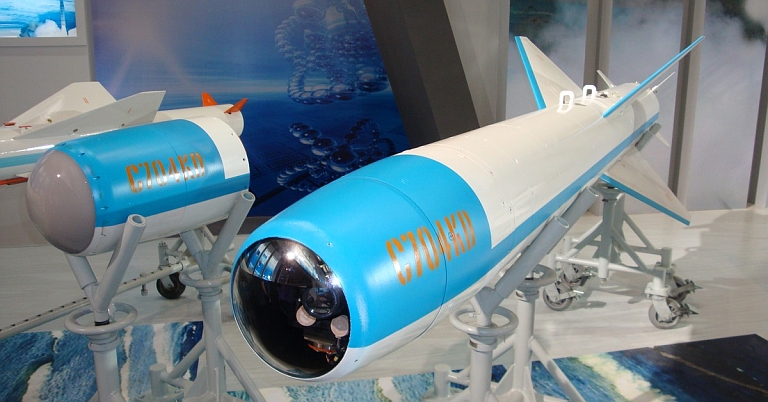

Ashm (C-802) is larger more than A2A (SD-10)
[ATTACH=CONFIG]234432[/ATTACH]
blackadamSu-24m2 is equipped with missiles R-73M / E newest 40km range, all-aspect, fire-n-forget, they can shoot Kh-59MK range of 285km. Khibiny ECM is extremely effective, it has been used Su-24 jamming DDG 75 at the black sea. Su-24 is capable of bearing 6.5+ g-limit
blackadamThe Russians do not have the IIR seeker missiles can LOAL
blackadamAN/ALQ-187
The AN/ALQ-187 is an internally mounted version of the AN/ALQ-184(V). Offered by Raytheon as the Advanced Self-Protection Integrated Suite (ASPIS) as an alternative to the AN/ALQ-165 ASPJ and ordered by Hellenic Air Force for the F-16C/D Block 52+. Fully integrated with the AN/ALR-93(V) Threat Warning System and AN/ALE-47 Countermeasures Dispenser System. Latest development is the ASPIS II, using DRFM (Digital Radio Frequency Memory). DRFM is designed to digitize an incoming RF input signal at a frequency and bandwidth necessary to adequately represent the signal, then reconstruct that RF signal when required. The most significant aspect of DRFM is that as a digital “duplicate” of the received signal, it is coherent with the source of the received signal. As opposed to analog ‘memory loops’, there is no signal degradation caused by continuously cycling the energy through a front-end amplifier which allows for greater range errors for reactive jamming and allows for predictive jamming.
Promotional clip about the MSP-418K Jammer pod produced by the “CNIRTI” ( http://www.cnirti.ru )
MSP-418K is a Russian lightweight, high performance jammer for the MiG-29. It uses DRFM (Digital RF Memory) technology and covers the G-J-band range (4-18 GHz). The pod’s weight is 150kg, dimensions are 230 x 225 x 3,800mm. It has 120° azimuth, 60° elevation coverage.
blackadamMISSILE THREATS GROW AND GROW
By SOF Editor on Mon, 07/28/2014 – 10:52am
Printer Friendly VersionPrinter Friendly VersionSend to a FriendSend to a Friend
China, Russia Deploying Deadlier Missiles
By SOF
China and Russia have been developing new missiles that could not only threaten the United States, but some could also be flaunting arms-control treaties. The threats include both cruise missiles and ballistic missiles.
According to a report in the Washington Free Beacon, Admiral Jonathan Greenert, the Chief of Naval Operations, issued the warning about China’s during a security conference in Aspen, Colorado. General Martin Dempsey also spoke at the conference last week, where he stated the United States was planning to take down the Islamic State of Iraq and the Levant (ISIL), also known as the Islamic State of Iraq and Syria (ISIS).
During a speech, Greenert said, “They have an extraordinary selection of cruise missiles, and a ballistic missile force that they developed.” Greenert particularly expressed concern over the DF-21D anti-ship ballistic missile, which has a range of 930 miles. The DF-21D could be countered by the RIM-161 SM-3 missile, but that would take up cells in the Mk 41 Vertical Launch Systems on Ticonderoga-class cruisers and Arleigh Burke-class destroyers.
The growing ChiCom arsenal of missiles could place American bases on Guam and Okinawa at risk of attack. China has been acquiring new ships, and its fleet of H-6 Badger bombers are being upgraded to carry as many as a half-dozen cruise missiles.
Russia, however, has not been standing still. According to a report by National Review Online, two new Russian missiles, the RS-26 Rubezh, and the Iskander K, are being developed – and both are blatant violations of the INF Treaty signed in 1987. The treaty bans all land-based missiles with ranges between 500 and 5500 kilometers (300 to 3,300 miles).
The 9K270 Iskander M is capable of flying at speeds up to Mach 7, and can deliver a 700-kilogram high-explosive warhead against targets as far away as 250 miles. The Iskander K reportedly has been tested at unidentified ranged that would violate the treaty. The RS-26 was reportedly tested with a single warhead at a range of 5,600 kilometers, but when additional warheads are added, the missile’s range decreases to those proscribed by the treaty.
blackadamNo warship has armor as thick as the heaviest tank frontal arc arrays- they would weigh far too much.
But that would not be an issue. The HEAT stream of typical ATGMs has a relatively “short” reach. Warships have many spaced decks and bulkheads and hull layers.
HEAT warheads are meant to penetrate a really dense small array, not the great amount of space warships have to absorb a hit.
Further the stream is really localized, so unless someone happened to be right behind the hull where it hit….it probably wouldn’t do anything.So yeah, no ATGM used today is anywhere near big enough to do anything substantial.
All we know the modern warship designed not as durable as WW2 warship shells or MBT. Take a look at the level of ATGM piercing
AT-14 RHA 1000–1300 mm
AT-16 Wicher-M 1200 RHA mm
TOW2A 1000 mm RHA
AGM-114 >> 900 mm RHA
ERYX >900 mm RHA
HJ-8 > 800 mm RHA
HJ-9 1100 – 1200 mm RHA
HJ-12 1100 mm RHA
Spike-ER 1000 mm RHA
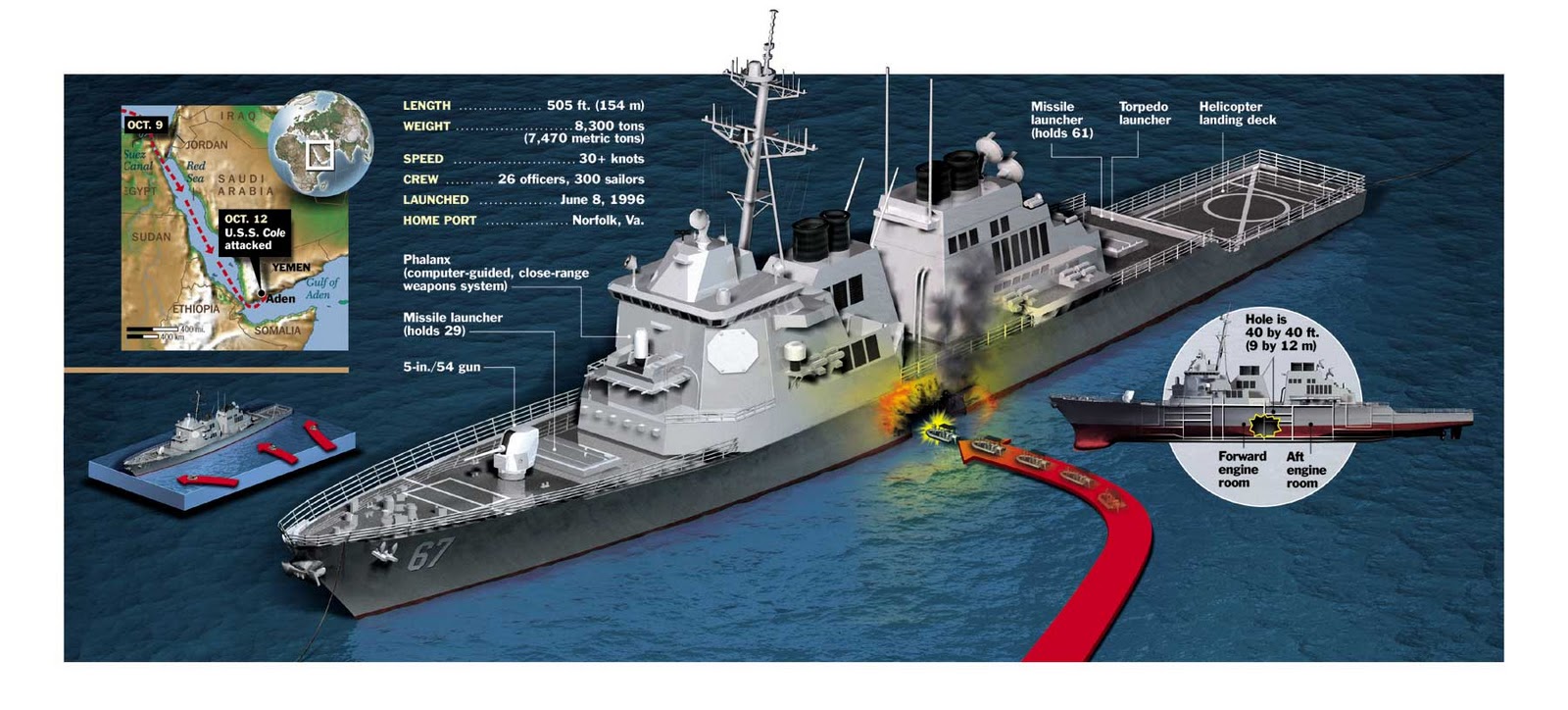
And remember always comes HEAT warhead with a blast, just 5-10 ATGM focus on one target it will have devastating greater than 1 quantity of explosives used to bomb the USS Cole
blackadamThe Sensor Becoming the Shooter
After decades of relying exclusively on laser and GPS for precision attack, the military and US special operations community is slowly opening to consider Electro-Optically (EO) guided weapons, gaining strike precision at extended range. In a recent test conducted by NAVSEA, six Spike EO guided missiles were launched from an USV-PEM unmanned boat, engaging targets 1.9 nautical miles (3.5 km) away. Such capabilities will further develop as EO guidance techniques become feasible and affordable, relying on matured image processing techniques, Micro-Electro Mechanical Systems (MEMS), miniaturized imaging sensors, navigation and communications derived from commercial off the shelf technologies.
This trend is correlated with a shift in military focus, from traditional linear battles toward asymmetric warfare. Different from the hardened, well-protected and distinct military targets of the past that could be neutralized by massive penetrating warheads today’s targets are vulnerable, yet illusive. They lack distinct signatures pursued by automatic target recognition, but are clearly recognized by the human operator, hence, bringing back ‘man in the loop’ control. Such control has been realized as imperative for modern asymmetric warfare, facilitating maximum flexibility in seizing short term opportunities while eliminating engagement of innocent people which the enemy often use as ‘human shields’, when briefly exposed in the open.
Outside the USA EO guided missiles became much more popular, with the Israeli Spike missile with its four variants leading the way for more than 20 armies worldwide, including the largest forces in NATO. Spike was developed and produced by Rafael Advanced Defense Systems. This weapon offers the most advanced level of EO guidance, dubbed ‘4th Generation’. The Israeli Tamuz – also known as Spike NLOS, was fielded by the IDF two decades ago, became the first land-based missile to strap a thermal imaging sensor to enable the operator to ‘see’ the target from the missile’s point of view. For the first time, the lengthy and complex ‘sensor to shooter’ coordination cycle was reduced into minutes and seconds.
Subscribe or Log-in to Defense-Update read the full version of this analysis
The Spike developer RAFAEL considers the system should maintain its development course as an EO system – enhancing the system through the improvement phased improvements – introducing Miniature Electro-Mechanical Systems (MEMS), large matrix imaging sensors and versatile actuating systems enabling manufacturers to drive weapons cost to the level of laser guided weaponry, shrinking the size to introduce smaller and lighter precision weapons, and enabling the warfighters on land, at sea and in the air to carry out their missions much more effectively, while remaining safe at stand-off distance.
Spike LR Missile launched from a Typhoon weapon station on an Israel Navy Super Dvora Mk 2. A similar configuration was recently tested by the US Navy, from an unmanned surface vessel (USV-PEM). Photo: RAFAEL
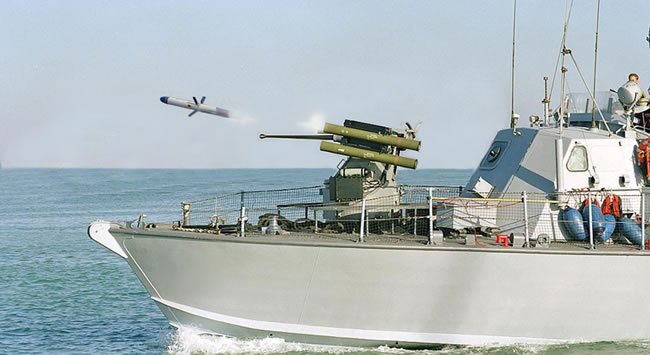
Spike LR Missile launched from a Typhoon weapon station on an Israel Navy Super Dvora Mk 2. A similar configuration was recently tested by the US Navy, from an unmanned surface vessel (USV-PEM). Photo: RAFAEL
http://defense-update.com/20121031_the-sensor-becoming-the-shooter.html#.VFRHL8k2SZ8
blackadamAnalysis: Turkish F-16 shoots down Syrian MiG-23 2014
http://airheadsfly.com/2014/03/23/turkish-f-16-shoots-down-syrian-bomber/
blackadamF-8 also has an impressive record MiG Killer, shot down 19 MiG-17 and 21
blackadamSweden and Norway have used Hellfire for coastal defense for decades.
USN uses SM2 against air and surface targets.
Its a matter of proper guidance, fuzing and warhead effects against the target of choice.
Sweden and Norway have used Hellfire for coastal defense for decades.
USN uses SM2 against air and surface targets.
Its a matter of proper guidance, fuzing and warhead effects against the target of choice.
Thank 🙂
Maybe HEAT ammo could against the warship hull ! Modern ships like the CG-47 class ships or the Aegis system fitted similar in design weight reduction. Therefore, they do not focus on armor, but for the Russian warships, they still focus on armor, I was reading the Kirov Battlecrusier class has 100mm armor hull on both sides, inside protected some place with 50-76mm armor …..

BQM-74E penetrate the hull USS Chancellorsville (Ticonderoga class)
blackadamThink about CG-62 accident damaged by drone BQM-74. Aegis system still shows weaknesses and need to be overcome
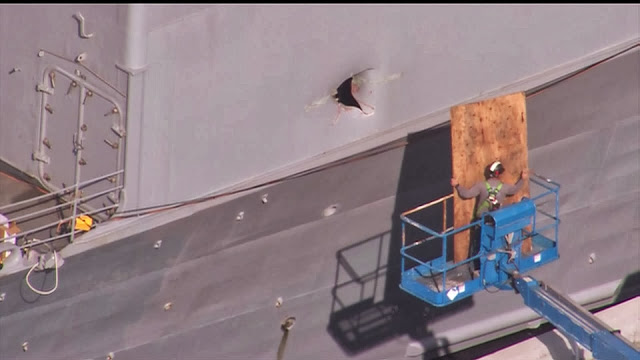
http://www.informationdissemination.net/2013/11/uss-chancellorsville-new-details-tell.html
This is the official press release by the US Navy.
PACIFIC OCEAN (NNS) — An aerial target drone malfunctioned and struck guided missile cruiser USS Chancellorsville (CG 62) off the coast of Southern California at approximately 1:25 pm local time today, Nov. 16, while the ship was conducting a radar tracking exercise during routine training at sea.No Sailors were seriously injured, but two Sailors were treated for minor burns. The ship remains capable of operations, however it did sustain some damage and will return to its homeport of San Diego to have the damage assessed. The Navy is investigating the cause of the malfunction.
That is very vague, so what if we add a bit of factual detail?
PACIFIC OCEAN (NNS) — A BQM-74 aerial target missile drone malfunctioned and struck a direct hit in the port side of the guided missile cruiser USS Chancellorsville (CG 62) off the coast of Southern California at approximately 1:25 pm local time today, Nov. 16, while the ship was conducting a radar tracking exercise of the BQM-74 during routine training at sea. USS Chancellorsville (CG 62) is currently conducting Combat System Ships Qualification Trials for Baseline 9 of the AEGIS combat system – the most advanced version of the AEGIS combat system. USS Chancellorsville is currently the only US Navy ship certified with the latest version of the AEGIS combat system.
No Sailors were seriously injured by the direct hit of the missile tracked all the way into the hull of the cruiser, but two Sailors were treated for minor burns. The ships officers and crew may or may not have bravely and intelligently attempted to defend itself from the rogue drone, but what’s really important enough to mention is that the ship and technology on the ship remains capable of operations. However it did sustain some damage from the direct hit that put a two foot hole in the port side of the ship, and as a result USS Chancellorsville (CG 62) will return to its homeport of San Diego to have the damage assessed. The Navy is investigating the cause of the malfunction.
So how is it exactly that the one ship on the planet with the most advanced version of the worlds best anti-missile combat system took a direct hit from a rogue missile drone?
The Navy tells us the drone malfunctioned, and apparently the combat system on the ship had no problems if the ship remains capable of operations, so based on those details of the press release the officers and crew of the USS Chancellorsville tracked the target missile drone – during the radar tracking exercise – apparently as it scored a direct hit into side of the ship.
But the ship was unable to defend itself? I get it that the safety systems were probably engaged that would prevent the full capabilities of the AEGIS combat system from being employed against the rogue drone, but what about the independent close-in point defenses of the cruiser?
The official story, based on the details as released officially, is that the most advanced AEGIS warship in the world tracked a direct hit by a missile drone and was apparently unable to defend itself successfully. Did the ship even try to defend itself from a rogue drone? We don’t know, because the press release focuses on telling the public the technology of the ship is sufficient enough for the ship to conduct normal operations, but tells us no details at all regarding what the crew did or did not do to defend the ship from a direct hit.
There is a detail that is omitted in the official press release, and because it is a detail of the incident known at the time of the press release, we can only assume the omission is intentional for purposes of protecting a reputation. The ships officers and crew apparently did try to defend the ship. The CIWS apparently fired at the BQM-74 but was unsuccessful in defending the ship. That detail matters, because the omission of that detail is the difference between protecting the reputation of the ships officers and crew who tried to defend the ship, or protecting the reputation of a piece of technology that was unsuccessful – for unknown reasons – in performing the technologies primary role as the last line of defense for the ship.
Let’s hope that while the Navy investigates the drone malfunction they also look into why the CIWS was unsuccessful in engaging the rogue drone in defense of the ship. It seems to me the CIWS investigation is much more important than an investigation into the malfunction of a target drone.
Based on where the rogue drone hit the ship, had it been a real ASCM – it could have easily been a mission kill for the ship. This is a very serious incident involving the most advanced AEGIS warship in the US Navy, and the Navy has started the incident with a press release that intentionally omits a critical detail – that the ship tried to defend itself and the specific technology designed to defend the ship for this specific situation failed.
This incident is a big deal, and on the first day there is already a deception effort underway to conceal key details of the incident – an omission that only serves to cast doubt upon the reputation of sailors for purposes of protecting the reputation of a piece of technology. Why did the Navy conceal from the public that the point defense system of the most advanced AEGIS ship in the US Navy failed to protect the ship from a direct hit from a rogue drone?


 Sign In








