Tempest414
Want and need are poles apart the want is there as they already operate 26 fast jets at this time as said its not building a new capability just updating the the one they have
Tempest414As swerve points out it’s not a rebuild that they need its more an upgrade of platforms. The first question is how much life is left in the Kfir’s and can they be upgraded if so this should be done if not then a number of options may be open. When we look at the air force it is well balanced if not a bit type heavy as in it has 26 fast jets 2 large and 9 medium tactical transports and also a good number of transport helicopters
Option 1) Buy 2 new types 10 JF-17’s and 18/20 A-29 Tucano’s
Option 2) buy 8 second hand Mig-29’s and 18 new Yak-130’s
Option 3) Do a deal with Dassault where they find and upgrade 10 Mirage F-1’s and 20 Alpha Jets at a fixed price
The three options are based on operating just two types in the fighter/attack roles with the second type able to conducked a training role and not 4 types with 8 variants
Tempest414Once again you miss the point ships of the fleet conducting home waters duties have air cover from MPA’s and land based fighters and when they are part of a coalition force they may be part of a CBG or have support from a air defence destroyer
The Argentine fleet has worked hard to build a good reputation on the world stage with operations like
Argentina was the only Latin American country to participate in the 1991 Gulf War sending a destroyer and a corvette in first term and a supply ship and another corvette later to participate on the United Nations blockade and sea control effort of the gulf. The success of Operación Alfil (“English: Operation Bishop”) as it was known, with more than 700 interceptions and 25,000 miles sailed on the operations theatre helped to overcome the so-called “Malvinas syndrome”.
From 1990 to 1992, the Baradero-class patrol boats were deployed under UN mandate ONUCA to the Gulf of Fonseca in Central America.[12]
In 1994, the three Drummond-classcorvettes participated on Operation Uphold Democracy in Haiti.[13]
In 2003, for the first time, the Argentine Navy (classified as major non-NATO ally) interoperated with an United States Navy battlegroup when destroyer ARA Sarandí (D-13) joined the USS Enterprise Carrier Strike Group and Destroyer Squadron 18 as a part of Exercise Solid Step during their tour in the Mediterranean Sea.
But right now today the fleet needs new ships to continue this work and dose not need a 10 or so fast jet carrier group for a carrier it dose not have
Tempest414A patrol a/c covers at least 100 times as much area in at most 1/1000 of time compared to a ship.
A few police/patrol boats with the patrol a/c is better in all relevant aspects.
One thinks you have a lot to learn if we go with your thinking all the navy’s in the world can wrap up and stand down
Yes aircraft can cover large areas quickly however once they have spotted something that may not look right they are done and have to hand over to naval ship to have better look
Defence in depth needs both MPA’s and naval ships and what the Argentine navy needs right now is good MPA’s and a workable fleet and not fast jets wasting money carrying out risky touch and goes on someone else’s carriers each hour in the air needs to be spent carrying out real mission profile training not show boating some capability you do not have its not just the fuel it’s the hours it knocks off the airframe every time you slam into the deck and once the air force has F-1 the need for super Ed goes away as F-1 can carry and deliver Exocet
Tempest414Ok, so whom do you propose is going to attack Argentina from the sea ?
Any country with a large cost line needs a workable fleet for home waters defence it is a question patrolling said waters for a number of reasons (area control, piracy, anti-drug and search and rescue )
Tempest414If they do buy the Mirage F-1ms and the simulator it will be a big step forward for the FAA allowing a new way of training and airframe management to take place plus the F-1m will allow them to turn up to regional exercises with real capability.and they have a long way to go before they are fully operational
As for the navy doing deck quals who ever is signing this off should be sacked I think they should lose the fast jet capability and start building a workable fleet for their home waters defence and UN duties as this is a area Argentina is getting some real credit from the likes of the US
Tempest414Take your place at the table of great naval leaders Admiral (RIP)
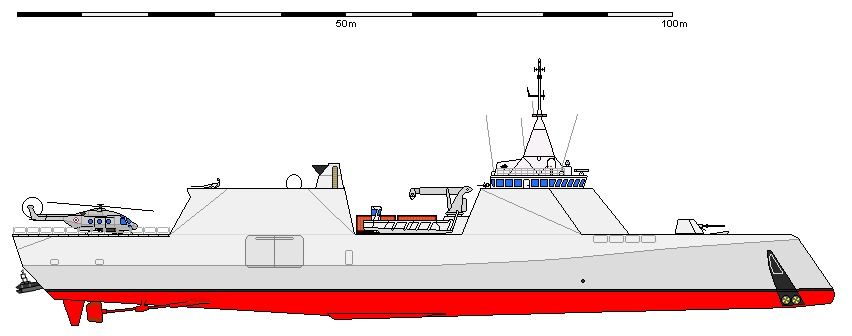
Tempest414Back on topic, it seems like “light frigates” are making inroads with the French & Italians… almost a rebirth of the UK’s C2 “choke point escort” concept!
Both navies are looking at 3,500-4,500t “mini-Absalons” (or “large-LCSs” depending on how you see it), with an emphasis on modular payloads instead of kinetic weapons:
- “Flex” deck for vehicles and accomodation for 100+ passengers/special forces
- Two helicopters
- Deck space for RHIBs, landing craft and/or containers
- Reconfigurable rooms for command spaces, hospitals etc
So basically optimized for sea control, special forces insertions, blockades, or prepositioned forces near failed states and disaster areas. Aside from a gun for NGFS, armament is limited or non-existant, but provisions exist for future add-ons.
The Italian concept – “Multirole Offshore Patrol” vessel
The French concept – “Mid-sized Frigate”
(Note: HIGHLY conjectural drawing, based on sparse info and extrapolating from DCNS’s Advansea concept)
All-in-all, the premise appears to be that there are many many conflicts involving low-tech, assymetric opponents. These “wars” are too intense for OPVs (what with the odd Grad rocket salvo, suicide attack, land-based missile launch, or low-end fighter-bomber…), but are a waste of a high-end frigate’s ASW or air defense capabilities. Some examples: Yougoslavia to Irak, Syria, Lebanon, Libya & Somalia. All failed states, border wars, terrorism, piracy or trafficking…
(Yes, there are many small countries with modern forces, including token numbers of jets and/or submarines, but they are rarely balanced, well-trained, AND dangerous. As for real “hot wars”, they can only be caused by a handful of usual suspects (China, Russia, India, Iran…), best handled by deterance, alliances and existing high-end warships.)
the British Black Swan sloop concept that was set to come in at about £65mn each
[ATTACH=CONFIG]219470[/ATTACH]
[ATTACH=CONFIG]219471[/ATTACH][ATTACH=CONFIG]219472[/ATTACH]
Tempest414Looks good what say 40mm forward mount
Tempest414Some ships that could meet this thinking for Asian market
PKG class patrol vessel cost $38mn length 62 m speed 41kn armament 1 76mm gun 4 anti ship missiles
[ATTACH=CONFIG]219457[/ATTACH]
Frassmar OPV 80 cost $38mn length 80m speed 25kn armament 1 40mm gun
[ATTACH=CONFIG]219458[/ATTACH]
Both allow 25 ships for about $1bn and offer good flexibility
Tempest414It is my understanding that the deal is for 12 operational F-1Ms plus airframes for spears and the F-1m simulator now if they have picked this little lot up for £145mn then they got them self a good deal and a good platform for the region
As for this report who ever wrote it needs his **** kicked talk about a pub special
Tempest414Matt I take it you did not take the time to read the article I high lighted as it talks about China’s navy’s need to control areas it sees as important and how in time as it learns to use this force it will start to match the USN it this region
Tempest414Sorry Matt head over to warship magazine site under commentary is an article is this the end of western naval supremacy from the 28th of June 2013 this is just a few lines from a very good article
It is wrong therefore to draw the conclusion that right now is the moment when the East surpasses Western naval supremacy. Measuring naval capability in platform numbers alone is not the way to assess the potential fighting effectiveness of a nation state.
Tempest414that must have been a first. winning all the battles and still losing the war takes some doing
but I would agree the biggest enemy the US forces had in Vietnam was the US government I mean sending 5 F-105’s with 1 bomb each just to get the sortie count for the day wow
Tempest414At the Battle of Jutland in 1916 between the German High seas fleet and the British grand fleet in terms of ships sunk the High sea fleet won the Battle but as it was the high seas fleet that turned away and headed to port and in terms of control of the region the grand fleet won as after the battle the High seas fleet never challenged the grand fleet in the North sea again
In Vietnam the North never stopped challenging the US and ended up winning the war and region despite losing a number of battles


 Sign In