 Mildave
Lohegaon airfield upgrade from November
The much-anticipated works on the modernization of the Indian Air Force’s (IAF) defence airfield at Lohegaon will begin from November, Chief of Air Staff Air Chief Marshal N A K Browne said on Saturday.
The works form a part of the IAF’s ambitious Rs 1,220 crore ‘Modernisation of Airfield Infrastructure – Phase I’ (MAFI-I) project for making 30 airfields capable of handling modern transport and fighter aircraft.
The IAF is in the process of acquiring 126 modern combat aircraft like the French Rafale jet and has recently inducted six C-130J Hercules transport aircraft, which involve use of modern equipment.[…]
On the Indo-French Rafale deal, Browne said that the bilateral negotiation process is now half-way through and is expected to pick up later this month. “I have flown the aircraft and we all are satisfied and happy with the aircraft. We hope the deal will be completed by the end of the financial year.”
MildaveBRASILIA—Brazil’s defense minister said the economic slowdown has delayed the country’s long-awaited decision to purchase a new generation of fighter jets.
“The project is not being abandoned. There will be a decision in the right time. But, today, I would prefer not to give a date,” Defense Minister Celso Amorim said in an interview. “The economic situation has taken a less-favorable turn than expected and it naturally requires caution.”
MildaveWhy is the F-35 “hugely expensive for what is does”? First day of the war strike and/or air to air aircraft have never been cheap: F-111, F-15E/SG/K, F-18F Block II. Aircraft like the Gripen may be cheaper on a per aircraft basis, but what about on a capabilty basis? For example, how many Gripens will you need to give you the same all up strike capability as 10, 25 or whatever F-35s; 1.5 time as many, twice as many?
True, for a variety of reasons a lot of European countries have painted themselves into an economic corner. I can’t see how that’s a failing of the F-35 though.
The thing is many European countries have chosen the F-35 because it was supposed to be a cheap and affordable replacement for the F-16 (or so many were lead to believe).
Had the real cost of the JSF programme been revealed in 2000, I doubt many countries would have joined for the same reason no European countries are operating F-15s.
Now when was the last time were Europeans countries went on the first day of war all by themselves? Even Libya had heavy US involvement. So such a capabilities is more for political reasons than anything else.
And now that the fantasia about the mythic and amazing stealth is finally getting within the realm of reality, it’s not surprising people are starting to wonder about what exactly they’re getting for their money.
Of course the US lobby is still strong and many countries will buy an aircraft they would never have under other circumstances… Which still leave a door open for Gripen to shine since it’s going to be the only western light fighter combat that can really be offered as an successor to the F-16. However the latter still has plenty of cards to play…
MildaveDassault Aviation First-Half Profit Rises on Plane Deliveries
Dassault Aviation SA (AM), the maker of Rafale fighter planes and Falcon business jets, posted a 91 percent jump in first-half profit on higher deliveries of corporate aircraft.
Net income, excluding Dassault’s holding in Thales SA (HO), rose to 179 million euros from 94 million euros in the year-earlier period, the French company said in a statement. Including the stake, net income rose 74 percent to 223 million euros. Sales rose 46 percent to 1.93 billion euros from 1.3 billion euros.
Dassault, based in Saint Cloud, a suburb of Paris, has relied increasingly on corporate jets for earnings in recent years as military sales have slowed with amid failure to find export customers for its Rafale. Dassault earlier this year was chosen as exclusive bidder to supply India with 60 fighter jets though it must successfully negotiate price and terms before it can declare victory on the contract.
In the first half, the company sold 34 Falcon business jets, up from 19 in the year-earlier period. The number of Rafales sold fell to four from six.
Dassault said it expects to deliver 65 Falcons and 11 Rafales this year. It sold a record 95 business jets in 2010.
The company sees net sales this year matching those last year. Dassault sees Europe’s economic crisis hurting the defense budget in France, its main customer for fighter jets.
MildaveYou are mistaken.
I have no idea what “signal[s] management” means, because (1) if taken literally, it is so general as to be meaningless and (2) if it is indeed a term of art, it has been kept secret so effectively as to be invisible, on an Internet search or elsewhere.
It’s also somewhat confusing because in plain English “signal” means an intentional act, so it is unclear whether you’re talking about EM scattering from an object, or not.
If you can provide some citations to outside sources using the expression “signal[s] management” in reference to counter-detection technology, it would be illuminating in the extreme.
First of all the debate was about signal processing capabilities and there are a number of available resources on the subject.
You either don’t know how to use a search engine, lack the intellectual capabilities to research a subject or are simply showing bad faith… pick one.
Now can we get back on the topic please?
MildaveWell I guess the real key here is how effective and reliable are these systems to prevent a LO target from getting into one’s airspace or into usable stand off ranges…
The main advantages of LO against X band radars is that there is a wide volume of air space to scan and detecting a target in such condition aren’t easy. But I think any radars mechanical but especially ESA can lock on a target if it knows where to focus its beam(s)…
MildaveCan you explain this? What parts of Gripen NG can be switched off remotely by the USA? And how is it that the USA has never demonstrated this capability even with entirely US-built aircraft?
I’m sorry I didn’t express myself correctly. I meant that due to critical US parts present in the Gripen NG like the engine, the US can put a lot of difficulties for the Gripen when and if it’s going to compete with the F-35 (or any other US product for that matter).
I was not talking about some secret button that could prevent the Gripen from working although any suspension in GPS services could prevent many aircraft from locating themselves and releasing their weapons, but that’s another debate.
To get back on topic I believe European countries will opt for the F-16 or F-35, but those for buy the F-16 now will sooner or later switch to the JSF circa 2025 onward…
MildaveSeems as if Oman is going ahead with their Typhoon purchase.
http://defense-update.com/20120706_oman-negotiates-buying-12-eurofighter-typhoon-from-the-uk.html
That’s a old news BAE has been repeating for a few month now (if not more) but we’re still to hear from Oman…
I’ve got my doubt about the deal being signed this year (not while Brazil, Malaysia, India and the UAE are still on…)
MildaveMukesh Ambani’s aerospace venture ready to take off
On January 31, 2012, Dassault Aviation’s Rafale emerged winner in the “dogfight”, beating the European consortium’s Eurofighter Typhoon in over $11-billion Indian Air Force deal for the 4.5 generation 126 medium multi-role combat aircraft (MMRCA). The Tribune in an exclusive report on January 11, 2011, had reported that Eurofighter and Rafale had been shortlisted for the final decision “but a political decision was awaited”.
As per a Memorandum of Understanding (MoU) with Dassault Aviation, the RIL’s new aerospace company will assist in manufacturing major parts of Rafale in India. The MoU was signed a week after the government announced Rafale as the winner in the MMRCA fray.
According to Dassault Aviation, the firm has entered into an MoU with the RIL “for pursuing strategic opportunities of collaboration in the area of complex manufacturing and support in India”. Dassault manufactures Rafale combat jets and Falcon business jets, and the proposed venture may be making a foray into both sectors.
Sources said the two partners had informed the Defence Ministry. Any such venture has to be cleared by the government and several procedural and security clearances would be required in due course.
As the Hindustan Aeronautics Limited is the lead integrator for the MMRCA project, the two companies will have to involve it also.
Industry experts feel the RIL may emerge as the biggest Indian player in various defence projects like combat aircraft, military systems and homeland security in near future. Mukesh Ambani’s new ventures of defence, aerospace solutions and homeland security may overtake his existing businesses in years to come.
MildaveIndia’s BEL moves to establish radar JV with Thales in line with MMRCA requirements
ndia’s state-run Bharat Electronics Limited (BEL) has moved to establish a joint venture (JV) with French firm Thales to develop and produce radars for the Indian defence market. The JV has been under consideration for several years, although renewed impetus is likely to have been provided by India’s selection earlier in 2012 of the Dassault Rafale for its Medium Multi-Role Combat Aircraft (MMRCA) programme
 Mildave
I think many European countries will buy into the F-35 beyond 2025 when the price will have reduced (we hope) even if they have to buy empty shells because the USAF/LM will pressure them into doing it to reduce the cost of their own orders.
Not every countries have to buy the F-35 with full mission capabilities. And other countries have already reduced their requirement in order to afford the plane even if it means cancelling or reducing other defence programs.
Gripen NG will only work where the US will allow it to, and I hope a few Europeans countries actually go for it, Dassault might become competitive for lower budgets with a simplified version of the Rafale if the Indian deal do go through (as well as Brazil), but it’s still unlikely and I doubt Typhoon has much chances in Europe unless they succeed in reducing its price and get Turkey interested (which I doubt).
Things have changed, latest ICBM have much greater ranges than at the start of the Cold War, the world is no longer bi polar and air forces must tackle a much wider range of threats, most of them having very little do to with opposing high end fighters.
Electronics are way more important these days and recent upgrades in the Viper will keep the F16 relevant for sometimes as well as other upgrades taking place on legacy aircraft all over Europe..
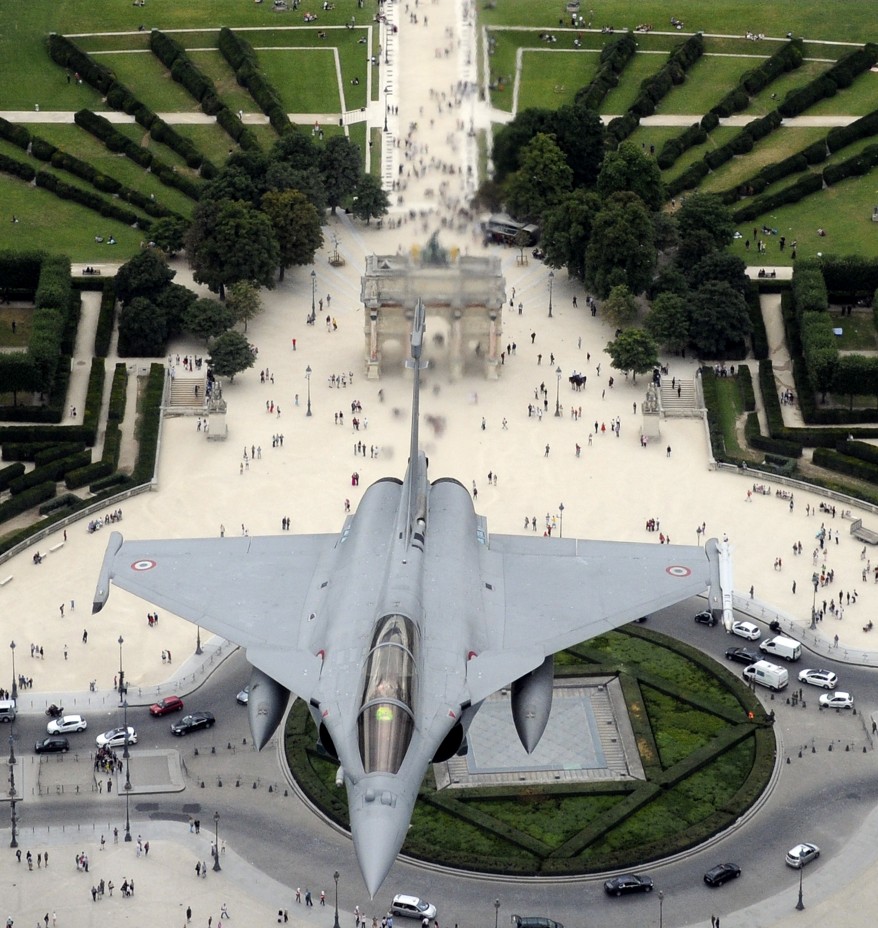
MildaveMildaveMildaveMore pictures from Bastille Day 2012



Patrouille de France, Bastille Day Parade, Paris


 Sign In








