Do you have anything else about the circumstances?
Sadly, I have not more details, beside those on link below:
I am in touch with a relative of John de Winton Tharp, who says his death certificate states that he died on 20.7.1951. So perhaps VP-KHT crashed on 1.8.51 without loss of life, and another aircraft (maybe another Anson) crashed fatally on 20.7.51. Any clues anyone?
Near this 20.7.1951 date we have:
– VP-KFO Auster 5J/1 “Autocrat” (c/n 2048), ex- VP-UAH. Registered in Kenya 27.4.48. Crashed in Mombasa 20.7.51.
– VP-KDN DH.82A “Tiger Moth” (c/n 668), ex- DX582, SAAF 2393 (registered as ex- 2303). Registered in Kenya 29.1.47. Crashed in Fort Ternan 21.7.51.
So, my opinion is – this was Auster.
I don’t know of it’s Sudanese. The silhouette looks like an Il-18.
Ha – ha ! Where You saw khaki-painted Il-18 (or in other camouflage scheme) ? :highly_amused:
The photos above show the Il-38 beauty ! [click to enlarge]:
[ATTACH=CONFIG]238143[/ATTACH]
Yenakieve (between Donetsk and Debaltseve)
Right writings for those settlement names are Yenakievo and Debaltsevo (only this way, in contrast to error, common to most Western media, which write and say like You – “Debaltseve”, and other “…eve/…ove”).
Little mistake on the french page…
Gerard ! Also on “Rusland” page I have noticed, that Russian “Marine vlag” is shown with black diagonal cross. This is wrong.
Our Russian naval flag of St. Andrew (the Patron of all saylors) is white with BLUE diagonal cross. The colour of cross could vary from light blue through blue to dark blue; but it is BLUE anyway.
The best sample is below – here is usual blue colour, without any colour variations:

Please, make the corrections on Your site.
P-63s mentioned are the wrecks on the Kurils
2012 photo of some (but not the same, shown in first posts in this thread) “Kingcobra” on the Kurils:
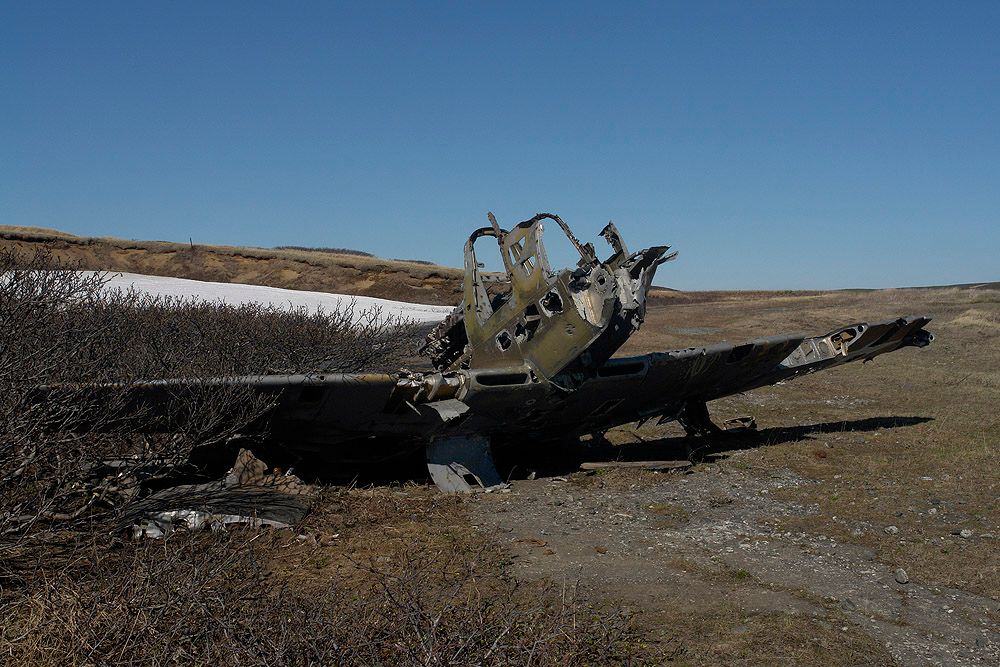
Most probably, at Present days this wreck is recovered and evacuated to Russia mainland for some restoration projects.
About the “Kingcobra”, depicted in earlier posts, Russian proficients state, this particular aircraft never was in Khodynka exposition, but more than 5 years it was in hands of one private restorer – in same condition; most probably, this plane was purchased and delivered from this man.
Speaking generally about P63s in Russia, after War some of them were scrapped, but remaining served about 10 years in aviation units. After this period they were used as instructional airframes in aviation schools (few examples), most part scrapped, and remaining were used, for example, on Army’s or Air Force’s firing ranges as targets (like those Kurils “Kingcobras”).
In last 20 – 30 years it was found, we have many their wrecks (there were and P39‘s wrecks). Many of them were sold abroad; the rest were restored (or are under restoration now). Several restored P63s/P39s are placed in Russian museums and collections – and sometimes even as “street monument” !:

And some remains even possibly to purchase – for example, in 2011 – 2012 this P63C5 fuselage wreck was offered for sale:
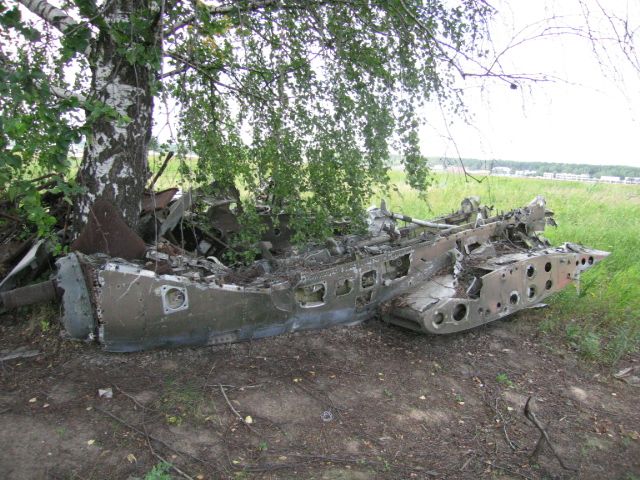

The Boeing B-29 was built to US Imperial, the Soviet copy, the Tu-4 was built to metric.
It ended up being lighter than the original as a result.
Сonversely, I read in some Russian memoirs, the Tu-4s were slightly heavier than B-29s.
Can anyone ID the version of this Tatarstan Government Mi-17 variant? The caption says that it is a Mi-8MTV-1.
Some Russian sources also referred this particular helicopter as Mi-8MTV-2, and others – as Mi-8MTV-5.
An AN-12 crashed in the North Atlantic in the early 70s. I don’t know if it was east or west of Iceland.
To be exact, that plane was not An-12 “Cub” plane, but An-22 “C o c k”. This disaster took place in July 18, 1970 in Northern Atlantic area.
[The Forum censor does not permit to write the NATO codename of this plane as one word, replacing it with ***]. :apologetic:
Would anybody know what type it is?
This is same Zlin, mentioned above in this thread.
During my childhood EACH schoolboy/schoolgirl in our country was required to have such protractor in his/her schoolbag. Those individual protractors had size about one half of palm of the hand, and were made of tin-plate (most part of them) or aluminium (minor part). Later there were used – and are in use today – plastic protractors.
And each mathematical classroom in each school has large version of protractor with size like the 19” computer display. Those large protractors were used for demonstration purposes and were made of hardboard with wooden parts.
Have You seen it ?
More FAS: [This is not advertisement ! – only for historical reference !]
Here is a current list of Proctor survivors.
… ZS-DCO (c/n) Ae 105 SAAF Museum South Africa, ex G-AIEU …
Have anybody any images of this ZS-DCO ? Or, maybe, photos of any other South African “Proctor” ?
They had 12 Percival “Proctor” planes at least.
I try to find any pictures of S.A. “Proctors” for several years – but my searches are fruitless up to date.
Here are excellent clickable cutaway drawings of Breguet (in about middle of page):
http://inter.action.free.fr/labo-aero/aero-portance/aerodynamique-portance.html
Here is 12-page Forum thread about Breguet with nice line drawings:
http://www.master194.com/forum/viewtopic.php?f=4&t=78929
Here is close-up views of Breguet chassis:
http://www.acam.asso.fr/histo/chrono_trains07.php
Enjoy !







