 Vnomad
But in reality, just looking at whats out there now, the base Pk is less than 50% in a jammed environment. With systems like BriteCloud the missile also has multiple possible targets to choose from + much clutter. Since a normal fighter jet has a capacity of 36 stations with BriteCloud + 36 stations with chaffs + towed decoys one can assume that the missile will face at least 4 targets (3 decoys + actual target).
Your Pk estimates are complete guesswork. The efficacy of something like the BriteClould against the latest generation of AAMs is, lets say… unproven at this point.
In the absolute best case scenario the missile will have a Pk of 0.5 x 4 = 0.125 or 12.5%. In reality this is probably optimistic if the enemy has modern jammers. 12,5% is the Pk for the correct target in this case.
Keep in mind, this the Pk for a single missile in a single sortie. Assuming the opposing aircraft are similarly limited, the loss-exchange ratio remains unaffected.
So… in a future air battle with 16 F35 and 25 Rafale there will be 16*6 missiles 96 missiles giving a potential of 12 downed Rafales (best case) on one side and about 78 IR-guided missiles vs the F35. DIRCM can only handle one at a time and the F35 is inferior as a dog fighter. It is also too slow to exit the fight. The Rafales also have some radar-guided missiles left (but these are assumed to be useless becase F35 is just.. alien technology).
A few points here –
One, F-35 costing 50% more than Rafale? Based on what?
Two, the Rafale will depend on its IRST for target detection and tracking. Doubtful prospect, especially at long ranges (F3s models aren’t even equipped with an IRST).
Three, if IR missiles are demonstrably more effective for BVR encounters than EM types, is there any technical barrier preventing an Aim-120IR from being developed? It would appear to be a relatively easy undertaking (and yet remains unpursued.
Four, according to you an F-35 with an external payload is more survivable than one with a purely internal payload. That sounds dubious to put it mildly.
VnomadThe F-35 would be pretty damn good…
If it weren’t for the STOVL requirement f**king the design team over.
There is an F-35-class stealth fighter that was designed without any STOVL-considerations. And as it happens, the J-31 isn’t significantly ‘sleeker’ than the F-35. Even without a STOVL-role, the F-35’s massive internal fuel load and 2000lb weapons bays would continue to be a major drawback (against superior kinematic performance). Both essential attributes.
The F-35B will net the program confirmed orders from UK, Italy, Spain and Singapore, and over the long term they may be joined by Turkey, Japan, South Korea, India and even Australia, depending on how the geopolitical situation in the Indo-Pacific evolves. Not to mention the USN’s LHA/LHDs which would otherwise have a limited role to play in the Air-Sea Battle.
VnomadThere has been some scepticism expressed on the forum with regard to the F-35’s production rate, which according to critics would never cross 150/yr. Just an update with regard to the bulk purchase that the JPO is currently working on :
The F-35 Lightning II Joint Program Office (JPO) intends to solicit and negotiate multiple contract actions with Lockheed Martin Corporation, Lockheed Martin Aeronautics, Fort Worth, TX for F-35 Lightning II lots 11, 12, and 13. The proposed contract actions will provide for one hundred and eight (108) F-35A aircraft, seventeen (17) F-35B aircraft, and four (4) F-35C aircraft in lot 11; one hundred and thirty-eight (138) F-35A aircraft, twenty-six (26) F-35B aircraft, and eight (8) F-35C aircraft in lot 12; and one hundred and forty (140) F-35A aircraft, twenty-six (26) F-35B aircraft, and ten (10) F-35C aircraft in lot 13 (or such other quantities as may be authorized and appropriated by the U.S. Congress or authorized by non-U.S. DoD Participants or Foreign Military Sales (FMS) customers). – FBO
Production order by year –
2017 – 129
2018 – 172
2019 – 176
Production order by variant –
F-35A: – 386
F-35B: – 69
F-35C: – 22
Total: 386+ 69 + 22 = 477 (delivered between 2019 & 2021)
VnomadTwo wing and one centerline, of course.
Actually in that case, it should be other way round. Should remind customers to buy at least three F-35s for every MRTT.
VnomadBiO – Nice photo. Reminds the customers that they need one of those for every three F-35Bs.
Why specifically three? Why not two? Or five?
VnomadI think all software language for aircraft are either written in ADA for older and lately in C/C++ , Not sure why Russia would be different.
The Su-27 family came into existence in the Soviet-era. And its unlikely that the later Sukhoi types that emerged in the early 90s like the MK-series were radically different, though given their ‘open architecture’ design, it is possible. If so, did they translate the entire avionics software from language X to C/C++? (Did they also replace all microprocessors?) If not, the PAK FA might be the first Russian fighter to be rooted in C/C++.
VnomadWhat language is the software for Russian aircraft written in? Have they adopted C/C++ or is a Russian analogue employed instead?
Anybody?
VnomadThe article in Janes states that one effect of these modifications is to make the Typhoon as agile in A2A with heavy or asymmetrical weapon loads.
Is it fair to say that this has put the TVC to bed effectively?
The TVN’s primary appeal IIRC was to improve fuel efficiency and supercruise performance.
VnomadNo idea what VAT has to do with fighters… (?)
The official French program cost figures always include a 20% VAT component, or so our French friends tell me. Hence a 0.8 multiplier.
Last time I checked, Typhoon was a multinational project, not a British one..
Unless the other EF consortium members have paid a substantially different price, the British figures should be more than adequate for computing the PAUC.
I also can’t see 1,600 USAF aircraft being replaced by 1,700 F-35s, when most export forces have hard time to replace their legacy design by 2:1 ratio. Operating 1,700 stealth fighters, that would ruin any economic power on this planet.. Downsizing is invitable and already started, IMHO.
Assuming the additional 800 F-35s are ordered, they would cost say… $120bn to buy ($150M x 800), or about $6bn annually spread out over 20 years. Add to that another $6.5bn annually in operations costs ($40K x 200hr x 800).
So in total that would cost the US govt roughly $10-15bn annually. That’s about 2% of the current US defence budget. It equates to 0.07% of the current US GDP.
(BTW the EU with a GDP only marginally greater than the US is on the hook for about $250bn in state funds if Greece defaults. And yet very few are predicting that a Grexit would lead to the EU being utterly ruined.)
Now there may be perfectly valid strategic and/or policy developments in future, that would result in a truncated F-35 build order. But to say that an additional expenditure equal to 0.07% of the GDP will ‘ruin any economic power on this planet’ is just plain absurd.
VnomadVAT does not apply here as MSphere noted.
I specifically excluded VAT as I said in my reply to MSphere. Including VAT the Rafale’s unit program cost is about $220 million. (This is of course all before the downsizing from 287 to 225 units. Current program cost is hasn’t been released.)
There are always alternative options available. Like upgrades, life extension, alternative aircraft (Hornets, new build F-16s, a cheap CAS platform, UAVs)
Alternative options have already been canned as I mentioned before. The SH line will be closing soon, as will the F-16 line. UAVs & COIN aircraft are niche types that can’t replace a fighter jet. Surrogate UCAVs are still a long way off.
I think the Navy dislikes the F-35 most but that’s just me
The F-35C isn’t quite as capable as its siblings (save in range). All the same, the SH is conclusively outperformed by the F-35C in almost every respect. In any event, the USN’s order stands at only 260 units making it less a replacement for the Hornet and more a force multiplier for its huge SH fleet. In that respect, the USN likely values it at least as much as its Growlers.
VnomadRe: F-35: Forget the 2,443 figure.. My honest estimate is ~1,600 at this stage…
Rafale: Fighters come without VAT, AFAIK..
EF: I don’t understand the number 180, what does it say?
Rafale: The figure was quoted after subtracting VAT (hence the multiplication with 0.8).
EF: $180M PAUC for UK (though the £18bn program cost is somewhat dubious)
With regard to the F-35… hmm.. while the 2,443 figure isn’t etched in stone 1,600 would be a low estimate, unless some major changes in military strategy or budgetary planning take place. Fact is, the Europeans are retiring all of their post-Vietnam fighters. The Harriers are gone. The last Tornado will be gone by 2018 or so. And the last Mirage will be retired by 2025.
The USAF has about 1,650 fighter/attack jets dating back to the 80s & 90s that it plans to replace with 1,750 F-35As. The F-16 upgrade program has been cancelled. The A-10s will be gone by 2020. The F-15C/Ds are scheduled to be retired by 2025. Only the F-15Es will persevere beyond 2030.
So, a prediction that the F-35A numbers will be cut, necessarily presupposes two things – one, that the USAF is fundamentally over-strength and two, that there exists/will exist the requisite political will to enforce a significant downsizing. Its true that the US’ (relative) economic strength has been constantly waning. On the other hand, the conventional threats it’ll face in the next two decades are far graver than the ones it faced in the last two. The F-35’s fortunes, in effect, depend on geopolitical developments in Russia & China.
F-35B & C orders will remain secure. And the program should comfortably achieve exports totalling at least 50% of the domestic order book.
Vnomadno, but nothing known make up 50% to counter twice the fuel burn,
heat expelled is also not a waste, how could the engine provide propulsion otherwise ?
in essence heat causing pressure is the propulsion, and thrust proportional to the amount of heat generated.
heat absorbed by the vehicle is waste, this is what can be manipulated to some degree,
but over 50% compared to other existing solutions ?
In a turbojet, the sole purpose of the turbine is to drive the compressor and its presence in a sense impedes the efficiency of the engine (for a fixed compression ratio).
Its the other way round in a turbofan engine where the turbine is used to ‘pump’ ambient air thus generating thrust. To achieve maximum work output, the temperature drop across a turbine needs to be as high as possible. The exhaust gas should therefore be as cool as possible and minimizing waste heat.
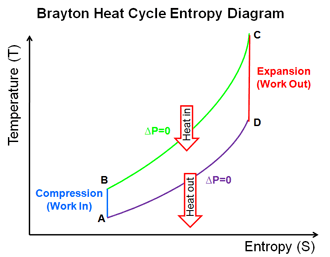
Specific Work Output at Turbine = γ x Cv x (Tc – Td) kJ/kg
(where γ & Cv are constants, and Tc temp at the turbine inlet and Td temp at exhaust)
[Any practical system running on the Brayton cycle will have low thermal efficiency (relatively speaking). Large fixed gas turbine engines like those in power stations and ships can employ regeneration to improve thermal efficiency. That’s not feasible for the engine of a jet aircraft.]
VnomadI did not say 1/4 thrust. I said 1/4 fuel consumption @M0.9 [1,800 kg/h] compared to max thrust @M1.4 [8,000 kg/h]. The amount of IR energy is, of course, quite proportional to amount of fuel burned.
1. The (chemical) energy entering the cycle does not equal the (waste) thermal energy expelled in the cycle.
2. An IR sensor is sensitive to temperature rather than the volume of the exhaust.
Which is why the gargantuan B-2 Spirit (70 tons empty) has a smaller IR signature than a light fighter.
VnomadThese are not $390bil programs, they need much less sales to hit a break even..
Not really. Program acquisition cost –
F-35: $160 mil [$390bn ÷ 2443]
Rafale: $175 mil [$63bn ÷ 287 x 0.8 (VAT)]
Eurofighter: $180 mil [£18bn ÷ 160]
The F-35’s unit program cost at the end of its production may be higher than budgeted (or not if it can replicate the F-16’s export success). That for the Rafale & Eurofighter will most certainly be higher.
VnomadWith regard to the ’40 year old’ F-16 –
“Level acceleration in military power or less is sprightly at all altitudes but downright astounding in full afterburner. I wish I could state some acceleration times, but they remain classified. Approaching Mach in military power, the acceleration reduces slightly as drag rises, but the aircraft punches on through easily. Accelerating through Mach in military power in the Raptor feels similar to accelerating in full afterburner in an F-15. … The best seat in the house for supercruise is from a chase F-16 or F-15. Remember, we fly both these chase jets with just a centerline fuel tank to give them a fighting chance to play with the Raptor. Still, the F-22 usually leaves these aerodynamically “slick” chase airplanes in the dust. The F100-110, -129, and -229-powered F-16s don’t fall very far behind the Raptor in the initial acceleration through Mach. But the race is really no contest at the higher Mach numbers and once on cruise conditions. Nothing can sustain supersonic conditions with the persistence of a Raptor. Load those chase F-16s and F-15s with combat-representative stores and they would not stay with the Raptor during acceleration or sustained cruise.“
– Code One Magazine
When it comes to fighting at high energy states, the F-16 is hardly an ‘ancient’ aircraft.


 Sign In







