 Vnomad
Are you aware that Rafales are plumbed for CFTs too? The Rafale would retain its advantage over the Typhoon even if the Typhoon got CFTs.
And what happened after it was integrated with CFTs? Were they issued for operational use to the squadrons? Are they retained as reserves for operational contingencies?
If I said that the Rafale’s range was limited by the absence of CFTs, you’d argue, and rightly so, that the AdlA had determined that 3 x 2000L were sufficient for cruise missile delivery. But if the EF were to demonstrate a similar range with CFTs, it would be “inadequate” in your eyes because its not piling on even more fuel that’s not required to get the job done.
The Rafale CFTs don’t hold 1500L but 12~~ something IIRC.
But are you saying a Rafale couldn’t take off with 2CFT, 2 2000L tanks & 2 Scalps? How is this config unpractical exactly?
Its impractical because its unnecessary. If it were necessary, I’d imagine it wouldn’t have been a theoretical configuration and we’d have seen it in service. Especially with the integration having been flight tested.
Vnomadhttp://www.naval-technology.com/wp-c…9/rafale_4.jpg
Once you integrate CFTs on Rafale as well, we’re back to square one.
Not really. I can’t really envision any mission that would require the Rafale to carry CFTs as well as EFTs. You could in theory equip the Rafale with 2 x 1500L CFTs + 2 X 2000L EFTs + 2 x SCALP-EG, that would indeed outrange a CFT-equipped EF, but its not a practical configuration.
In practice, a CFT-equipped EF with a 1000L centre-line won’t be too far off the range of a Rafale with 3 heavy EFTs which is more than sufficient for a cruise missile platform.
That’s basically my point – Typhoon has infrastructure in place, and as good as Rafale is for strike, as a Tornado replacement F-35 is even better. Best to go with either a very modest Typhoon development or F-35 and put the critical mass of available resources behind the Franco-German next generation project, as TomcatViP says
Agreed.
Vnomadthe beggining of your answer says it all… it’s the same Typhoon story since 30 years.. “once you integrate [add the thing you wanted to have yesterday]…”
This is absurd. German Rafales? No problem. Never mind the induction costs, new training pipeline, difference in munitions & logistics, local workshare etc. Upgrading Eurofighter with CFTs, to the same end? No can do because.. budgets, politics and what have you.
VnomadI think what Kovy is getting at is that to carry those bulky cruise missiles Typhoon (unlike Rafale, due to the main landing gear) has to trade in two external fuel tanks, which are furthermore smaller than Rafale’s.
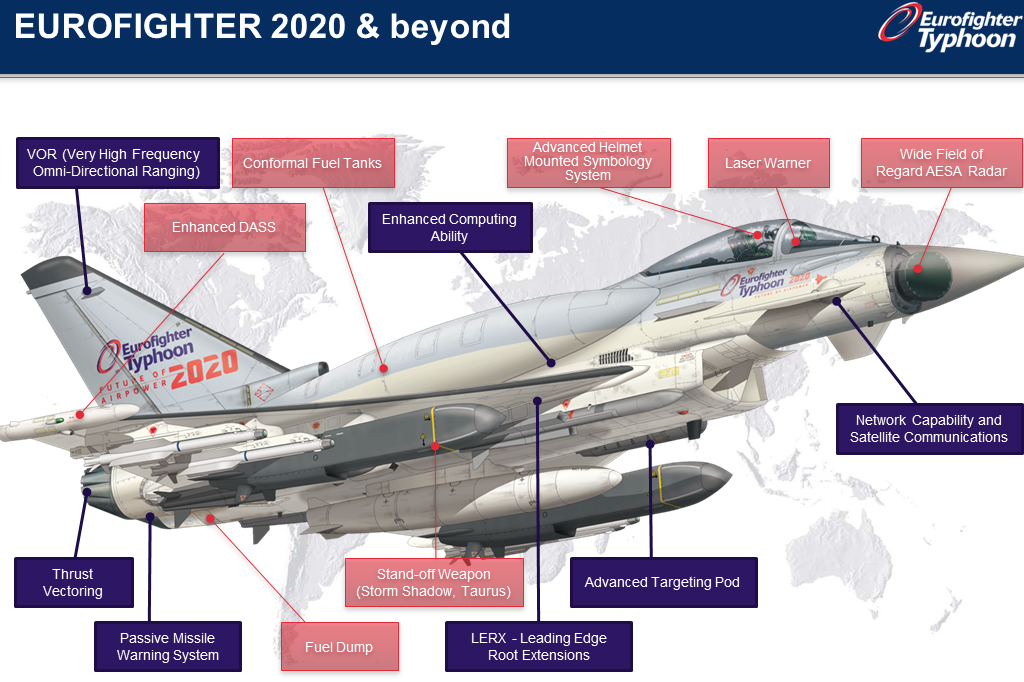
Not once you integrate CFTs on the Typhoon. 1500L each but pretty much equal to a 2000L tank when you factor in the lower drag. With 2 x Taurus + one 1000L on the centre-line, it takes care of all bomb missions that the Luftwaffe might be called on perform.
Objectively, I think the point stands that for long range strike a lot of capabilities which are already operational on Rafale have yet to be integrated on Typhoon. However, introducing a new type and associated logistics is expensive – if the Luftwaffe takes that plunge, the F-35 would arguably be an even better solution than Rafale (B61 already integrated off the shelf, full VLO stealth).
The F-35 is of course the most capable option but the second best option for the GAF (and arguably the best for the German industry) is to induct a new batch of EFs with suitable upgrades – CFTs, PIMAWS, chin hardpoint (for LDP), SPEAR-3 along with maybe the AMK & Pilum.
VnomadI can think of a few features the Rafale offers over other platforms for deep strike penetration
Over the current Typhoon
The operative phrase being ‘current’. As far as Germany is concerned, it makes far more sense to invest in upgrading the EF to equal or exceed that capability than it does to invest in an entirely new platform.
Vnomad50 to 60 “un-priced” items are BELEIVED to have been listed as miscellaneous …this from a media source .This is hardly proof of anything as you seem to think .
While this report is the only one that mentions “50-60” number, there are others (at least one that I remember) that mentioned the inclusion of unpriced items in the bid. The dispute about life cycle cost (like an outcome of this) is quite well known and both defence ministers have alluded to it.
Beside, assuming the report to be somewhat accurate (with a big IF ). what items are we talking about , oil…lubricant…the radar…what was the relative amounts 0.0001% , 1% more ? of the deal . Where they nevertheless not included in the offer and or valued as miscellaneous without details. Did this resulted in an increase of the offer . Clearly not.
The unpriced components were marked as miscellaneous but were later determined to contain a ‘substantial’ cost element leading to an increase in the LCC estimate. Hence the dispute.
The exact figure is unknown, which is actually part of the problem. Wherever discretionary decisions are taken without transparency, the possibility of malfeasance will always be present.
The MMRCA went on up to the time of assessing the concluded exclusive negotiation by the Indian Gov, The assessment concluded that the outcome under current setup was not sustainable notably due to a 2.7 factor increase on labor as per HAL estimation to produce in India.
Given that labour costs in India about a fifth that of France (even less for unskilled labour), a 2.7 factor increase in labour allocation would still result in the net labour cost being about 50% of that in France (not including training costs). So I’m sceptical about this story.
If anybody, especially competitors or opposition had any good suspicions , you can bet that they will have engaged in legal actions, as opposed to attempting re-submitting their offer 20% discounted for some or else voicing more than rumors of suspicions.
Legal action on what grounds? The L1 assessment had been officially flagged for review, and no contract was actually awarded. No contract, no damages.
It is a bit odd that for some ,there are no other alternatives that either Dassault has abused 2 governments , and or the system under 2 different governments was either corrupted or else incompetent.
I think it is a bit odd that some would try to stick up for the efficacy of the MMRCA program that is pretty widely accepted as an example of incompetence/shortsightedness (the corruption angle is speculative), with the only real dispute being how blame is shared between the IAF, MoD and the govt. of the day.
VnomadNo I get it, but it is just your own little intuitive concept, and there is nothing to actually demonstrate that the lower labour costs in India would make it bearable for the IAF. If you need nearly twice as much manpower to look after an aircraft, over 40 years of ownership and given the number of airframe in the MMRCA competition you can bet the differencial will be significative in absolute value as well for total cost of ownership. And bringing the GDP per capita is still perfectly valid as costs are relative to each country. Just like talking of the added complexity of managing a bigger workforce or the impact on fleet availability are relevant.
There is nothing to demonstrate that it wouldn’t either. “If you need nearly twice as much manpower” but your manpower costs a fifth or sixth as much, the cost of spares will be a bigger factor (compared to Switzerland) leading to a more competitive CPFH if your spares are cheaper.
You did not establish anything, and saying that there was no standardized method of comparison is exagerated, unproven & very unlikely. Unless CNC are complete rookies, you have to come with a method to compare costs and they would use their critical sense to see if there is a distortion between manufacturer. Rafale was not declared L1 out of the hat after such a long process of evaluating costs. You will always be able to raise some questions in such a mamoth task, especially from those with an agenda, but in the end the L1 evaluation has not been invalidated, and nor Dassault nor former Indian defense minister were faces with any charge. MMRCA stalled at a latter stage during exclusive negociation due to the complexity of implementing the contractual frame.
Your belief in the L1 status appears borders on the religious, but I don’t think others will be as blase about the facts.
– Dassault’s bid included 50-60 unpriced ‘misc’ items, which distorted the LCC assessment.
– the defence minister put the L1 up for review after getting that (and possibly other) feedback
– the decision to proceed with the CNC before resolving the L1 problem, was made on an ad hoc basis (discretionary decision by the DM)
– “in the end” the MMRCA was scrapped, so the L1 review never happened, the selection was never validated and the issue was not resolved
– the idea of ‘nobody faced any charges’ so all must have been well, implies that there was no criminal conduct but ignores the possibility of gross incompetence on the MoD’s part in drafting the RFP or in accepting Dassault’s bid (in either case, since no contract was awarded under the MMRCA RFP, no subsequent investigation was deemed necessary).
In what appears to be a rerun of the Scorpene project, around 50-60 ‘un-priced’ items are believed to have been listed as miscellaneous’ in Dassault’s offer for the Rafale which emerged as L1 or the lowest bidder in the MMRCA tender ahead of the Eurofighter. MoD sources claim that it is these sundry articles that have emerged as the principal financial hurdle in negotiating the Rafale deal on the basis of its Life Cycle Cost based on keeping the fighter operational for four decades. It appears that subsequent pricing by Dassault of these so-called miscellaneous but critical items — like in the Scorpene tender — in its deliberations with the MoD’s Cost Negotiation Committee, are responsible for significantly inflating the Rafale contract cost, jeopardising the vendors L1 status and delaying its closure.
.
.
what does prompt embarrassing questions for the MoD and the IAF is their failure or worse, possible collusion in categorically evaluating bids, leaving vendors to spring un-anticipated and hugely expensive surprises upon them once it was too late to pull back. – Link
No that’s different as the rafale was assessed during a comprehensive technical evaluation and was declared L1 after a long assessment. MMRCA was scrapped at a later stage and the final choice of the cancelled MMRCA has not been called into question both technically and on price. Because MMRCA contractual frame was so complex the new Indian authority decided to go the Gov to Gov route to speed up the process. If there were any wrongdoings, Dassault and former Mindef would have been faced with a probe and a fresh bid would have been relaunched. Because the New Indian government was comfortable with rafale selection (and they certainly had a closer look) they could proceed with a direct purchase with France, capitalizing on MMRCA selection.
The L1 decision was never validated as I showed above. The decision to proceed with a govt-to-govt sale was made by the PMO by bypassing the MoD. If the political factors are to be ignored, and this assumed to be proof of the Rafale’s superiority, then it would be hypocritical to allege “politics” when it comes to the F-35’s success.
And how do you know that assumptions would have been more liberal or conservative for one or another competitor and the the CNC would have been plain naive or corrupted ? You are implying that Dassault would have cheated or quoted unfair prices but this has never been proven by a court/indian justice/inquiry. If there was something serious Dassault would currently be under scrutiny. There is this naive idea that Dassault would have played its game well within the RFP and that Typhoon Gmbh wouldn’t have tried to do the same…This has never been demonstrated and is just in the mind of people who will never completely accept the outcome.
I don’t know that it would have been more liberal or conservative or exactly the same. Nobody does. Hence the dispute. The L1 decision should have reviewed in order to remove these ambiguities before proceeding with exclusive negotiations but the defence minister (presumably afraid of facing brickbats for a process that had already taken almost decade) decided, on his discretionary authority, to let it ride and leave the L1 problem to be sorted out later (maybe by his successor).
I’m not saying that Dassault provided “unfair prices” that is unproven. I am saying that it provided incomplete prices, and that IS proven. Did EF do the same? If so, did they do so to the same extent? Nobody knows.
You were proven wrong but cannot accept it, rafale ease of use was a design driver and is deeply rooted in Dassault’s DNA of producing light, rugged and simple fighters that can be remotely operated and there is nothing anecdotical with it
Err.. I don’t think you understand what ‘anecdotal’ means. I think you have it confused with ‘believable’.
VnomadYou have to make assumptions, it is irrealistic to think that costs could be accuratly predicted, espcially when the actual manufacturing set up is negociated AFTER being declared L1. But this is not an issue in itself if assumptions applies to both competitor.
Let’s say that the assumption is to apply a +20% markup on both competitor costs in their home market to estimate the cost of being manufactured in India. However you can more accuratly measure the cost of ownership with manufacturer own data. You have to make simplification somewhere.
And how do we know that your assumptions weren’t much more liberal or conservative than your competitor’s?
How are you supposed to accurately calculate the costs in the home market? How do you authenticate the “manufacturer’s own data”? And how can you make the exact same markup on the respective costs in India?
For example, Dassault shares manpower between the Rafale & Falcon lines, the same efficiency may not be transferable to a Rafale-only line. Similarly, the allocating (say) 12 mechanics instead of just 8 mechanics per aircraft may increase the CPFH by 15% for a European air force but only 3% for the IAF.
VnomadI am understanding your rationale but it is simply incorrect. X€ per hour of Indian manpower might not seem expensive from the swiss point of view but that is another story for India. Bringing the GDP per capita or the cost of life is perfactly relevant.
No you certainly have not understood the concept, at all (or you’re pretending not to). Nowhere in my post was the ‘Swiss point of view’ or any such positional perception mentioned.
If the CPFH to India for aircraft B is lower than aircraft A because of lower labour costs, and we’re talking in absolute figures (not whether it ‘feels’ less or more), then GDP per capita is obviously meaningless.
You did not prove anything, the first L1 has not been called into question in the end. The new Gov had all latitude to put former indian Mindef or Dassault Under scrutiny if any wrongdoings were suspected. That would have been quite a political coup and I am sure they would have jumped on the opportunity if it was the case. When the new Gov took office, they must have had a closer look of the process, some points were raised, but not to the point that a fraud or error would have cancelled the deal.
“In the end”, the MMRCA contract was scrapped so the re-examination of the L1 status became a moot point.
We’ve already established that the Dassault bid included a large “miscellaneous” uncosted component (which is what led to the L1 dispute). You can blame that on ambiguities in the RFP, but if so that means that there was no standardized method of comparison. And if there was no standardized method of comparison then the L1/L2 positions aren’t genuine. That’s just basic logic.
The fact that the rafale choice has been confirmed by the new indian gov is the most important thing. Acts not just words.
Oh that’s perfectly fine then. But I trust you will not display a hypocritical streak when the same logic i.e. “it was chosen by the govt so it was clearly the best, ‘acts not words’!” is used to justify the superiority of the F-35 over the Rafale.
Incorrect, here is French AF chief of Staff in 2012 point of view in an Interview:
An apt example of anecdotal evidence.
Vnomadthing is, you put HAL and Reliance on the same level, but they are not.. HAL is a national firm, Reliance a private one
The idea of the SP model was create a national private sector counterparts to HAL & other SOEs. For example, Tata/TASL (aviation), L&T (submarines), Pipavav (naval vessels), Mahindra/Tata Motors (ground vehicles), Bharat Forge (artillery) and so on, i.e. firms with experience in a particular sector. All of that has been undone by watering down/ignoring that policy and letting the likes of Reliance into the market by allowing OEMs to handpick partners based on their own interests (and likely the political influence that such firms bring to the table) rather than that of the country.
and, in any case, HAL was an impossible partner in Rafale deal as seen in MMRCA
Which is why the L1 status was dodgy. The assumption/projections that went into those financial bid weren’t standardized (whether based on ambiguity in the RFP or creativity on the OEM’s part) leaving a huge amount of the cost left for ‘negotiation’ after the fact.
VnomadDefense is national by definition. While in France you have Dassault who has, pretty much, eaten all competition, you can’t go much further as every country (because they all are separate countries) wants to protect its own “national defense sector industry” and has its own policy, thus, its own specific needs.
Well India needed to create its own version of Dassault (or BAE, if you like), so this argument that monopolies are bad of business is obviously questionable.
Now, talking about Reliance, why regression? It’s the answer to a need expressed by the GoI. They want Rafales, Dassault brings them Rafales. They want 51% offsets.. Dassault provides the offsets they asked for. It’s not because others were there before that everything has to go through them… if they can win markets, good for them, if not, their problem. IF you want to move on, you need competition, without competition (with a monopoly of one actor), you only get stagnation or even regression as there’s no stimulation that will make them move forward.
The problem is that you’re looking at this from the perspective of a Frenchman. So you’re justifying a monopoly as good & fine for France but a duopoly (with HAL) as a source of stagnation for India.
Reliance offering “competitive” terms to Dassault to secure a deal might be good for Reliance, good for Dassault, good for France (supports exports & jobs) but not so much for India. The actual delivery of the offset value is very difficult to audit and further fragmentation in the industry makes the emergence of private sector counterpart/counterweight to HAL much more distant.
VnomadNo you don’t get it. First man power costs is relative. Like any cost is relative to a country. Indian skilled manpower might not be expensive from a swiss point of view, less so for the Indian taxpayer which is nowhere near the GDP per capita than Switzerland. Secondly spares where to be manufactured in India for MMRCA.
I’ve understood your point perfectly, you haven’t understood mine or are choosing not to understand it.
GDP per capita is immaterial as is the absolute cost. What matters is the composition of the CPFH. Eg, if labour costs in country Y are a fifth that of country X –
Country X: CPFH – aircraft A: €110 per hour, aircraft B: €100 per hour; where labour costs €40/hr for A and €20/hr for B.
Country Y; CPFH – aircraft A: € 78 per hour, aircraft B: € 84 per hour; where labour costs €8/hr for A and €4/hr for B.
What the impact in terms of levelling the playing field, local production of spares would have had, is also debatable, since we don’t know in what time-frame that indigenization would have taken place (e.g more than half the 126 aircraft were going to be delivered off-the-shelf or merely assembled locally) or what infrastructure would have been employed (the EF, for eg, had the option of relocating equipment to a local Indian partner to reduce capital costs).
India, consistently with the swiss evaluation pointed the rafale as L1/cheaper to operate. Evaluation structure was not the same but the result was similar.
As I’ve proved in previous posts the L1 declaration was dubious because of non-standard assumptions/projections and had been marked for re-examination by the defence minister with the negotiation proceeding on an ad hoc basis.
Given the difference of design philosophy of the two platforms this is not surprising. Rafale is a lighter, simpler and more rugged design than the Typhoon.
Anecdotal.
VnomadOne more time: Europe as a country does not exist, period.
Well.. I’d describe Airbus as a European company but maybe that’s just me.
While liners compete on global scale and uniting into a single big multinational company still avoided monopoly as there’s Boeing to compete with, in defense, every country (UK, Germany, Belgium, Spain, France and so on, NOT Europe) has its own policy. The “would-be partnership” that gave the Typhoon, still can’t compete with a “single national product” be it price wise or on the development as it was delayed by for internal political reasons of different partners (the “I want my share and don’t want to pay for others” syndrome). Not to speak about countries that buy fighters from outside EU instead of buying “local”. You want to compare to the USA? do you imagine one second Texas, or any other US state buying the Rafale or the Typhoon for their Air National Guard? The european countries operating fighters like the F-18 or F-16, and still buying some today are there to prove, if need be, that they are European only when they can pull some profit from it but otherwise couldn’t give a damn about Europe
Well like I said, the objective of the SP model was to create national champions like those in Europe with France being an apt example; there’s relatively little overlap between Dassault, Thales, DCNS, Nexter, etc with most of the internal competition (like Breguet) having been merged into single entity.
Fragmentation will simply lead to a diffusion of investment capital & lower levels of local value addition leaving the state perpetually beholden to foreign OEMs. In that sense, allowing the likes of Reliance & Adani into the fray has been a regressive move, though given the kind political influence wielded by them, perhaps not unsurprising.
VnomadIndian Manpower costs is lower but India GDP per capita is nowhere near Switzeralnd. What would look inexpensive to the swiss (Indian workforce costs) is not for the Indian. And then a fighter jet that would need more (skilled) workforce to operate is simply more of a headeache.
What is the amount of effort and money you need to achieve the desired result ? If you need 10 times the workforce compared to another aircraft you might have scored very well but that is much less efficient. The swiss rated the Typhoon lower than the rafale in two chapter of the evaluation : maintenance and training as a whole. The difference was noticeable enough to be raised by swiss air force chief of staff, he was just as surprised as the Typhoon scoring lower in AtA.
How are you still not getting it? Its a very simple concept.
Labour in India is cheaper than in Switzerland but other contributors to the CPFH still remain the same or similar (fuel, consumables, depreciation etc). So an aircraft with higher personnel costs but lower spares costs will be more competitive in the Indian market than in a European one. That’s all.
As far as technical side is concerned, the IAF rated both the EF & Rafale as technically compliant with its requirements. Its possible that its operational benchmarks differed from that of the Swiss (who curiously picked the F-18 over the more popular F-16) or that it tested a different configuration(its testing was conducted two years after the Swiss), but the bottom-line is that they both made the cut and were viable options for an off-the-shelf purchase as well.
I don’t know about specifically optics, but what about engines, hydrolics, materials, avionics…This type of knwoledge can be of interest in many type of industries. Also generally if you don’t have a big demand in the private sector you don’t have many schools that will train you for that type of jobs so the issue remains. The point is that if you need a bigger workforce it will create other kind of issues beyhond costs.
Pick any segment related to aviation or defence and the opportunities in the private sector will still only be a fraction of what’s available to someone doing the same job in Europe, further inflating the wage differential. The IAF has no issues at all with regard to retaining technical staff in the NCO cadre (movement to the pvt sector is usually to the pilots). As far as the industry is concerned, its not uncommon for tradesman in niche areas to be sent abroad (Europe or the Middle East, or sometimes SE Asia) to attend a training course or two.
VnomadAvailability rate does not mean much if you don’t understand the effort and money involved. With 10 time the manpower you might reach the same availability rate but it is ten time less efficient. And usually most ressources are drained to support opperations which leads to impressive availability rate while at home the situation is often less rosy. In both cases it doesn’t tell much about the maintainability of the aircraft but rather indicates where ressources are allocated.
You should look at the number of man hour required to maintain the aircraft per hour of flight for instance, the number of flight hours after which you have to put the aircraft to the depot for extensive maintenance, the ease of change of each subsystems etc…That is the only single way to measure. Your rationale does not work.
I’m still not sure what all this extemporising is meant to prove.
The Swiss gent said that the EF had higher manpower costs and likely lower spares costs in the Swiss environment. The cost of manpower is much lower in India than for the West for all levels of skill/education. So the labour component of the CPFH will be relatively much lower, and cost inputs will be dominant. That’s all there is to the manpower argument.
As for the argument about the EF having lower serviceability than its peers (and thus requiring a larger fleet), I still await actual evidence.
An aircraft that needs more (skilled) manpower to maintain is simply more difficult and expensive to operate, that is just plain logic.
It is costlier because of the bigger workforce you have to hire, train, and pay with the risk of brain drain from the private sector and that is worth for India as well, even if the workforce is relatively cheaper in comparison. More expensive is more expensive.
More expensive only if everything else is the same. In a country, where labour is cheap, the cost of spares will be a bigger contributor to the CPFH, and vice versa for a country with higher labour costs.
Just one example also that goes beyhond costs to show there is a greater stake at risk : I guess that an expert on optical sensor maintenance is a rare ressource in India (like in many other fields), I bet that the private sector would be happy to hire this expert which has gained valuable professional experience on top tier technology. Same goes for avionics, engine etc…You are assuming that this kind of skilled worforce can be quickly replaced while in real life that can be quite a headeache for the IAF. Less work force needed = peace of mind.
Trouble is that you’re ‘betting’ without any real knowledge of what the industries dominate the private sector in India and what their actual HR requirements are. There is, for example, unlikely to be a vacant position for an “optical sensor maintenance technician” in the classifieds.
The underlying fact is that skilled workers/technicians with such experience, have greater opportunities in the private sector in Europe (than in India) by virtue of a large & mature aerospace & defence industry. Which further inflates their wage difference with their Indian peers. (The same may not be true for the IT or automobile industry.)
Then if you need to perform more maintenance checks, your are anticipating more possible breakdown which will logically lead to higher spares consumption…Which is also logic given the rafale has fixed intakes, fixed fuel probe, fixed radar antenna, and no dedicated airbrake. Simplicity of design is in Dassault DNA as it sold many aircrafts to poorer countries and that the Armée de l’air deploys in remote location in Africa since ages. Light and simple has been one of Dassault’s trademark. Tornado or Typhoon is not of the same design tradition.
I’m yet to see any credible evidence let alone quantification of ‘higher spares consumption’. Fuel probes, intake ramps, airbrakes & radar gimbal aren’t typically associated with consumables or common points of failure AFAIK. The rest is anecdotal – has no evidentiary value.


 Sign In







