 H_K
H_KLatest stats for the French contribution during the past 5 months. 2,500 targets destroyed, including:
480 armoured vehicles
250 vehicles
160 artillery pieces
170 command centers
850 supply depots
Very impressive, keeping in mind that the UK has destroyed 850 targets and the US somewhere north of 500 targets.
H_KWhat type of Air superiority (jet or prop) could of been operated by the colossus/majestic class though and the Independence class (saipan) in the secnario that a “third world” country had operated them in war against each other.
Depends on the timeframe, but in the early 1960s there were only two options: the A-4E and Etendard IVM/IVP Avon-engined variant.
The Avon Etendard was specifically designed with the Colossus carriers in mind (UK engine and blown flaps for lower landing speed), was offered to the RAN in 1959 (who didn’t follow up due to a lack of funds/test pilots), and did in fact fly as a prototype in 1960. Best option for air defense and recon roles (more thrust than the A-4E and better ranging radar), and superior to the A-4A/B/C in every respect.
The A-4E would be the choice for air-to-ground missions because of its centreline pylon and ability to carry more external fuel. Both aircraft probably even in the anti-shipping department – the A-4E having more fuel, but the Etendard’s Aida radar could come in useful despite its short 12nm range.
As far as second-hand aircraft go, not much available in the early 1960s. The A-4A/B/C was still in front-line service and saw intensive use in Vietnam. Perhaps the F11F Tiger? Would be similar to the Avon Etendard as a fleet defender. The Sea Venom would be just too old.
H_KMaybe I was expecting too much, but given the carrier’s proximity to its targets I would have liked to see more sorties per plane per day. Instead CdG’s aircraft were flying at about the same tempo as their land based counterparts, even though the land based sorties last much longer, 5 or 6 hours.
That said, CdG certainly did bring a few valuable capabilities that can’t be measured in terms of sorties flown, such as combat SAR helos on standby for NATO pilots and medical support for 17 NATO ships.
H_KEnd of mission for Charles de Gaulle
The French carrier docked today in Toulon. Flying strikes 6 days a week during four months, CdG launched ~11% of NATO’s strike missions:
840 strike (Rafale/Super Etendard)
390 reconnaissance (Rafale)
120 AEW (Hawkeye)
240 buddy refueling (Rafale/Super Etendard)
http://lemamouth.blogspot.com/2011/08/les-chiffres-du-gae.html
This adds up to 13 sorties per day for the 18 aircraft embarked, a rather low number. Average sortie duration was around 2hr 20min.
During this time, CdG sailed 40,000nm at an average speed of only 12kts.
All in all, solid but hardly earth-shattering numbers. Unlikely to really help the case for a second carrier.
H_KYes, back then I was under the mistaken impression that Gowind had waterline (not underwater) exhausts. Figured it out a month or two back, when the hi-def pics of her came out and when I read that the exhausts go through the inside of the bridge (who would have thought?). That was on another forum though. 😉
No schematics of Gowind yet, unfortunately. I have a few hunches of what goes where based on the construction photos, but that’s about it.
H_KDoes anyone have any detailed info on the intake/exhaust system, and any associated pros and cons of that layout? How similar is it to Valour‘s?
I believe you’re thinking of an underwater exhaust system? None of the ships discussed in this thread have that.
(I know Gowind’s exhausts are a bit confusing, since they’re very well hidden in the superstructure, behind the conical radar dome – they actually go through the bridge).
H_KThe comparison between the Serviolas and the Gowind OPVs is certainly interesting. Only ~400t displacement between the two designs, and similar engines, but the jump in capabilities is quite substantial. IMHO, this explains why so many OPV designs bunch around in the 1,500-1,800t range – anything less (like the Serviolas) won’t cut it, and anything more is on the downward sloping side of the hypothetical “OPV efficiency curve”.
Also, just realized that Navantia has a direct competitor (size-wise) to the Gowind OPV – it’s the BVL OPV delivered to Venezuela. Seems quite capable – wonder how much cheaper it is compared to BAM.
H_KSwerve, maybe, maybe not.
I’ve dug into every technical description that is publicly available for both designs (plus the Kiwi Otagos), which adds up to more than a few, and I’m just saying that I’m not seeing any major differences in patrol capability – aside from some of the ones I mentioned before (container carrying capacity, separate engine rooms etc. But these are not directly tied to OPV mission requirements – rather they provide flexibility to re-role for other more demanding missions, which is both the greatest strength and a bit of a weakness of the BAM design, since it does drive up costs).
Endurance and range are certainly in the same ballpark for all 3 designs and sufficient for oceanic OPV duties (e.g. Gowind carries 30m3 of aviation fuel, same as a Forbin class destroyer and 50% more than Otago – you can infer what you want about endurance. Too bad I don’t have the figure for BAM). Habitability – can’t say, need more info on Gowind.
H_KIMHO L’Adroit is more a possible replacement for smaller patrol boats like P400or even A69 “avisos”.
BAM can operate NH-90 size helos and make more than 8000 nm at 15 n.
No doubt that L’Adroit will excel in a lot of missions, but for others (like anti-piracy along Somaly costs) seems a bit small an shortlegged. In that sense BAM are in the league of Floreals (but with a crew of 35-50)Spain hopes to call home costly F-80s and F-100s from missions like de Africa Horn one and send BAMs in their place.
Snow Monkey beat me to it, but I don’t fully agree with you on that point.
Yes the Gowind OPV is intended to be (almost) cheap enough to replace patrol boats, but it also seems to offer most of the capability of a BAM (90%?). And in fact anti-piracy missions in the Indian Ocean are one of the core design drivers. Lots of capability for cheap – that’s the beauty of the concept, if it works.
So why is there a 1,100t difference between the BAM and Gowind? What capabilities are being traded-off?
I’m sure there are other trade-offs, but so far I haven’t seen anything too critical. Seakeeping is the big question mark, as Jonesy pointed out. I happen to believe that the long, low foredeck is intentional – goes back to the whole wave-piercing vs. wave riding debate in naval architecture. But I’m very curious to hear what happens when she hits a gale in the Bay of Biscay.
H_KThanks for the pics Santi. I’m a big fan of the BAM design.
IMHO, the BAM is the benchmark against which DCNS’ effort should be measured against. The French have bet that they could design a much smaller and cheaper hull without compromising much in terms of OPV capabilities (sea keeping, endurance, mission payload). The main difference is that the Gowind OPV platform is too small to be readily adaptable to other roles requiring containerized ,or to build specialized sub-variants (for hydrography or mine hunting, for example), but that’s a logical tradeoff.
Soon enough hopefully we’ll find out if the “small high-seas OPV” concept actually works…
H_KGoWind looks really top heavy. I wonder how her sea keeping abilities will be in rough weather.
It’s an optical illusion. Rather convincing too. But in fact Gowind’s bridge is on the same deck level as the Otago and BAM (you can check if you don’t believe me). It’s just that the shorter superstructure (lengthwise) and lower bow make it look a lot taller relative to the others.
H_KPersonally, I’d go with a split buy replacing the OPC with additional Legend-class ships replacing the half the Bears and an 20 of these replacing the other half and the Reliance class. But as you said, that makes too much sense.
Here’s a comparison of USCG cutters against the best foreign OPV designs, including the Gowind/Adroit. Or “cutter porn”, as I like to think… 😉
Shows quite well how massive the Legend class NSCs are, really not well suited as a replacement for the medium endurance cutters. The Spanish BAM would be a huge step up in size, while the Gowind and Kiwi Otago though smaller are still very significant improvements over the medium cutters.
Click thumbnail for full size:
Small size preview:
H_KNot only the Brits & Russians…
Douglas A2D SkysharkThis was after examining mixed-propulsion with the Ryan FR Fireball, Consolidated Vultee XP-81, and Ryan XF2R Dark Shark
The US had no decent small turboprops in the late 1940s… maybe this explains why mixed propulsion didn’t catch on? Had the US had ~1,500hp turboprops of the same caliber as the British Mamba or Dart, maybe mixed propulsion would have seemed a lot more attractive in the 1948-1952 timeframe.
Admitedly, mixed propulsion didn’t make sense for a pure fighter/interceptor aircraft, but for a carrier strike aircraft it should have been pretty interesting in terms of range and slow speed handling.
H_KThe prettier sister of the Tupolev Tu-91 ‘Boot’……..:diablo:
Interesting, I didn’t know about the Tu-91 Boot. I think the Tu-91’s real sister and inspiration must have been the Westland Wyvern – both large naval strike aircraft with massive contra-rotating turboprops.
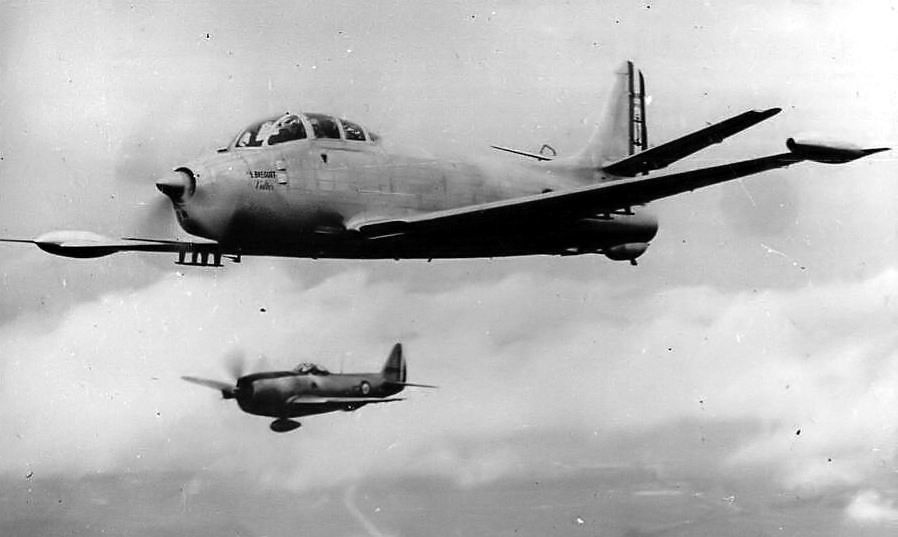
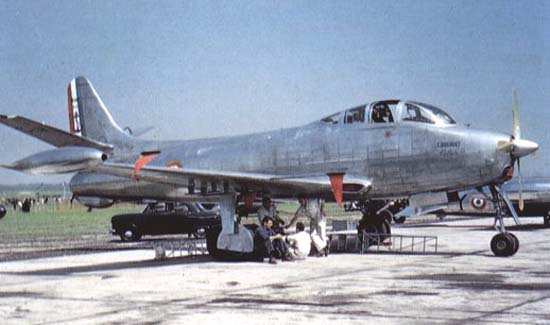
IMHO, the Breguet Vultur’s mixed turbojet/turboprop solution was far superior and if used on the Wyvern could have been a real winner. The contra-rotating turboprops were simply too heavy and massive. Replacing the Wyvern’s 4,100ehp Python turboprop with a small 1,475ehp Mamba turboprop and 5,000lb Nene turbojet would have shaved off at least 700lbs and offered much better high speed performance. Both the Mamba and Nene were available in the late 1940s, so I don’t get why British designers preferred the heavy and troublesome contra-rotating turboprop solution.
H_KAs a wide-eyed kid at the Paris air show in the early 70s I totally fell in love with this – in a way that no adult could comprehend!
You’re wrong – I totally get it even as an adult! For example, I have a huge irrational love for mixed propulsion (“hybrid propulsion” in modern terminology) ever since I heard of the Breguet Vultur. Especially for naval use. The idea of combining the best of prop and jet worlds is so appealing to me – slow-speed nimbleness for carrier landings, endurance for close support, and the ability to fight and climb (almost) like a jet on the push of a throttle…
(Of course there are huge compromises somewhere, but that doesn’t stop me from liking the idea)
Breguet Vultur – mixed turbojet & turboprop naval aircraft, 1951. I’d mentioned it in this thread: http://forum.keypublishing.com/showthread.php?t=96642


 Sign In







