 H_K
H_KFor anyone interested in French prototypes, I just found this thread which is chock full of amazing pictures: http://pics-aeronef.discutfree.com/t3377-un-p-tit-tour-au-c-e-v-dans-les-annees-50-60
Here’s a weird one indeed – the SNCASO Trident II interceptor (10 pre-production units built). Mixed rocket & turbojet propulsion, Mach 1.8 circa 1957.


H_KI can only guess, as there is very little public data available.
I would guess 40-50 million euros for the Gowind OPV, depending on the radar and electronics fit, and excluding weapons, RHIBs etc.
My semi-fuzzy logic is that Gowind OPV should cost roughly half-way between the 800 ton OPV 70 built in France for Morroco, and the much better equipped 2,600t BAM OPVs built by Navantia in Spain. Gowind certainly has to be much cheaper than the BAM, being not only smaller, but also benefiting from some intelligent cost saving features. For example, she uses low-density fishing boat diesels (which are not only cheaper but may also be easier to maintain in foreign ports), and doesn’t have a dedicated combat information center. Also, a very rough back of the envelope calculation based on the very rapid build time suggests that she required less than half the work hours needed by Navantia to build the BAM (the BAM required~540,000 direct man-hours and ~200,000 sub-contractor work hours, vs. I’m estimating only 200,000 hours for Gowind). The very simple slab-sided design in particular would explain how DCNS could have cut a lot of man-hours.
For reference, a ~300 ton patrol boat with a much lower equipment fit typically costs $30-60 million, based on prices for the Aussie Armidales, Kiwi Protector IPVs, and US Coast Guard Sentinel class FRCs.
H_KYes, the helo hangar can accomodate a Dauphin, Lynx or similar 5t class helo.
Here’s a pic (very large, so link only): http://www.lorient-technopole.com/wp-content/uploads/2011/06/IMG_61371-e1308664675106.jpg
H_KI’m normally for domestic designs, but this would be a very good replacement for the Reliance class cutters.
Replacing the US Coast Guard’s medium cutters with a ~1,500-2,000 ton OPV makes a lot of sense… so it won’t happen. The USCG is busy right now gold-platting the Offshore Patrol Cutter. They’re shooting for twenty-five 3,500 ton hulls to replace twenty-six 1,100 and 1,800 ton medium endurance cutters. Not going to happen…
The genesis of the Gowind OPV is interesting. It all came from the realization that 400 ton patrol boats aren’t very good value for money – they’re near-sighted (no UAVs or helos or air-search radar), pretty much toothless (can’t launch two RHIBs to board an uncooperative ship or carry a decent boarding team), and don’t have the legs (seakeeping, crew comfort and endurance). So the challenge was to design an effective OPV that could be cheap enough to replace patrol boats almost one-for-one for coastal tasks, while still being able to deploy a few hundred or even thousand miles, for a drug interdiction or anti-piracy mission.
Turns out that upsizing from a patrol boat to a ~1,500ton OPV is not as expensive as it sounds – the engines are the same (you lose ~2-3 knots), the electronics are not that much different (mainly adding an air-search radar and a few more tactical consoles and ESM equipment). But the bigger hull is a huge capability multiplier. The challenge is to avoid gold plating – just because a 1,500 ton hull is big enough to fit a medium gun and missile system, or a pretty decent combat information center, or bigger engines to go 25kts, doesn’t mean that you should.
Also, no weapons?
See above – she is replacing a 400 ton patrol boat, so she will only have a 20mm and two 12.7mm guns (not fitted for sea trials). One could of course fit a 76mm gun and 4 Exocet anti-ship missiles as on the DCNS artists’ renderings, but that’s not the point.
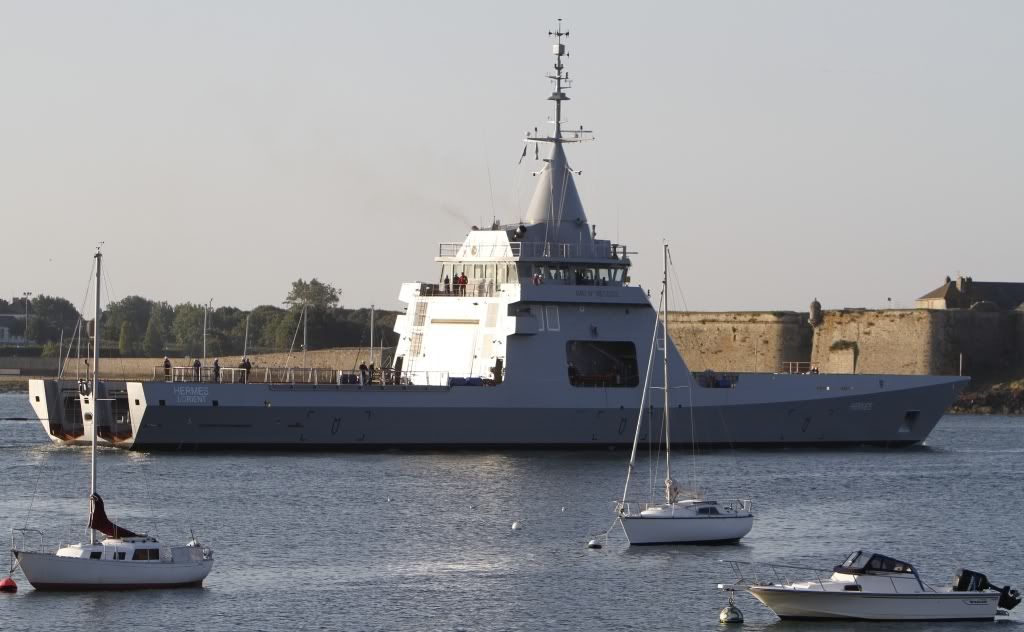
H_KMore pics of L’Adroit on sea trials. These show quite well the unique high bridge design, with the helo hangar nestled below the bridge.
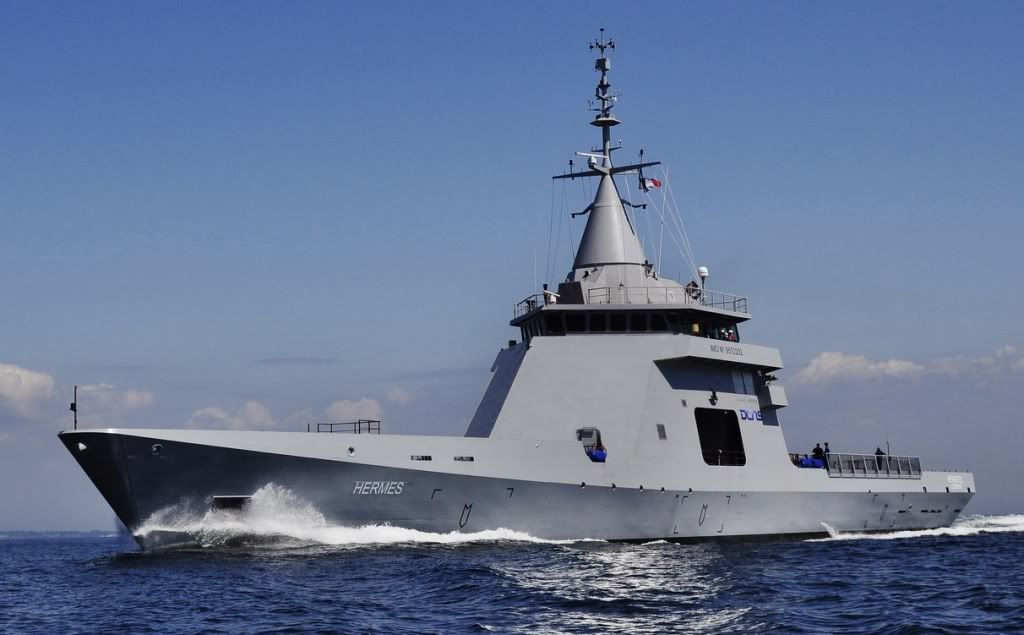
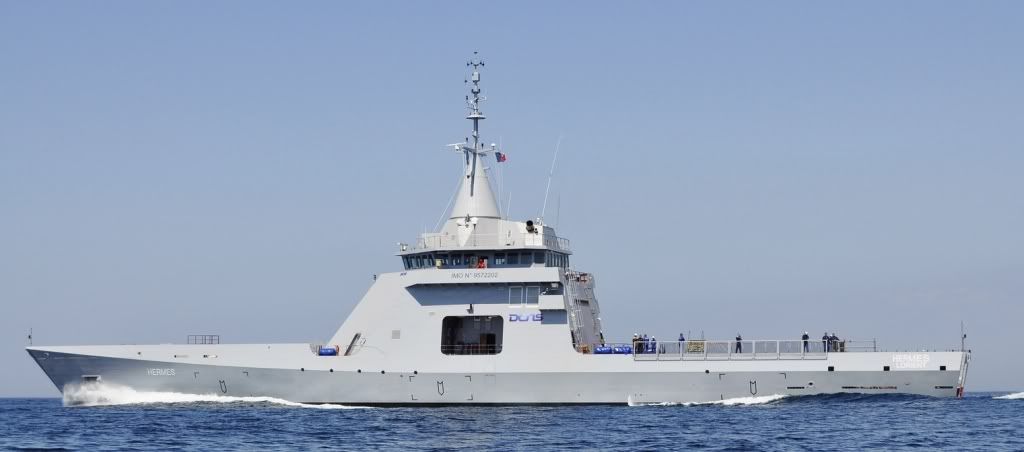

(All pics copyright of DCNS, high res originals here: en.dcnsgroup.com/mediatheque)
H_KFirst sea trials
The first Gowind OPV on her first sea trials. Looking very sleak and prim!
Impressively, she exceeded 22kts on only 5.6MW. That’s the same power as the 400 ton, 24 knot patrol boats she is designed to replace, and 50% less power than the similarly sized, 23 knot New Zealand OPVs. Will surely prove to be very economical to operate.
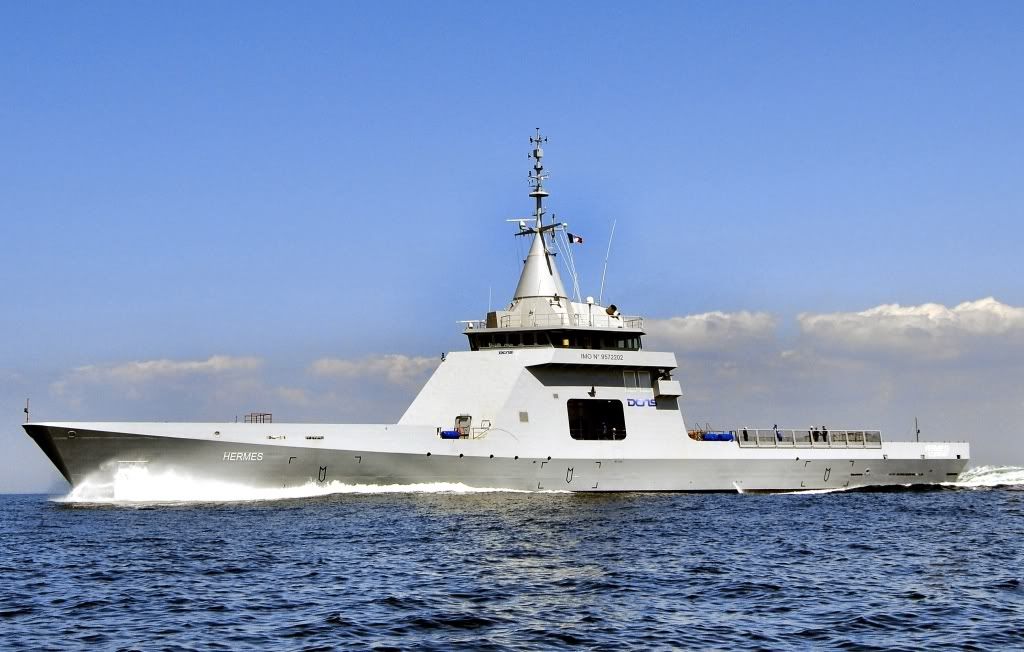
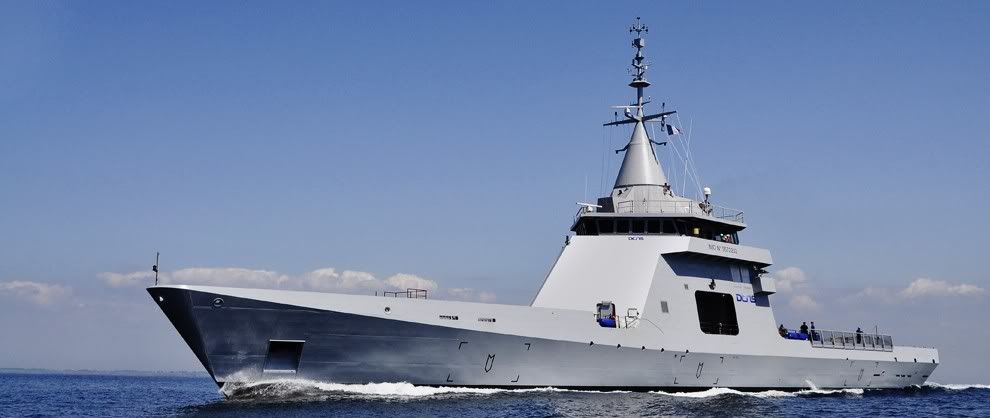
Gowind OPV L’Adroit begins first sea trials 2011/07/28
The Gowind offshore patrol boat L’Adroit began its first sea trials on Wednesday 27 July for DCNS to validate the seakeeping and other nautical qualities of the vessel. (…)The sea trials are beginning in line with the contract schedule, just 14 months after construction started on the Gowind L’Adroit, an innovative offshore patrol boat designed for maritime safety & security missions.
(…)OPV L’Adroit has a length of 87 metres, an at-sea endurance of 3 weeks and a range of 8,000 nautical miles. With a top speed of 21 knots, the vessel has a helicopter flight deck and can accommodate UAV (unmanned aerial vehicle) operations. It is designed for reduced crewing, with a complement of 30 and space for 30 passengers. The ship features a number of major innovations for navies, commandos and coastguards: 360° panoramic visibility from the bridge, a single integrated mast for 360° radar coverage, covert deployment of fast commando boats in less than 5 minutes and provision for UAVs and USVs (unmanned surface vehicles).
http://en.dcnsgroup.com/presse/dcns-effectue-la-premiere-sortie-en-mer-du-patrouilleur-hauturier-gowind-l%E2%80%99adroit/
H_KSuperior bombing capabilities of the Typhoon may be a bit mad to claim, as of now it must be said, but the likes of lower life cycle maintenance costs and higher operational availability, well, I wouldn’t rule & laugh those off.
Funnily enough, Rafales have been flying 130+ hours a month over Libya versus… 80 hrs/month for Typhoon.
As for maintenance costs, at least Rafale’s are known: 12-13k euros/hr, or about 20% more than a Mirage 2000 (10.5-11k euros). (Both excluding fuel) I don’t know of any solid cost numbers for Typhoon. But it has been reported that the Germans were unhappy with Typhoon’s costs per flying hour. And as recently as yesterday the RAF chief of staff Sir Stephen Dalton expressed similar mixed feelings: “It has a long way to go. I don’t know about total life cycle costs, but I know that its availability and performance has been outstanding”. http://m.thehindu.com/news/national/article2236348.ece/?secid=3044
IMHO, there are more useful datapoints publically available about Rafale’s performance, while Typhoon tends to benefit from “marketing” spin with no supporting datapoints. Perhaps this reflects a different PR culture, but definitely the lower level of transparency and higher level of spin coming from the Typhoon partners is frustrating, and inevitably will continue to sow doubts about its actual performance.
H_KI’m with bager here. So 5 kts speed difference suddenly makes a fleet carrier? Utter bull.
What makes a fleet carrier is the ability to project force (aircraft) both on a peak and sustained basis, without getting sunk, i.e. dominating the space around it. That has everything to do aviation and maintenance capacity, and almost nothing to do with speed (unless we’re talking about an 18kt carrier, which is a different story).
Now admittedly things were different in the all-gun era, where fighting effectiveness DID depend on speed in order to escort friendly battleships & cruisers and avoid enemy ships. But 5kts doesn’t count for s*** against missiles. And the fact that the USN NEEDS a 30kt cruise capability because its fleet bases are so far away from likely theatres of operations does not apply to the RN or other navies, so saying that only 30kt ships are “fleet” capable is much too yankee-centric.
By the way, CVF can sustain maximum shaft horsepower indefinitely, since it has excess generating capacity and electric motors work fine at their maximum continuous rating. Not sure a CVN’s steam turbines and other propulsion systems can sustain 33kts very long.
H_KSuper Etendards are now flying with 4x GBUs over Libya – the old lady hasn’t lost her teeth!

H_KRule of thumb: each drop tank released when empty increases ferry range by ~4%.
This is true for the F-4 Phantom & A-6 Intruder, see for example this file: http://www.alternatewars.com/SAC/A-6E_Intruder_(TRAM)_SAC_-_November_1979.pdf. It may be a bit higher for smaller aircraft, for example for the Harrier II it’s more like 5%.
The impact on combat range should be lower, because the aircraft drag with underwing bombs & missiles is much higher than in ferry configuration, so the incremental impact of a drop tank on drag is lower.
H_KCan anyone tell me what the angle of attack would be for a Rafale coming into land on that carrier compared to the latest F-18 taking into account similar sea and wind states plus I guess payloads.
See this thread: http://forum.keypublishing.co.uk/showthread.php?t=108910
Rafale M: 16 degrees
Hornet : 8.1 degrees
Apparently AOA is constant irrespective of weight & wind. Only thrust & speed vary: higher weight –> higher speed, more wind –> less speed.
H_KNot going to happen
In May 2008, Sarkozy said that he would decide on PA2 in 2011-2012.
… everyone laughed because the presidential election is in May 2012 and no outgoing government would take such a decision (or it would be reversed by the new government).
In August 2010, the Defense Minister swore that there was a very set timetable and that the decision would be taken in 2012. He also swore that the timing had nothing to do with the elections but was based on the timing of CdG’s next refit.
… everyone laughed, because you can’t design, order, build and work-up a carrier in 4.5 years (CdG will enter refit in early 2017 at the latest).
Two months later, the same defense minister said the decision would be made in late 2012/early 2013.
…but by that time it was too predictable to be funny. In 2013, you can fully expect the next government to delay PA2 for another 5 years because “there’s no point in ordering PA2 now since it won’t be available for CdG’s refit”
H_KNote to UK MOD and RN re the CVF’s. Intensive carrier operations require an effective fixed wing COD capability.:diablo:
EH-101 can do the COD job well enough IMHO – 3,000kg payload to 500nm, rear ramp etc. Would also be a good use of surplus RAF airframes.
Staying on topic, here are a few new pics to celebrate some of the “senior citizens” operating off Libya:
Rare view of the 32-year old ex-Belgian Wielingen class frigate Drazki, now in Bulgarian service.
Lovely ship (very retro, reminds me of WWII style frigates), wonderful names for the whole class (“Daring”, “Loyal” & “Prideful” in Bulgarian).
The other two ships are 30-year old French AOR Meuse, celebrating her 3,000th replenishment in this very pic, and (relative) youngster, 28-year old ASW frigate Montcalm.
http://www.defense.gouv.fr/marine/actu-marine/3000eme-ravitaillement-a-la-mer-pour-la-meuse
Value for money… the 13th Alouette III off the production line, now in her 49th year, still providing stirling plane-guard service for an unbeatable price
H_KTo me the superstructure just looks to damn high and it rises up at too steep an angle, it’s just like a lump in the middle of the hull.
The high bridge certainly is quite a novel setup. Hopefully it won’t roll too much up there.
On the other hand, this could turn out to be one of Gowind’s biggest strengths, since it eliminates many of the seakeeping trade-offs you find on a traditional small hull: normally you can’t locate both the helo deck and the bridge near midships, while leaving enough space for a long foredeck and a helo hangar.
The key to the Gowind solution is to keep roll under control – the sloped hull, passive Flume stabilization tank and integrated mast (low top-weight) may do the trick. This setup will either crash & burn or become a new standard. That’s the beauty of innovation isn’t it? 😉
H_KMe too, the bridge would look okay on a longer ship, but it just looks weird and out of place on a hull that short.
From sideways the hull looks actually quite long & sleek, with the bridge squarely positioned in the middle and a low, almost-wave piercing bow. Very yacht like compared to most OPVs (more like the Holland class). Some people will like it, others won’t.



 Sign In







