 H_K
H_KScorpion, 93 Rafale were delivered as of the end of 2010, but 9 or 10 Rafale M F1 are in storage (not sure if M1 is still flying for tests). Another 4 lost.
So ~80 in service, of which ~50 at St Dizier, ~10 at Cazaux & Mont de Marsan for testing, and 16 at Landivisiau.
H_KRafale out of area deployments
2002: 7x Rafale M (Indian Ocean)
2004: 8x Rafale M (Indian Ocean)
2005: 8x Rafale M (USA/North Atlantic)
2006: 9x Rafale M (Indian Ocean)
2007:
12x Rafale M (Indian Ocean/Afghanistan)
3x Rafale B (Afghanistan)
2008:
3x Rafale B (Afghanistan)
6x Rafale M (USA/JTFEX)
4x Rafale B (USA/Red Flag)
2009:
3x Rafale B/C (Afghanistan)
6x Rafale B (UAE/ATLC)
2010:
4x Rafale C (Brazil/Cruzex)
3x Rafale B/C (UAE permanent detachment)
9x Rafale M (Indian Ocean/Afghanistan)
About 80 Rafale in service right now (37 B, 24 C, 18 M).
H_KFully agree regarding moving the VLS forward, but that may only be an option for a batch 2 new build. I was trying to stick to changes that could be retrofitted to an existing La Fayette with “minor” structural changes.
H_KLCS – A different view
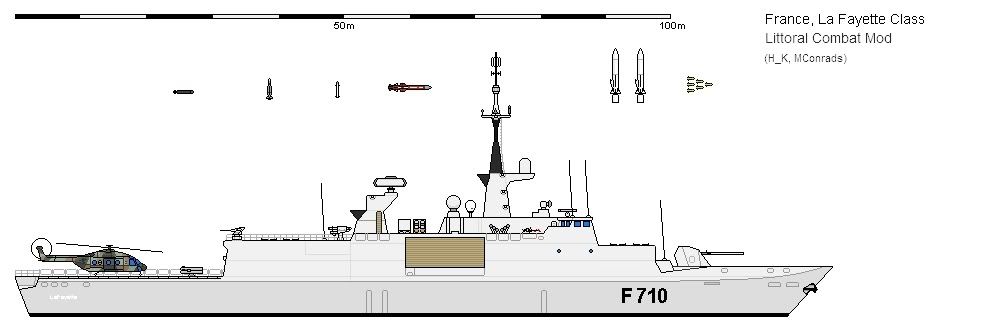
My favorite what-if is if LCS hadn’t been compromised by the speed requirement. Same general tonnage, completely different capability set. Something akin to a pimped-up La Fayette frigate:
La Fayette class – Littoral Combat Mod
Mission requirement:
– Close in to an enemy shore, either autonomously or as part of an amphib task-force
– Sea control: SIMULTANEOUSLY clear littoral waters of a) enemy ships, b) enemy submarines, c) enemy mines
– Land attack: SIMULTANEOUSLY engage a wide spectrum of tactical & strategic land targets, via commando operations (by sea & by air), naval gunfire support, and long-range precision attack
– While defending self & nearby vessels (<5nm) against air & missile attack
Rationale: You can’t predict what OPFOR you’re going to face, and you can’t predict what land targets the President will ask you to engage or ships you may have to escort, so you should be able to re-role on the go without sprinting back to a support base.
Mods to La Fayette frigate:
ASW
– Bow-mounted sonar
– 2x triple torpedo launchers
– Additional payloads as-needed: ASW-configured NH90 helo, USVs for mine warfare (instead of RIBs)
AA & Self-Defense
– 8x VLS for 16-32x radar guided MICA VL (replaces Crotale)
– 2x TETRAL reloadable launchers for 8x IR guided Mistral SAMs
– 2x 20mm remote cannon (in addition to the existing 2x 20mm manual cannon on the bridge)
Land Attack
– 16x SCALP Naval cruise missiles in raised forward VLS area for strategic strike
– 8x Exocet Block III for littoral strikes
– 1x 127/64 Oto-Melara gun with Vulcano ammunition for NGS
– (existing capability) 1x NH-90 (2x at a pinch) + 4 RIBs for 25 commandos
If this was a Batch II new-build, add a gas turbine to increase speed (currently only 25kts), and a 2nd helo hangar.
H_KThe indian navy has been remarquably coy about this whole incident. I can only guess that there was a major screw up in damage control and they’d rather not face tough questions. For example:
– We know from video footage that the collision was at fairly high speed but only at a glancing angle (seems like 30 degrees, bow on midships). How did that damage the boilers?
– The collision damage does not seem critical. The fire started only several hours later when everyone had been evacuated and the ship was sailed/towed back to a berth with only 7 meters depth, so the initial flooding can’t have been too bad. There was also time to unload the magazines.
– How come once the fire started it couldn’t be controlled by the ship’s DC equipment let alone all the help around it?
Pic taken at least 20min after the collision. Everything seems under control, no fire, no huge list, at least one engine room still working.
H_KNot to drift too far off topic, but I don’t understand why the Taiwanese haven’t jumped all over the UAE and Qatari Mirages. :confused:
The ROCAF has been begging for 66 F-16 Block 52s for the past 3-4 years, to no avail. Even if those 72 Mirages were only a 2nd choice (and I’m not sure they would be, given that the -5 is superior in air-to-air – kinematics plus ECM – to the Block 52, and the -9 even better still), the Taiwanese could at least make a go for the Mirages just to get Obama to the negotiating table. I think the French would be OK with Taiwan buying the Mirages, since there’d be enough plausible deniability that they couldn’t block the sale, and the ROCAF would have enough spare parts to last for a while.
H_Kpage 34
I dont see how you get those numbers, but they are probably not right ;).
1.5hrs flight roughly equals 720nm range at 480kts cruise. Normally fuel flow is ~15% higher at cruise speed than max endurance speed, so it should be less than 720nm, but let’s give SAAB the benefit of the doubt and assume that the time on station is spent at lower altitudes where max endurance fuel flow is higher than optimal and about the same as cruise fuel flow at >30k ft. Divide 720nm by two to get 360nm radius, add to 200nm, and that gives you a radius of roughly 550nm.
page 42
Maybe SAAB knows more of the real thust than you? 🙂 The only stated thust of the NG is the minimum thust. How do you recognise Gripen as 4 AAM= full AAM load? it should be 10AAM, and 12AAM for ex F-18
The wing loadings on this chart are OK – all aircraft are shown with 4 AAMs:
Gripen NG: 65lb/sq.ft. x 323 –> ~21,000lbs
Rafale: 57.5lb/sq.ft x 492 –> ~28,200lbs
Typhoon: 57lb/sq.ft x 551 –> ~31,400lbs
To check this:
Gripen NG: 15,700lb empty +3,650lb (50% fuel) + 2*350lb AMRAAM + 2*200lb IR AAM + 2*100lb pylons + 200lb pilot + 200lbs chaff/flares/liquids = 21,050lb
Rafale C: 21,500lb + 5,200lb + 2*350lb + 2*200lb + 200lb + 200lbs = 28,200lb
Typhoon: 24,250lb + 5,500lb + 2*350lb + 2*200lb + 2*100lb + 200lb + 200lbs = 31,450lb
All pretty spot on. The problem is with the thrust loadings:
Gripen NG: 0.882 x 22,000 thrust = 19,400lb combat weight
Rafale C: 0.9 x 32,800 = 29,500lbs
Typhoon: 0.825 x 40,000 = 33,000lbs
So SAAB have subtracted 1,600lbs from Gripen NG (basically all stores including the pilot!), while ADDING 4x AAMs to Rafale & Typhoon (1,300-1,600lbs). Alternatively, they are assuming 23,800lb thrust to maintain 21,000lb combat weight. If so, then that’s news, because SAAB and GE have always advertised the F414G as being an F414-GE-400 derivative with 22,000lbs thrust (20% more than RM12).
Looks like SAAB are counting on the F414 EDE, without telling anyone. That’s OK, but if so then we should be also use higher thrust numbers for the M88-4 and improved EJ200 versions to keep it apples-to-apples. Also, we’d have to reduce Rafale and Typhoon’s loads to 4 AAMs, which would give something like:
Thrust loadings with 4 AAMs
Gripen NG: 0.88
Rafale C: 0.83-0.86
Typhoon: 0.78
H_KSupercruise with 4 AAMs. That’s all we know.
The drag I’m talking about refers to all the nice promo pictures with heavy weapons loads (e.g. 4x GBU under-fuselage, 4x AAMs on twin pylons underwing). The parasitic drag on those closely spaced stores and interactions can’t be pretty.
Funny how SAAB’s performance and range numbers always refer to lightly loaded Gripen NGs, while the pics always show 2-3x those loads. I for one am not surprised that when they have to quote performance with a real bombload, the results are exponentially worse than previously publicized performance numbers.
H_KThis presentation actually betrays Gripen NG’s key weaknesses: its poor thrust-to-weight ratio, and its draggy, closely spaced, side-by-side stores!
Page 33
The Gripen NG to Typhoon comparison is meaningless, since the Gripen NG is carrying only half the # of AAMs, and carrying more external fuel (2x 1,700L vs. 2x 1,000L). No wonder it can fly farther – but it certainly can’t perform as well. Thrust loading in for the Gripen NG is 1.41 lbs/lbf versus 1.06 for the Typhoon, i.e. 33% worse. Even without tanks, the Gripen NG’s thrust loading is still 1.11, i.e. 10% worse than Typhoon with 4 AAMs and 2x 1,000L tanks. Apples-to-oranges.
Page 34
1.5hrs endurance at 200nm with 4xAAMs and 4x GBUs!!! says Saab. The exclamation marks are trying to spin what’s actually quite a poor performance. This converts to a radius of only ~550nm, versus >800nm for a Rafale in a same configuration. This puts Gripen NG in about the same category as an F-16, which makes sense since although Gripen NG is a bit lighter than early F-16Cs, the F414 has a slightly higher SFC. The draggy side-by-side underfuselage stores probably do the rest.
Page 42
This is by far the worst slide. Utterly false advertising on SAAB’s part. 😡 They compare thrust loadings of a bunch of fighters with 6-8 AAMs. The Gripen NG seems to do quite well – but that’s because it’s carrying only 4 AAMs and SAAB are estimating ~24,000lbs 😮 thrust for the F414. In reality, the Gripen NG’s thrust loading on that slide should be 0.97 instead of 0.88. That’s worse than almost all competitors, e.g. 12% worse than Rafale (0.87) and 24% worse than Typhoon (0.79), once you adjust AAM loadings.
I’ll give it to SAAB though. I was impressed by the presentation, until I started fact checking. They’re masters at spin. :rolleyes:
I’d like to think that they haven’t lied on costs though. Would love to find out whether Gripen’s REAL cost of ownership is as low as advertised.
H_KIf cost and range are the two key criteria, then surely Gripen NG is at least as good an option as the super hornet or Eurofighter tranche 1. It also meets most of the secondary criteria, such as being multirole. If it wins in either Brazil or india then it needs to be considered as a serious contender.
If range and capability were the two criteria then I can only see the Rafale, since the F15 is too big/unstealthy and too old and the other contenders don’t have the same legs.
H_KAdditional comment on CBR ratings: the C-17’s CBR runway performance has turned out to be wildly optimistic. It was supposed to be able to land thousands of times on the dirt runway at Camp Rhino in Afghanistan (CBR rating = 72), but in fact could only land 8 times the airfield required repairs.
A lot of that had to do with the limits of the CBR methodology, which doesn’t capture the stress a runway takes during C-17 braking. I don’t know whether there’s something unique about the C-17’s braking behavior (thrust reversers) or whether the A400M and C-130J’s braking behavior with variable pitch props would lead to similar problems.
http://oai.dtic.mil/oai/oai?verb=getRecord&metadataPrefix=html&identifier=ADA430864
H_KWhen it comes to practical performance it is the ratio of empty weight versus max landing weight.
Yes, with the caveat that for tactical operations it’s not the absolute max landing weight that matters, but the max weight for a given runway strength, length and number of passes.
So for example, the C-17’s MLW is 447,000lb and it has good field length performance, but both are irrelevant for tactical operations because the limiting factor is that it can only land at 350,000lb on soft CBR 6 runways, i.e. only with 40,000lb payload once you subtract 30,000lb of fuel for return to base. Even then, it can only do ~8 rotations before the runway needs repairs. And it can’t land on CBR 4 runways.
The A400M has similar field length performance to the C-17, and its max landing weight to empty weight ratio is a bit lower (though offset by lower fuel burn of turboprops vs. turbofans, so not a real handicap). So you’d think that it’s no better for tactical ops. But actually it can land on CBR 6 runways with more a lot more payload than the C17 (~66,000lb vs 40,000lb), and it can do 40 rotations instead of only. So it can carry 8x more tons before the runway needs repairs! All due to having a large landing gear. It’s also less susceptible to FOD damage, which is critical, and can land on CBR 4 fields. That’s why you can’t compare the A400M to the C-17 for tactical ops, only to the C-130J.
For logistics operations, you’re right that the C-17 is ahead, as it should be. Especially if you need to carry tanks or flying long 3,000nm+ segments. For most normal logistics missions, however, 2x A400M should do about the same as 1 C-17 for less cost (especially since they can bring the payload staight into many more forward bases).
H_KThe weight problem was “solved” by increasing maximum take-off weight by 11t, in two steps – first in 2005 (+6.5t), then in 2008 (+4.5t).
The latest specs were released in Sept. 2010 and confirm that. The trade-off is that there was a slight decrease in range, engine growth margin, and tactical capabilities. Nothing deal-breaking though – as a tactical transport the A400M is still equal to the C-130J in terms of # of passes on a soft field and better in terms of tactical landing distance, when carrying a similar payload (and of course it can carry a lot more than the C-130J if needed, not to mention fly faster and fly farther).
Evolution of A400M specs – 2001 / 2005 / 2008
Empty weight: 66.5t / 76.9t / 78.6t
Max landing weight: 114t / / 119t
MTOW: 130t / 136.5t / 141t
Thrust: 4x 9,500shp / 4x 10,700shp / 4x 11,000shp
Range with 30t payload: 2,600nm / 2,450nm / 2,450nm
Ferry range: 5,000nm / 4,900nm / 4,700nm
Tactical passes on CBR 6 field: 120 / 120 / 81-286 (depends on weight)
Tactical passes on CBR 4 field: 10 / 10 / 7-25 (depends on weight)
http://www.fzt.haw-hamburg.de/pers/Scholz/dglr/hh/text_2001_11_29_A400M.pdf
http://www.fzt.haw-hamburg.de/pers/Scholz/dglr/hh/text_2005_11_24_A400M_BWB.pdf
http://www.c-295.ca/images/documentation/A400M_Pocket_Guide.pdf
http://www.ndtahq.com/documents/FutureAirTechEADS.pdf
H_KBuccaneer should take up ~25% less space and burn ~25% less fuel than the A-6, shouldn’t it?
Buccaneer: 96m2 folded (16m x 6.1m)
A-6: 128m2 folded (17m x 7.7m)
Spey RB.168-1A Mk 101: SFC 0.63 lb/lbf-hr
J52-P8: SFC 0.86 lb/lbf-hr
H_KLooking at performance numbers, it looks like the A-6 had to choose between speed & payload/range: it could fly far with 2-3 300gal tanks, but that implied carring multiple ejector racks which would slow it down and in fact eat up most of the range gain. Or it could carry bombs/missiles in low drag single setups, but then it couldn’t carry as many drop tanks and wouldn’t fly as far or as fast as the Bucc. Some numbers:
Max Speed
A-6E – 18x 500lb Snakeye: 500kts
A-6E – 4x Harpoon: 520kts
A-6A – 5x 1,000lb: 554kts
A-6E – 1x 2,000lb: 560kts
A-6E – clean: 571kts
Buccaneer S.2 – 4x 1,000lb internal: 580+kts (from flight test report at flightglobal.com)
–> In fairly slick conditions, the A-6 flew at least 10-30kts slower than the Bucc. With multiple ejector racks (i.e. most of the time), it slowed down another 40-50kts.
Hi-Lo-Hi radius
A-6A – 3x 1,000lb, 2x 300gal tanks: ~1,000nm
A-6A – 4x 1,000lb, 1x 300gal tanks: ~930nm –> Matching the Buccaneer’s payload means losing a drop tank & losing range
A-6E – 6x 1,000lb, 3x 300gal tanks: ~950nm –> Those multiple ejector racks are draggy! Even if range is OK, speed won’t be so good.
Buccaneer S.2 -4x 1,000lb internal, 2x 300gal tanks: ~1,000nm
–> The Buccaneer could fly fast AND far. Too bad I don’t have performance figures for the Bucc. with 4 Martel & internal bombbay fuel tank. That would be a good alternative comparison with the A-6 carrying 4 Bullpups/Harpoon.
(All A-6 numbers extrapolated from the A-6A & A-6E standard aircraft characteristics: http://www.alternatewars.com/SAC)


 Sign In








