 H_K
H_KDassault Super Etendard S (for “Supersonique”)
Supersonic Super Etendard, that would have resulted from the cancellation of the Atar 8K50 engine in 1975 and adoption of the identically-sized afterburning F404-GE-400 engine plus dorsal fuel tanks. Result: +45% thrust and +30% range on internal fuel, and all the good things that go along with that (frees up hardpoints for more weapons, interceptor capability etc). Service entry delayed two years from 1978 to 1980, with Argentina still getting a couple before the Falklands and a larger production run eventually replacing the Crusaders in service…
OK, it’s only a what-if and the U.S. probably would never have let Dassault use the same engine as on the brand-new F/A-18, but I feel the need to correct one of the greatest injustices in carrier aviation. 😉 The Super Etendard would have gone from good to great with a better engine, and the F404 was an ideal candidate for integration given its very similar size, weight & mass flow.
Something like this:
H_KWe may also have to take into consideration, that by 2015, the FAA (not the Fleet Air Arm, ratter the Fuerza Aerea Argentina :p), will have replaced the planes of the 6th fighter group, with at least 24, and quite possibly up to 36 fourth geneneration aircraft. In all likelihood, Mirages 2000-5F from the Armee de l’Air.
:confused: The French Mirage 2000-5 are not for sale, now or ever. They are a very scare resource with limited airframe hours remaining, and the French will nurse them for all their worth for as long as possible (until ~2020). Same goes for all the remaining Mirage 2000C.
Now if the Argentines want to buy & upgrade the old Mirage 2000N (for the strike role) or the newer UAE Mirage 2000-9, that’s another story. But they don’t have the money, do they?
H_KWith careful planning, loads that are not too draggy, and buddy-buddy AAR (the use of land based KC-135 sized+ tankers defeats the purpose) on the way in and out (two different AAR flights, obvisously) that was in principal achievable with A3D, A3J, A-6 and A-7, and maybe also F-14. The SHornet falls short, Rafale should be able to do it.
A good rule of thumb is that buddy refueling can help you cover one third of the required distance, i.e. in this case ~500nm. So you need a radius of ~1,000nm without buddy refueling.
The A-7, which has extremely long legs despite its small size, can do that easily, as can the A-5 Vigilante. The A-6, Buccaneer and Rafale can also do it, but they’re hitting their maximum range (the Rafale will need its CFTs). No other carrier aircraft has the legs – the F-14 doesn’t have enough external tankage. As for the F-35C and the F/A-18E, they just don’t cut it.
Of course, you could always double up on buddy refuelers, but there are several reasons for the 1/3 distance rule of thumb:
– The buddy tanker stays far away from the threat
– This gives enough time for the buddy tanker to help on the return leg. Remember, if the fuel offload happens at 1/3 of the strike distance, then by the time the tanker returns to the carrier the strike aircraft are 2/3 of the way to target. The tanker then needs to launch again when the strike aircraft are 1/3 of the distance home, which means that on a 6-7hr mission it has 2 hours to recover, refuel and launch.
– Fuel offload at 1/3 of the distance means that each buddy tanker has enough fuel to support 2 strike aircraft, so a 12-aircraft squadron becomes an 8-aircraft strike force, which is the bare minimum.
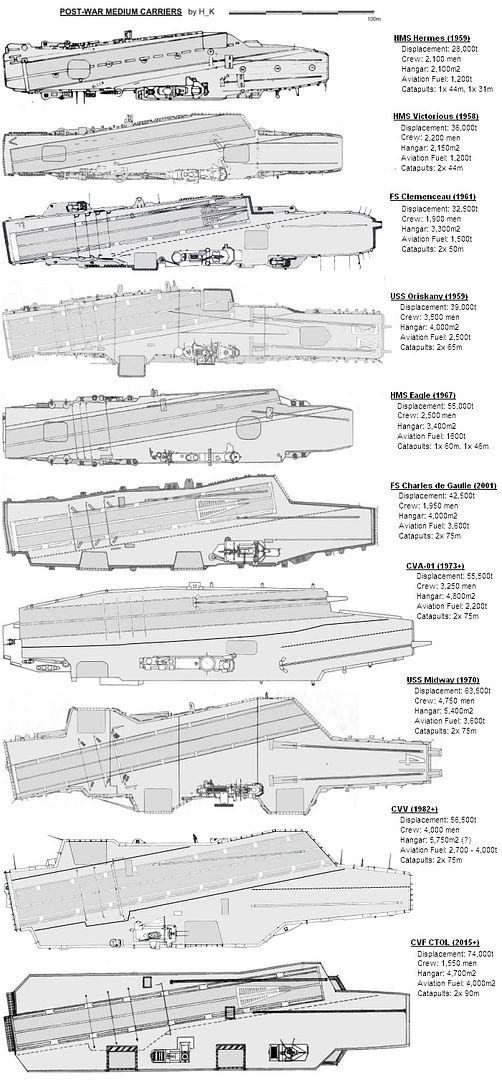
H_KWith the switch to cats the CVF’s deck layout is really suboptimal. My criticism towards CdG, of being unable to perform simultaneous launch and recovery, is valid for CVF also. Even more so, cause we’re dealing with 65.000ts ships here. All the flight ops on CVF will require extensive deck maneuvering, crossing the deck multiple times, cause literally all the positions are the wrong way round..
Ahhhh, the flow… the FLOW, says he! 😀 (Sorry, couldn’t resist that, we both must sound like broken records :p)
Would be interesting to compare sortie generation rates of CVF vs. CVV. That would settle our debate on flow pretty nicely since they’re close to the same size. I gather you’d see CVV’s deck layout as close to ideal.
Sigh …. In the end a ship 50% larger than a 27C will have only 50% of the latter’s fighting power. The manpower advantage comes not from layout and design, but from unrelated technological advances like GT-electric propulsion and computer networks.
Hardly. The modernized Essexes couldn’t match Charles de Gaulle, let alone CVF. You know as well as I do that you can’t extrapolate from aircraft numbers then and now. You have to look at sortie generation, aircraft size, ordnance & aviation fuel storage…
H_KNot surprising considering the CdG reliability record but still…
Not exactly true. From 2001 to 2007 CdG was the BUSIEST carrier in the world, spending 145 days away from her homeport year in, year out, for 6 years straight. All worries about her reliability had pretty much disappeared.
The problem is that since her refit everything’s gone wrong. This is now raising questions about whether this is just “bad luck” or something more serious:
[*] Maybe the propulsion is aging poorly, but that also sounds unlikely because the components that are breaking are fairly standard stuff (unlike the propeller problems during sea trials).
[*] That leaves maintenance & quality of work issues. It’s quite possible that budgets have been shaved a bit too much for comfort, or that privatization of contracting has led to loss of engineering knowledge within the navy. Either of those would be very worrisome.
Maybe they just feel there is a lower risk to the propulsion system by switching it off? The last thing they want to do is cause even more damage.
Here’s my guess: it’s a steam valve, so to repair it you have to flush the entire steam circuit. Which in turn means you probably have to shut down the reactor. Once the repair is done you have to slowly bring the reactor back on line. No wonder it takes a few weeks.
H_KBTW, on the subject of LSDs/LPDs/LHDs. etc., I’d quite like to know the sizes of docks of various classes.
You can infer from stated landing craft numbers, adding a few feet in length and width. Generally speaking, since LCMs and small LCUs all take up roughly 175-250m2, all well decks will be multiples of that. For example:
1 LCM/LCU (200-300m2): San Giorgio, Bay class
2 LCM/LCUs (575m2): Johan de Witt
4 LCM/LCUs (800-1000m2): Mistral, BPE, Albion, Galicia, LPD-4, LPD-17, LSD-49 classes
6 LCM/LCUs (~1500m2): Rotterdam, LHD-1 class
10 LCM/LCUs (~1800-2000m2): LSD-36, LSD-41, Foudre classes
Ultimately though, all amphibs whether LSDs, LPDs, LHDs or LPHs can be expected to have similar capabilities in terms of total payload area/volume (for a given displacement). The only differences being in how these spaces are broken down between aviation/vehicle & cargo/well dock/accommodation areas.
P.S. For VERY detailed specs of USN amphibs, this is a treasure trove:
http://www.usmc.mil/news/publications/Documents/MCRP%203-31B%20Amphibious%20Ships%20and%20Landing%20Craft%20Data%20Book.pdf
H_KWhat’s interesting about the X3 is that Eurocopter is starting off with existing helicopter components and a realistic fuselage size, so the performance and cost data they get from this is going to reflect more accurately what’s achievable in the real world.
By contrast, the X2 is just a bite-sized 2-man concept engineered for the lightest weight and lowest drag, so we don’t know how well it’ll translate to a real-world helo (i.e. more weight & drag, larger rotor diameter etc).
Hopefully the next step for Eurocopter if the X3 works out will be to design a more production-ready pusher-prop configuration with shrouded rotors and redesigned exits.
H_KJust looked at NATO’s callsign books, and they only add to the confusion!
1996 callsign book: http://www.p530-daphne.dk/Downloads/call%20sign%20book%20for%20ships.pdf
2008 callsign book: http://jcs.dtic.mil/j6/cceb/acps/acp113/ACP113AH.pdf
H_KBack on Topic – LPDs vs. LSDs
Reviving this thread to continue the discussion about LPDs vs. LSDs from the CVF thread (http://forum.keypublishing.co.uk/showthread.php?t=92518&page=31). Here’s what triggered our debate:
I won’t derail this topic anymore, but I would point out the a Foudre, being a LSD a-la-“Widbey Island”, make little sense as a LPD, lacking any provision to sustain any troop or vehicle it can deploy ashore.
It’s a worst choice, IMHO.
It’s a huge force multiplier for the Mistrals, providing a huge first amphibious landing force, even well motorized or mechanized, but it makes little or no sense at all if take it alone.
You must be confusing with another ship. 😉 The Foudre class are 100% LPDs, very much in the same class as the Rotterdam/Johann de Witt and Albions, as can be seen below:
– Dock for simultaneous storage of LCMs & heavy vehicles (1,700m2)
– Light/medium vehicle storage (mostly topsides – 1,000m2)
– Hangar for 4 helos (400m2), two-spot helo platform (1,100m2), and aviation fuel for ~120 sorties (215m3)
– 50-bed hospital (500m2)
– Command facilities – these are very cramped and old-fashioned by modern standards, but they do exist. Provision for additional containerized HQ facilities.
– Accommodation for ~400 troops (long-term)
The differences between an LSD (e.g. Whidbey Island or Bay class) & an LPD are a little fuzzy, but AFAIK are generally reckoned to be in the aviation facilities, & the mix between troops & vehicles, not in the ability to sustain whatever it lands. LSDs generally lack hangars or aviation support & are oriented towards troops rather than heavy equipment. Foudre is typical of LPDs in having a hangar, & the ability to support sustained helicopter operations.
Of course, the French have their own classifications. Foudre is a TCD – transport de chalands de débarquement, & Mistral is a BPC – bâtiment de projection et de commandement.
Agree on the rest of your post, though. That big dock, & the first wave capability it gives, is very useful.
@H_K
No, I’m not confusing ships and calissifications.
I base my own on U.S. Navy standards, it could be questionable if they are the best or most appropriate, but there is intrinsic logical coherence with them.
By U.S. Navy standards, an LSD is a ship with most of its hull devoted to a very large dock, able to transport and deploy ashore large amounts of landing crafts.
By the same standards, what you save of your LSD’s hull from the dock is part deck space for motorized or mechanized assets, or berthing facilities.
There is almost no room at all for storing facilities, either dry or liquid.
And at the present time, U.S. Navy LSDs are the Widbey Island class ones, whose cutaway is really close to Foudre class cutaway, and related facilities as well.
By the aforementioned standards, is LPD’s standard (Austin class and now San Antonio class) to provide facilities for logistic support, i.e. mainly stores.
This is the rationale dictating a dock’s depth of less than 30 meters for San Antonio class vs. around 100 meters for Widbey Island class
Of course you can sort out of an LSD something resembling an LPD, e.g. you can turn out with sometinhg like an Harpers Ferry, an iteration of Widbey Island with only 30 meters depth dock and plenty of stores builded on the saved room.
But it is something I would think of for a new built ship, like if Marine National discovered their amphibious fleet is severely impaired by the lack of a logistic amphibious ship (and they actually lack that asset) and like to keep R&D costs low modifying the Foudre project the same way U.S. did with Widbey Island, but ways too expensive to refit in an already built ship.
Verbatim,
Well in that case, it’s the USN standards that are rather overly simplistic, because they focus on form (size of well deck) rather than function. By contrast, I believe most NATO navies would agree to a classification based on function:
LPDs: Cover the tactical side of ship-to-shore – this requires an ability to embark and sustain troops, a mix of landing craft and helicopters, some vehicles, a command element, and medical facilities.
LSDs: Cover the logistic side of ship-to-shore , i.e. supporting other amphibs – this focuses much more on cargo, vehicle and/or (especially in the USN) landing craft stowage.To me this kind of functional classification is much clearer and generally applicable. For example, both the Whidbey Island and Bay class are clearly LSDs, even though the former have a huge dock and the latter have a poststamp-sized one. Similarly, the Albion and Foudre class are both LPDs, even though the former have no hangar (but still can sustain helos, so they’re LPDs) and the latter’s dock is “too big” for a traditional LPD…
I was always confused about LPD vs LSD, now I’m even more so.
I was also under the impression the main difference was in the size of the well dock, LSDs having a smaller well dock but large storage while the LPDs have large well docks but at the expense of storage capacity.
This is how it is in the RN atleast, IIRC the well dock of the Albion able to store up to four LCU Mk 10s while the Bay class’s dock can only support one + a couple of LCVP Mk 5s, but the Bays able to carry far more vehicles than the Albions. I thought this was due to the Albions landing the first wave, so focusing on getting what they have onto the beaches as soon as possible while the Bays simply trickle reinforcments onto the captured beachhead at a much slower rate, but ultimately delivering more equipment.
H_KVerbatim,
Well in that case, it’s the USN standards that are rather overly simplistic, because they focus on form (size of well deck) rather than function. By contrast, I believe most NATO navies would agree to a classification based on function:
LPDs: Cover the tactical side of ship-to-shore – this requires an ability to embark and sustain troops, a mix of landing craft and helicopters, some vehicles, a command element, and medical facilities.
LSDs: Cover the logistic side of ship-to-shore , i.e. supporting other amphibs – this focuses much more on cargo, vehicle and/or (especially in the USN) landing craft stowage.
To me this kind of functional classification is much clearer and generally applicable. For example, both the Whidbey Island and Bay class are clearly LSDs, even though the former have a huge dock and the latter have a poststamp-sized one. Similarly, the Albion and Foudre class are both LPDs, even though the former have no hangar (but still can sustain helos, so they’re LPDs) and the latter’s dock is “too big” for a traditional LPD…
H_KI won’t derail this topic anymore, but I would point out the a Foudre, being a LSD a-la-“Widbey Island”, make little sense as a LPD, lacking any provision to sustain any troop or vehicle it can deploy ashore.
It’s a worst choice, IMHO.
You must be confusing with another ship. 😉 The Foudre class are 100% LPDs, very much in the same class as the Rotterdam/Johann de Witt and Albions, as can be seen below:
– Dock for simultaneous storage of LCMs & heavy vehicles (1,700m2)
– Light/medium vehicle storage (mostly topsides – 1,000m2)
– Hangar for 4 helos (400m2), two-spot helo platform (1,100m2), and aviation fuel for ~120 sorties (215m3)
– 50-bed hospital (500m2)
– Command facilities – these are very cramped and old-fashioned by modern standards, but they do exist. Provision for additional containerized HQ facilities.
– Accommodation for ~400 troops (long-term)
H_KRafale should require fewer man-hours because it is mechanically simpler (PESA radar, fixed refueling probe, no air brake, fixed intake, side-opening canopy for easy ejection seat maintenance etc). This was an explicit goal of Dassault’s and driven (partly? mostly?) by the carrier requirement.
However, Typhoon’s components might be less expensive, due to the larger production run. I say “might”, because Typhoon’s fixed R&D costs were much higher than Rafale’s (due to the inefficiencies of multinational cooperation and a steeper learning curve for the Eurofighter partners). So although Typhoon’s variable production costs should definitely be lower, the high fixed costs have to be amortized somewhere.
Who knows where it all nets out? 😉
H_KThere are serious issues involved with the, crazy decision to go with a split island on the QEs (shortest vent route distance from the engine rooms), bungled flight deck layout that resulted, and the plane handling issues.this caused, ***** decisions followed as to hanger layout from the stack exhaust routing. This also involved lift placement, as the split island cut into usable available below and above storage, plane park space, and plane movement routes.
(…) As for the PA2, can I believe this at all? First, where is the funding? Second, from the same bunch that created the CdG, with its original bungled takeoff runs and bad island placement, you expect a competent CATOBAR design mod of a QE STOVL carrier? Please don’t make me laugh so hard.
Sounds like this GF fellow is part of that tiny fringe of people who obsess about aircraft “flow” aboard carriers (Stuart Slade, Distiller – maybe GF & Distiller are the same Aussie poster?). There are a couple of issues with their arguments:
– Flowing aircraft through the hangar is stupid. Imagine that – a few times an hour, asking everyone to stop all maintenance and play musical chairs. In the middle of changing out an engine? Sorry chap – get a move on! 😮 (Thanks Badger for explaining this)
– Flowing aircraft through the hangar directly to/from catapults/angled deck raises a host of safety issues: you have to arm/disarm the aircraft in the hangar, keep fire doors open most of the time etc. Fine on a WWII carrier with gun-armed prop aircraft, but not OK with modern fighters each carrying 10t of fuel & explosives…
– Finally “flow” loses a lot of its urgency on a medium carrier with only 30-35 aircraft. The USN alone is in a different boat – they have to cycle twice as many aircraft/sorties through the same angled deck. So obviously minimizing fouled deck time is more critical for the USN. But for CVF or CdG? Their “bungled” deck layouts are prioritizing more important things, such as all-weather operation (not possible with forward deck-edge lifts) & maximum internal volume.
H_KMerlin2,
UAE, Greece and India are all repeat Mirage 2000 customers. That’s 3 out of 4 major export users. Spin it anyway you want, but you’re not going to convince anyone on this forum that the Mirage 2000 is a failure. Unless by “average” you actually mean “competitive with an F-16”?
The 4th major export user is Taiwan, and there’s no way of knowing whether they might have been a repeat customer, had the ROCAF Mirage 2000s not became collateral victims of China’s growth and the Lafayette frigate scandal.
(I count India as a repeat customer because additional Mirage 2000s were repeatedly asked for by the IAF, approved, and then lost somewhere in the raj’s maze)
By the way, are you still the same Merlin2 as before? You know, the French poster who is a Rafale fan and presumably should know enough about the Mirage 2000 not to discount it so quickly? :confused:
H_KDistiller, I fully agree that commercial diesels may turn out to be a poorly thought out concept. Certainly FM 400 is a GP frigate, so the propulsion requirements are fairly benign compared to an ASW or AA escort. Most likely commercial diesels don’t translate well across the board.
What’s interesting about commercial diesels is the weight/volume savings on the fuel & reduction gear. Maybe these offset the higher weight of the engines? Not to mention the lower ownership costs.


 Sign In







