 H_K
H_K@ Screw/Jet combo: That French stuff above is nice, but such a propulsion is already operational (as I said in my post above). The German built South African MEKO 200 Valour class uses it for a couple of years already!
The difference between MEKO & DCNS is that DCNS is looking at low speed commercial diesels instead of medium/high speed military diesels, for a claimed fuel efficiency increase of ~30%. In an ordinary CODAG/CODLAG setup this would make no sense because commercial diesels are hardly quiet, but with a waterjet hybrid setup you can shut off the diesels and use the waterjet whenever you need to shake off an enemy sub. Waterjets open up a whole slew of propulsion options, and DCNS are just taking this new technology to a logical conclusion.
H_KDo gas turbines burn a lot of fuel, compared to say, a diesel?
Yes. Gas turbines have a very narrow efficiency band, near full output. Outside that band they are horribly inefficient; within that band they are more efficient, but IIRC still less than a diesel. So for a large combat ship all-gas is an option because you have several gas turbines and for normal operations can shut off most of them, leaving only one or two to operate close to full output. (e.g. U.S. destroyers/cruisers have 4 gas turbines)
Is the diesel/electric option still a rather complex set-up? The all-electric sysytem seems to be the fashion of the moment, but has it matured, in terms of reliability and simplicity?
IIRC, IEP is expensive and demanding in terms of weight/volume requirements. Not sure why this is more the case than “simple” CODLAG or CODLOG setups, which are more complex mechanically. I think it’s because of the size of the electric engines required to reach full speed – these have to be much bigger than the electric engines in a CODLAG or CODLOG setup.
Diesels still appear to offer substantial benefits in terms of simplicity, fuel efficiency, ease of operation and maintenance, reliability?
Yes. In fact, one of the most interesting recent propulsion ideas is the one proposed by DCNS for its FM400 frigates. It’s beautiful in its simplicity – 2 cheap slow speed commercial diesels each driving a shaft (up to 23kts), plus a waterjet driven either by a high speed military diesel (25kts) or a gas turbine (29kts). Maximal use of commercial components plus no complex reduction gear.
H_KGas = Excellent acceleration, compact
Diesel = Efficient for cruise (medium-high RPMs), simple intake/exhaust requirements
Electric = Silent, efficient at low RPMs
IEP = More damage resistant & more design freedom (can locate diesel/gas generators anywhere)
These days diesel-electric is almost mandatory for ASW combatants and OPVs. Moreover gas is required for ASW (for sprints). AAW and GP combatants, as well as amphibs/logistics ships, are the only ones that can get away with diesel-only propulsion
In addition, don’t forget the “Or” propulsion variants – COGOG, CODOG, CODLOG. They may appear less flexible and less capital-efficient, but those disadvantages are often more than offset by the less complex reduction gear. Reduction gear is often a weakness of “And” propulsion arrangements.
H_KI think the Greeks were probably correct about the A-7 being the best strike aircraft in Europe until advent of the Tornado….even then I think it still provides good capabilities in comparison.
When you think about it, even today with its range, low-cost of operation (& relatively easy maintenance), plus big payload, the A-7 can still provide a great long-range punch.
Fully agree that the A-7 was an impressive little aircraft. You can sum it all up with two statistics:
3,700km – that’s the A-7E’s range with 4.5t of internal fuel (clean). :eek:Amazing even by today’s standards, and even more so for a carrier aircraft. Only the Buccaneer compares, though it was a much heavier aircraft.
600kts – that’s the A-7E’s max speed. It was very fast for a non-afterburner engined aircraft – faster than a Buccaneer in fact (but no internal bomb bay). :diablo:
I still have a softer spot in my heart for the A-4M though, mostly because it was cheaper to operate and better as a fighter. The A-7E was miles ahead as an attack aircraft, but it never had anywhere near the same export success as the A-4M, and was not an option for small/mid-sized carrier navies.
H_KRe the French: I think it was less a technical/operational reason, but more the fact that the French had something that could fill the attack mission (the Super/Etendard), whereas for the fighter mission they had nothing, and thus went for something foreign (the Crusader). NIH works/worked on both sides of the Atlantique.
Those industrial reasons explain why the Super Etendard edged out the A-4M in the end. However, the A-4M was seriously considered by the French; the A-7 wasn’t. The difference comes down to the technical/operational & price concerns I mentioned in my previous post.
H_KDid the French ever consider A-7s for their carriers?
Beautiful plane indeed.
The French considered the A-7 twice, in 1970 & 1972. Both times it seems to have been quickly discarded – the real battle was between the A-4M & Super Etendard (the Jaguar M was a favorite in 1970 but fell out by 1972 following very disappointing carrier suitability trials).
The reasons for the A-7’s dismissal were:
– Too expensive: 2x the price of the A-4M/Super Etendard
– Complex avionics: potential maintenance headache, plus raised concerns about whether Congress/DoD would even release the A-7E for export
– Too heavy: Would have required an expensive refit to the French carriers, and lower MTOW, which would have significantly reduced the A-7’s payload/range advantage over the A-4M and Super Etendard
– (My hypothesis) Less versatile: Both the A-4M and Super Etendard were quite capable in their secondary fighter role, with good thrust/weight and low wing loading, while the A-7E’s A2A capability was mostly a sham (IIRC – correct me if I’m wrong). Versatility would have been highly valued by the French given their small airgroups.
H_KThe C-27J can only carry 9t in tactical mode, and only over ~1,000nm. That’s good enough for a small armored vehicle on a short intra-theatre hop, but that’s it.
The C-27J simply won’t work if you’re trying to project a force from an airbase in a neighboring country into a rough field. A C-130 can do it moderately well; the A-400M should do it extremely well if it comes close to its specs. There are many instances where that’s been helpful in the past. E.g. Uzbekistan –> Afghanistan, Kenya –> Congo, Central African Republic –> Chad etc.
H_KYes. They are saying this was never a requirement, and the 37 t is payload plus customer defined options such as cockpit armour, etc. Most recent figurs i have are:
Max 32 t
25 t to 3700 km or 17 t to 5550 km.
Peter G, what’s your source for those numbers? They’re so bad they’re hard to believe. The last official specs were 30t to 4450km and 20t to 6400km. Those ranges were already revised downwards by ~8% compared to the early 2000s.
H_KEE Lightning just fits the British culture. Bold, daring, a sense of flair, and a hint of drama. The F-8 was kind of boring in comparison.
Agreed. You can add to the Lightning’s “British” attributes: complex (but nice) electronics, expensive, atrocious maintenance, odd weapons fit (IR only missiles). If only the Germans or the French had tried to build it, but then it would have been too practical, and anyway they didn’t have Rolls-Royce… :p
All said, I think I’ll stick with “boring”, like the F-8 or Mirage F1. 😉
H_KThat’s a great graph! Any chance you can add the bypass ratio & SFC?
Just a note, IIRC the F414 is slightly larger than the EJ200, so your specs seem a bit off. Here are the specs from another thread:
Weight: 2,445lb
Dry thrust: 14,756lb
AB thrust: 22,000lb
http://forum.keypublishing.co.uk/showthread.php?t=66123
Note also that the F414’s AB thrust of 22,000lb is also somewhat misleading. That’s more the installed thrust at altitude. In the real world, the F414’s SL uninstalled static thrust is ~20,700lb, as per a GAO report somewhere.
The M88-2’s real world thrust is slightly lower than your numbers: 10,971lb dry & 16,630lb with AB, according to Fox Three #14. No telling whether that’s installed or uninstalled.
H_KT
2 AM.39 Exocet, 1 1300 L drop Tank (855 nm)
1 1300 L drop tank, 2 ARMAT, 2 R.550 Magic (885 nm)
1 1300 L drop tank, 2R.500 Magic, 2 R.530D (885 nm)
4 Belouga, 2 1700 L drop tank, 2 R.550 Magic (1094 nm)
18 EU2 250 kg bombs (756 nm)What are those numbers in parantheses? Combat radius I presume?
Those are combat range figures – divide by two to get combat radius.
Interesting to see that the Mirage 2000-5 in A2A configuration with 6 MICA and the 2 extra under-wing 2000L tanks has a combat radius of 830nm, i.e. almost double what you listed (440nm) for the old Mirage 2000C with 4 AAMs and only the ventral 1300L tank.
H_KA lame excuse to stay polite. Airbus had real trouble with the A-380 and not enough engineers at hand to overcome that. Its civil customers were not willing to take the extra cost of delays and even claimed penalties from Airbus. At that time-scale the development of the A-400M slowed down considerably. :diablo:
The first prototype of the A400M was even built and waiting for its engines, which were delayed by software problems. Faithful believers in EADS claims will not ask, why EADS did not use that time to cope with the known “overweight” problem of the A400M.:
I think your argument is equally lame. :p You can’t just shift engineers around like that. The production engineers & electricians working on the A380’s wiring problems were of no use to the software developers working on the TP400 FADEC and the A400M’s FMS, nor where they of any use to the structural engineers working on the A400M’s. So it’s unlikely that the A400M was delayed much by the A380.
As for the TP400 problems, these explain at most 26 months of the A400M’s total delay of 38 months. At least a year’s delay is simply due to Airbus being forced to sign up for an unrealistic testing program, to make up for (mostly German) delays in signing the contract. The delays themselves wouldn’t have been that costly if there’d been extra time available. What’s expensive is rushing testing & production and then having to constantly make changes once production has already been launched.
H_KBoom, I think this warrants some Mirage 2000 porn. Don’t you think? :p
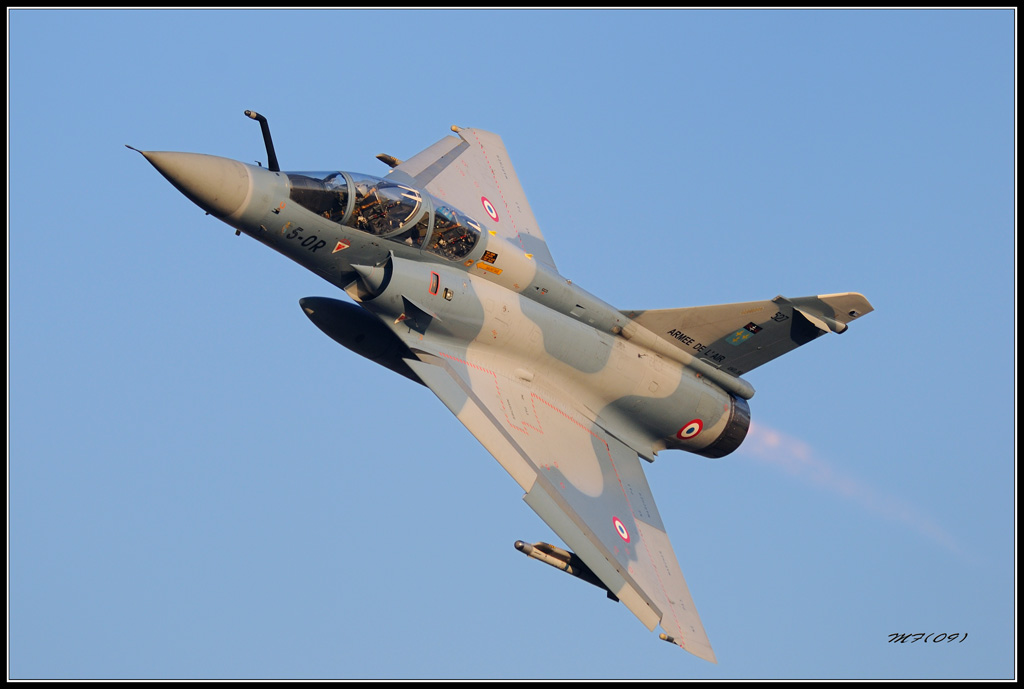


More (60 pages :cool:), here: http://www.foxalpha.com/forums/viewtopic.php?t=10330&postdays=0&postorder=asc&start=0
Now of course it’ll never be as elegant as the Mirage IV…

H_KThe A400M is a real trouble. The Germans are not willing to take cost-overruns any longer. The allocated money for that program will cut the procurement number from 60 to 30 and EADS will suffer some further blows for its horrible management.
The irony is that Germany is indirectly responsible for a larger portion of the delays & cost overuns than any other nation, or even EADS.
Had they not flirted for so long with the An70, then committed to unrealistic order numbers to maximize their workshare (what need does Germany have for 60 A400Ms, let alone 73 originally?), specified stuff they isn’t needed (automatic terrain following), and finally taken 18 extra months to sign the contract, Airbus would have been under much less timing pressure and the A400M’s development wouldn’t have had to be rushed. Rushing development is terribly expensive…
H_KAs I said, the new RBE2 AESA has been tested on the CEV’s Mirage 2000 B501 shown in the pictures. There’s a French MoD press release somewhere confirming this.
B501 is not an operational aircraft due to the combined weight of OSF + RBE2 (OSF may actually be a dummy due to limited space for cooling systems – someone would have to find the relevant articles to confirm). All we can conclude that RBE2 AESA fits in the Mirage 2000’s nose, but we can’t know for sure that it would be operationally useable (depends on the centre of gravity issues).


 Sign In








