 H_K
H_KCan the mirage dash 5 be upgraded with the rbe2aesa?
The RBE2 AESA and OSF have been tested on a Mirage 2000B, but with operational limitations due to the change in centre of gravity: 300kg ballast added in the rear, less fuel, disturbed airflow & 7% higher fuel consumption.
That said, most of those limitations have to be because of OSF. Probably RBE2 AESA alone would be OK. You might like these pics:


H_KIt looks like what it is an example of too many people being involved in the design process. They built a machine that looks like it should have turbofans and they put turboprops on it. Couldn’t agree on what it was supposed to be. If it is intended as a C-130 replacement I doubt it will get in and out of some of the places the Herc has used, not with a useful load anyway.
Well, to me the A400M looks just the opposite. :p The turboprops are a great choice – I really don’t see any advantages to turbofans. The undercarriage is miles better than the C-130’s, and if it looks rotund and slightly awkward it’s because the fuselage has to be big enough to carry a real payload and the controls powerful enough to keep it flying with an offset center of gravity (for paradropping). Those features have a cost in terms of weight, but they’re worth it.
By your argument, the C-17 also looks designed by committee. Trying to pair a STOL landing capability with turbofans! 😮
H_KThe Mirage 2000 looks great compared to the undersized F1.M53 because the latter is a little airframe with a big engine. The Mirage 2000 was quite a bit heavier, more in the class of the F2 or F3.
Not so. Empty weight of both the Mirage F1C and 2000C is ~7,400-7,500kg. The Mirage F1/M53 was heavier at around 8,000kg. Internal fuel was within 5% for all three.
Not sure why you’re so impressed with the Mirage F2. It was expensive and IIRC its performance wasn’t as great as you’re painting it to be. Certainly it didn’t have fly-by-wire and wasn’t intended for high-altitude interception, the TF30 engine being relatively high bypass, i.e. lower thrust at high altitude/high speeds.
H_KIt does still not explain why the french feel the need to boast about being able to fly 1 hour (or 200km at average speed) a day with their new toy
Re-read the French MoD’s press release. It doesn’t boast – just factually reports that the Tigre fleet has surpassed 1,000hrs in Afghanistan.
Eurocopter then added a press release of their own calling this a success and boasting of a 90% availability rate in a “tough environment”. Obviously a dig at the Germans who can’t seem to get their house in order and are (wrongly?) blaming Eurocopter for their issues with the UHT Tiger.
Bottom line: I don’t think anyone is claiming that 1hr per day is a remarkable figure, just that it shows that the Tigre is mission ready and performing in line with other French helicopter types in Kabul such as the Gazelles, Cougars and Caracals, which are all averaging about 1hr day too. (Keep in mind that all these helicopters spend a lot of time on alert, which uses up manpower too)
H_KIIRC, the risk with Jaguar M wasn’t so much engine failure on approach as afterburner failure. There was too much risk that the modulated afterburner would respond too slowly if the Jaguar needed to gain height during approach, so the safety margin was poor. Add all the other structural, range, performance, avionics & carrier refit issues, and the Super Etendard was clearly a better choice.
Jaguar International might have been a different story, but it didn’t even exist on paper when the decision was made in 1973.
See this thread: http://forum.keypublishing.com/showthread.php?t=66621&page=2
H_KI’ve flown both.
What do you want to know?
Fantastic. How did they compare in ACM for starters? F-4E with slats vs. F-104 with very high wingload. My hunch is the F-4E should out-turn the F-104. In the vertical they’d be fairly similar? (Similar T/W)
Which model of F-104 did you fly by the way? F-104C or G? Any big difference in how they flew?
Lastly, for interception, which one was better in terms of raw performance? (Time to climb, supersonic acceleration etc). I won’t ask about avionics & weapons systems, because they’re hardly comparable.
H_KCompare it to the M2000 available from 1982 and you get an idea, why it was not built for good reasons.
I’m not saying that more Mirage F1s should have been ordered instead of waiting for the M2000. Just that the 165 Mirage F1s delivered from 1977 (two thirds of French orders) could have been M53 powered. This would have led to a slight logistics headache, but the French Air Force was moving towards the M53 anyway, and what’s one more engine sub-type when you already have 5 different Atar sub-types? Also most of the integration cost had already been paid for.
Back to the topic. I’d love to hear what Greek/Spanish pilots had to say about F-104G vs. F-4E vs. Mirage F1, Jordanian/Moroccan pilots about F-5E vs. Mirage F1, and Libyian/Iraqi pilots about Mig-23 vs. Mirage F1. If only we could find out!
H_KMadRat, that seems way too complicated. But it’s true that the Mirage F1-M53 should have been bought. It was a great performer:
– Engine: 300kg lighter engine, -55% specific fuel consumption at maximum thrust
– Climb: +11,800ft/min climb rate at Mach 0.9 & sea level, +23,500ft/min climb rate at Mach 2 & 34,000ft. +4,000ft service ceiling. Time-to-climb: 5min20s to Mach 1.8/40,000ft instead of 8min…
– Maneuverability: +0.7g sustained turn at Mach 0.95
– Combat radius: +120km hi-lo-hi (+40km lo-lo-lo) with 4x 454kg bombs & 2 drop tanks, +460km ferry radius
Source: DASSAULT Mirage F1 by René Francillon / Aerofax Minigraph #17
H_KWhen did the Mirage F1 shoot down an F-100 (Super Sabre?)?:confused:
Iran-Iraq war. According to ACIG, the Mirage F1’s confirmed kills are as follows:
Iran-Iraq War (1981-1988): 17 kills
2 F-14A
7 F-4E
3 F-5E
2 F-100
2 RF-4E
1 EC-130
Angolan War (1981-1985): 4 kills
3 Mig-21MF
1 An-26
At least 5 missile launches on Mig-23MLs, but no kills (would have been different with Magic IIs or Super 530F).
Peru border war (1995): 2 kills
2 Su-22
A generalised “superior” would be a little bit far stretched. Superior in certain areas perhaps. But no big deal at all, and for the record the MiG-29 was night and BVR capable since its inception.
I wasn’t implying that the Mirage F1 was superior in a dogfight – only in BVR and as an interceptor, which IMHO is key. That said, for the Mig-29 I was going from memory so I may be mistaken. I thought the R-27 wasn’t really used operationally on the Fulcrum-A due to the N019 radar’s problems (poor ECCM, phantom contacts, ground clutter issues). The Mirage F1’s Cyrano IVM was an older non-doppler design with limited look-down/shoot-down capability, but it had good ECCM and was bug-free, and so it seems to have been effective in BVR.
As for the F-16, I disagree strongly that the performance gap was “no big deal”. I have it straight from the mouth of a French F1 pilot (now colonel) that his unit would regularly cream Belgian F-16As (pre-MLU) during exercises in the early 1990s. His explanation? Lack of ECM on F-16s & the Super 530F missile. He seemed almost insulted, because I had suggested that the F-16 was superior! (I learned something that day) IMHO, during the first 10 years of its service life the F-16A/C was little more than a sad joke – had NATO gone to war, it would have been shot down in spades by Mig-23s & Mig-25s, even without the help of new Mig-29s & Su-27s.
H_KHard to beat the F-4 – combat proven, effective as both an escort fighter & interceptor, served many countries. Not to mention carrier & air-to-ground capable!
That said, the under-rated Mirage F1 is a worthy runner-up from 1975-1990:
1. Great all-round fighter/interceptor/ground-attack aircraft, very competitive with its 2 main rivals, the F-4 & Mig-23. Also, not many laymen know this, but the Mirage F1 was superior to newer F-16s/Mig-29s until the early 1990s, since these were day fighters with no BVR capability! :p
2. The Mirage F1 saw widespread service – 3 NATO nations, 8 emerging countries, including some interesting players such as Greece, South Africa, Iraq, Libya. Proved to be a very affordable fighter/interceptor.
3. Good combat record, with victories against F-14s, F-4s, F-5s, F-100s, Mig-21s! :diablo: Plus Su-22s after the end of the Cold War. And let’s not forget that it would have scored against the Mig-23 too, were it not for the embargo which limited South Africa to Magic 1 missiles instead of newer Magic IIs and Super 530Fs.
3. The Mirage F1 “flew like a Mirage III but handled like a Sabre”. 😉 Pilots loved it – it was the best all-round performer of the pre-fly-by-wire fighters.
Jordanian Mirage F1 – what a beauty!
French Mirage F1C

H_KI was wondering how the Hawker & Super Sabre compared as ground attack aircraft? They entered service in the same year, both were the first afterburner equipped fighters in their country’s service, and both saw most use in ground attack.
As far as I can tell, the Super Sabre just seems so much better: larger bombload, much more range, faster etc. Obviously the Hunter had great handling caracteristics and the 4x30mm cannon, but not sure that mattered as much?
H_KThis very, very interesting graphic from Richard Beedall’s Navy Matters summarizes the results of the F35 versions: effective performances against requirements:
You can notice that the F35C and A exceded the requirement for range, the F35C scoring 732 naval miles combat radius against a 600 nm requirement.
The F35A scored 605, and the F35B failed to meet the requirement of 450, scoring 442.However, the logistical footprint of the F35C resulted only slightly higher than those of the F35B UK: again, if the analysis was carried out considering US Air Wing number for the C and UK air wing numbers for the B, we have a confirmation of my assumption that the F35B has a far larger unitary logistic footprint than the F35C.
Last noticeable thing, the failure of the F35B to meet all the STOVL requirements. This should have been fixed, at least partially, from 2004 to today. Save for the Bring-Back weight, and in fact the Royal Navy is planning short rolling landings for its F35B and NOT vertical landings: in order to do the vertical landing, the F35B would have to drop unsed bombs in the sea.
A No-No for a laser guided bomb costing half a million dollars.
That’s old performance data from 2004. Here’s an overlay of 2008 data (sorry it’s not more readable, but you get the gist of it: for each pair of bars, top one is 2004, bottom one is 2008).
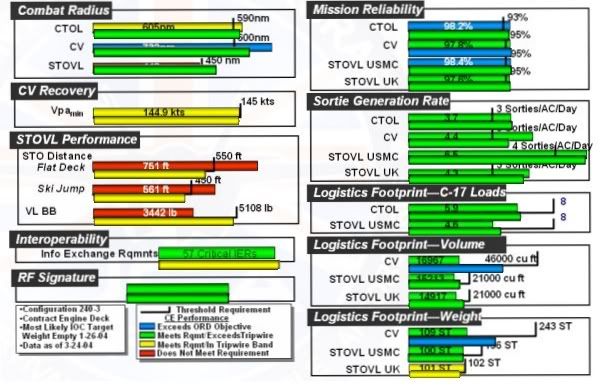
Basically, the F-35’s weight issues were taken care of. Notice how the F-35B’s STOVL performance has improved, although bring back is still only a measly ~5,000lbs.
Also notice how the F-35C’s performance has deteriorated in almost all respects: range, sortie generation, logistics footprint. Range won’t be much more than for the F-35A, which is not good because as everyone said, that indicates high drag.
H_KArthuro, you should have posted these great pics of the nuclear Rafale too. 😉


H_KI assume there are plans to equip the RAF/RN’s F-35B STOVL fleet with buddy re-fuelling stores?
If not I feel this would be an absolutely huge mistake and make the air group significantly less flexible and frankly safe then it could be.
There are no bolters, no fouled decks, and much lower visibility limits on a STOVL carrier, so buddy refueling isn’t as critical safety-wise compared to on a CTOL carrier.
As Grim said, it’s a “nice to have”, because it gives you some tactical flexibility for long range missions, which would be very useful in high intensity ops against a well defended opponent.
H_KLooking at costs, it’s interesting what happens when you adjust published figures for inflation. Here’s what costs look like in 2010 pounds.
Historical carrier modernisation costs
– Victorious 1951-1957: £500MM
– Eagle 1960-1963: £500MM
– Hermes 1964-1965: £140MM
– Ark Royal 1967-1969: £400MM
–> TOTAL: £1.5B
New carrier cost projections
– 1952 fleet carrier (54,000t): £550MM
– 1954 medium carrier (35,000t): £350MM
– 1960 medium carrier (42,000t): £750MM
– 1962 medium carrier (40,000t): £700MM
– 1960, 1963 & 1963 CVA-01 (55,000t): £950-1000MM
–> Three CV-1952 would have cost ~£2.4B, assuming a £800MM unit cost with economies of scale and a lower electronics fit than CVA-01. Only £900MM more than historical, with higher aircraft capacity than the 5 carriers they were replacing!


 Sign In







