 H_K
H_KThere is a difference between “Best-case” scenarios, depending on what your underlying economic assumptions are.
Anyway, perhaps the program would be a bit more stretched than I laid out, with more years between the first & second “batches”, and even only one on the building slip at a time, instead of the two-at-a-time I proposed. That would place #3 commissioning around 1967 (in time for an un-modernized Eagle to be placed in reserve), and 1970 for #4 (to replace Ark Royal).
I think the window for ordering the last carrier ends in 1962, when the decision is made to buy Polaris. After that, all the evidence points to the fact that the money simply wasn’t there:
– Huge Polaris spending in 1964-1968 (four SSBNs with missiles each worth as much as CVA-01 :eek:)
– Cancellation of CVA-01 and Polaris sub #5 in 1965
– Retirement of Centaur, Victorious & Eagle in 1965, 1969 & 1972
That’s why I suggested that hull #3 would be ordered circa 1960, so that it would be almost complete by 1964, before the budget crunch. Trials in 1965 and commissioning in early 1966 so Ark Royal doesn’t need an expensive 3 year refit & Phantomization.
Basically, hull #1 is paid for by scraping Victorious & Centaur’s modernisations. Half of hull #2 is paid for by scraping Eagle’s 5-yr refit. Half of hull #3 is paid for by scraping Ark Royal’s 3-yr refit and Hermes’ 2yr refit. Add the additional savings of having a common class of 3 carriers instead of 4 unique carriers, and the net capital cost in the decade from 1955 to 1965 has got to be less than that of one brand new carrier. 😉
After 1966, either Hermes is converted to a commando carrier or more likely laid in reserve because of manning constraints.
H_KTwo “CV-1952” class ships are laid down in 1953-54. They will complete around 1958-59 (perfect timing to fill the slots of Victorious & Hermes in the historic RN). They will be fitted with a full 7° angle, and with 3 steam catapults (corresponding to the historic BS-4/4A, one on the angle and two on the bow).
Two “CV-1952 Batch II” are laid down in 1956-57, to replace the 3 ships of the Centaur class in 1961-62. These will be fitted with an enlarged flight deck (more deck parking), and with only 2, but more powerful, catapults (corresponding to the historic BS-5/5A).
Actually, CV-1952’s catapult arrangements were changed during the design process sometime between Sept. 1952 and July 1953 (according to Brown’s book). This involved one 150ft bow catapult and one 200ft waist catapult (launch weight: 60,000lbs), instead of 3 short catapults. Presumably BS-5 & BS-5A?
HMS Lord Mountbatten, 809 with 14 Buccaneers, 892 with 12 Sea Vixen, 849B with 4 gannets, 824 with 6 rotodynes, a COD & 2 SARs. In an emergency, due to their size these vessels aught to be capable of carrying an extra squadron of either Buccaneers or Sea Vixen depending on the threat.
CV-1952’s maximum airgroup would have been considerably greater than that – in fact, CV-1952 would have been equal to CVA-01 in most respects! It would have had more aviation fuel, slightly larger hangar & higher aircraft capacity than CVA-01, but shorter catapults:
The proposed airgroup was 55 aircraft:
12x strike (NA.39, would become the Buccaneer)
33x fighter (Scimitar)
8x ASW (Gannett)
(+ presumably 2 SAR helos)
In 1970, that would have given us about 50 aircraft. Quite something! :diablo:
22x Phantom
16x Buccaneer
5x Gannett
7x ASW/SAR helos
I’ve updated my list of post-war medium carriers to show how CV-1952 compares to other RN carriers, as well as the contemporary Clemenceau & Essex classes.
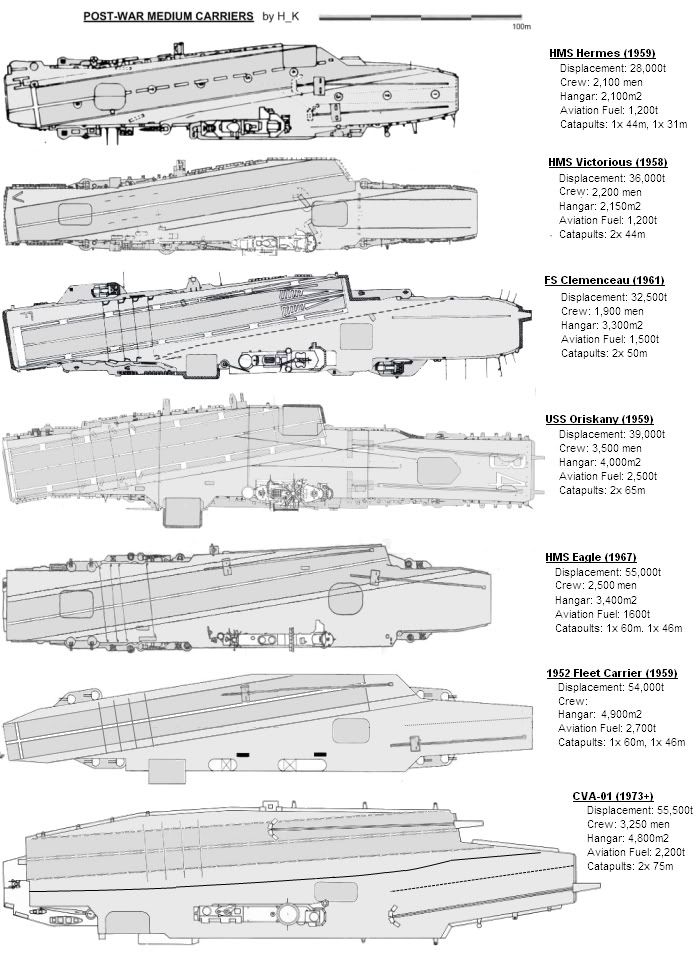
H_KThe idea of 6x fleet carriers in the 1960s (4 CV-1952 plus Eagle & Ark Royal) is a bit of a wet dream. Cut the number in half & we have something plausible. 😉 Here’s what I think is the most realistic scenario:
Late 1952
– Cancel Victorious, Implacable & Indefatigable modernizations & replace them with 2x CV-1952.
– This is justified based on new information indicating the need for reboilering and a complete redesign to fit angled deck, steam catapults & Type 984 radar. Also, each CV-1952 is at least 2x as capable as Victorious, so this is a net gain in capability for less cost.
– Contract signature early 1954; CV-1952 #1 enters service 1959 (one year after Victorious in real life); CV-1952 #2 enters service in 1962.
1956-1959
– Centaur & Eagle major refits cancelled to pay for CV-1952 #2. Both laid up in reserve until CV-1952 #2’s commissioning in 1962.
– CV-1952 #1 effectively replaces both Victorious & Centaur; CV-1952 #2 replaces Eagle. This nets out to a 30% INCREASE in capability. 😎
1960
– Follow-on CV-1952 #3 is ordered, to replace Ark Royal & Hermes in 1966
– Justified based on avoided cost of major refits (Phantomization for Ark Royal, Buccaneerization for Hermes) & commonality.
– Hermes converted to commando carrier 6 years ahead of real schedule.
This is the BEST CASE scenario. Worst case, CV-1952 #3 is never ordered and Ark Royal is retired in 1966 without replacement.
H_KWasn’t the Super Sabre difficult enough to land and actually stop on an airfield, let alone a carrier?!
I take it this design was proposed before the ‘Sabre Dance’ and and keeping power on to avoid stalling became a big issue.
You’re correct. The F-100A fleet was grounded about a year after this proposal (Nov. 1954) and received extensive aerodynamic mods including a longer tailfin and wingtip extensions to improve landing characteristics and high speed stability.
http://www.joebaugher.com/usaf_fighters/f100_2.html
The Super Fury would have had the same problems – it’s got the same short tail that caused so much grief on the early F-100As.
Short tail F-100A

H_KAccording to Brazilian Navy technical evaluations the Rafale M if operated from the São Paulo would be limited to taking off with no more than 40 minutes worth of fuel on its tanks, making it operationally USELESS as well as DANGEROUS to the pilots.
Keep in mind though that Rafale’s payload can be improved by 1t, if you use the 1.5 degree mini-skijump that was tested on Foch in the early 1990s (equivalent to 10kts airspeed). This would require disabling the Rafale’s jumpstrut, which is no big deal.
Would that extra 1t in payload make a difference? That adds ~45min extra flight time, so about 1.5hrs instead of 40min. Note the picture below of a Rafale on Foch launching with 2 drop tanks and 4 Mica missiles – not a bad payload compared to legacy Skyhawks or Super Etendards.

H_KFascinating stuff Bager! According to those specs, the Super Fury would have been superior to the Crusader in many respects:
Strengths
Weaknesses
H_KAs for Vietnam, I hope you were being sarcastic because the F-100 was a steller performer in Vietnam….superb quick reaction close air support, superb on interdiction missions, a great first Wild Weasel aircraft, and a good aircraft for the Misty FAC’s.
All in all I’d rate the F-100 was one of the Vietnam War’s success stories.
Sorry, I meant using the F-100 with uprated engines in the escort role alongside the USAF’s F-4C/D. 😉
Prior to 1967, the Phantom was lacking in this role, especially the Falcon armed F-4D. Only after the F-4E/gun/AIM-9E combo appeared in 1967 did the USAF Phantom became really good & only after the wing slats were retrofitted in 1972 did it become great. Also, contrary to popular opinion the F-100 had similar range & cruise speed to the F-4, so it had the legs to escort F-105s into North Vietnam.
H_KLook again.
F-100D: Wingspan 38 feet 9 inches, length 50 feet 0 inches, height 16 feet 2 3/4 inches
F-8E: wingspan 35 feet 8 inches, length 54 feet 6 inches, height 15 feet 9 inches
What you are seeing is due to aircraft being at different distances from the camera.
+1. The F-100 was actually about 4,000lbs heavier empty than early F-8A Crusaders. However, later air-ground capable F-8E/Hs were heavier so by the mid-1960s the gap was reduced to 1,500-2,500lbs.
Despite the weight disadvantage and older design, the F-100’s performance really seems quite good. Climb rates at all altitudes were essentially identical to the F-8A Crusader, which had the same engine. The F-100C was also up to 20kts faster under 20,000ft, and only 40-80kts slower between 20,000ft & 40,000ft. Finally, the F-100’s range was unmatched by any single-seat fighter until probably the F-16, thanks to large internal fuel plus external tanks. Not bad for an aircraft entering service 1.5 years ahead of the “last gunfighter!” 😎
All this makes me wonder whether the Hun’s “Lead Sled” moniker was actually deserved. :confused: Imagine if the F-100 had been uprated with the same J57-P20 engine as on the F-8D (+2,000lbs AB thrust). This engine was available just a few months after the end of the F-100 production run and on the F-8D delivered huge performance improvements vs. early F-8As (+M0.3 top speed, +50% climb rate at sea level, despite a 2,000lb weight gain! :D). Sure, the F-100 would still have been slightly behind the F-8 in A2A performance, but probably good enough against MIGs, and its multirole capability would have been attractive.
A J57-P20 powered F-100D (plus ideally a small radar). Now that might have turned out to be useful in Vietnam… 😉
H_KThere’s a book coming out later this year on the F-100 in French service, which should have some interesting details on French F-100 ops in Djibouti in the 1970s. They seem to have been multi-role tasked, incl. reconnaissance & interception. (There was a fair bit of Yemeni MIG activity at the time, which led to F-8 Crusaders being deployed to the region).
A couple of pics from Djibouti in the 1970s. Shark-toothed F-100:

Reconnaissance pod:

http://www.checksix-forums.com/showthread.php?t=90284&page=3
F-100s & Crusaders:
http://f100supersabre.e-monsite.com/
H_KOne thing a lot of people forget is that Gripen NG’s heavy stores configurations are going to be very draggy, creating a big penalty in speed, acceleration and range. This is due to parasitic drag from multiple ejector racks, compounded by interference drag from tightly spaced pylons such as the twin fuselage pylons. So while Gripen NG may have good range with only fuel tanks or light stores, as soon as you add 6x AAMs or 6x bombs that range most likely stops being competitive, not to mention dynamic performance going down the drain.
Based on the examples below, it’s clear that:
Drag Indices
F-16 clean: 100
2x 1400L tanks & pylons:35
2x 2000lb GBU-24 bombs & pylons: 40
2x TERs with 3x 500lb GBU-12 each: 76 😮
Single 500lb GBU-12: 7
F-18 clean: 100
2x 1250L tanks & pylons: 44
2x VERs with 2x 1,000lb Mk-83 each: 57
Single 1,000lb Mk-83: 6
Interference drag of full loadout: 12 😮
F-15 clean: 100
2x 2840L CFT: 21
2x 2300L tanks & pylons: 25 😎 (Very low vs. F-16)
4x 2000lb GBU-24 (2 abreast): 25
Single 500lb GBU-12: 4.3 😎 (40% less vs. F-16)
Sources:
http://edocs.nps.edu/npspubs/scholarly/theses/2002/Sep/02Sep_Young.pdf
http://www.rand.org/pubs/monograph_reports/2005/MR1216.pdf
H_KThere is a fundamental mistake being made here. People are talking about the KC-390 as if it is in production, which is very silly indeed.
It is absolutely impossible for the KC-390 to fill the gap before A400M deliveries, reduce immediate acquisition costs, or allow early A400M deliveries to be delayed. The A400M will be in service well before the KC-390 is flying. If Embraer manage to keep to the current schedule, the first KC-390 prototype will be delivered in late 2014, & will probably fly in early 2015.
You don’t get it. I’m not talking about filling the gap before initial A400M deliveries. I’m talking about the fact that by 2018 France will have ~25 A400Ms, which is enough to fill most of the gap in transport capability if they are all in squadron service. The remaining 25 A400Ms are mostly needed to replace the 14 C-130Hs which retire in 2020-2025 and for fleet management, i.e. to cope with airframe losses, overhaul periods etc.
So instead of continuing the rapid rate of A400M deliveries in 2018-2024 (25 A400Ms), which puts a lot of strain on the defense budget due to the A400M’s high cost, the French could switch 2-3 A400M delivery slots each year for KC-390s, pushing back deliveries of the last A400Ms until 2025-2028. Since 1 A400M = 3 KC-390s in terms of costs, that’s some serious savings for the budgets prior to 2025.
H_KThe 19 AdlA CN-235 are new, & another 8 have been ordered, for a total of 27. They won’t need replacing for many years, & the KC-390 won’t replace them. It’s an extra type.
50 A400M is enough to replace the current inventory of Transall & Hercules. That number will provide a lot more capacity than them, & the CN-235 can deal with small loads, where an A400M is excessive, & provide the necessary numbers.
Nothing wrong with the KC-390, as far as I can see, & I hope it’s a great success. I can think of many countries which it would be suitable for, as both a transport & a tanker, & I’d like to see it take sales off the C-130J, but for France, it’s definitely a political purchase. That’s not a criticism, BTW, merely an observation.
I think most observers disagree that the French have no need for the KC-390. Currently they have a massive shortfall in transport capability, even before the retiring of Transalls and A400M delays. IIRC, the French can meet less than 20% of their strategic transport needs. A400M will just about help fill this gap, but more transport aircraft are certainly not a luxury. Also, the A400M is expensive in terms of acquisition and operating costs, so anything that can help stretch out A400M deliveries beyond 2025 (as currently planned) is welcome.
CN-235 meanwhile is useless for logistics missions – it can only carry 5t-6t on short intra-theatre hops. The French use it only for parachuting and local transport missions from their foreign airbases.
So the KC-395 is perfect to fill the logistics gap below the A400M. It can do medium range logistics missions for light payloads such as people, spare parts, medevac etc. It can help reduce the peacetime burn rate of A400M hours, reducing fleet operating costs. It can also help push back some of the A400M deliveries into the 2020-2025 or even 2025+ timeframe, reducing immediate acquisition costs. Win win for the French, IMHO.
H_KMy take on this news:
Very sly move by Lula. He knows that he needs some political cover to justify the selection of Rafale, and now he has it: KC-390.
Lula knows that the Swedes and Americans can’t commit to buying KC-390; the French already have. So KC-390 is just being used as a new fake selection criteria to eliminate ex post all contenders other than Rafale. From the French perspective this is fine because they actually can put the KC-390 to decent use, to fit in between the C-295 and A400M for small payload logistics missions.
Dassault must be smiling today. 😉
H_KSo why has nobody done that? Why do most navies that build amphibious ships think it’s worth having a couple of different types, e.g. an LHD & a cheaper (& usually smaller) LPD or LSD?
Might it be because a high/low mix can provide more flexibility? Because having more ships is more flexible, enabling one to send a basic LSD when that’s all that’s needed, & save the more expensive LHDs for the tasks only they can do?
LHDs aren’t inherently more expensive than LPDs. Certainly the Mistrals and Juan Carlos are cheaper than the Albions and San Antonios. It’s a question of equipment fit and modular design, not displacement or deck shape.
In addition, LHDs do have one huge inherent advantage over LPDs. They have much more volume, thanks to having more internal decks and a flush deck. This is great for low density payloads such as helicopters, pallets, command & hospital spaces etc. Partially as a result, the 21,000t Mistrals have the same vehicle and dock space as the larger 25,000t San Antonios, but also a huge hangar, larger command and hospital spaces, not to mention the empty deck space!
The other reason why Mistrals have more usable internal volume than the San Antonios is that they have half the crew requirements.
In summary, the LHD vs. LPD debate is pointless. What matters is:
1. Ship automation to reduce crew requirements & volume uptake
2. Modular design to cut costs (might be a bit easier with an LHD than an LPD?)
3. Maximizing volume (easier on LHDs)
H_KAt least the French got the size right with roughly 4.000 ts. Only thing I really like about both LCS is the huge aviation complex.
Yes, 4,000t is the sweetspot IMHO. The volume available is sufficient to perform both the escort and mothership roles:
– Bow: 76mm or 127mm gun + 32 VLS
– Midship: 2 RIBs + 2 containers + 8 SSMs or more VLS
– Hangar: 2 helos or 1 helo + 3 UAVs
– Stern: Mix of 4 RIBs/containers or towed sonar + torpedoes
Also I wonder if their propulsion mix would enable them to keep up with a fast(er) task group w/o using thirsty turbines, like the LCS has to.
I think 20kts on diesel is sufficient, since frigates will be on the carrier’s outside perimeter, so they don’t have to maintain perfect position even when the carrier speeds up to 30kts for launching.
Speed on diesels only
LCS 1: 18kts?
LCS 2: 28kts
FM400: 23kts


 Sign In







