 H_K
H_KI agree this scenario is inane, but I do think it highlights two interesting Israeli weaknesses:
– The Israeli Air Force relies on the Mediterranean for strategic depth, but in a scenario against a larger power that can control the Med, Israel is vulnerable. Most of its bases are along the coast, its AWACS don’t have anywhere to run, and its Patriot SAM batteries can’t be placed along the threat axis.
– Israel has limited cruise missile and anti-ship capability, which means it can’t really destroy well defended enemy airbases or task forces.
So if the French can use their navy to push back the Israeli air force into a fairly small overland defensive perimeter and then launch massive standoff strikes from Corsica and CdG with their 80 Rafale carrying SCALP cruise missiles and Apache anti-runway missiles and 20 Mirage 2000-5 running escort (refueled by KC-135), they stand a chance of neutralizing the Israeli air force just long enough to then destroy it on the ground with AASM standoff bombs. Otherwise, if the French have to punch through dozens of Israeli fighters far away from home, it’ll be a battle of attrition that they can’t win.
H_KBTW, what would a DCNS go for cost wise? $1billion USD?
Well under that, and less than LCS. Remember, LCS is frigate sized, has a cruiser propulsion and all the expensive bells and whistles to try to keep it within its weight margins. Overall a fairly expensive proposition compared to a normal frigate.
I think FM400 would probably cost about $350MM with a large (10 hull+) production run. DCNS originally guaranteed a unit price of €280MM (excluding one-time design costs) for the 6,000t FREMM land attack variants. FM400 should be slightly cheaper due to the smaller hull & propulsion fit. Not much savings in the electronics & weapons fit though, since FREMM AVT already had the bare minimum for a frigate.
As another data point, the 2,000t German Meko A-100s cost ~$300MM for small production runs in Israel. Their equipment fit and propulsion is not that different from a larger frigate, but smaller hull of course.
The problem ultimately isn’t the hull’s cost. It’s the US shipyard + systems integrator premium. Somehow they always seem to add billions to any program. IMHO, the USN should keep the LCS combat system and mission modules (the development dollars have already been spent), and just plop them into a modified frigate design licensed from TKMS or DCNS.
H_KLCS was never intended as a replacement for the Cyclone class nor any other class of vessel, where did that idea come from? It’s armed like a patrol boat because it’s main threat will be coastal speed boats such as those operated by the Iranians.
Bingo. Thanks for pointing out the obvious. I fully understand what LCS will bring against the Iranians, and I agree it has niche value. But why buy 55 hulls then? LCS is useless in the Indian Ocean, and useless in the Pacific theater. OK, maybe useless is a strong word – how about “limited”, “dangerous”, “overpriced”.
As for the size, last time I was aboard an FFG (HMAS Sydney to be exact) it was more than 138 meters long (Freedom is 115 Meters long and Independance is 127 Meters long).
FFG-7 isn’t the only frigate out there. Singapore’s Formidable is 115m, Meko 200 is 118m, La Fayette/FM400 is 125m. I don’t see how LCS is any smaller (lighter displacement certainly, thanks to the misguided use of aluminum – hope that bright idea never gets combat tested).
The power is needed for the fast get aways involved with Special Forces especially when facing the previously mentioned High Speed power boats of Iran.
Huh? The USN needs a cruiser sized powerplant to run away from speedboats that don’t stand a chance against a modern ship armed with RAM, guns & helos? :confused: Do you seriously think there’s a material difference between 30kts and 45kts? Any situation where speed would be of the essence by definition implies the kind of high-threat environment that LCS is not designed to tackle.
I checked comparing current RAN equipment and there is well over a 2 meter difference in draught here (note English spelling not American). In littorals even 1 meter makes a difference- this was evident to me aboard various patrol boats in Australian service.
Most of that difference is due to the hull mounted sonar. Remove it to make a more apples to apples comparison and you’ll see that LCS has very little advantage – 50cm at most, and less in the case of the Formidables and Meko 200s of the world.
There is good reason for that power and I won’t restate my point but will point out to you that a French Carrier and an American LCS may have the same power but the thrust to weight ratio is the deciding factor here- more power on a vessel this size means quicker get away times.
Again, IMHO any situation where get away times matters means that you should be worried about a lot more than speedboats. Willing to agree that this is a difference of opinion though.
With this comment it is clear that you do not understand the principle behind a Mission Module when compared to a Modular building type- Mission modules are designed to slip in and out in a matter of hours, Modular construction requires days for change over and that is provided you have the right module available and the technicians to install it- then you need the staff to operate that module (we have MEKO 200’s down here, so Australia is fully aware of how to use this design principle, in fact we have done and currently are doing major module swaps on our MEKO’s as we speak). We previously operated a mission module pack aboard our Bay Class Mine hunters- we could change those in a matter of 2 hours to suit the need. These modules looked like Shipping containers on the backs of these vessels neatly parked between the two funnels. Mission Modules are designed for RAPID deployability- Modular construction means you have a layout that you can change when you want but requires a refit to accomplish, that’s the basic difference!
Apologies if my point wasn’t clear. What I’m saying is that mission modules aren’t exclusive to LCS. They can be implemented on any type of ship, especially frigates which are going to have more volume and weight margins than LCS due to the lower speed requirements. All the USN has to do is specify it. IMHO, Stanflex seems pretty close already in terms of allowing rapid changes. It’s a mistake to justify a poor platform simply because it has a great payload – the two are (mostly) independent.
I hope you have a better understanding now of what the LCS is about-
Small crew (56 only), quicker insertion/ extraction times, better support of forces in areas previously denied to an navy such as the USN. Weapons fit to achieve a mission not blow another nations navy out of existance. Quick turn around times between missions- Extract a seal team, get them back to a staging point then swap the module for a Sea denial mission in under 2 hours.
As I said, a worthwile but niche mission. By the way, for Seal team missions in the Persian Gulf, I do wonder what’s wrong with helicopters and the current high-speed craft?
I honestly think this will go nowhere! The design principles are messed with too much and a vessel having this “Add on” would find it suffering some serious performance issues! I know it’s supposed to help with performance and it’s supposedly designed by one of the best- but I expect serious problems initially. For starters, you are messing with the designed Center of Gravity, chuck this add on on a currently serving vessel in MN, then have that vessel put to sea in the torrid North Atlantic: watch as the ships center of gravity forced the wave piercing bow through the wave alright, in a slight 25* down pitch and see your frigate become a submarine- Why do you think Vosper Thornycroft killed off the Sea Wraith so quick- they tried it! This adaption would serve well in calmer seas such as the Agean, Northern Indian or even the Black Sea.
It’s an add-on to existing designs, not to existing ships. Bit of a nuance there. They must believe that the required changes to the design’s CoG are pretty straightforward, no more than minor tweaks that can be made prior to starting the build. Concerns about the ships acting like a “submarine” are real, but DCNS clearly state that according to their tank tests the wave piercing bow would be better for high seas in the Atlantic. Up to them to prove it now.
H_KBager, I would have agreed with you in theory. Except that LCS didn’t turn out to be what was originally intended (edit: as Pfcem noted). In practice, it’s armed like a patrol boat, sized like a frigate, and powered like a 10,000t cruiser. IMHO, a really bad joke.
Size? No difference with a frigate. If you don’t believe me, check the dimensions.
Draft? At best 50cm difference – completely irrelevant for littoral missions.
Propulsion? LCS 1 has 25% more power than a Ticonderoga class cruiser – about as much in fact as the 42,000t Charles de Gaulle! 😮 LCS 2 is slightly better, but still has more power than a Ticonderoga.
Cost? Somewhere north of a frigate, that’s for sure. The propulsion and weightsaving penalties alone will guarantee that.
Mission modules? Let’s cut with the mission bay crap. Using the Stanflex principles, a frigate do that just as well. E.g. forward bay for gun/VLS, midship bay for 20ft containers, RIBs & missiles, and a stern bay for helicopters, and RIBs or UUVs.
What’s the edge with LCS? Speed? That’s about it. :confused:
H_KNot exactly what you want, but I did find these very rare pictures at http://www.mirage4p.com:


Those are the only pictures I’ve ever seen of a Mirage IV with bombs.;)
H_KWell ok they can fit in there, but ask a mechanic to change a rotor hub or gear box and don’t be surprised when they hit you in the head with a spanner!
Yes you can make the EH-101 fold down, but you can’t make it reduce height- this is my point that everyone is skipping over!
Mistral has a “high hat” area in its hangar that can fit one helicopter for maintenance, so the EH-101 to be maintained just fine. Here’s a pic of a Super Frelon under the high hat area, which is located under the island (hence the raised part at the back of the island). You can also see where the area begins in the other pictures. EH-101 has the same height and width as Super Frelon so no problem whatsoever.
H_KThe Super Frelon is still in service in France (though expected to be replaced by NH-90 by 2011-12) abd both produced and used in China (as Z-8).
The Super Frelon is actually being retired in less than a month. Since the NH-90 isn’t ready yet, the French Navy has bought 2 EC-225s in SAR configuration as stop gaps.
Pics of Super Frelon aboard Mistral and Tonnerre:

http://bpctonnerre.free.fr/actualites2010transittoulonbrest4.htm
H_KEven if CVV’s displacement was off by 5,000t, that would still leave an almost 20,000t gap compared to CVF CTOL. So that’s doesn’t answer the question.
As I said, we know that CVF has a deeper hull, giving an extra deck (deck #9). This should add ~12% internal volume versus CVV. CVF’s hull is also slightly fatter, and given their respective displacement numbers we can reasonably expect CVF’s total internal volume to be ~20% larger than CVV.
In addition, CVF’s layout should free up some extra internal volume. The podded propulsors and gas turbines should be more compact that a 2 shaft/6 boiler arrangement. Fuel efficiency is most likely better, leading to less bunkerage. The hangar is 1,000m2 smaller over 2 decks, which frees up a fair bit of internal volume for other uses.
I have a hard time believing that all this extra space goes to accommodation. Just keeping the accommodation spaces constant would give CVF 2.5x more space per crew. How much bigger do they really need to be?
H_KCheck whether both figures are the same type of displacement (standard, full load) and unit of measurement (ton, tonnes, etc)
Yes, I standardized everything from US short tons to metric tonnes. CVV’s displacement is full load, just like CVF’s (based on data for PA2).
H_KComparing CVF and CVV, I just don’t understand how CVF’s huge internal volume has been put to use. :confused:
They’re exactly the same size, except that CVF has a deeper and slightly fatter hull giving one extra deck and a lot more displacement. But that extra volume doesn’t translate to extra capability: 😡 CVF’s hangar is smaller and aviation fuel stowage the same. I’d wager that munitions storage is also smaller, since CVV has quite a large munitions storage (double that of CdG). What’s going on???
<br />

                   [B]CVF CTOL[/B]         [B]CVV[/B]<br />

[B]Hull Dimensions[/B]<br />

Lenth WL            264m           262m<br />

Beam WL              39m          38.4m<br />

Hull depth           [B]30m[/B]          26.7m<br />

Displacement      [B]70,000t[/B]        56,500t</p>

<p>[B]Flight Deck Dimensions[/B]<br />

Length              284m           278m<br />

Width              72.5m            78m<br />

Deck Area:       15,300m2       15,000m2</p>

<p>[B]Aviation Facilities[/B]<br />

Hangar:           [B]4,700m2[/B]        5,700m2<br />

Hangar height:      6-9m           7.5m<br />

Catapults:         2x90m          [B]2x75m[/B]<br />

Aviation Fuel:    5,000m3        5,000m3<br />

Munitions:           ?          10,400m3</p>

<p>[B]Propulsion[/B]<br />

SHP                 95,000      140,000<br />

Speed               26.3kts     27.8kts<br />

Endurance:    10,000nm @15kts   8,000nm @20kts</p>

<p>Ship's crew            900      [B] ~2000[/B]<br />
H_KI doubt that there’ll be any life left in the Los Angeles class subs. The USN is going to have to run all of them into the ground to stem the bleeding of its sub fleet. Remember the math: 52 USN SSNs today, only 42 in 2029, with a minimum requirement of 48, and the threat posed by the rapidly increasing SSK fleets around the world…
H_KActually it’s more like one refueling every 7 years for the Rubis class SSNs.
The refueling itself only takes 6 months, but you’re right that all the other systems have to be overhauled too, which usually extends the overhaul to at least 12-14 months…
H_KUnlikely that any Western navy will have any SSNs to spare in the timeframe we are talking about (2020+).
The USN’s sub fleet is set to decline from 53 today to 41 in 2029 (dramatically less than the minimum force level of 48), so they are looking to use up the remaining Los Angeles class subs’ lives as much as possible. They’ve identified 16 subs whose lives can be extended, mostly by 9-15 months, but the RAN won’t be able to get any of that. http://www.fas.org/sgp/crs/weapons/RL32418.pdf
The French will be retiring their Rubis class SSNs between 2017 and 2028. Fits the RAN’s timeframe perfectly, but those subs will be 33-35 years old, so I’m not sure if the nuclear core will have any life remaining.
The RN’s last 3 Trafalgar class SSNs will be slightly younger (27-31 years old), but they will be retired rather early: 2017-2022. The last one (HMS Triumph) retiring in 2022 would fit the bill best.
Ultimately, whoever can spare an SSN, even just for 1 or 2 years, will be in a great position to secure this hypothetical contract, since it doesn’t make sense to train on one country’s sub knowing that you’ll ultimately be using another country’s kit.
H_KNoteworthy French Navy news
April’s a busy month for the French Navy. Half the ships and two thirds of the fleet’s tonnage are at sea, so a lot of noteworthy news. Worth a quick photo report. 😉
Some firsts…
Charles de Gaulle just crossed the arctic circle for the first time, in order to escape the volcano cloud and continue leading NATO exercise Brilliant Mariner.
The weather is a far cry from the Med and the Indian Ocean. :diablo:
Charles de Gaulle and the two brand new Horizon frigates met for the first time, during operations in the North Sea.
Previously,the Horizon frigate Chevalier Paul paid a visit to Murmansk – a rare chance for the Russians to see leading edge technology up close.
Not a first, but still quite rare… Spanish Harriers cross-decked on Charles De Gaulle off the coast of Portugal.
…Where Charles de Gaulle exercised with the sad remnants of the Portuguese Navy.
Meanwhile… L-CAT continues testing, embarking a Leclerc MBT for the first time.
http://www.meretmarine.com/article.cfm?id=112887
A final passage…
Jeanne D’Arc has left the shores of Quebec on her final trans-atlantic voyage. She will decommission shortly, after 46 years of service and the equivalent of 80 circumnavigations.
Some history…
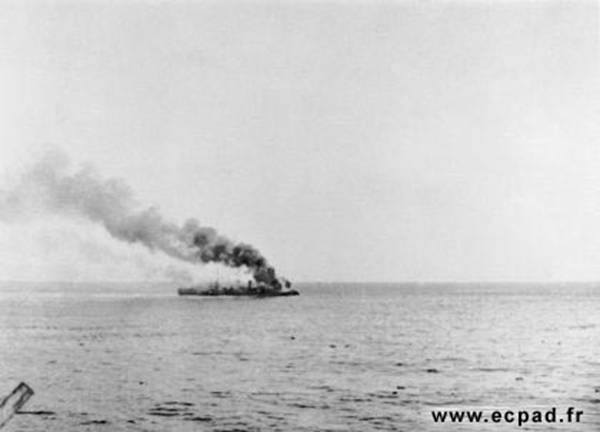
70 years ago exactly, the French Navy went in action off the Coast of Norway. Very fitting then that Charles de Gaulle is sailing in the same waters.
Landing at Namsos, and the loss of the large destroyer Bison.
H_KActually, modern nuclear subs are probably quieter than SSKs at most speeds.
That’s because modern reactors do not use pumps at tactical speeds. Instead they use natural convection to cool the reactor. That leaves only the pumps for the secondary steam turbine/condenser circuit.
This enables Seawolf to go 20kts “silently”., apparently The newer French subs are similar, with radiated noise being reduced by 1000x over early generations of nuclear subs.
Once you add in the fact that SSNs are large enough to have have better vibration dampening systems and pump jets for lower cavitation, the net result is probably in the SSN’s favor.


 Sign In







