 H_K
H_KIt’s $8.1 billion in FY2008 dollars, and that’s just the building cost.
The non-recurring investment in the design and development of the Gerald Ford Class is $5.6B. This is comprised of $3.2B in RDT&E funds used to develop technologies needed to meet program requirements and $2.4B of SCN funds used to develop the detail design for the class. The total cost to build the lead ship is $8.1B in FY08 dollars.
http://www.globalsecurity.org/military/systems/ship/cvn-78.htm
H_KExchange rates are a moving target, but here’s a shot:
Acquisition Costs (hull only, excluding development costs)
Follow-on Charles de Gaulle (2003): €2 billion –> $2.7 billion
CVF UK: £2 billion –> $3 billion
PA2/CVF FR (2007): €2.5 billion –> $3.4 billion
CVN 76 Ronald Reagan (1998-2002): $5 billion
CVN 78 Gerald Ford (2008): $8.1 billion
Note that because of recent dollar and pound devaluations this tends to overestimate the cost of the French carriers and underestimate the cost of the UK carriers. To be completely accurate you’d have to take a weighted average exchange rate over the life of program according to when payments are made.
Annual Operating Costs, including crew (source: French DGA 2003 report)
Charles de Gaulle: €104 million
Nimitz class CVN: €257 million
Annual Maintenance Costs, excluding crew & fuel (source: French DGA 2003 report)
Charles de Gaulle: €50 million
Conventional CV: €30 million
H_KPS: a probable little error
For the CVF, not 74000 tons, but around 64/65600 tons (full loads, start of service life)
Limiting 75,000 tonnes at end of service life (after two re-ballastings)
😀
I know. CVF CTOL/PA2 is heavier though: 70,000t start of service life.
I use max displacement intentionally, since most of the other designs were already at their max displacement.
H_KDo the French sub reactors qualify as a tea kettle reactor?

http://www.cea.fr/defense/propulsion_nucleaire/le_reacteur_a_toute_vapeur
If I understand correctly, you’re arguing for a similar reactor setup, with optionally a more advanced cooling system (e.g. sodium instead of water) or enriched uranium to reduce the size of the core further? If so, what are the benefits vs. current technology and who would Australia be buying the technology from?
IMHO, the French reactors are probably the right size, so not sure why the RAN should look further. There are also economic and PR benefits to using civilian non-enriched uranium which can be easily reprocessed. Here’s a pic of the French reactor core, 5m high by 3m diameter:
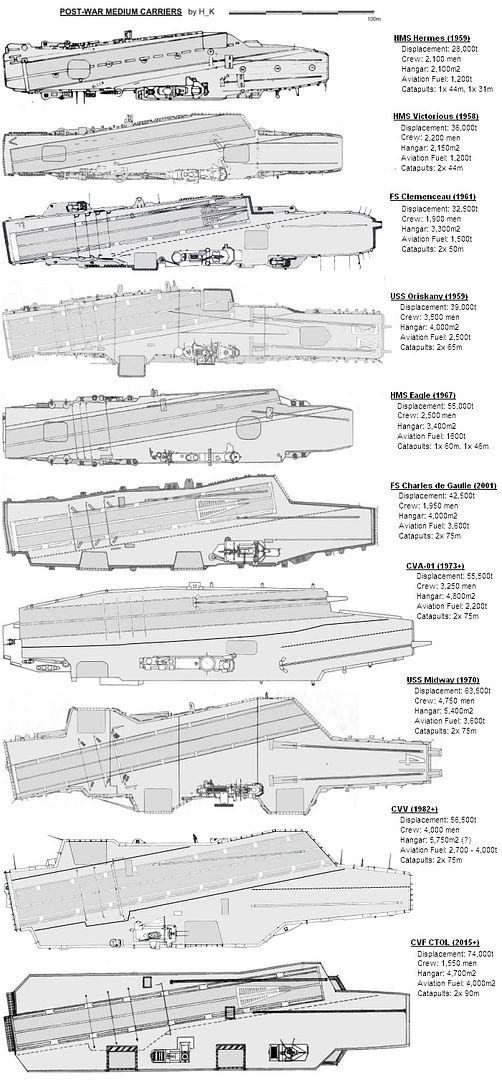
H_KIt’s interesting to note the huge gap in displacement between CVF and all other carriers. I’ve never understood why it grew so “obese” even though in every respect it’s an unremarkable design compared to the much older Midway and CVV… :confused:
H_KMore carrier porn: 😀
H_KFin stabilisers were deleted midway through the CVA-01 because of weight constraints (they would have taken up 250t and displaced 550t of fuel), which raises questions about roll behavior. http://books.google.com/books?id=bw46M1qI9gMC&lpg=PA187&ots=WxEnyS4kpf&dq=%22cva-01%22%20%22fin%20stabilisers%22&pg=PA187#v=onepage&q=%22cva-01%22%20%22fin%20stabilisers%22&f=false
(AFAIK CVV, in keeping with USN practice, would not have had fin stabilisers either. She had a 20ft wider deck, but also a 4ft wider waterline beam, so not sure if she would have rolled more or less)
Buccaneers and F-4 Phantoms had 9,000-9,500L of internal + external fuel, so let’s say they used 8,100L per mission on average, that rounds nicely to 6.5t. Let’s assume 20% of CVA-01’s aviation fuel is needed for reserves and the dozen fuel-sipping AEW aircraft and helos, that leaves 1,750t of available aviation fuel.
So CVA-01 could have done around 1,750/6.5 = 275 fighter & strike sorties. Assuming 2 sorties per aircraft per day, that’s about 4 days of operations.
H_KYes, CVV was F-14 capable. That’s one of the key improvements over the Midways. However, only about 12 F-14s were planned since it was more of a strike carrier. The USN never established a doctrine of use for CVV, so the rest of the air group is unclear. But given its strike focus a and the stated 60-64 aircraft capacity, I would guess:
CVV Airgroup (1980s)
12 F-14
24 A-7 (later 20 F/A-18)
10 A-6
4 KA-6D
4 EA-6B
4 E-2C
6 SH-3
(Basically a normal CV airgroup with one less F-14 squadron and no S-3B Viking squadron)
With a small reduction of air group spot size (5%) to increase sortie rates, that would imply a current air group of about:
CVV Airgroup (2010)
20 F/A-18 E/F
20 F/A-18A/C
4 EA-6B
4 E-2C
6 SH-60
H_KI agree that as originally intended (T-CBL study) CVV was a flawed design. However, by 1978 CVV had evolved significantly into a fully capable strike carrier with a number of improvements (larger aircraft capacity, taller hangar, wider hull, more aviation fuel, better magazine protection, more electronics). The only thing still lacking was speed (26-28kts), which is similar to Charles de Gaulle today and IMHO not a deal breaker. Overall, CVV should have more capable than a Midway, though still far less than a Nimitz CVN.
If the RN had adopted CVV’s air group centric approach for CVA-01, it would have ended up with a very powerful carrier, with ~60 Phantoms/Buccaneers instead of only 36, on the same tonnage. That gives an idea of the trade-offs inherent in CVA-01’s design.
Regarding CVA, Ikara was indeed deleted from the final CVA-01 design to save weight, but it left its mark by reducing flight deck width and aft deck parking. I don’t understand why it was ever included in the first place. Inclusion of Sea Dart is somewhat more understandable in the early 1960s, though Enterprise was sailing around without anything at all at the time and JFK was also being built without the planned Tartars, so by 1964-1965 you could argue that the trend should have been clear enough for the RN to follow suit.
H_KI have a hunch that if CVA01 had entered service the Ikara and Sea Dart mounts would of been deleted during its mid life refit anyway and the flight deck extended aft.
Possibly, but unless the flight deck was also widened that wouldn’t produce much more deck parking.
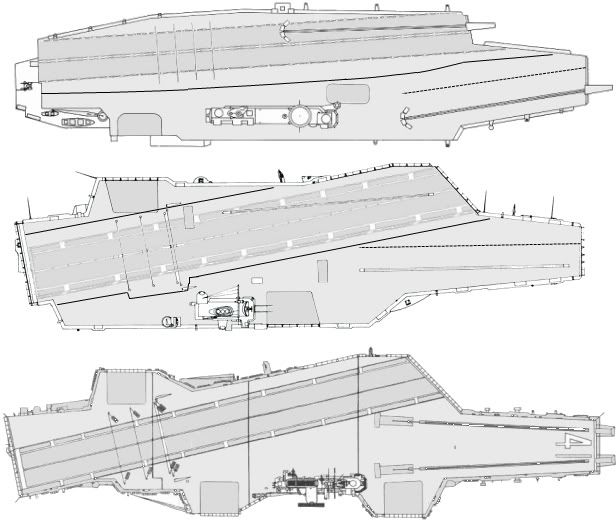
H_KAlmost identical hull sizes, but very different designs.
In a nutshell, CVV seems like a very balanced and capable strike carrier – a modern Midway. Ironically, the USN argued that it was a flawed design. Only compared to a Nimitz class carrier!
IMHO, CVA-01 was well and truly flawed. The RN didn’t seem to know what it wanted – an air platform or an escort cruiser (history repeated itself with the Invincibles). It got both, but traded-off capability in too many areas.
– Sea Dart and Ikara installations led to a short, narrow deck, smaller hangar and a huge island. Not so good for aircraft parking and movements. Aircraft capacity was about 45 vs. 60 on CVV.
– The Alaskan taxiway was a way to fix this, but it seems dubious whether this would have worked operationally, especially in heavy weather
– Focus on North Atlantic operations meant CVA-01 couldn’t sustain operations for long: only 2,200t of aviation fuel vs. 2,500t-4,000t, range of 6,000nm vs. 8,000nm @20knots
Here’s a comparison of the CVA-01, CVV and Midway:
H_KThe Soryus are incredibly expensive: about US$6.5B for the 1st of class, now down to US$5.5B for the 5th (20SS). That’s twice as much as a Virginia!
H_KIf the RAN decides to go for an SSN, wouldn’t the French Barracuda be a better choice than the UK Astute or US Virginia? I know it might not be a popular choice, being less capable, but I can think of at least 5 reasons why Barracuda would make sense:
– Crewing requirements: Barracuda only has 60 crew (similar to Collins) versus 100 for Astute and 130 for Virginia.
– Cost: Barracuda costs $1.4B per hull ($2B including all development costs & taxes which the RAN won’t have to pay). Virginia costs 2x as much ($2.8B excluding development costs), Astute is somewhere in between ($2.1B including development costs but excluding taxes I believe).
– Tech transfer: DCNS are very experienced in submarine tech transfer, having built Agostas/Scorpenes in Pakistan, India and Brazil. The US and UK have zero experience in this respect. Also, not sure whether the UK can even sell Astute given how much help they got from the US?
– Littoral capability: Obviously smaller is better (5,300t vs 7,600t-7,900t). Also Barracuda seems to be designed with maneuverability in mind (X-shaped stern planes).
– “Civilian” nuclear reactor fuel: might help get public support by framing this as a safer, cleaner solution than military grade enriched uranium, and would neutralize any concerns about Australia’s support for nuclear non-proliferation and disposal issues (the French could take spent rods back and reprocess them).
H_KI would like to see the RAN get ships based on the Austal design that the USA used for their Littoral ships. The trimaran design I am talking about was open between the hulls.
Wow I thought I was being ambitious proposing a fairly basic 2,500t OPV. And you’re talking about a 2,800t, 40kt+ trimaran. 😮
That said, Austal does have a design that might fit the bill better: the MRV 86. Though I’d be worried about the cost of an all-aluminium trimaran and its payload/range would also be on the low side.

H_KBut once again if size doesn’t impact cost and the RAN has already decided that it needs a helo deck, then why not go for 2,500t instead of 1,500t? (Just to reiterate this point, the 3,750t Dutch OPVs have the same propulsion as the 1,900t Protector OPVs (10.8MW) and only a 0.5kt speed differential!)
With a 2,500t OPV, the “O” in OPV will mean “Oceanic”, not “Offshore”. That opens up the possibility to send these OPVs to patrol sea lanes in areas of interest such as South East Asia, the Pacific Islands and the Indian Ocean. Given that these OPVs will still be around in 2050, building in an upgrade path to a wider set of missions makes a lot of sense.
If cost is a concern, then instead of building smaller OPVs I would advocate building 2,500t OPVs with an “empty shell” and very basic systems (no medium gun, no combat system, no ESM, no countermeasures, no electric propulsion, no helo maintenance equipment). By doing so, you could cut the cost to probably within 10% of a 1,500t OPV, while still getting the benefits of better range, endurance, and payload. And there’d be upgrade path open for adding basic self-defense weapons, sensors and organic helo capability latter if the need arises to send some of them to the Persian Gulf or somewhere a bit “hot”.
By the way, a variant of the Spanish BAMs exists for hydrography, so that makes it an even more attractive design.


 Sign In








