 H_K
H_KIMHO, the Kiwi OPVs represent the minimum effective size for ocean-going OPVs. Anything less than ~1,600t/85m compromises key capabilities such as range, seakeeping and payload (helo, RIBs, containers, passengers etc). Maybe you can shave off 100t by removing ice reinforcement but that’s about it.
But here’s the interesting thing. Cost for OPVs has almost nothing to do with size. So if the RAN went for a 2,500t OPV, it would cost almost the same as a 1,500t OPV. 😎
Why? First, crews will be the same, since they’ll be driven by mission requirements, not size. For example, the Spanish BAM and Kiwi OPVs both have about 35 crew. Second, propulsion will be the same. In fact, BAM reaches the same speed as the Kiwi OPVs on smaller engines (9MW vs. 10.8MW). 😮 Third, steel represents barely 10% of the total cost, ~about €8MM on a BAM. Almost all the remaining costs are driven by user requirements, not by size – design costs, crew spaces, sensors, weapons, electrical plant etc. That’s about 65% of the cost.
Now of course, it’s hard to resist the urge to add more toys to a larger hull :p. That’s probably why a BAM costs almost 2x the cost of a Kiwi OPV (€85MM vs NZ$90MM). But hopefully the RAN would only specify the toys it really neaded. Also, leveraging Navantia’s existing BAM design would bring an immediate 20% discount due to the design costs already being amortized. So now we’re talking AU$98MM for a 2,600t OPV vs. AU$69MM for a 1,900t OPV. Only a 40% price differential, and that’s entirely driven by the weapons and sensor fit.
What would the RAN get with a 2,500t OPV? Basically a whole lot more value for money:
– 25% more range (8,000nm vs. 6,000nm for BAM vs. Protector OPVs)
– 65% more endurance (35 days vs. 21 days)
– Enough space for a fuel efficient CODOE installation (electric propulsion under 12kts), reducing operating costs
– Medium helo capability (NH90 sized hangar/EH101 sized platform) vs. Seasprite only. Very important for the RAN, IMHO.
– Space for more armament if needed (1x 76mm + 2x 25mm vs. 1x 25mm)
– Space for better sensors if needed (basic air search radar, countermeasures)
– Better habitability (separate living rooms & messes for each rank, dedicated gym/internet/library spaces)
– More room for growth (which, as Swerve already pointed out, is where the Kiwis screwed up)
So what I don’t understand is why does the RAN seem set on such a narrow specification for its new OPVs? 1,200t-2,000t? Way too restrictive. And 75-80m? What are they smoking? That excludes any design larger than 1,500t or NH90 capable. So basically they seem to want a 1,200t-1,500t OPV with limited endurance, no medium gun and light helo capability at best. Barely able to get to the South China Sea on its own, and not very useful once it gets there either. :confused:
Here’s a comparison of the 2,600t BAM vs. 1,900t Kiwi OPVs:
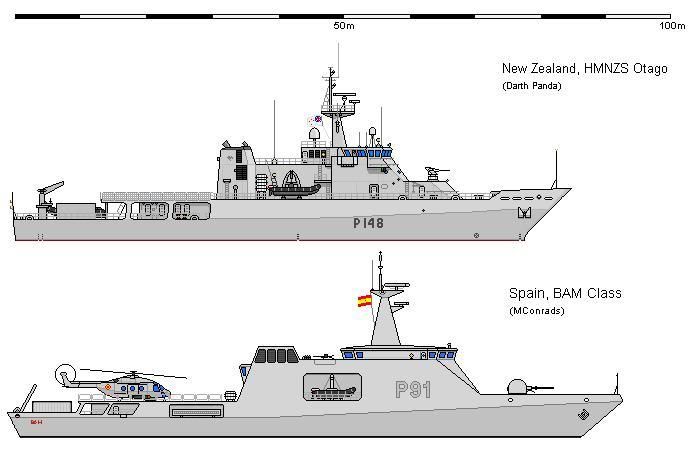
Also, there are a couple of great PDFs on each. The Spanish PDF includes a pie-chart with a breakout of acquisition and operating costs for the BAM. Very, very interesting. 😎
BAM: http://www.ingenierosnavales.com/docurevista/841-PAG.%2081-91.pdf
Protector: http://brickmuppet.mee.nu/files/nzopv.pdf
H_KSeahawk, I don’t think the Gulf War analogy is really right. With the F-22 and F-35, the USAF is heading towards having a much smaller fleet of more thirsty aircraft. So there’s a viable argument to be made that the “more booms in the air” paradigm is no longer relevant, and that instead the USAF needs fewer booms with lots of offload capability.
As for the KC-30’s cargo capability, isn’t it a much cheaper vector to deliver pallets compared to leased civilian aircraft and C-17s? Seams ideal to me for sustained operations such as in Iraq and Afghanistan. IIRC, Airbus claimed savings of $1B ANNUALLY by using excess KC-30 capacity instead of overworked C-17s.
Of course, the KC-767 would also provide some savings in the cargo role, but much much less. It can only carry 19 pallets vs. 32, so even if its operating costs are 15% cheaper that’s not going to cut it. By the life of me I don’t understand why the USAF doesn’t want to factor in those benefits. Or maybe their hand was forced? 😉
H_KYou got me there. My immediate reaction was WTF is the A400M cursed? Then I saw you mention rand and I was even more confused. Then I saw the date and it all made sense. 😀
H_KLooks like MSN001 is now undergoing engine-out tests. Nice picture from last week with its engine 3 feathered:

Still waiting for MSN002 to fly though. Initially it seemed like it would fly in late March, now hopefully early April???
H_KA400M flies to Toulouse on 10th flight
Update on A400M testing: http://www.airbusmilitary.com/PressRelease/tabid/112/smid/491/ArticleID/14/reftab/76/t/First-A400M-ferried-from-Seville-to-Toulouse/Default.aspx
MSN 001 flew to Toulouse today on its 10th flight. Also, MSN 002 was handed over on Saturday and will fly later this month. So far 39 hours have been flown in the first 9 flights, so just over 1% of flight testing complete.
Pictures from Toulouse:
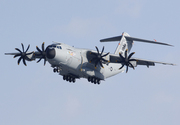
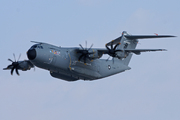
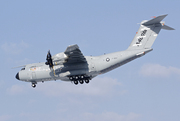
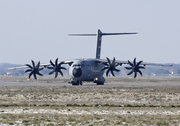
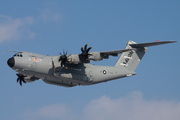
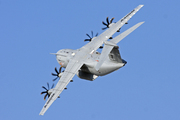
Looking at the picture of MSN 001 banking, it seems like Airbus have already modified the APU exhaust to reduce drag, following positive test results. Compare to the first flight, when it stuck out like a sore thumb:

H_KHow good were the IR guided BVR missiles of the time? Could they have been no worse than AIM-7D/Es for head-on shots against bombers and/or fighters?
I’m thinking specifically of the British Red Top and French R.530 IR, which both seem to have been quite capable against bombers, including limited all-aspect capability. Looks like the British were happy enough with Red Top that they cancelled development of a radar-guided version. As for the R.530, it seems comparable to the Sparrow, i.e. not very reliable and requiring lots of care, but worked at least some of the time for the Israelis (radar-guided version) and Pakistanis. The R.530 has a bad reputation, but in Spanish service 15 out of 16 where successfully launched during end-of-life tests in 1986, so not too bad. The IR version was actually said to be more effective, due to the fire-and-forget mode which reduced the likelihood of pilot error.
(Only the AIM-4/D Falcons were almost completely useless due to limited seeker cooling and no proximity fuse)
H_KThe reason for drop tanks is more for CAP endurance.
According to the F-8J’s SAC (http://www.alternatewars.com/SAC/SAC.htm), with 2 Sidewinders the tanks doubled loiter time at 150nm, and increased range by 20% despite being only 75% full due to maximum gross weight issues.
The drop tanks were never used operationally though, even on the F-8J. I don’t have time to find the source, but should be easy to find. It has something to do with the risk of the drop tanks hitting the tailplane when jettisoned.
H_KMaybe it’s time to return to the original post and its original question.
The problem with this question is that it doesn’t say what the ground rules are. Were we supposed to frame our answers using the conditions over North Vietnam…or was this a general question?
Because those ground rules define the debate. Regardless of whether or not we are talking about the USN/USMC or the USAF, NV presented us with a combat arena that was a long way away, one where we had little support from GCI, and one where political considerations cut deeply into what we could and could not do.
If we take the question out of the Vietnam scenario, it becomes a whole different matter. Set the stage in a European environment (nuclear or conventional) and the limitations that we had to live with in NV pretty much go away. This means that what were seen as shortcomings of certain aircraft become less so. The dreaded MiG-21 becomes much less a formidable opponent when we don’t have one or more arms tied behind our backs.
Good post. Here’s my take on what the requirements should have been circa 1957, based on a high-low fighter mix (similar concept to the F-14 + F/A-18 mix in the 1980s):
“High end” fighter
– Excellent fleet air defense capability vs. Soviet bombers (i.e. Sparrow, all-weather, CAP endurance)
– Secondary escort / fighter interdiction capability (i.e. podded gun, acceleration, maneuverability)
– Secondary air-to-ground capability
“Low end” general purpose fighter
– Excellent escort / fighter interdiction capability (i.e. gun, acceleration, maneuverability)
– Good air-to-ground capability (at least as good payload/range as latter Skyhawks, Bullpup avionics etc.)
– Secondary fleet air defense capability vs. Soviet bombers (ideally provision for fitting avionics boxes for continuous wave illumination on an “as needed” basis for limited Sparrow capability)
With these ground rules, the F8U Crusader or its alternatives (F11F-1F Super Tiger, F5D Skylancer) should have had a greater emphasis on air-to-ground and drop tank capability, which the F8U lacked. The F4H Phantom only became capable of performing both high and low end roles in the late 1960s, with the F-4J and the benefit of more reliable missiles.
H_KI’m curious as to why you’d think a single-engine, single-cockpit design would have poor maintainability in comparision to the F-4. Also, I could understand the “limited A2G” if looking at weapon stations compared to the F-4 but I wouldn’t consider it poor on an absolute scale. It did have underwing pylons as I recall.
Here’s my source on the F8U-3’s poor maintainability and poor A2G, from a book on the F-4 Phantom. It also highlights the F8U-3’s flying qualities, so seems pretty balanced. By the way, underwing pylons didn’t show up on Crusaders until 1962 (F-8E), and they were never operationally capable of carrying drop tanks (drop tanks were “qualified” on the F-8H/J in the late 1960s but operational restrictions prevented squadron use).
“Engineering the F-4 Phantom II: parts into systems”, by Glenn E. Bugos
Vought encouraged BuAer to give Raytheon the prime contract to modify its missile control system to the F8U-3. The Raytheon Aero IB AMCS included the APA-128 injection system and a slightly different Westinghouse APQ-74 radar. The nose cylinder, for instance, was too narrow, so Vought wired together modules from around the airframe.
(…) The pilots also rated the aircraft qualitatively, on maneuverability and control (the single-engine F8U-3 was sprighter) and on potential structural weaknesses (like magnesium on the F4H). The F4H cost more to operate during the trials because two engines consumed more fuel. But the F8U-3 required more maintenance time, because Vought had buried its engine deep in its fuselage and failed to federate its electronic equipment. The F4H could indeed carry a variety of weapons on its three hard points, while the F8U-3 had only one.
By 10 September the NPE trials ended with both aircraft easily satisfying their contract guarantees. Again Spangenberg urged the CNO to buy both aircraft , though the F8U-3 flew slightly better: “NPE results indicate the F8U-3 control system to be one of the best yet devised, and the flying qualities to be excellent.
Spangenberg told the CNO, however, that the slightly better speed of the F8U-3 did not outweigh the reliability of the two-seat, twin-engine F4H. Twin engines were, technically, only 20 percent more reliable than one, but Spangenberg thought they enormously boosted morale. Spangenberg Spangenberg more strongly advocated the two-seat concept: “The single seat era is dead, and no more should be initiated. The correctness of this conviction can only be ascertained by getting service experience with truly competitive types. The cost to do this is only 8%.” That is, the cost to purchase 382 of the F8U-3s purchased 8 percent fewer (or 352) F4Hs.
The F8U-3 is not only the highest speed aircraft yet produced for naval use but is the best in overall flying qualities. The performance of the contractor in beating his time schedule for development, and in correcting deficiencies as they appeared in flight testing has been outstanding. The F4H-1 development has been less spectacular, but its schedule has been met. Its performance is excellent and flying qualities satisfactory. The requirements decision made in 1955 that a two seat airplane was necessary appears controlling. A single seat airplane offered advantages in cost then, and does now. But with a single aircraft to be produced, it is necessary to procure the design which can do all the jobs which must be done at the time.
H_KI found some interesting comments on the F11F Tiger from George Spangenberg, who apparently was a big shot within NAVAIR at the time. He’s definitely in the Super Tiger camp and doesn’t have much good to say about the F-104. :p
RAUSA: The F-11F you say was a good design?
SPANGENBERG: It was an excellent aerodynamic design. It just didn’t have the engine that it should have had right from the beginning. Grumman couldn’t really afford to try to achieve the level of performance that the Navy was likely to want for the next fighter so it was really regarded as an interim step between a truly supersonic fighter. It was supersonic but just mach1.1 or 1.2, something like that. It was regarded as an interim fighter but the aerodynamics of the airplane were excellent and it was a well laid out design. Didn’t have quite enough fuel in it.
(…)SPANGENBERG: Yeah. It was a famous story for awhile. The main reason the airplane didn’t go anyplace was the engine was a grand flop basically. There was really no engine in this country —
RAUSA: Which engine was it?
SPANGENBERG: It was an afterburner version of the British Sapphire. Curtiss Wright had the license to build the engine. It existed as a non-afterburning engine but for the F11F they had to develop an afterburner to put on it. That development lagged and they had engine development problems. The first couple of airplanes as I recall flew without the afterburner and then gradually they got the thing running. The designation was J-65. It was not a good engine. At the end of the program J-79s were put into the airplane on an experimental kind of a basis. Grumman had I think two of the airplanes and it was a Mach 2 plus airplane and a very high performance machine.
In the international arena Grumman tried to sell it to Japan in lieu of the F-104s and there were sales efforts in Germany as well. Both of those countries would have been well advised to buy the F11F-2 we called it then, Tiger King. I remember Gordon Ochenrider who was Grumman’s sales guy at the time. It was before he got to Washington. Gordon would come back from his attempts to sell it and he was just completely naive in the international field. The story was that he wasn’t paying the bribes that others were, trying to handle it honestly. He didn’t sell the airplane and it was a far better airplane than the one against which he was competing. My opinion.
http://www.georgespangenberg.com/history2.htm
(Note that the main issue was range, which should have been less of a problem on Super Tigers since the J79 had 7% better SFC in dry thrust and it could have carried 3x larger drop tanks.)
H_KSorry if I was curt with my previous reply, H_K, I should have explained rather than snap. You are applying current operational doctrine to the different reality that was the 50s and 60s.
During that period of the cold war, the U.S. and certainly Germany which would be ground zero in any nuclear war, operated under the Mutual Assured Destruction doctrine. This calls for massive nuclear retaliation to any attack. There are only two types of aircraft needed for this scenario, one type to prevent the enemy from delivering their nuclear ordinance to your position ( a point defence interceptor ), and a second type to deliver a single special weapon ( that’s what nuclear was called in the 50s/60s ). Since the chance of intercepting their aircraft are slimmer and the hope is to prevent an attack in the first place with retaliation capability, you may as well have more delivery aircraft than interceptors. You’ll note that even the U.S. didn’t have any other types than interceptors and strikers until the 70s.
The F-104 fit the bill perfectly for smaller air forces, not so much for USAF which needed a long range interceptor ( quest for F-108 ) and long range delivery, read heavy and costly. For Germany and the other nations who bought the F-104, it provided a low level, stable and fast delivery vehicle as well as an excellent pint defence interceptor. Under their doctrine they had no need for a ‘dog-fighter’. The only aircraft, if any, that did the job as well were a lot heavier and thus more costly.
Up until 1968-1970 Germany was developing F-104 replacements which were optimised for low level delivery, such as VJ-101 C/D/E, VAK-191B ( see the size of those wings, makes F-104 look huge ), and other developements leading to MRCA. The shift from MAD to graduated response finally dawned on the U.S. about 1965 when they drafted the requiremnt that led to the F-15, after hard learned lessons in Vietnam. A few years later Germany and the rest of Europe followed suit.
The F-104, designed by Clarence Johnson to the operational requirements of the time was the smallest airframe possible which met all performance requirements, and as such was cost a effective solution for many air forces ( although not so much for U.S. who wanted longer range ), and the reason so many were sold.
No worries. 😉 I was mostly jumping at your claim that the F-8 Crusader had good landing characteristics, which I don’t agree with. Also, IIRC adding 600lbs extra thrust (going from the J79-GE-3 to the J79-GE-7 for example) would typically have a major impact on performance, particularly climb rates and acceleration. Certainly did for the Super Tiger.
I agree with your analysis of the doctrine of the time and why the F-104 was well suited to it. Though IMHO this doctrine was obsolete shortly after 1959, when Soviets fielded IRBMs, and only became more so as the Soviet ballistic missile fleet gained numbers and intercontinental range. The writing was definitely on the wall for tactical nuclear strike – I don’t understand why the USAF felt a need later on for the FB-111… :confused:
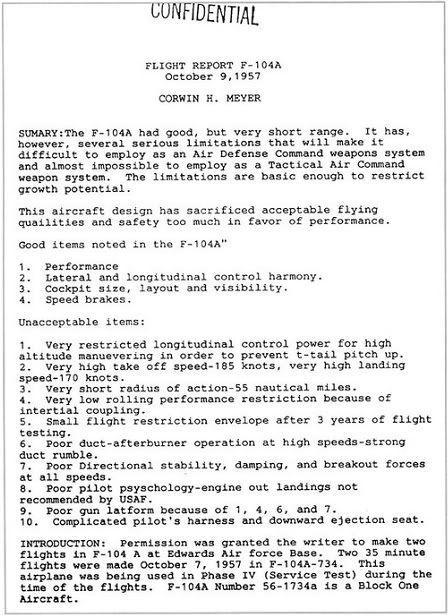
H_KHere’s Grumman’s internal assessment of the F-104. Shows how raw performance is only one of many drivers of combat effectiveness, something that a lot of people seem to forget (including some of the German test pilots who evaluated the F-104 at the time! :p)
H_KThe F-8 Crusader hard to land? There are several documented instances of the Crusader taking off and landing on a carrier with its wings in the folded position.
And your point is? Sorry, but each of your comments on this thread only serves to further highlight your lack of understanding of how fighters operate. The F-8 had a ton of landing issues, including poor lateral stability, high stall speed so low stall margin & poor wave-off characteristics, nose gear bounce etc. Check this report for part of the story:
http://www.aoe.vt.edu/~durham/2002-71.pdf
The thrust to weight ratios quoted for F-4, F-104 and Super Tiger are misleading because they use thrust at standard (sea level press and temp) conditions. as you gain height and speed, the more efficient multi shock intakes of the F-104 would give it a thrust advantage over the Super Tiger. Grumman was pleasantly surprised by the M2 capability of the two Super Tiger prototypes as they onlyexpected M1.4. See American Secret Projects: fighters and interceptors 1949 to 1975.
Right. Show me the evidence that the F-104’s intake design gave it a thrust advantage in the Mach 1.5 to Mach 2.0 range. :p
The reality is that the F-104 intakes were temperature limited to Mach 2.0 (though one F-104C with modified intakes for a record attempt did reach Mach 2.37). By comparison, the Super Tiger was able to reach Mach 2.0 with 2 underwing Sidewinders, so pretty similar. Clean, it had earlier reached Mach 2.04 with the weaker J79-GE-3 engine (15,000lbs instead of 15,800lbs on the J79-GE-7 that would have been on production aircraft, which is a big difference). Its intakes had some interesting boundary layer devices that seem to have worked quite well.
As far as I know, and I’ll admit it was a special stripped version, no other aircraft from that era, neither F-4, Lightning and certainly not the Super Tiger could zoom climb to 104,000ft like the F-104. That should imply something about its T/W ratio and its wing.
Agree that that’s very impressive. However, the actual T/W ratios and climb performance give a more accurate picture of its operational capabilities than some super high altitude record attempt.
IMHO the F-104C had a slight raw performance edge over all other American jets of the time (don’t know how it compared to the Lightning). I don’t think that this edge carried over to the F-104G. And I certainly don’t think it outweighed the F-104’s numerous issues, including dangerous landing/engine flameout characteristics, poor maneuverability, and so-so tactical capability.
H_K1,39 min versus 1,40 min is a questionable difference of 0,6 seconds to stay polite. The typicial variation from aircraft to aircraft is even higher. 😉
Yeah, but we’re talking about the F-104G and did you notice that it’s T/W was 0.62 instead of 0.68 for the F-104C? (due to 1,500lbs higher gross weight for avionics & fuel, and 200lbs lower thrust. I wouldn’t be surprised if it the F-104G’s time to 30,000ft was closer to 2min, i.e. a lot more than an F-4.
H_KA very important quality for carrier aircraft is flat take-off and landing attitude. The only aircraft that excelled at this was the Crusader with its variable-incidence wing.
Unfortunately, AFAIK the Crusader actually turned out to be rather hard to land on carriers. Despite having good visibility, it had a fairly high approach speed, which got worse through time as it gained weight, and also its gear/tailhook assembly led to the nose wheel slamming into the deck. This led in large part to the F-8J/H reconstructions.




 Sign In







