 H_K
H_KThe F-104G with two tip-tanks and two AAMs was ~11 tons TOW and ~4 tons of that were fuel. In that interceptor configuration the fuel fraction was
0,36 and better than a F-4 with 0,3!The F-104 had never “short-legs”, whatever was claimed about that.
That’s cheating. The proper comparison is with an F-4B with a 600gal centreline tank, which would have a better climb rate and higher fuel fraction:
F-4B (4 Sparrows + centreline tank): 1.39min to 30,000ft , thrust/weight 0.71, fuel fraction 0.37
F-104C (gun only + 400gal underwing tanks): 1.4min to 30,000ft, thrust/weight 0.68, fuel fraction 0.36
F-104G (gun + 2 Sidewinder + 2 330gal wingtip tanks): thrust/weight 0.62, fuel fraction 0.36
Super Tiger (gun + 2 Sidewinder + 2 300gal underwing tanks): thrust/weight 0.60, fuel fraction 0.34
As you can see, the F-4B was actually a better climber than the F-104C and also had more fuel. (Of couse, once the F-104 jettisoned its wingtip tanks it would do better, but wouldn’t have much fuel left). You can expect the F-104G to have been a fair bit worse than the F-104C due to being about 1,300lb heavier and having 200lb less thrust.
Comparing the Super Tiger and the F-104G, you can see that they were very close, with the F-104G slightly ahead. The difference can be attributed to the navalization weight penalty.
H_Kpagen01 and sens,
Acceleration and climb rate would be critical in a number of situations:
– Deck-launched interception
– Interception of supersonic reconnaissance aircraft such as the Tu-22R
– Responding to attacks from a completely different axis than planned (quite likely with saturation attacks)
A subsonic fleet defense interceptor is useless in all these cases, so you’d better pray that the Sea Vixen was in the right place at the right time, and that the Soviets had the courtesy to approach from the expected direction!
(P.S. There was an interesting USN study in the 1970s that showed that deck-launched interceptors were in many cases actually more effective than having a large permanent CAP, because you could keep more fighters on alert with full fuel for a quick intercept in afterburner, while the CAP would often have to re-vector at subsonic speeds to meet the threat).
H_KI remember reading in an aviation magazine or book ( i cannot remember which, damn middle age ) that there was a fly-off between the Super Tiger and the F-104. I don’t recall if the context was the German order or the U.S. order, maybe someone with readily accessible date/version information can tell us if the Super Tiger was a contemporary of the F-104G or F-104C.
What stood out was an account of a takeoff and climb-to-hight test in which the F-104 had already reached 60,000ft whereas the Super Tiger was still struggling to clear 30,000ft. Maybe the wing of the Super Tiger wasn’t as efficient as some think?
I have noticed that the latest volume of Secret Projects: U.S. fighters, shows numerous Grumman fighter designs of the 60s, all with rather large wings, but that were not selected for production. Either Grumman was designing for qualities tha the U.S. wasn’t interested in, maneuverability as opposed to ordinance delivery, or maybe Grumman didn’t have a good handle on wing design.
Never heard that anecdote, but quite possible. The F-104 was a “rocket with a man in it” after all. :p Time to 30,000ft was only 1min, but then again it carried so little fuel in that configuration that it barely had enough to accelerate to Mach 1.7, engage in 5 minutes of combat at high altitude, and then glide back to base! 😉
AFAIK, there were F-104 vs. Super Tiger contests in at least 3 countries: Germany, Canada and Japan. The F-104 was apparently praised for its climb rate and the favorite of the more “hotshot” pilots, but there were significant misgivings about its dangerous handling caracteristics (particularly, high stall speed), poor range and generally poor suitability for turning combat as well as air-to-ground. The Super Tiger was praised as a “pilot’s aircraft” offering unbeaten maneuverability, good supersonic performance, solid multirole capability and an easier transition from existing fighter types. The Japanese selected the Super Tiger over the F-104 before reversing themselves, the Germans were divided into two camps, and the Canadians selected the F-104 for industrial reasons despite the grumbling of the Canadian Air Force, who wanted the F-4 Phantom. Not sure which they preferred between the F-104 and Super Tiger – possibly there were multiple camps just like in Germany.
Overall, what was remarkable about the Super Tiger was that it was so competitive with the F-104 despite the constraints of being a naval fighter. The F-8 was never competitive. The F-4 was competitive, but in a totally different cost/capability range.
H_KRange – It could go 2 hours at 420-440 kt at very low level!
Speed – It was faster than the MiG-21s on the “deck” and had a better Accelleration. Just the Lightning had the limited chance to catch a F-104 on the deck!
High wing-load for low buffeting – It allowed to go fast and low for more than a few minutes!
Avionic – It had one of the most advanced suits for navigation for its time-scale!
RANGE
Super Tiger would have had better range than the F-104G. The F-104 and Super Tiger had the same engine, so range would depend only fuel capacity and lift-to-drag ratios (Cl/Cd). The Super Tiger had 25% more internal fuel, so closer to an F-104G with wingtip tanks. In that configuration (clean vs. wingtip tanks), Cl/Cd would be in the Super Tiger’s favor, especially since the F-104’s small wing was very sub-optimal for generating lift.
AVIONICS
Agreed, but the Super Tiger would have been fitted with whatever the Germans specified, so no different from the F-104G.
BUFFETING
Agreed that this is the F-104’s key advantage, but how operationally significant was it really versus the Super Tiger’s very easy handling characteristics?
H_KI don’t agree with that, speed is critical for the interceptor, especially to get the Backfire before launch.
A Backfire can fly at near mach 2 from Norway to Iceland easily, so calling it “dash” isn’t really appropriate either.
True in the 1970s, but what about the 1960s?
The Backfire didn’t exist yet, and even in the late 1960s there were only a handful of rather unreliable TU-22K Blinders. The bulk of Soviet anti-shipping tasks would have been carried out by subsonic Tu-16K Badgers, and the very slow Tu-95 Bear B.
I still think speed is important though, but mostly to shoot down supersonic reconnaissance aircraft before they get a proper fix on the carrier.
H_KThe win against the F-104G is no surprise, at least when the mission is that of a pure fighter (in the role actually intended for the F-104G in Germany, the Super Tiger would have been a massive and epic FAIL).
Would love to hear you explain why you think that. What made the F-104G so special for low-level nuclear strike?
Grumman boosts its design, and like so many, these unfinished prototypes always seem to be the best ever conceivable (like F-4 Super Phantom, Super Tomcat, F-16XL, F8U-3, YF-12).
Big difference: the Super Tiger was a very minimal upgrade of an in-service fighter. The changes were as follows: Bigger radar, more avionics, aerodynamic tweaks, more stores and a higher thrust engine that fit in the same form factor. Sounds like a lot, but really no more than going from an F-8A to an F-8E, or from an F-4A to an F-4J. Plus it flew for several years and was extensively evaluated by 6 airforces. So we have a lot of certainty on the Super Tiger’s performance.
But I fail to see any noticeable advantage above the F-8/A-4 combination. For a single seater A2G work either is profession or it is fail. Letting a fighter pilot with a 1950ies aircraft do A2G demands quite huge targets. Vietnam was the perfect example (today with smart bombs and CCIP the world looks different). The A-4 is a perfect bomb truck with very small logistical footprint. Replacing a complement of F-8/A-4 with J79 equipped F-11 hardly seems of advantage. And you cannot train aircrew to be professionals both in A2G and A2A. That became apparent even with the F/A-18. Generally, aircraft of the 1950ies could have limited multi-role capability (i. e.: able to carry missiles and drop bombs), but aircrew generally couldn’t.
2 arguments for the Super Tiger:
FLEXIBILITY. That’s the ability to switch your airgroup between A2G and A2A taskings on demand. The USN learned the value of this during WWII, and never really stopped believing in it. See: F6F Hellcat, F4U Corsair, F9F Panther, F9F Cougar, F3H Demon, F-4 Phantom, F/A-18. Now of course the pilots were expected to be stronger in one role than the other, but they still could perform the other role to some degree. In fact, even A-4 pilots were expected to do fleet defense on the Essex CVSs!
Also, MISSION AVAILABILITY. The Tiger apparently required less maintenance than any other fighter in the fleet. Just compare to the Crusader: manual wing fold, manual arrestor hook, no variable wing, fewer structural issues due to the stronger airframe (just compare the empty weight to aircraft volume ratios) and better landing characteristics (compare approach speeds and tailhook locations). For the Super Tiger, replacing the troublesome J65 with the J79 and using the same engine and avionics as on the F-4A Phantom would also reduced downtime due to spare parts issues.
The Sparrow missile proved to be a failure on F-4B against fighter sized targets. Without the second crew member an F-11 would hardly gain any advantage from it, it would just add weight and complexity. It might extent its missile envelope slightly, but the percentage of out-of-envelope shots and duds was about 90%* for the Sparrow in Vietnam.
True against fighter-sized targets, but in the back-up fleet defense role that I was envisioning, the Sparrow would have been very useful against bombers. There were in fact quite a few single-seater fighters with SARH missiles in the early 1960s: Demon (AIM-7 Sparrow), Draaken (AIM-26B Falcon), Mirage III (R530), Crusader (R530), not to mention the Russian types. And of course, the Super Crusader would have had Sparrows.
H_KStrongly disagree. The F-11F-1F was basically a supersonic Tiger, able to perform daylight duties and some light attacks.
F-8A: That aircraft provided the USN with a daylight supersonic aircraft able to take-on most of the possible opponents. The Super Tiger did not offer so much more capability to justify a replacement, especially as the F4H1 was already in late design phase (first flight: 1958).
F3H-2: Surely a strange aircraft. Replacement was due and was achieved via the F-4B. The F-11 had only one year lead on the Phantom, but it never would have given the Navy a similar capability of a truly independent all-weather interceptor (the carried missile of the F3H – Sparrow I – was quite a crappy weapon, so the F3 was hardly all-weather and after all a questionable addition to the CVBG’s inventory).
A-4: This aircraft was not only very capable, it was also very affordable. Replacing it with a supersonic aircraft would have been exactly the wrong decision.
Conclusion: for the USN the F-11F-1F could have been a gap filler between the Crusader and the Phantom, but only superior to the F-8 by a very small margin (and possibly not in every aspect) and clearly inferior to the Phantom, not only in performance but also general capabilities.
I’m not sure why you’re bringing up the Phantom. There was always a real need for single-seat fighter/attack aircraft well into the 1960s, as proven by the fact that over 2,000 Crusaders and Skyhawks were ordered in parallel to the F-4 Phantom. Partly this is because it took years to deliver the Phantom throughout the fleet. Partly because the Phantom was much more expensive. Partly because the Essex carriers couldn’t operate the Phantom. But even aboard the large supercarriers, you could still find Crusaders and Skyhawks in the mid-1960s!
My argument in favor of the Super Tiger is two fold:
– First, the USN could have saved itself the money it wasted on the last ~150 Demons, which were so limited that they only flew for 4 years 😮
– Second, compared to the (mostly) single-role Crusader and/or Skyhawk, the USN had an opportunity to go for a fully multi-role airgroup, with Super Tigers at the low-end and Phantoms at the high end. This added flexibility would have significantly improved their carriers’ ability in both A2A and A2G, as needed for any given day’s mission tasking. The wisdom of multirole capability being demonstrated by the stellar service of the Phantom and Hornet… 😉 Now of course, the Navy could have done the same with the F-8E, but it didn’t come until 1963, and even then it didn’t have drop tanks so was very short-legged. Weight gains also made the F-8’s carrier suitability even more marginal. So the F-8E wasn’t really in a position to take over the A-4’s role.
As for pure A2A capability, as I said the Super Tiger was superior to the F-8 in terms of speed, climb rate, endurance (thanks to its drop tanks, which the F-8 didn’t have until much later with the F-8E) and maneuverability. The Sparrow capability and same radar system as planned for the early F-4 Phantoms were the icing on the cake. Remember that the Super Tiger won technical evaluations in Canada, Germany, Japan and Switzerland against the F-104 or Mirage III, so its overall fighter performance was quite good. None of these countries even considered the Crusader! :p
I’ll admit that my argument hinges on the Super Tiger being able to perform integrate Sparrow capability and also carry A2G loads without massive weight gain and impact on carrier landing characteristics. Grumman seem to have been confident that this was possible, since they were advertising Sparrow capability and a maximum of 9,000lbs stores on 7 pylons (plus 2 dorsal Sidewinders). I’m hoping to clarify this with Tailspin Turtle on another website, since he’s a real Grumman expert…
H_KThe integration of a new engine into an existing airframe with the need to make as little changes as possible is always a challenge that rarely pay off. In the 1950ies and 1960ies engine technology developed so quickly that engine changes made sense. Strange enough, none ever really made it into service (aside maybe the British Phantom, where the engine was changed more due to political considerations). Higher drag and CG problems are only one thing. The clumsy addition of a dorsal fin also shows the significant stability problems the aircraft had. On paper it might look good, in reality a clean-sheet design normally excels.
Except that in this case the J79 was the same size as the J65 and about the same weight. So very different from a typical new engine integration. The air inlets had to be enlarged, but that’s it. Stability was apparently quite good up to Mach 2.0, and the dorsal fins (which were a precautionary measure) were actually removed at some point in the test programme.
H_KThere’s a strong argument to be made that the supersonic, multirole Super Tiger could have had one of the biggest production runs of the 1960s, had it been ordered. :diablo:
As of November 1957, when the Super Tiger passed its Navy Preliminary Evaluation (doing well enough that the Navy almost reconsidered its plan of buying only F-8 Crusaders), the Super Tiger promised superior performance to its contemporaries:
Upgraded versions of the Skyhawk and Crusader in particular were at least 5 years away, so there was a window of opportunity for the Super Tiger to be framed as an affordable, single-seat multirole fighter-bomber (the F/A-18 of its day… :cool:). It could have substituted first late production F3H-2 Demons (deliveries from mid-1958), then later the F-8B/C Crusader which was only marginally improved (deliveries from early 1959), and even later the A-4C Skyhawk, which was again only a marginal improvement (deliveries from early 1960).
If Crusader and Skyhawk production had ended with the F-8A and A-4B, then that implies that up to 2,300 Super Tigers could have been produced!!! 😮
Here’s the situation as it stood in January 1957:
F11F-1F Super Tiger
Two prototypes flying had reached a speed of Mach 1.85 and been positively evaluated by the USN. Integration of higher thrust engine a few months away to enable Mach 2.0, with plans to integrate Sparrows (same radar as the F4H-1 Phantom) and A2G weapons.
The Super Tiger could leverage the fact that 199+ F11F-1 Tigers were rolling off the production line and just entering squadron service. IMHO, Grumman could have offered an accelerated service entry date for the Super Tiger of around mid-1958, by converting the last Tigers on the production line (which kept running until Jan 1959). This would have been possible given the relatively minor enhancements needed to fit the J79 engine, modified avionics and aerodynamic enhancements required. In addition, engine commonality with the F-4 Phantom would have been attractive for carrier use.
F3H-2 Demon
Subsonic only, but saved by its ability to launch Sparrow AAMs and multi-role capability. Too late to cancel the 224 F3H-2M/Ns whose deliveries were well underway, but the final F3H-2 version was still 6 months away from first flight. So approx. 150 of the last 239 F3H-2s delivered from mid-1958 onwards could have been cancelled and replaced by Super Tigers.
F-8 Crusader
The F-8A of the time was slower (Mach 1.58), had a more limited payload than the Super Tiger (2 Sidewinders only, no A2G capability, no drop tanks), inferior maneuverability, and poor carrier landing characteristics. The F-8C’s first flight was still 8 months away, and the A2G capable F-8E was still 5.5 years away from squadron service. Too late to cancel the 360 F-8As and RF-8As whose deliveries were underway, but part or all deliveries of F-8B/C/D/Es (750 aircraft delivered from early 1959 onwards) could have been replaced by Super Tigers.
A-4 Skyhawk
The A-4A of the time was a limited day-only striker with only 3 pylons for external stores (versus 7 for the Super Tiger). The significantly more capable A-4E was still 6 years from squadron service. Too late to cancel the 700 A-4A/Bs whose deliveries where underway, but part or all deliveries of A-4C/E/F/M (1,450 aircraft from early 1960 onwards) could have been replaced by Super Tigers.
H_KI realize that, it still seems rather funny. So much for being production representative 😉
Yeah, I’m not a huge fan of that Sidewinder configuration. That said, even without it the Super Tiger could still carry 6 AAMs and drop tanks, apparently without a huge drag penalty (centreline or underwing AAMs up to Mach 2.0, drop tanks up to Mach 1.5), so makes you wonder whether they really needed the dorsal Sidewinders.
H_KTail drag is something that hurts most in transonic flight. The overall design of the Super Tiger looks pitiful, nothing you hinge your future on.
And? Aside from the fact that judging transonic drag purely based on the shape of the aft fuselage (ignoring area rule) is rather speculative, no fighter is going to stay in transonic for long. The whole point of afterburner being to quickly accelerate past that point. The Super Tiger seems to have had no problem doing that. It could even go supersonic with AAMs and 2 drop tanks (Mach 1.5) which is fine by me.
H_KThat’s the book I was using as one of my sources. When I go to the ebook site and tried to download, though, the first time it offered me a chance to play a game with a scantily-clad lady. While at another time I certainly would consider this an intriguing prospect, at this moment I’m enough of a nerd to want the book. Since that adventure, it’s offered me no chance to download the book, so clearly I must have hurt its feelings…
LOL 😀
Click on the “Register” link on the top of the page. Once you’ve created an account, log in and you should see the download button.
H_KWhoever had that questionable idea, the obvious instalation of the small AIM-9s were/are the wingtips in general!
In that pics the AIM-9s do look oversize at all!
The tail section does look very draggy too, when the radar-dish in the nose does look very small.
Drag certainly wasn’t an issue, since the Super Tiger proved that it could reach Mach 2.0 with 2 Sidewinders under the belly. As for the radar, it was the same 24in radar planned for the F8U-3 Super Crusader and F4H-1 Phantom, though produciton Phantoms soon got a 32in set instead.
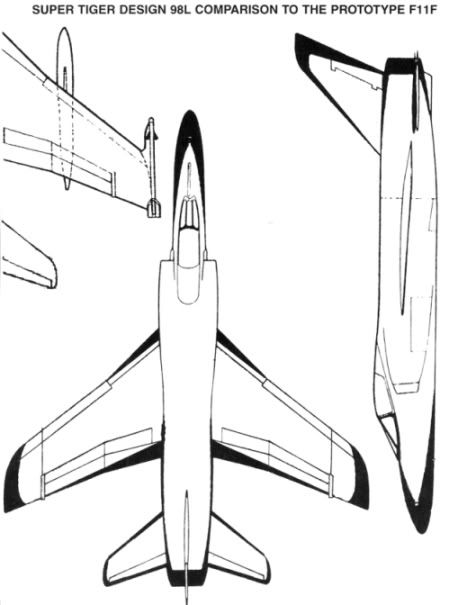
Regarding wingtip AIM-9s, it seems like they were proposed for the paper 98L design circa 1957, which looks like a Super Tiger (98J design) with a new, slightly enlarged wing. Looks like this would have eliminated the wing-fold capability though.
Here’s a drawing of the wingtip Sidewinders on the G-98L:
H_KWith all of Embraer’s lobbying, makes you wonder what they’ll do if Rafale does win in the end. Will they be able to kiss and make up with Dassault to cooperate on the KC-390? Or maybe they don’t want to cooperate on the KC-390, despite their government’s wishes?
H_KI gave the link to Corky Meyer’s book in the first post of this thread. It’s a great read and worth downloading the electronic copy: http://ebook30.com/history/history/152747/grummans-mach-2-international-f11f-1f-supertiger-naval-fighters-series-no-44.html [Edit: To download, click on “Register” to create an account. Then log-in and you should see the download button]
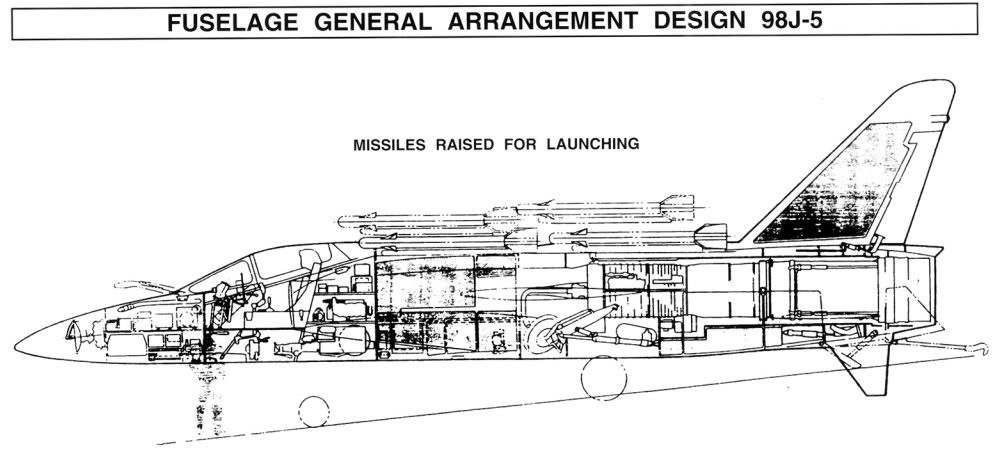
Here are a few pics from the book to illustrate the Sidewinder situation:
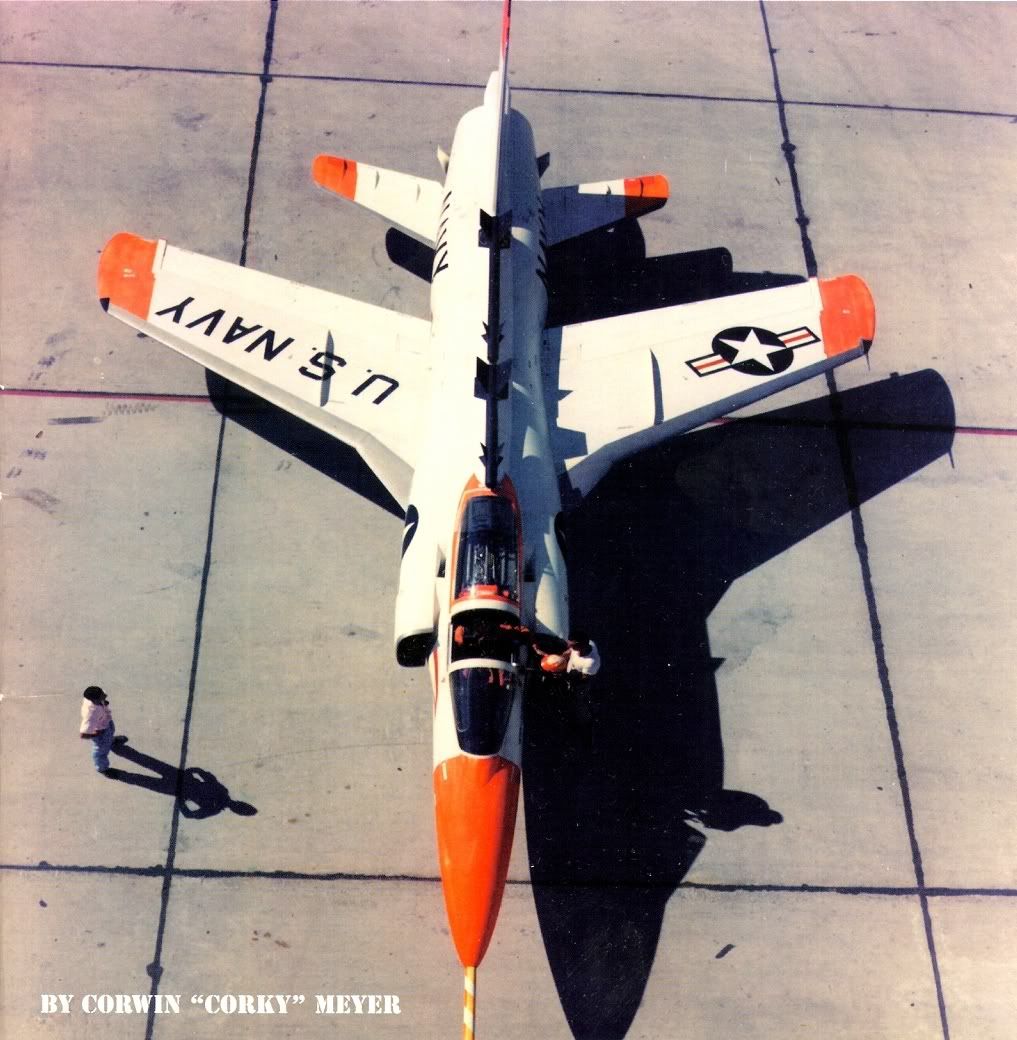
Note how the forward dummy Sidewinder splits in 2 to allow the canopy to open. In-service aircraft would have had a movable launch rail which would have raised the Sidewinder to allow the canopy to move back.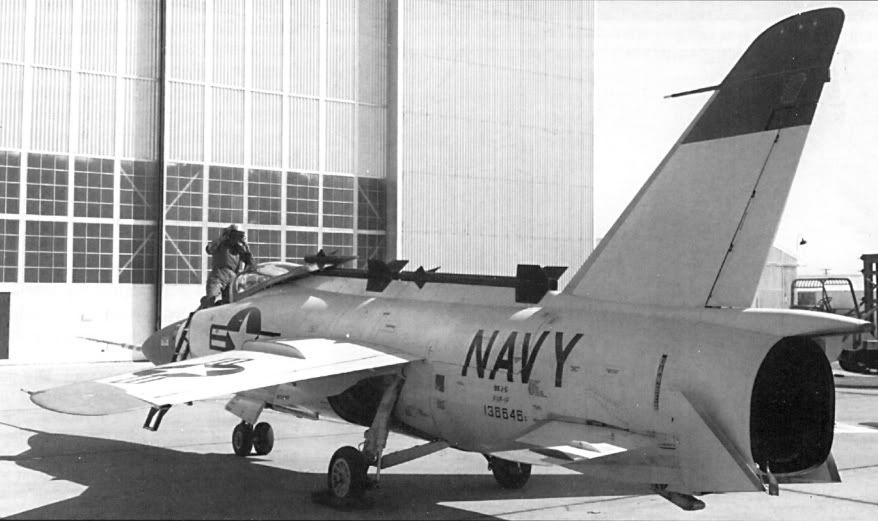


 Sign In







