 H_K
H_KThe 4075 km max ferry range figure however is rather “dubious” — the real figure is higher than that… 😎
Really? Why in the world would they undersell range to two of the LARGEST countries in the world, when going up against larger competitors? Do you think they’re dumb? 😀
H_KThe Rafale flies a 16 deg/AoA 125 knots approach. The Gripen flies a 14 deg/AoA 125 knots approach.
You’re not comparing apples to apples. The Rafale data you quote is for close to maximum landing weight: 15t, so with ~5t bringback. Official French sources give an approach speed of 120 knots, which is more consistent with a typical landing weight with AAMs and empty external tanks.
[QUOTE=robban;1492576]The A/C version Gripen can fly supersonic in dry thrust with a full load of AMRAAM’s, Sidewinders and a drop tank. Why shouldn’t the NG manage to fly M1.2 with the same load with 20% more thrust? Test pilots have noticed that the landing gear farings have actually contributed to overall aerodynamic performance.
/QUOTE]
Because thrust & drag aren’t linear, so we just don’t know until SAAB explicitely says so. By the way, how in the world do those farings improve drag? :confused: Do you have a source?
H_KYou shouldn’t have to tear down the entire aircraft to change parts. The engine switch is one good example.
Engine switch times
Gripen: <1 hr
Rafale: <1 hr for 1 engine, <1h45 for both engines
Now tell me again, are you so sure that SAAB are the only ones who know how to design an aircraft for low maintenance? 😉
H_KIf you cared enough to read my post, you saw that I gave you a source stating ONE DT for 1300km + 30min.
(…)The fact sheet of Gripen NG for India (which is “post Norwegian campaign”) states 3,500kg internal, 3,500kg external fuel and range >4,000km. That doesn’t add up to 4 external 450gal DT’s.
Yes, I did read your source, but I wasn’t sure it was credible. I now realize that it’s taken from the SAAB slide below. Maybe they do mean “1 drop tank”, though in poor english that could also mean “drop tank(s)”.
The fundamental problem is that SAAB has been throwing out a lot of funny numbers, so you’ll have to excuse me for my skepticism:
– They’ve said that Gripen NG has 38% more fuel than Gripen A/C, so 1.38 *3000L = 4,140L. That is in line with claims I’ve found of 4,200L internal fuel.
– They’ve said that with 1,700L underwing tanks, total fuel capacity is increased by 1,400kg, so about 1,750L. The 2 tanks add 1200L, so that leaves 550L extra internal fuel, which is too low. http://www.gripen.com/NR/rdonlyres/FCB6D4D6-8D7E-4824-B674-4B42B761A7F9/0/GripenNewsDemo_080414_final.pdf
– They claim that the Gripen IN can carry 3.5T internal fuel, which is 46% more than Gripen A/C, which seems too high.
– They claim 3.5t external fuel (i.e. 2x 1,700L underwing + 1x 1,100L underwing), but they show CGI images of with 4x tanks.
– They state a ferry range of 4,000km, and we are seriously to believe that that is with only 2 tanks instead of 4?

H_KWait a minute. You increase thrust by a factor of 50%
(15000 lbs –>22500 lbs), but increase fuel consumption by a factor of 16%
2.5 kg/km–>2.9 kg/km) :confused:Bigger does not inherently give longer range, see p-51 vs twice-the-weight P-47, and about comparability in aerodynamics Gripen NG manages to SC >M1.2 with paltry 15000 lbs of thrust, Rafale has a higher T/W so unless it can SC at even higher speed ……
Thrust is irrelevant for range. What’s relevant is Cl/Cd (lift to drag) and fuel fraction. There’s no way to know for sure, but IMHO Rafale and Typhoon should have a better Cl/Cd due to lower wing loading and cleaner aerodynamics (more wing sweep, air inlets, recessed AAMs):
Several data points suggest that Rafale/Typhoon have a better lift to drag ratio:
– Rafale’s low speed performance is slightly superior to the Gripen A/C (approach speed 120 knots vs. 125 knots, minimum speed 80knots), and Gripen NG will do worse than the Gripen A/C.
– Both Rafale & Typhoon have superior supercruise performance (despite what fans say, there is no confirmation that Gripen NG can do Mach 1.2 with a drop tank)
As for Rafale’s fuel fraction, it is about 1% higher than Gripen, more with CFTs. Typhoon’s fuel fraction would also be higher with CFTs.
You can’t beat the laws of physics: while Gripen NG does well in range terms, its aerodynamics and fuel fraction are slightly behind Rafale/Typhoon and cannot compensate for its smaller payload capability. This is not a criticism of SAAB, just a reflection of the fact that smaller aircraft tend to be more aerodynamically constrained since they have to fit the same electronics and pilot in a smaller package.
Btw i said one of the best, or at least that’s what i meant with “just about”, the several orders of magnitude cheaper to operate Gripen for the same work is a plus that puts it ahead in my book.
IMHO, Gripen NG isn’t going to compete with Rafale in A2A, not with the draggy configurations proposed by SAAB (see pictures in my previous post) and without the billions invested in Spectra/OSF and signature reduction.
That said, for A2A against other South American airforces and A2G, IF it really is 2x cheaper than Rafale, then yes it’s a better choice for Brazil. However, that’s a big IF, since I don’t see why Gripen’s electronics or airframe should be any cheaper to maintain. The only difference is the extra engine for Rafale, but then again Rafale has fewer moving parts (fixed refueling probe, no airbrakes) and some unique maintenance friendly arguments such as the canopy designed to facilitate ejection seat removal.
H_KAs others have pointed out, the above is wrong.
NG: 1,500 km radius with 6 AAMs and 1 drop tank.
NG: 1,900 km radius with 6 AAMs and 2 drop tanks….
No, you’re just guessing the number of drop tanks, since SAAB has never stated how many drop tanks are involved. However, there’s a lot of evidence pointing to at least some of the range numbers being 4 tanks:
– Gripen NG’s ferry range is 4,075km, which will be with 4 tanks unless SAAB is stupid and underselling their plane. This equals to a fuel consumption of 2.5 kg/km, about 70% more than a clean Gripen NG, which makes sense.
– Most of Gripen NG’s CAP configurations for Norway are shown with 4 tanks:


– The 1,000km per 1,700L drop tank figure implies a fuel consumption of 1.7kg/km, which is about the same as a clean Gripen NG, which is highly unlikely given the extra weight & drag, and certainly doesn’t work once you have 2-4 drop tanks. Honestly, this makes a lot of SAAB’s marketing numbers smell slightly suspicious.
H_KA delta wing has stronger structural integrity then a conventional a/c,
at the same time they have by far less wing loading.
I’d estimate a fully laden A2G Gripen NG has around the same wing loading as a F-18E with internal fuel + couple of wingtip sidewinders only.One point is obviously to have just about the best range outer air interceptor that is out there, save F.3.
The main limiter for deltas has been few hard points, but the Gripen NG boost 10 IIRC, vs F-18E 11, but perhaps that makes up and tip the scale towards F-18E ?
Ahem, dream on. :p
Gripen NG: 16t MTOW, 25.5m2 wing area –> 625 kg/m2
F/A-18E: 20.8t with 2 AIM-9s,45.5m2 wing area –> 450kg/m2 😉
Anyway, are you honestly implying that the Gripen NG is the best long-ranged interceptor out there? It is certainly extremely impressive for its size, and IMHO a better airframe than the F/A-18E, but both the Rafale and the Typhoon will get inherently better range due to their larger size and comparatively more efficient aerodynamic configurations:
– Recessed AAMs
– Better lift/drag ratio due to larger wings
– Proportionately less impact of stores on drag
Public data confirms this. Not just comparing supercruise performance, but also comparing ranges in similar configurations:
Gripen NG
1,300km radius + 30min CAP with 6 AAMs and 2x 1,700L drop tanks
–> About 3,000km effective range
–> About 2.5kg fuel consumption per km
Rafale
1,780km interception radius with 8 AAMs and 3x 2,000L drop tanks
–> About 2.9kg fuel consumption per km assuming 1,000L used in combat (usually 5 minutes)
–> Only 20% more than Gripen NG with much more payload/range!
IMHO, the Gripen NG’s wing is too small for its size and in addition the Gripen NG’s proposed stores configurations seem very draggy, especially the multiple ejector racks/launch rails and very closely spaced pylons.
Also, the Gripen’s CAP numbers are misleading because endurance numbers tend to look better than range numbers for high-drag configurations, so in reality even if Gripen NG can come close to Typhoon and Rafale in endurance, it won’t get the same range (lower cruise speed due to more drag).
If customers have any need for a long-range interceptor, then the clear winners should be the Rafale or Typhoon with CFTs to reduce drag even further compared to drop tanks.
H_KNot to mention the 18 month refits and doubled pricetag
Ahem. :confused:
All ships need to refit and it’s not clear that CdG’s refit would be much shorter even if it was conventionally powered, since the nuclear refueling occurred in parallel to the regular refit. IIRC, the Invincible class carriers also have had 20+ month refits on a regular basis (every 7-9 years), despite spending much less time at sea.
As for the pricetag of nuclear carriers, it’s estimated to be 10-20% higher depending on whether you include lifecycle costs. Depending on the assumptions you make about future oil prices and whether you include the cost of extra replenishment ships for conventional carriers, nuclear propulsion may even be cheaper!
H_KNaval aircraft can generally use ski-jumps without any modifications. In fact, in the early 1980s the USN ran real life ski-jump tests with the F/A-18 and F-14. The USAF also ran computer simulations with the F-15 and F-16, but these aircraft would have required strengthened undercarriage.
http://handle.dtic.mil/100.2/ADA237265
For the F/A-18, the test results were as follows:
Launch conditions: No wind on deck (I think), no altitude loss, 9 degree ski jump
Launch weight: 32,800lbs
T/W ratio: ~1.0
Stall Speed: ~112kts
Approach speed: ~139kts (from here: http://www.aoe.vt.edu/~durham/2002-71.pdf)
Ground roll: 385ft
By comparison, the F-35B’s ground roll target is 450ft. So in a real world situation (450ft ground roll, 25kts wind over deck, some altitude loss allowed), an F/A-18 could launch at a significantly higher weight than 32,800lbs.
The same thing applies to Rafale, except that Rafale has more thrust (34,000lbs) and a lower stall speed (10kts lower?, due to more lift), so a Rafale should do better than an F/A-18. IMHO, a launch weight of >40,000lbs (>18t) is likely, which would give you at the very least a 3t external payload.
H_KJonesy
Hindsight is 20-20. For sure, if you were to base your decision purely on the past 20 years, then there would be no need for a fleet carrier like CdG, and only slightly more need for a strike carrier like CVF. Nor would there be any need for F-35 for that matter.
But that’s not how the world works. The whole point of a military is to prepare for contingencies. CdG was designed and ordered during the Cold War, when there was a very real risk of war with the Soviets. Moreover, like any carrier, she must serve for 30+ years, and even today there is no telling whether or not she may one day have to conduct high-intensity operations against China, Russia, or maybe even India.
The same goes for CVF. She will have to deal with future contingencies, but it seems that the RN has decided that high-intensity warfare is not going to happen. Which IMHO is a rather illogical starting point for designing an expensive carrier, and not consistent with the rest of the RN’s acquisition strategy (T-45, Astute). To be internally consistent, CVF should have:
a) A real self-defense system
b) A fighter capable of range extension (buddy refueling), and of carrying cruise missiles and anti-ship missiles (none of these capabilities seem to be in the RN’s roadmap for F-35B)
c) Fixed wing AEW
H_KThe presumption is faulty! :). A small STOVL carrier isnt sufficient as, even in modest intensity operations, sortie generation rate is the key metric…especially where the carrier deck may be the only source of available tactical airpower. Bottom line airgroup size matters!. You could make the case for multiple small STOVL carriers, but, we get into efficiency issues there!. Rather a larger, more austere, cheaper Strike Carrier would have been a more cost effective solution than a 3bn Euro CATOBAR Fleet Carrier with modest fleet-level performance.
(…) Fair comment, but, what capability has that higher spec delivered. This is my point. For the same money as we are likely to get a pair of CVF’s for – what would a pair of CdeG’s deliver?. No real speed advantage, lesser sortie rate, lower unsupported air ops sustainability offsetting the nuclear propulsion advantage. The only meaningful advantage is conferred by Hawkeye and my personal opinion there is that high endurance UAV’s will soon turn E-2 into little more than an airborne comms relay/offboard control node anyway.
Yes, except that your STOVL strike carrier idea doesn’t have a viable airgroup until 2017 at the very least, at which point CdG will be past her mid-life point! So the austere strike carrier option was rather academic for the French… 😉
In addition, the whole point of investing vast sums of money in a carrier capability is to cover yourself for the worst case scenario: high-end warfare. IMHO, the idea that you should optimize your carriers for high-probability but low-importance conflicts is an example of rather muddied strategic thinking. From that perspective, a well-protected fleet carrier with fixed wing AEW and longer ranged strike aircraft is a much better insurance policy than the tactically more efficient (in terms of sortie rates) but strategically less relevant CVF.
Again, the key metric is sortie generation rate and sustainability. I remain to be convinced that CdeG with a, say, 26 Rafale airgroup is going to get to 75 sorties per day in any sustainable sense. Even with that aircrafts impressive turn-around figures there is a serious amount of work there to generate 3 sorties per airframe, assuming all airframes serviceable, per day.
IMHO, the MN’s 75 sortie target includes Hawkeyes and helos, which would leave 60-65 sorties for Rafale. With 30-32 Rafales, which I’ve shown is a reasonable upper limit in wartime, that’s 2x sorties per aircraft.
For a narrow hull with commensurate internal volume I similarly find it difficult to believe that AVCAT bunkerage, aviation spares and air-ordnance stowage can be as extensive as that we determined we’d need a 65k ton hull to accomodate in order to sustain 75 sorties per day with a larger airgroup. Even with the availability of space otherwise taken up by ships bunkerage.
No, of course CVF has more storage space than CdG. However, not all of that extra storage space is put to use (some of it is just margin for growth, which CdG doesn’t have). And some of it (at least 5,000t) has to be used for bunkerage. The aviation facilities themselves (hangar, aviation fuel, munitions storage) appear to be within 10% of each other.
H_KProjet Juliette was an in-house design based on the extant CdeG hull. It would be reasonable to anticipate that some design pull-through from the earlier hull could be achieved. Systems integration should have cost very little at least….then we have the real killer for carrier funding…life-cycle costs these could not be anything less than dramatically lower for the Juliette vessel over CVF-FR for the reasons we’ve agreed on. If CVF-FR was being listed as a Eu2.5bn vessel just how much was DCN expecting Juliette to come in at?.
Romeo/Juliette was a conventional design proposed by DCN in 2004, AFTER Chirac’s political decision in favor of conventional propulsion. All the way up to 2003, DCN was pushing for a nuclear design, so Romeo/Juliette was really just a way for DCN to play in the conventional carrier game in case cooperation on CVF proved too difficult.
A notional 55,000t conventional carrier was initially costed at 2.3B euros in 2003. Romeo/Juliette was the direct descendant of this design. However, by 2005 the cost had apparently been revised higher than CVF’s and it was ditched (i.e. >2.7B euros).
By comparison, a sistership to CdG was costed at 1.9B euros in 2003.
26knts wasn’t sufficient to meet the MN’s requirements for CVF-FR and they were demanding 29 for understandable reasons. The displacement uplift on CVF-FR from CVF from 65k tons to 74k tons, as acknowleged by the Ministère de la Défense, was going to drop the vessels maximum speed by about a knot and a half. I’m not sure that Springsharp is accurate enough to determine that a purposefully narrow-beamed hull like CdeG would lose only a knot with an extra 15k tons of dispalcement….that is even if the hull length to beam ratio was maintained.
I’ve never heard of this 29kt requirement – do you have a source? The 2003 parliament report says that the MN had a 27kt requirement (end-of-life), and the events of 2005-2007 clearly show that the MN was willing to compromise on that as long as it got 90m catapults.
I’m not saying that it is an awful carrier per se. It does work and its a more potent multirole platform than anything else afloat that doesnt fly the stars and stripes. In fact it will still be a better Fleet Carrier than anything non-USN after the CVF’s hit the water. Problem is that whats been needed so far and going forward isnt a Fleet Carrier. There have been no Backfire regiments for Aeronavale Hawkeyes to plot intercepts on and this state is, happily, unlikely to change for the forseeable future.
The point was made, by another poster, that he was ‘jealous’ of the CVN and its capabilities. My point was that, for the 3bn euro’s without the costs of the airgroup, the CdeG hadnt really delivered all that much of relevance and was technically a modest design at best.
So, phrased slightly differently, apart from the fact its slow and a bit too small its done fine!. 🙂
I smell a contradiction in your argument. 😉 CdG isn’t relevant because no one needs fleet carriers or Hawkeyes anymore, so presumably a smaller STOVL carrier is quite sufficient. But then you turn around and say that CdG is too small and modest a design, so presumably you’re arguing for a larger fleet carrier? :confused:
IMHO, we shouldn’t get stuck up on definitions. What is relevant is that CdG meets 422 out of 426 of the MN’s requirements for PA2, therefore including presumably the sortie generation rate (IIRC, 75 per day for 1 week, similar to the much larger CVF). The 4 requirements which aren’t met are:
– Simultaneous launch & recovery –> neither CVF FR nor Romeo/Juliette offer this either
– Alpha strikes of 20 aircraft
– Aircraft recovery in sea state 6
– Ships crew under 900 (CdG: 1,200, would be reduced to 1,050 in a sistership)
(Apparently, the 90m catapults are not a requirement?)
On that basis, what makes CdG less relevant than CVF, and is she really too small for the low-to-medium intensity warfare you seem to expect? 😉
As for CdG’s cost is wasn’t out of line given her being a first of class. Had 2 carriers been built, the total cost of 5b euros would be comparable to CVF UK today, despite the artificially low pound and higher specs of nuclear CTOL carriers with a high-end weapons system.
I guess the question is, regarding the last deployment, how much room there was to spare!. SEM has a significantly smaller deck footprint than Rafale, by virtue of the wingfold, plus if you wanted to keep up 24hr coverage you would be looking to embark the third Hawkeye. I wont dispute the ultimate, practical, airgroup size with you as I haven’t done the work and I’ve never seen how MN deck handlers perform. That said I think, off a quick scan, I’d be suprised to see a 30 fastjet airwing on the ship.
We may have to wait at least 10 years before we know who’s right. 🙁
H_KBut all in all I bet the French wish they would have built CdG 5000 tons larger …
Absolutely. IMHO, a new-build, stretched CdG of 50,000t displacement still makes sense today as an alternative to CVF FR. I’ve actually been toying with this idea:
Hull Plug
– Add a 15m plug below the island, between the propulsion and the munitions storage tranches, allowing you to significantly improve aviation facilities
– Compensate for the increased displacement by using silicone anti-fouling to retain a 27kt top speed
– Use CdG’s post-refit plans, since the refit addressed many equipment obsolescence issues, particularly on the communications side
Improved Aviation Facilities 😎
– 5 extra Rafales in the enlarged hangar and deck parking
– 30% more munitions and aviation fuel storage
– Fit 90m catapults, to enable Rafales to launch at >24t (e.g. with CFTs).
– Enlarge both lifts to carry 2 Rafales each, improving aircraft flow
Cost
– A follow-on CdG was costed at 2b euros in 2003 :eek:, significantly less than CVF FR (2.5 billion), despite have nuclear propulsion. CdG itself cost 2.2b euros in the mid-1990s.
– Additional cost savings of ~200MM euros are possible ;), by simplifying the combat systems and procuring parts from CVF UK. For example, use only one multifunction radar (Herakles) instead of 4 radars on CdG, take one of CdG’s Sylver launchers (16 Aster on each), buy the same lifts as on CVF etc.
See the image below for where CdG’s hull could be stretched: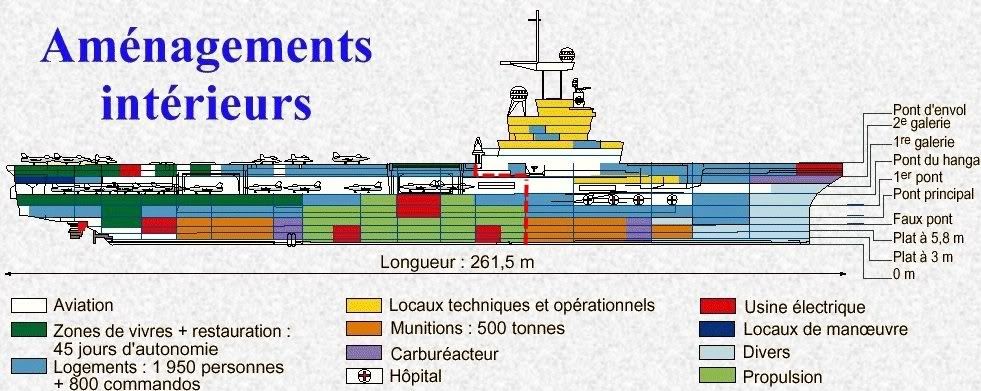
(Original image: http://www.netmarine.net/bat/porteavi/cdg/caracter.htm)
And…the final result: 3rd carrier down from top. :diablo:
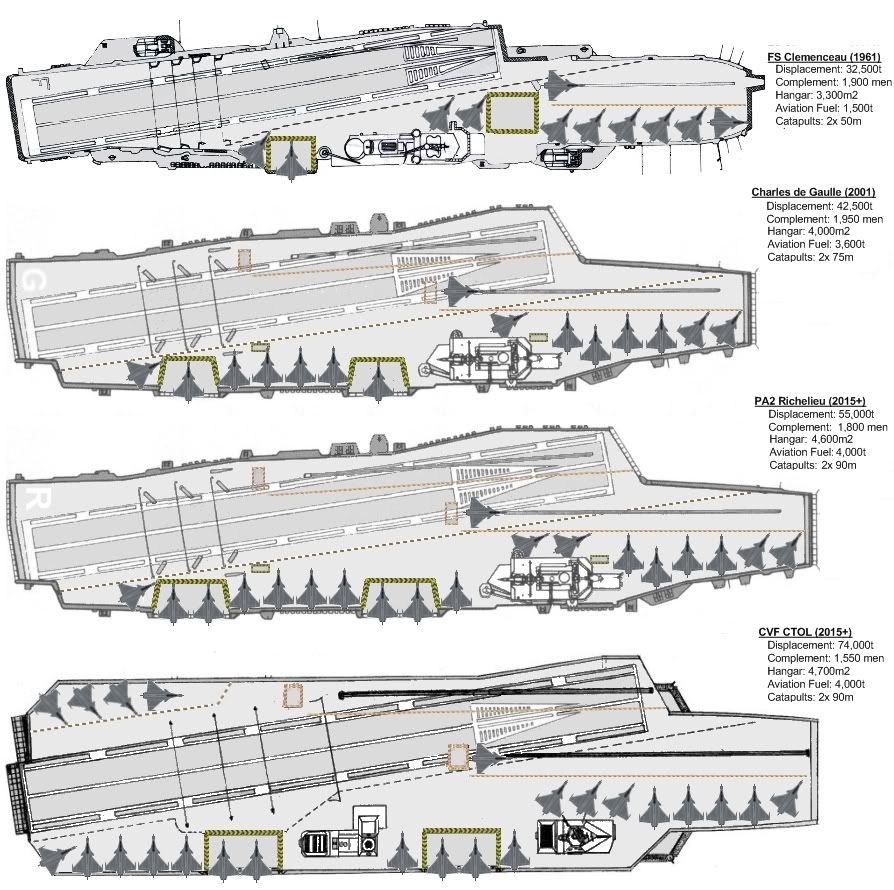
H_KThere shouldn’t be a need for than ~28 Rafale, since with that number they can realize two strike packages with escorts and optional buddy-buddy-AAR, plus have enough planes left for task force protection CAP. All that under a mission capable rate of at least 80%. Of course it’s not sustainable, but can be done once.
(…) If it’s not for a deep strike mission against some land target CdG would be just fine with, say, 18 Rafale, three Hawkeye, and 8/10 AW101. And later additionally some three or four ISR UAV in the MQ-9 class (like the proposed carrier capable version that lost BAMS).
The problem is that CAP eats up at least 20 sorties a day (2 aircraft every 2.5 hours or so). Then add a minimum of 10 sorties for buddy-refueling, reconnaissance, and air interdiction/escort/SEAD. So unless you’re operating in a permissive environment or with air cover from another carrier or from land, you can only generate strike sorties once you’re past the 30 sortie mark.
At 2 sorties per aircraft per day, that means that you can generate 6 strike sorties with 18 fighters, 30 strike sorties with 30 fighters, and 70 strike sorties with 50 fighters. Those economies of scale explains why it makes so much sense to operate super-carriers, and even more so in pairs.
I’m actually suprised the French didn’t buy the AW101. The ASW capabilities of a French task force seems quite underwhelming!
NH-90 was supposed to bring EH101-like performance 10 years ago, though trading off range/endurance for more airframes (which is not necessarily a bad trade-off). Unfortunately NH-90 is now so late and problematic that in hindsight EH101 wouldn’t have been a bad choice. That said, French ASW capability remains among the best in Europe (almost on par with the RN), thanks to active towed sonar, SSNs, and a great torpedo (Mu-90).
And I’d say a third Hawkeye would be worth its weight in gold!
Fully agree. 😉 In 2007, the US actually offered to sell a second hand Hawkeye (upgraded to Hawkeye 2000 standard) for $260 million, which was a significant discount. This would have allowed the French to deploy 3 Hawkeyes while keeping the 4th at home for training. Unfortunately, they couldn’t afford it.
H_KYou seem to be thinking in terms purely of complete peace, & all-out war, so I will repeat: much of what Western forces are engaged in these days is neither peacetime training, nor high-intensity warfare. Without detailed analysis of data which none of us here has, we cannot be certain, but it seems possible that the savings on operating high-performance aircraft could be enough to justify the addition of another type for use in low-intensity conflicts, if that type had operational advantages in such conflicts, & was cheap enough.
(…) You’ve not addressed the use of cheap S-3s in low-intensity conflicts, such as those the UK & France are, & have been for quite a long time, heavily involved in.
I get your argument, and in fact I do see some empirical validity to it, since in the past many countries have tried to hold on as long as possible to their legacy aircraft (Jaguars, Mirage F1s, Super Etendards, F-5s, Skyhawks), because these are cheaper for low-intensity missions.
Along those lines, IMHO the S-3B would be a great, cheap stop-gap for any country that lacks sufficient numbers of land based MPAs/loitering CAS platforms, since there are hardly any of these available for sale on the second hand market. That could be useful for example for the RAF in Afghanistan and the Indian Ocean. In the case of France, the S-3B could be useful in Africa as a supplement for the Atlantique, but for low-intensity CAS missions there are still enough Mirage F1s and Super Etendards left until 2015.
However, I still disagree on the S-3B’s value for carrier based missions. Looking back at the last 20 years, it’s quite clear that carriers don’t often conduct low-intensity missions. If you look at Iraq, Afghanistan and Africa, low-intensity missions have almost entirely been covered by land-based aircraft, with the exception of Afghanistan in 2002 because of land-basing issues, which is IMHO the only case where S-3Bs could have taken a large share of the burden off the shoulders of more expensive fighters.
In general, carriers have only racked up lots of hours in the high-intensity early stages of conflicts, before reverting to basically a training posture, with low sortie rates. Finally, if the S-3B was really a money saver compared to operating F/A-18s, then why did the USN bin it?


 Sign In








