 H_K
H_KDoes parking behind the island include impinging on the lifts (preventing movements from the hangers)?
I’m including 2 aircraft on the lifts, but these could be moved to the catapults for the 1st launch, or to bow parking (where they would block the bow catapult though). Overall, with 14 Rafales in deck parking, the density is somewhat less than USN practice.
Does CdG have enough fuel or ammunition storage to support that many aircraft?
Yes. CdG’s aviation fuel storage is 4,000m3, which is enough for 7 days of operations at 2 sorties per aircraft per day (about 70 sorties per day including helos). If you scale this up to a USN CVN (2x larger airgroup and at a guess 30% more fuel consumption for the F-35C and F/A-18E/F), that’s the equivalent of approximately 10,500m3.
USN CVNs actually have 13,000m3 Avgas, so their combat endurance should be about 25% better than CdG, which demonstrates the benefits of a larger carrier.
CdG’s munitions storage is 4,900m3, which according to various sources translates to 600t-2,100t of munitions depending on density. USN CVNs carry 2,900t, but it’s unclear at what density. Overall, capacity is similar given that CdG has half the airgroup.
Does CdG carry helicopters? Because they reduce the number of Rafale’s that can be carried. And 2 E-2’s isnt enough for 24/7 coverage.
CdG typically carries 2 medium helos (Puma, NH90 in future) plus 2 light helos (Dauphin/Panther) for plane guard duties. These 4 helos take up about as much parking as 1 Rafale, so they’re almost irrelevant. (I did factor them in though)
2 E-2Cs is unfortunately all the French Navy can deploy at any one time. At 2 sorties per aircraft per day they can provide almost 24/7 coverage, but only for a few days until one needs to go into maintenance.
How much space does CdG’s propulsion plant take up compared to that on CVF or even her predecessors?
Not sure. But the nuclear configuration does allow for more aviation fuel carriage than with conventional propulsion.
How are the hangers arranged? Depending on arrangement, total area does not tell you how much is “usable”.
I’d love to get my hands on a layout. 🙂 However, numbers given originally were 20-25 aircraft, in theory F/A-18Cs since that’s what CdG has been designed around. More recently, 16 Rafales has been mentioned, which is consistent with the Rafale’s larger spotting factor.
Does rafale need more and bigger maintenance equipment then the SE?
The answer is definitely yes for engine spares (since there are 2 engines). However, you also go from 2 types to one type, so I don’t know where it nets out.
Oh, is that 32 rafale number with or without other aircraft? (E-2 & Helicopters)
30-32 Rafale, 2 E-2C, 4 helos
H_KFrom memory CdG would carry 30+ aircraft only when the majority were SE’s. The Rafale is a much larger aircraft, so 24 is probably about right.
I’ve given this a lot of thought, and everything points to 24 Rafales being an absurdly low number. So if there’s any truth to this number, IMHO it must reflect peacetime budgetary constraints and not the way CdG could be operated in wartime, or the way another navy such as the USN would operate her.
USN CVN benchmark
USN CVNs had a 72% space utilization rate during OIF, and achieved very high sustained sortie rates despite this (2x per aircraft for 3 weeks, i.e. 125 sorties per day). USN CVNs in the 1980s and 1990s had even higher space utilization rates, but sortie rates may have been lower. CdG’s space utilization rate with 30 Rafales and 2 E-2Cs is 66%. With 24 Rafales this number falls to 54%, which would imply that the French navy doesn’t know how to use parking space efficiently.
Clemenceau benchmark
Clemenceau could carry 36 fixed wing of Super Etendard size, despite the fact that her parking space was only 6,800m2 (3,500m2 deck parking + 3,300m2 hangar). CdG has 20-25% more parking space (8,400-8,900m2), which would be enough to carry around 45 Super Etendards.
CdG’s design objectives
CdG was designed for an air group of 35-40 aircraft, with F/A-18s providing the fixed wing component. If you take that as meaning 36 F/A-18s and 4 helos, that adds up to 5,300m2. Which in turn translates to about 30 Rafales, 2 E-2Cs and 4 helos.
CdG deck parking analysis
CdG can accomodate 14 Rafales in deck parking without interfering with launch or recovery operations (6 on bow, 8 behind the island), and in a fairly efficient layout for aircraft movements. The hangar can accommodate roughly 18 Rafales and E-2Cs. That’s a total of 30 Rafales and 2 E-2Cs
French parliament reports
In 2003, they stated CdG’s capacity as 32 Rafale.
H_KI’m resurrecting this thread to talk about medium carrier air wings, and compare these to USN air wings.
USN CVNs
During Operation Iraqi Freedom (2003), a fairly typical USN airgroup was 12x F-14, 12x F-18E, 24x F-18C, 8x S-3B, 4x E-2C, 4x EA-3B, 2x C-2, 6x helos (on Nimitz). This airgroup was able to sustain ~125 sorties per day for 3 weeks (2 sorties per aircraft per day), so wasn’t overcrowded.
Total parking area:15,400m2 (9,400m2 deck parking, 6,000m2 hangar, so a 60-40 split).
Total spotting area for airgroup (wings folded): 11,000m2
–> That gives us a benchmark space utilization rate of 72%
Charles de Gaulle
The maximum airgroup is said to be 32x Rafale, 2x E-2C, 4x helos, though 24x Rafales has also been quoted.
Total parking area: 8,300m2 (4,300m2 deck parking, 4,000m2 hangar). That’s a 50-50 split, so the hangar is larger than USN practice.
Total spotting area for airgroup (32 Rafales): 5,800m2 –> 70% space utilisation rate. The 24 Rafale airgroup gives a 54% utilization rate.
CVF CTOL
Total parking area: 12,000m2 (7,300m2 deck parking, 4,700m2 hangar). This brings us back to the 60-40 split that is common USN practice.
Assumming a maximum space utilization rate of 70%, this implies a spotting area of 8,300m2.
–> That’s enough for 52x F-35C, 3x E-2C and 6 helos! 😮
Conclusion
CVF could carry about 75% of a USN CVN’s airgroup, and CdG can carry about 50% of a USN CVN’s airgroup. The interesting thing is that CVF is about 75% of the displacement of a USN CVN, and CdG is about 45%. This implies that the economies of scale for carriers don’t apply as much as they did in the past, or that at the very least medium carriers can be designed with enough internal volume to be as efficient pound per pound as a CVN. 😉
(The caveat is that CVF’s fuel & munitions storage isn’t sized to cope with such a large airgroup, so isn’t entirely true).
H_KCdG catapulted a Nounou at 22.2 tons on 21/06/2007 (date of edition of the article).
http://www.meretmarine.com/article.cfm?id=105033
This included: 4 X 2000 l tanks under the wings, a Refueling pods, full internal fuel and 6 X MICAS AAMs.
Dare2 look closer. 😉 You can just see in the picture the fins of an Exocet missile under the belly, so this is the anti-ship config (1x Exocet, 2x 2000L, 6x MICA).
Kovy had posted before a great picture of the “Super Nounou” Dare is referring to. The config is 2x 2000L, 2x 1250L, buddy pod and 2x MICA.
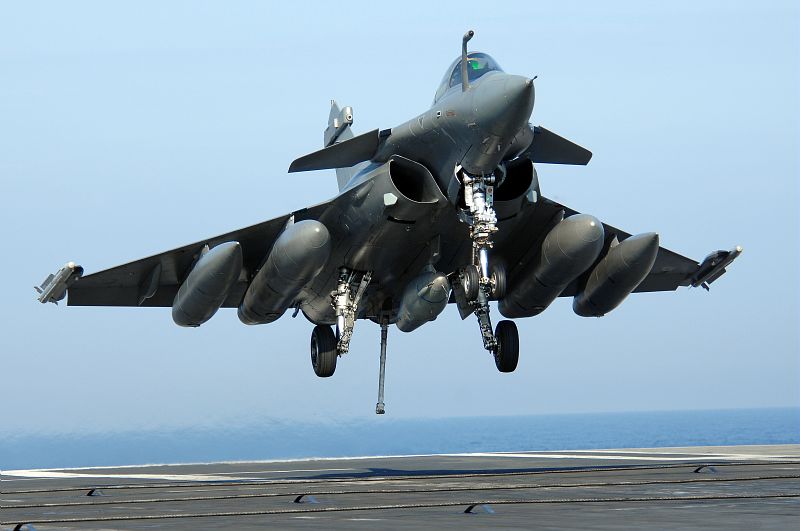
H_KBut not in war time, which is the point.
I’m going to have to repeat myself. 😉
In wartime you’re much better off with a single pool of multirole aircraft such as the F/A-18E/F, F-35B/C or Rafale, because of significant economies of scale:
– Fewer types of engine spares, external tanks etc –> More space in hangar
– If you have a 3-type airgroup, you need one or two aircraft of each type on standby to cover in case the primary aircraft has to abort. With a single type airgroup, the same standby aircraft can cover for all scheduled missions (CAP, strike, buddy tanker etc). –> Frees up more aircraft for missions.
Then you have to factor in the flexibility of a multirole aircraft, which allows quick retasking on deck and even in the air. E.g. an F/A-18E/F or Rafale can serve as a buddy tanker and back-up alert aircraft at the same time. It can self-escort on a strike, etc.
This flexibility argument becomes ever more important with a smaller number of aircraft, so is particularly valuable in a UK or French context. But even the USN agrees, since it’s moving to 2-type, multi-role airgroups!
H_KNo way would you get that speed! CdG has just 56 MW from it’s propulsion compare this to CVF’s 72MW + 16MW out of that 88MW 60MW is for the motors and CVF only does 25kt. The proposed CVF-FR is 75000 tonnes 10000 more than the CVF.
CVF’s propulsion is ~95,000shp (80MW electrical input) with a sub-optimal hull form (due to block construction), giving 26.3kts clean.
CdG’s propulsion is 83,000shp (61MW output), giving 26.7kts clean.
CdG’s propulsion on a 55,000t enlarged CdG would lead to a speed about 1kt lower (using Springsharp – http://www.springsharp.com), though new silicon anti-fouling would more than make up for this (2-3kts improvement on Ark Royal and Principe de Asturias).
H_KI accept what you say about this not being the MN’s fault, but, how on earth can the nuclear option (project Romeo/Juliette?) be back on the table, as you say, when PA2 is not?. Does France have a new reactor able, now, to power a larger vessel?. If not what has changed since the propulsion announcement in 2004 in technical terms?.
The comment of the propulsion choice being about ‘economies of scale’ has always been spurious, and barely credible, as the question must be asked about balancing the savings in build, of CVF-FR, against the whole-life costs of running alternating nuke and conventional battlegroups. How much did the creation of nuclear support facilities for CdeG cost PLUS the necessary costs of building up the MN’s UNREP capability to support a, high-capacity, conventional CV group balanced against, what, the saving of a few tens of millions in shared design and steel-bashing costs?.
I agree with your point about the CVF FR option not being signficantly cheaper than another CVN, due to the support costs. However, the acquisition costs of CVF FR were certainly cheaper, and that carried the day. Today the choice is up in the air again, and as I said many people in the MN and the French always preferred the nuclear option to CVF FR, and were willing to pay extra for it.
There is no technical issue with the reactors. CVF’s speed was going to be 25kts anyway, and IMHO it’s very likely that if the CVN option is chosen the propulsion configuration will remain almost identical to CdG’s, which would still give you a speed of 26kts for a ~55,000t CVN.
No its not. How much has been paid for a vessel of modest performance and limited airgroup (in medium fleet carrier terms)?. What is the sustainable sortie rate of the vessel, how long can it maintain that rate unsupported and how do those figures compare againt the original requirement of, what was it. 100 sorties per day?. Didnt the MN drop that requirement down to 75 per day sustainable, with a PA2 airwing of 32 fastjets against the CdeG’s supposed 24, for PA2 after experience with CdeG?.
The problems with the boat were manifest from the start – it was never going to get the installed power for a practical performance range off the powerplant chosen. Once you get that decision wrong you are fighting an uphill battle every step of the way.
They were therefore obliged to narrow the beam, to preserve performance, reducing internal volume and having to go down this ludicrous active-stabilisation route to keep the thing within flight ops parameters in sea state 5!. The screws issue underscored the narrowness of the performance band for all to see. Dropping 3knts is tolerable when your designed perfromance is 31knts or so, but, when its 27knts from the kickoff and you are a CATOBAR carrier that does need WoD…..!
Do you not see the contradiction in your own last sentence there?. Long hiatus in carrier design coupled to the most technically challenging design possible for an aircraft carrier?. You tell me thats either desireable or sensible?. Bottom line is that, if they went to the US for reactor technology at the same time they were getting the catapults etc, then CdeG is built to the right size needed to operate the required airgroup and comes out as Project Romeo – what it always should have been. They didnt and ended up with an expensive and compromised hull that is not considered successful enough to build a second unit of.
I’m not sure what your point is. Are you saying that CdG is an awful carrier? Or are you saying that it’s less effective than a 55,000t+ carrier?
If it’s the later, then that’s rather obvious. If it’s the former, then I disagree. There has been a lot of misinformation about CdG, and IMHO the French Navy has played along since they’ve had an incentive to justify to parliament the need for the much larger CVF FR. The fact is that aside from the propulsion problems CdG has performed quite well within the constraints of its size, and indeed all the way up to the 2003 decision in favor of CVF FR, a sistership to CdG was an option on the table, so it can’t be remotely as bad even in absolute terms as you seem to believe.
Of course I agree that 55,000t+ is a much better size for a carrier, mainly because that is the minimum size needed to accommodate longer 90m catapults.
Regarding airgroup size and sortie rates, I don’t see why CdG couldn’t sustain high sortie rates with 30 Rafales. That’s based on my analysis of the hangar size and deck parking area, and comparing these to USN CVNs and the Clemenceaus, so of course you don’t have to take my word for it. However, I have noticed that French parliamentary reports stated even quite recently (in 2003) that CdG can carry about 32 Rafales, so that would tend to confirm that the 24 number was more fiction than fact (possibly it’s a peacetime limit). CdG’s airgroup has been slowly building up over the years (the last deployment was 12 Rafale, 16 SEM, 2 Hawkeyes plus helos, with room to spare), and IMHO we won’t see maximum sortie rates until SEMs are retired around 2015, since a one type airgroup will enable significant efficiencies in terms of sortie planning and hangar operations.
H_KLand-based MPAs need land bases.
But in peacetime finding land bases is hardly a problem. Currently you have MPAs based in Djibouti, Mombasa, the Seychelles, and UAE/Oman would be possible if needed. The same would be true for most other regions in the world, which explains why AFAIK no carrier is ever tasked with sea control in peacetime. So where’s the real need for S-3s today?
In wartime, as I said, I’d choose a multirole single type airgroup of F/A-18s or Rafales any day.
Er – it carried rocket pods in USN service, & anything that can carry Maverick missiles should be capable of being equipped with an assortment of PGMs. Triple ejector racks can carry quite a few smallish weapons. It could easily be equipped for self-designation. And it’s a lot cheaper than a Rafale. Remember, they’ve actually been offered for the cost of delivery plus support. Even with upgraded avionics (not to the same level as Rafale!) it would still be a fraction of the cost of Rafale, & for low-intensity warfare (which might include, but not be limited to, anti-piracy operations) the S-3s long loiter time could actually make it superior to the Rafale for some missions. Meanwhile, the more valuable Rafales would be preserving their airframe life for the many tasks they can do that an S-3 can’t.
I didn’t know that the S-3 could carry so many weapon types, so it would be more useful than I expected. However, I still don’t buy the low cost argument. Sure the airframe is free, but airframe costs are only a small part of an aircraft’s total cost. What about the following costs?
– Overhead cost of running a new squadron
– Training costs of 3 crew per aircraft plus ground crew
– Infrastructure + spares
– Modifications to carriers
– Integration of French/UK weapons and mission equipment
It’ll all add up quite fast. Plus the Rafales/F-35 have to fly anyway in peacetime to keep pilots proficient, so it’s possible that you won’t even save that many airframe hours anyway.
H_KThe age of the airframe (as long as it’s sound) isn’t significant. Avionics are. The P-3 is an old weapons system compared to the NH-90/EH-101, or even the S-3, but look at what the Spanish have done to their P-3s, & Brazils: completely up to date now, as weapons systems. I could list many more examples.
I agree entirely. 😉 My point was that if you have to update the S-3’s avionics for ASuW/ASW (which you almost certainly do), then suddenly you’re talking about a fairly expensive option. Add the extra operating, manpower and training costs, and I’m not sure that the S-3 is such a good deal compared to a few more Rafales/NH-90s that can plug into existing squadrons and infrastructure.
The S-3 can do long endurance patrols, good for a lot of the stuff that navies are doing nowadays, such as anti-piracy duties. Why use up airframe hours on expensive & rare Rafales, or make do with the shorter range, longer time to get on station, etc. of a helicopter? It’s a good low-intensity maritime action aircraft.
Agreed, but in that case does it even need to be carrier based? A few land-based C-295 or Dassault Falcon MPAs should be able to do the job just fine for peacetime, and shouldn’t have any basing issues.
Your arguments are all based on the assumption that European carriers will only ever take part in high-intensity wars. In reality, it’s quite possible that they will never fight such a war, & will spend their entire lives doing the sort of things that an S-3 can do as well as, or better than, a Rafale, NH-90 or EH-101.
Have you seen any carriers doing anti-piracy work? 😉 They’re complete overkill and anyway there aren’t enough to maintain a permanent presence.
No, the whole point of a carrier is to do warfare. From the low-end of the scale (Afghanistan) to the mid-end (Kosovo, Iraq), to the high-end. The S-3 might be slightly cheaper than a Rafale at the low-end of the scale, but then again only for a very limited set of missions: high-altitude bomb truck plus buddy tanker. No show of force, no cannon, no rockets, no self-designation…
IMHO, it’s not worth it.
H_KI like that idea. Dirt cheap (the USA has been offering them virtually free, as long as you pay for a support contract), with loads of airframe hours left, & huge spares stocks available. Buy the lot, & all the spares, paying enough to not have to sign the support contract. Insist on none of the standard US restrictions on resale, control over customisation, etc. We own them absolutely. Given their age, that should be agreed to. With cannibalisation, we should be able to keep enough of them operational for a few decades, upgrading avionics as needed.
What can a Viking do that an NH-90/EH-101 couldn’t do? :confused: The Viking is an old weapons system by now compared to the NH-90/EH-101, and today’s ASW helicopters have improved a lot in terms of speed/range/payload so they can cover a much larger perimeter around a carrier, and they can refuel on escorts.
Fixed wing ASW on a carrier takes too much space (at least 2x an ASW helo’s deck spot factor) and will disrupt strike/air defense sorties, which are the carrier’s primary role. And they can’t use dipping sonar, so how good really are they going to be against SSKs?
Also, adding another aircraft type will take up more space in the hangar for spare parts (engines etc), and you need to add spare aircraft in case one goes down.
Much better to operate a single pool of ~30 Rafales. You’d have 2 constantly on CAP, 2 on alert, 2 on readiness for tanker duties with a back-up alert role. If any of these aircraft has a problem you can just move up a Rafale from the hangar and in 15 minutes configure it for the mission needed.
Finally, not only can a Rafale buddy tanker carry 4 MICA, it can also carry a lot more fuel than a Viking. The Viking is about 9,500L including 2x 1,135L external tanks, while the Rafale is 12,500L including 2x 2000L external tanks and 2x 1,150L CFTs.
H_KSo is it a compromised design or not then?
BTW have they fixed the propulsion problems that saw her sent back to dry dock after refit earlier this year?
Sorry, I wasn’t very clear. 😉 I meant “with fewer compromises” but used “less compromised” as shorthand.
IMHO there’s a world of a difference between a “compromised design” and design compromises. The first implies that the design has significant operational flaws to the point that it can be considered ineffective or even dangerous, and generally won’t adapt well to unexpected usage situations that stretch their capability (e.g. LCS, Boulton Paul Defiant, naval Jaguar, Seacat, Matra R.530).
CdG clearly doesn’t fall in this category. It is very much an operational platform, having spent 150 days at sea for 6 year years straight. During 2001-2002, for example, it conducted 3,500 catapult launches over a 7 month deployment. It can launch fixed wing AEW and 22.5t fighters.
That said, there are a few too many compromises in the design than would be ideal. IMHO, CdG is the naval equivalent of the Tornado ADV – underpowered, with some performance compromises, and some reliability problems early on. Fortunately, for both the CdG and the Tornado ADV these problems could be fixed or didn’t overshadow the effectiveness of the weapons system as a whole.
CdG has been requalifying its airgroup for the past 2 months. The propulsion problem cost 10MM euros to fix.
H_KThe French wanted to build all (or the majority of) the CVF blocks in France, thus giving them a large workshare on the project out of proportion to the amount of ships they would receive. The UK said no, the French had a dummy spit and pulled out. It should be noted that the taxes they’d collect from their construction of the UK carriers would have gone a long way to funding their own PA.2.
That’s a red herring. The assembly of the blocks/hulls is only a fraction of the total contract value. The UK would have gotten the propulsion, which is just as costly, and other parts of procurement (elevators, fittings etc) could have been contracted in the UK to maintain a fair workshare. IMHO, the reason why the UK didn’t like this approach was that the shipyard jobs are a lot more high visibility than the other parts of the value chain, especially when the PM-to-be is Scottish. 😉
The reactors fitted to CDG are not designed for powering a large aircraft carrier (but rather an SSBN). It took ten years to build her, her propeller’s were faulty, hell, she wasnt even big enough for one of the aircraft she was supposed to carry.
Hardly what I would term a success.
More misinformation.:mad: CdG took 10 years to build because of funding shortfalls that led to construction freezes. Hawkeyes weren’t part of the original design specs and the angled deck was lengthened as a precautionary measure for the piddling cost of 4 million euros. Honestly, it’d be nice if you did some basic fact checking rather than using schoolyard arguments. 🙁
That’s not to say that CdG didn’t have several problems that took time and money to be fixed and that could have been easily avoided with a less compromised but potentially more expensive design. But ask outside observers such as the USN and I’m sure they’ll tell you they respect the CdG a lot more than any of the STOVL carriers or the Russian carrier.
Actually, they are deployed in Afghanistan right now, sorry.
That’s a rather childish response. We’re talking about the value of fixed wing versus rotary wing carrier borne AEW, and the point is that ASaC7 cannot operate very far inland – certainly not over Afghanistan or much of Iraq. Helicopters are not well suited for AEW in a world where carrier aircraft reach ever further inland.
H_KTo recenter the thread a bit, in a few months Rafale squadrons will receive high performance AASM IIR guided bombs. AFAIK this will bring the world’s first low altitude standoff launch capability for metric precision bombs.
Simultaneous test firing of the AASM-IIR and the MICA RF
Tuesday, October 27, 2009
A Rafale from the CEAM military testing center at Mont-de-Marsan has fired two types of weapons during the same mission at the Biscarosse weapons testing range. The Rafale first launched an AASM-IIR with imaging infrared (IIR) guidance against a ground target 50km away. The AASM-IIR hit the target with the expected precision. The Rafale then fired a radar guided Mica RF missile against a drone simulating an air threat. Both shots were successful, demonstrating Rafale’s ability to deliver precision weapons at long ranges while defending itself against air threats.
AASM-IIR is an evolution of the AASM INS/GPS guided bomb used since 2008 in Afghanistan. Like its predecessor, AASM-IIR includes GPS/INS guidance, but also adds infrared guidance. Precision with GPS guidance is 5-10 meters, and this is reduced to less than 5 meters with IIR guidance. After release, AASM-IIR automatically flies to the target coordinates initially programmed in its inertial guidance system. Terminal phase guidance is achieved by comparing the IIR image to pre-saved images to refine the impact point.
AASM’s two variants offer a modular precision weapons capability, enabling Rafale to remain outside enemy air defenses and providing great mission flexibility. Rafale can thus simultaneously perform close air support (CAS) missions and air interdiction/deep strike (AI) missions.
CEAM hopes to deliver the AASM-IIR to squadrons in early 2010. A third version, AASM Laser, is currently under development for use mainly against mobile targets.
http://www.defense.gouv.fr/air/base/breves/2009/novembre/tir_simultane_de_l_aasm_ir_et_du_mica_em
H_KWhy are you jealous?. Its unkind on the French but if there is a good example of how NOT to do carrier acquisition CdeG has to be the finest in show!.
The got it horribly wrong from the outset. Fine and dandy that you want to have nuclear propulsion…..if you have a powerplant suitable for purpose. If you don’t then swallow the pride and buy American or forget nukes and go conventional. They did neither and tried to make modest submarine derived units do the job forcing significant design compromises to extract any kind of useable performance.
They take this option, end up with a compromised design, and force the follow-on vessel to be conventional in order to get acceptable performance.
Ahem. Sorry to burst your bubble, but the French Navy never stopped advocating for a second nuclear carrier, and so did the French parliament. The conventional option was pushed through by Chirac in 2003, mainly for political and economic reasons linked to cooperation with the UK. Those reasons proved to be illusory when the UK decided to pursue a UK only build strategy for CVF, and now the nuclear option is firmly back on the table.
From a technical perspective, CdG had a few too many corners cut in its design, which led to more corrective work than would have been ideal, but that does NOT make it a compromised design. All things considered, it is a very capable medium carrier and also successful example of how to build an extremely complex ship despite a decades long hiatus in carrier production.
As for AEW Hawkeye is a blue water Fleet asset. Against that ASaC7 has proven extremely useful in the conflicts we have engaged in. E-2 is a great capability but yo have to ask the question as to whether it is a true value-for-money system at present in today’s threat environment.
It’s exactly the reverse actually. ASaC7 is a limited blue water asset and a holdover from the Cold War mid-Atlantic threat scenarios. When was the last time ASaC7 operated as an overland C3 node in Iraq or Afghanistan? You must not have seen those pictures of Hawkeyes operating over Afghanistan…
H_KYes indeed Argentine domestic politics requires politicians to make lots of hot air and noise about the Falklands…And the UK politely ignores them!
Constitutions can be changed so there will always be a millitary threat but not for the moment.
That’s what I meant. The fact that Argentines continue to make official statements about the Falklands doesn’t necessarily mean that they really care, or that Argentina is still a threat. It’s all just posturing for domestic consumption: no politician wants to be the one to officially admit what is already understood by everyone.
After all, Spain still makes official statements about Gibraltar, and I hope no one considers them a threat…


 Sign In








