 H_K
H_K(Edited with more info on pilot backgrounds)
Both pilots were as experienced as it gets:
Rescued: Capitaine de Corvette (Lt. Cmdr) Yann Beaufils, CEPA, 40 years old.
2,900hrs flying time, including about 1,000hrs as a test pilot. Was French air boss aboard Teddy Roosevelt during JTFEX 2008, and also flew Super Etendards in combat over Bosnia and Kosovo.
Missing: Capitaine de Fregate (Cmdr) François Duflot, CEV-DGA, 45 years old.
4,300hrs flying time, including 80 combat missions in Super Etendards over Bosnia and Kosovo, 600 carrier landings, and experience on 34 (!) different aircraft types.
H_KAccording to Argentine news agencies, Buenos Aires has denied making any complaints about the deployment. So hardly sounds like they’re “enraged”.
IMHO, this is just another sad example of chest-thumping hype in British tabloids. Seems like they just can’t stop hanging onto the threads of past glories, the better to forget the sorry state of the UK armed forces today. 😡
For all their official statements, I’d wager that the Argentines couldn’t care less about the Malvinas. If they did, they sure as hell would have continued to invest a bit more in their armed forces. :p
H_Kwas surprised at the absence of any of the manoeuvres that show the degree of agility and ‘off axis’ nose pointing capability that modern FBW FCS gives.
Was that an F/A-18 pilot? :diablo: What he didn’t mention is that ‘off axis’ pointing ability is more important at low speeds. So not all aircraft need to rely on this ability equally. Aircraft that have poor energy conservation characteristics or aren’t inherently agile at high speeds will end up maneuvering at low speeds more often and will therefore have to rely on their off axis pointing ability – indeed, they don’t have much else to show for in an airshow. Those would be the F/A-18, Mig-29 and Su-35.
On the other hand, aircraft that are agile at high speeds or don’t degrade as much will rarely end up in a low speed situation where they’ll need to point their nose off axis somewhere fast. Those would be the F-16, Rafale, Typhoon. This doesn’t mean they can’t demonstrate off-axis nose pointing, it just means that they don’t need to rely on such energy degrading measures as much.
For an illustration of this, look at the dogfights between F/A-18s and Rafales. According to French pilots, the F/A-18s couldn’t compete in conventional agility, so they ended up trying to do some desperate off-axis maneuvers to get a last-ditch shot at the Rafales. But in doing so they ended up degrading their energy even further.
H_KReasons?
Number one I strongly believe in what “Distiller” posted under #551. That is very sound reasoning, and this guy generally sounds very intelligent and knowledgeable. What he says about the F-35 connection is valid in my mind. He also came up with the idea of building fewer EF2k instead of EADS paying for the A400M delays as maneuvering mass for negotiations – not sure about that, he might be smoking something at times. But generally I follow his line and have nothing to add.
Did I miss something, or did you just quote yourself and then pat yourself on the back too??? 😮
Multiple personalities?
H_KIMHO the whole small boat swarm threat is completely overblown. The amount of training, coordination and luck required to get 4+ speedboats laden with explosives close to a naval vessel is beyond the means of most organizations. Much more likely that navies will face only one or two speedboats with RPGs at a time, which can’t even come close to disabling a warship. Alternatively, ennemies might try approaching under false pretenses (e.g. distress signals), in which case the amount of firepower at your disposal is completely irrelevant.
In addition, a 57mm gun is no more capable of engaging multiple simultaneous threats than any other type of main gun. What you need is multiple guns with overlapping firing arcs. IMHO, 2x 12.7mm machine guns and 2x 25-30mm rapid fire cannon (ideally remotely operated) will do the job quite satisfactorily.
H_KLastly look at antidrug patrol, embassy evac, disaster assistance and the multitude of less clearly defined roles undertaken by deployed ‘patrol’ vessels. All of these are missions more readily and successfully undertaken by a larger vessel than a smaller one.
It all adds up to the right choice for C3 being the vessel that Vospers proposed with their circa 3000ton OPV or at least a very close relation of it. You can do quite a lot with a 100m 3000ton hull too!.
I agree with your vision for C3. It needs to be capable of fulfilling a wide range of expeditionary and patrol roles, which takes at a bare minimum around 1,700t and preferably closer to 3,000t. Even if C3 tipped the scales at 3,000t, the RN could probably afford 4-5 C3s for every C2, because the weapons + sensor fit on C2 would have to be several orders of magnitude more expensive.
However, once you have such a fleet of C3s that can do most standing patrols (APT(N), APT(S), Indian Ocean, in addition to minesweeping, is there really a need to make up hull numbers with C2? At that point, C2’s peacetime raison-d’etre mostly disappears, since ~18 first rate warships could comfortably cover the remaining standing patrols (SNMG, Gulf, + 1-2 more temporary patrols as needed) without running the risk of overstretch. What’s better:
– Having only 18 warships, all of them first rate and comfortably backed up by 15 C3s?
– Or having 22 warships, but only 16 first rate (and even then still missing vital kit such as SSMs, torpedoes and CIWS)? With the remaining 6 C2s being rather underarmed and having to pick up the slack left by only 8 C3s ?
I’d go for the first solution. The debate would then be about the right mix for those 18 first rate warships. One idea might be 6 Type 45s + 12 C1s, ideally all with Aster. Optionally, 3-4 of the C1s might do away with TAS and instead have a slightly more GP role, e.g. with more cruise missiles and a larger gun.
H_KIt seems like there are basically 2 options:
Option 1: Buy lots of hulls, with a wide gap between C1/C2/C3
This seems to be the consensus option. But it requires a lot of C2s to perform standing patrol tasks, since C3 would not be able to undertake those patrols (very low-spec, no organic helo, focus on minesweeping & inshore patrol duties). To fit the required hull numbers within a fixed budget, C2 would also have to be fairly low-spec’ed, though hopefully not as bad as a La Fayette frigate.
Option 2: Go for fewer hulls, with less of a gap between C1/C2/C3
A fair number of standing patrol tasks could be devolved to C3, as long as C3 were at least as capable as the new NZ OPVs (>1,700t, helo+hangar + RHIBs): APT(N), APT(S) and Indian Ocean. The whole C3 fleet of 10-15 ships could be fitted with the required patrol capabilities for less incremental cost than 1 or 2 C2 hulls (only requires a few hundred extra tons per ship).
Only the Gulf and SNMG patrols need a C2 or better, due to the need for countermeasures and anti-missile defenses. So the number of C2s might be kept down to 5-6 hulls, with the 6 Type 45s and 8-10 C1s providing a surge capability for 1-2 more patrol taskings as needed. In wartime, some of the C3s tasked with patrols would be re-tasked for minesweeping (at least 5-6 C3s would be permanently tasked with minesweeping), by adding minesweeping modules (some training issues would have to be resolved to maintain crew proficiency in peacetime). Since the number of C2s required would be half that of Option 1, C2 could be much closer spec’ed to C1 and therefore have a real wartime role (e.g. NGS platform, cruise missiles, possibly Aster).
As you’ve all probably figured out, I prefer option 2. IMHO it’s the more efficient solution, because the smaller number of hulls is compensated by the fact that they have very clear and complementary missions in both peacetime and wartime. Option 1 offers more hulls “in reserve”, but I find neither C2 nor C3 very convincing in that scenario, with C2 in particular straining to maintain the fiction that it is a real “warship”.
The greatest barrier to Option 2 is that the RN would have to accept the reality that it can no longer afford to have warships on all seven seas, and that OPVs (C3) are sufficient for showing the flag and for patrol duties in peacetime, with warships in reserve potentially quite far away. This is basically the situation the French Navy is facing in in the Caribbean, South Atlantic and larges parts of the Indian Ocean, but I don’t think the RN (or most posters on this board) is willing to go there yet…
H_KI agree with the 2 tier solution, since it would mean that C2 would become a real “Tier 1” GP frigate on the same level as a F125, FREMM AVT/GP etc. The risk with going for a “cheap” C2 is that some critical ASW or AA weapons system will be “forgotten” to cut costs, much like what happened on the French La Fayettes (no sonar/torpedoes) and their Taiwanese sisterships (only have Sea Chaparral). You can see some of this happening already with Type 45, since it’s currently missing Harpoon, Phalanx & torpedoes…
Regarding Aster, it’s apparently too expensive for C1/C2. However, maybe a suitable middle ground would be to carry say 16 Sylver A70 for SCALP N/Aster 30 and 8 Sylver A35 for 32x CAAM. In a hot warzone, half the SCALP N could be traded off for Aster 30, which would be guided by off-board sensors (i.e. Type 45 or EH101 AEW) and would expand a task force’s protective bubble in an interesting way…
H_KI’m happy to talk about weaknesses :p:
– With regards to Afghanistan, the main limitations of the Rafale aren’t the M88 & OSF, but the lack of Rover and lack of a laser designator. The Rover issue can be expanded to the French Air Force as a whole, and the laser designator issue is compounded by the fact that the Rafale has to rely on the Mirage 2000’s PDLCT laser designator which is getting old. Ironically, the French Navy has none of these issues because its antique Super Etendards have Rover+Damocles…
– With regards to OSF’s IR camera, it appears to have met/exceeded performance specifications. Unfortunately, it adds to maintenance requirements and is based on 90s technology, hence why it’s been called “obsolescent”. It’s not bad by any means, but the French have decided not to “waste” any money on buying more while they wait for the next great technology on the horizon (if you’ve ever bought a computer and waited for the next greatest Pentium or DDRAM technology, you know what I’m talking about :D)
– With regards to maintainability, the M88’s new modular maintenance concept took a lot of getting used to, with the result that parts were replaced before they needed to be, because the military was very cautious. In general, the military seems to have underestimated the amount of precautionary maintenance and software “bugs” in a brand new aircraft (and Dassault/SNECMA seem to have overpromised). I personally think part of the problem was the very slow delivery rate, which made it hard to get up the learning curve quickly and which led to a very small fleet of aircraft & spares. These issues have been slowly resolved, and 2007-2008 seems to have been a turning point, because there have been a lot fewer public reports about canceled missions & downtime since then. For example, availability of the Rafale F2s in 2006-2008 was at least 10% higher than that of the Rafale F1s in 2005-2007…
H_KGhost of Tmor,
By the way, given your login name and the fact that all but 2 of your posts have been about Rafale , wouldn’t you say that you have a somewhat unhealthy obsession with denigrating Rafale??? 😀
(I’m guessing you must use another login to post about other subjects. Should I start guessing? :p)
H_KMy claims ? No, they are comments and reports of chief of staff of french navy, french Assemblée Nationale and french Senate, no more than the most official representative sources in the Country.
Actually, Tmor is right, your claims ARE misleading.
If you bothered to read the report you’re referring to (http://www.assemblee-nationale.fr/13/cr-cdef/07-08/c0708006.asp), you’d see that the same Admiral later clarifies his comments when asked specifically about the Rafale’s availability problems:
“Regarding the Rafale’s availability, the 57% availability mentioned before is the overall availability for the whole French fleet air arm. During the 1st semester 2007, the Rafale had a remarkable availablity of 77% while used on the CdG. The problems with the Rafale are essentially logistical, and concern the spare parts for the engine: our goal in this respect is to improve the supply of spare parts.”
Now tell me what cash strapped military doesn’t have problems with spare parts? The French are just like the Dutch, Canadians, Swiss etc – this tells you exactly zero about the qualities of the engine and aircraft itself. Especially when at that time the M88 was an immature engine (less than 100,000 engine hours), which required more precautionary inspections and parts replacements. And especially when we know that the French were already quite happy with the Rafale’s overall maintainability: 12 hours per flight hour and a maintenance cost only 15% higher than for the much simpler Mirage 2000. Again, all for a still immature aircraft… (http://www.senat.fr/bulletin/20071022/etr.html)
H_KFrench navy always complains about M88
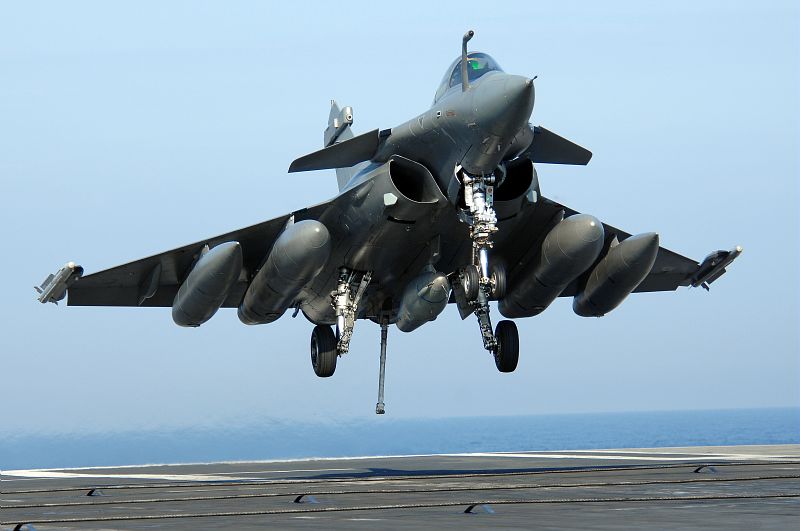
Not quite true. They’d like to launch the Rafale M at a heavier MTOW, which has more to do with limitations of the CdG than with the M88. As it stands, the Rafale M can already launch at a take-off weight of 22.2t on CdG. That’s almost 7t of external payload! :diablo:
So despite CdG’s short 75m catapult and top speed of only 24-25kt, the M88 already does a fine job. As things currently stand, the Rafale M can launch from CdG with 0.5t more external payload than the Typhoon can carry from land! It only carries 1.5t less than a Super Hornet, which launches from carriers with 90m catapults and a higher top speed…
H_Kto use the ASW capabilities of the projected C.1 purely as an escort is a waste, T23 is an amazing ASW platform (T2087 improves this further) but it would benefit from being able to hangar 2 or 3 merlins with a deck for 2.
C.2 there are as many different opinions on what that should be as there is members on this forum but it is universally accepted that it is a cheap GP warship to thicken the numbers in the dwindling RN surface fleet. it is not a LCS-esque ship, do not confuse it with such.
I can imagine a hangar for 2 Merlin, or 1 Merlin + UAVs. But why in the world would you need a deck for 2 ASW helos, or a hangar for 3? That doesn’t fit what any navy in the world is doing. IMHO, the idea that the RN is suddenly going to relaunch the Cold War-style DDH concept, when every other navy in the world has abandoned it, is just a pipedream.
Regarding C2, I personally don’t like the idea of a cheap GP warship, because it can’t add much value as an escort in a high-threat environment, and has no other real wartime role. I don’t buy the “chokepoint” escort concept – it’s too narrow. There might be a need for 1 or 2 ships to deploy in that role in wartime but what about the remaining C2s?…
The one area where C2 could definitely add value in wartime is as a “GP+ frigate”: a somewhat expendable scout on the edges of a task force, taking on roles such as land attack, commando infiltration, NGS etc, and using its sensors to expand the task force’s defensive bubble, all while allowing C1 and Type 45 to focus on their primary escort roles. LCS can’t do all that – I was thinking something like a watered down FREMM AVT frigate, i.e. bigger than a FM400 frigate but much cheaper than a F125 frigate. Say about 5,000 tons, with:
– 32x CAAM
– 8x Harpoon
– 16x TACTOM
– 1x 127mm Oto-Melara gun (or BAE 155mm if it is everdeveloped)
– 6x torpedoes for ASW self-defense
– Hangar for 1x Merlin HM1 or 2x Future Lynx or 1 Lynx + UAVs in ASuW/transport role
– 2-4 large RHIBS
Such a C2 would be rather more expensive than a pure GP frigate, but it would have a real wartime role while also being very well suited to peacetime patrols, and still cheap enough without expensive long-range radars or towed ASW gear. I wouldn’t want more than 5-6 C2s, and would try to get one or two more C1s. I’d try to have them share the same hull, possibly based on a shortened Type 45 hull.
H_KAs discussed before FREMM doesnt work here. Its too small and compromised for our Fleet ASW taskings and too big and expensive for the cheap stabilisation combattant requirement of C2.
One thing I don’t understand: if a 6,000t FREMM is too small for fleet ASW taskings, then how come a 4,500t Type 23 is perfectly satisfactory? Unless you’re implying that the RN’s ASW requirements have changed dramatically, I’m not sure I buy your logic. IMHO, FREEM is perfectly sized for C1, with the main problem being lack of commonality with Type 45s. Anyway, if C1 is based on the Type 45 hull, I’m willing to bet that it’ll be on a shortened hull, not a stretched one…
I would personally prefer to see cruise missiles and 155mm guns on C2, since there won’t be enough C1s to spare any for land attack. They’re all going to be busy escorting carriers, amphibs and SSBNs. Better let C2 take care of littoral operations (where towed arrays are less useful) and land attack.
H_KDo you know on which pylons the M2k carries them? Can they carry them on the 4 fuselage pylons like on the peruvian Mirages, or on the central pylon in single or dual pylons link on the french ones? Or under the outer-wing pylons? Inner wing pylons surely is used for fuel tanks right?
Theoetically there’s a layout I’d like to see and I wonder if it’s possible…
1 damoclès pod on the right front fuselage point
1 Mica EM on the left front fuselage point
2 GPS/Laser GBU 12 on the two aft fuselage points
2 GPS/IIR AASM on the dual bomb central point
2 long range fuel tanks on inboard wing pylons
2 Mica IR on outboard wing pylons…Wonder if the MTOW would allow it…
Nic
Should be OK, just below the 17t MTOW:
7,600kg empty weight
+ 3,130kg internal fuel (3,900L)
+ 3,200kg external fuel (4,000L)
+ 2x 200kg 2000L tanks
+ 2x 340kg AASM
+ 2x 280kg GBU-12
+ 3x 110kg MICA
+ 265kg Damocles
+ 9x60kg pylons
+ 100kg pilot
+ 200kg ammunition, expendables etc
= 16,900kg 😀


 Sign In







