 H_K
H_KAnother delta aircraft with good low altitude performance, but designed for a Mach 2 high altitude environment was the B-58:
http://www.zenosflightshop.com/ProductDetails.asp?ProductCode=B58DVD700 mph under 500 feet is impressive considering that it also averaged 938 mph from Tokyo-London, including 5 hours at speeds of 1230 knots.
Yes, apparently gust response depends not only on wing loading but also on the wing’s lift curve. Deltas have relatively flat lift curves (compared to say a “straight winged” F-4/F-16/F-18/F-15), meaning that turbulence induced changes in angles of attack don’t affect the wing’s lift much. That helps to explain why deltas aren’t always poor low level rides despite their low wing loading.
For example, the English Electric Lightning’s quasi-delta wing was chosen precisely because it offered the best combination of low altitude performance (flat lift curve) and high altitude performance (low wing-loading, high sweep). Quite an achievement…
H_KCalm down. Every fighter could be pushed to the limits. To go low at high speed for some time you are in need of a high wing load. See the special designs for that purpose. All that Mirages were designed for best performances at altitude, when in the 60s it was learned to stay low level for strikers.
As long as you go not behind Mach 0,6 at low level it is no problem for the F-15E to do so for a whole mission. When highly loaded you can go even faster for some time. But doing 600 kt on the deck for more than 5 minutes will bring the F-15E into problems. Both, the Mirage 2000N and the Rafale are kept below 500 kt on the deck with a dash of 600 kt.
While wing loading is a decent proxy for low altitude comfort, it’s not a 100% exact rule. The Mirage IV’s low level performance and gust response seem quite good, despite its delta wing, based on those quotes from RAF test pilots as well as on the fact that the Mirage IVP was used for so long as a low level striker. Similarly, some deltas such as the Rafale have a reputation for good low level gust response, while others such as the Mirage III have a very poor reputation. So unless you have data for the Mirage IV’s low level g-accelerations or speed limits, then I see no reason to doubt reliable claims that the Mirage IV was an excellent low level strike platform.
IMHO, aside from a few exceptions such as the Mirage III and F-15E, the sustained low level speed of most aircraft will be limited by fuel consumption and tactical radius considerations, not by comfort/wing loading. An F-111 or Tornado won’t be able to sustain 600kts any better than a Mirage IV, simply because it’s burning too much fuel. In fact, compared to an F-111, a Spey Mirage would have had very low drag and more efficient engines, and so I strongly believe the article’s claims that it could have sustained Mach 0.9-0.95 at low altitude in cruise, which would have been an outstanding performance.
H_KThe ride at low level in the Mirage IV would have sucked though with the low wing loading.
Not that simple. The F-15E sucks at low level despite having a higher wing loading than the Buccaneer. As the quotes show, the Mirage IV’s low wing loading didn’t prevent it having good gust response and very favorable reviews from RAF test pilots regarding its low altitude performance.
H_KIn genenral the lower the bypass the more “oomph” the engine keeps at higher altitudes. The M53 in the Mirage 2000 is more powerful at high altitude than the F100-220 of the early F-16s for exactly that reason even though the situation is reversed at sea level.
Agree entirely. IMHO, however, the Spey’s thrust loss would have to be massive before the Atar outperformed the Spey at high altitudes, simply because the Spey was starting from a baseline 33% more static thrust than the Atar. By comparison, the gap between the M53 & F100-220 was only 15%, so the bypass ratio played a bigger role.
H_KSorry, when I do challenge your wishfull thinking.
In low level cruise such Mirage is well below Mach 0,8. In dash it is limited to Mach 0,9, when it could be pushed behind Mach 1 briefly.
All that has something to do with buffeting and how long men and machine can endure that. Life time of both in mind, as short as possible.
Similar thing is high up, when the time above Mach 1,8 is limited too. 😉
My “wishful” thinking is base on real sources. What about your numbers? The Mirage IV’s dash speed was Mach 1.1 at low altitude, with a speed of 600 knots in a normal tactical setting. This is in line with other low-level strike aircraft, such as the TSR2, F-111 & Tornado. The Spey Mirage would have done a bit better than the Mirage IV:
“Although the Mirage IVA for the Armee de l’Air was built for the high-altitude nuclear-strike role, it satisfies the requirements for low-altitude operation in two important respects. These are fatigue life and gust response. Dassault has built into the Mirage IVA sufficient extra strength for the structure to withstand fatigue induced by low-level gusts and turbulence, and the shape and loading of the wing provide good gust-response characteristics. Dassault and BAC stated that the increase in weight of the Spey-Mirage will not require further airframe strengthening. Furthermore, the replacement of the Atar 9K engine with the Spey will enable the Mirage to take advantage of the low s.f.c. of the latter engine at low altitude. Maximum speed at low level (i.e., 200ft) is Mach 1.15 (760kt), although a more economical speed, offering nearly the same degree of immunity from surface-to-air missile attack would be about Mach 0.9 to 0.95 (590kt to 650kt).”
Flight International, 1966, http://www.flightglobal.com/pdfarchive/view/1966/1966%20-%200266.html
“The other thing which the hon. Gentleman said about the Spey/Mirage was that it was unsuitable in the low-level role. I pointed out in an intervention that two British test pilots had been over to France, they had flown the existing Atar engine version at high speeds and very low levels, and they reported extremely favourably not only on its low-level capabilities but on all aspects of the aircraft. I can inform the hon. Gentleman also that the French intend to convert all their aircraft ultimately to the low-level rôle and that nothing fundamental needs to be done to it. The strength and fatigue aspects of the matter are entirely satisfactory. Thus, it is not such a difficult matter as the hon. Gentleman seems to suppose, even though the Mirage was, as he said, originally designed for a high-level rôle.”
Eric Lubbock, MP, Liberal Party (9 years experience as a Rolls-Royce engineer, so obviously one of the great supporters of the Spey Mirage) http://hansard.millbanksystems.com/commons/1965/dec/13/f111-aircraft
At high altitudes, the Mirage IV was the first aircraft designed to sustain Mach 1.8-2.0. The structure was built to withstand prolonged heating at those speeds, and the only limit was the amount of fuel onboard, which allowed for over half-an-hour high supersonic dash.
H_KThey were better informed than you think. The Spey was not very efficient, except at low altitude. It was definitely a bad choice for intercepting high altitude intruders. Above 35,000 feet, even the reheated Speys lost too much power. Also there were reliability issues that Rolls Royce skirted in its sales campaign.
RAF officials complained loudly about being scammed (by British politicians) into buying the F-4M with Spey turbofans and other parts made at British factories, which doubled the cost of a Phantom that gave lesser performance than a standard U.S. Navy F-4J, some of which the RAF purchased later in a separate contract.
I know the Spey-Phantom didn’t perform great at high altitude. But the Spey-Mirage would have been different. First, its primary mission would have been low altitude penetration, where the Spey excelled. Second, even at high altitudes the Spey should have been superior to the Atar:
– It offered 32% more static thrust in AB than the Atar. By comparison, the Spey only increased the F-4’s static thrust by 17%.
– The Mirage IV airframe would have accommodated the Spey with fewer of the structural changes and drag penalties that hurt the F-4K. The Atar’s diameter was about 2 inches wider than the J79, the intakes were already optimized for high altitudes so would have required less of a size increase, and the longer fuselage made area rule less of a problem.
In fact, Dassault truly believed in the Spey-Mirage, as can be seen from this quote decades later, in 1989: “Concerning the Mirage IV Spey, we lost a chance to build the most brilliant combat aircraft of this century” – General Jean Glavany, Chief Test Pilot Mirage III & Mirage IV-01 http://www.stratisc.org/ihcc_nuc1_Dassault.htm
This is from a very serious colloquium of French aerospace professionals, at a time when Dassault had moved on to the Mirage 2000 and Rafale, so hardly likely to be PR-spin. Finally, comparing Dassault’s track-record in the 1960s to General Dynamics’, there’s no reason to doubt their ability to deliver the Spey Mirage’s promised performances. Remember that the F-111 was an awful design. Here’s a quote from 1966, describing the F-111A:
“True, its prototype versions fly (they had better do so in this day and age!) but there the resemblance to the final aircraft ends. It weighs 33% more than its specification weight of 60,000lb and will weigh 50% more by the time it is operational. Its engines, as conceived, are too small and have serious compressor trouble. The intake does not work. The aircraft drag, or fuel consumption, or a combination of both, is up by 25%. No single performance figure of any significance is available, and no wonder! […] If Group Captain Harrop keeps up with the American Press he will see that the aviation writers have already detected ominous shimmerings in the vision centred over Fort Worth. That “over 4,000 mile” ferry range has already shrunk to 3,000 on closer inspection. The 100kt “over the fence” will be much nearer the 150kt which he fears. And what point in putting down on a rough and ready airfield on a blockaded island when one needs at least 30,000lb of fuel to take off for the next trip?”
R. Melling, Hawker Siddeley, in Flight International, http://www.flightglobal.com/pdfarchive/view/1966/1966%20-%200541.html
H_KWow. That was an amazing aircraft-combining the low altitude speed of the F-111 and the high-altitude speed of the B-58. A one-of-a-kind aircraft.
Actually… I’d argue that the Spey-engined Mirage IVK was that “one-of-a-kind” aircraft, superior to TSR2 at both low and high altitudes. The mating of a Dassault delta with Rolls-Royce’s best engine was a match made in heaven. 😀 See the F-111 thread:
http://forum.keypublishing.com/showthread.php?t=87704&page=2
H_K“Spey Mirage IVK” – Better than the F-111
A fighter aircraft or low level bomber normally has 700 to 800 Knots (EAS, that is, actually a bit more in real due to compressibility). Aircraft like the B-58 have lower KEAS (Knots Equivalent Airspeed), it actually is not allowed more than M0.8ish at low level. Same would apply to Mirage IV or Tu-22.
You are mistaken about the Mirage IV. Even though it was designed as a high-altitude bomber, it turned out to be a fast, stable low-level platform that could do Mach 1.1 at sea level, which is pretty good.
In fact, the UK came pretty close to ordering the Mirage IV, with Spey-engines instead of the thirsty French Atars. This would have been the ultimate Cold War bomber, mating a low-drag fuselage with powerful, efficient engines. Indeed, the “Spey Mirage” would have been superior in most respects to both the F-111A and TSR2.:eek:
Spey Mirage IV vs. F-111A
– Better lower level performance: 50% larger bomb-load for supersonic low-level penetration
– Better high altitude performance: Mach 2.5 & 20,000m ceiling vs. Mach 2.2 & 17,500m
– Longer ferry range: 5,500km vs. 5,100km
– Much easier maintenance & more reliable engines
– 33% cheaper: 2.2-2.7MM GBP vs. 3.0-3.7MM GBP
Spey Mirage IV vs. TSR2
– 33% better hi-lo-hi radius
– Similar lo-lo-lo radius, but with a larger bombload
– Better high altitude performance: Mach 2.5 & 20,000m ceiling vs. Mach 2.25 & 16,500m
– Slightly better low altitude performance: Mach 1.15 vs. Mach 1.1
– 50% cheaper: 2.2-2.7MM GBP vs. 4.7MM GBP
The “Spey-Mirage”s only real drawback was its longer take-off and landing run, due to the delta wing. But the MoD argued that the “Spey-Mirage” was a “high-risk” and inferior solution than the paper F-111A, even though it was becoming quite clear that the F-111 was turning into an expensive, high-drag pig that would never achieve its promised range/speed performance and would be delayed by several years. The argument was especially ludicrous given that the Mirage IV was already in service and that Dassault had plenty of experience grafting Rolls-Royce engines onto already proven Mirage airframes.
BAC and Rolls-Royce lobbied hard for the “Spey Mirage”, since they would have built 50-75% of it. Even Flight International editorialized in its favor, because it met the RAF’s requirements at a lower cost than the F-111 and very little technical risk. RAF pilots who evaluated the French Mirage IVAs were blown away by their sustained Mach 2 capability and also praised their low-level performance – both of which would have been improved with Spey engines. Apparently, even the RAAF’s chief was very interested, but Australia was committed to the F-111…
But the MoD ended up ordering the F-111, mostly for political and trade reasons. We know the rest of the story. The F-111 suffered big cost overruns and never met its performance goals, and the RAF canceled it. Had they chosen the “Spey-Mirage”, they would have had the best supersonic bomber in the world instead of coming empty handed. 😉
Here are some interesting what-if pictures. More here: http://www.airlinebuzz.com/forums/blog.php?b=102&goto=next


 😎
😎
H_KYes, the video is of a French Navy SINKEX in 2004. The target was EE Vauquelin, a 4,000t decommissioned destroyer built in 1956.
According to this website, it was hit by:
– 2x 500lb Paveway LGBs from Super Etendards
– 1x MM38 Exocet from Duquesne
– 3x SM1 missiles from Jean Bart (that’s the video clip)
– 80x 100mm & many 20mm rounds from both destroyers
Despite all the above, the ship did not sink – possibly because there was no fuel, munitions & other flammable materials onboard.
Ultimately it had to be scuttled with explosives. This gives a good idea of the relative difficulty of sinking even a fairly small ship
(by today’s standards) with anything other than torpedoes or heavy bombs.
Here’s a series of pictures:


And in honor of its sterling Cold War service:
Indian Ocean (1960s?), in its original AA configuration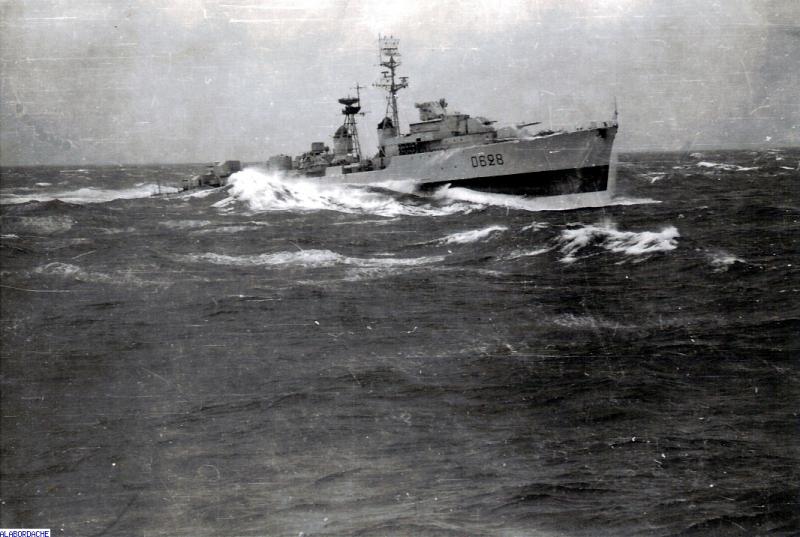
After a thorough anti-submarine refit (1980s?)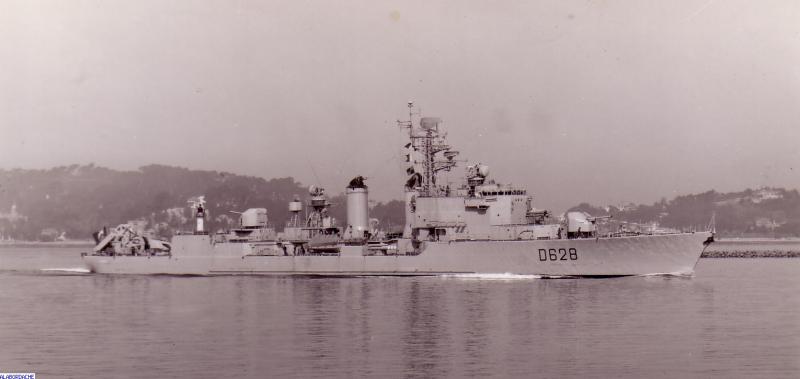
From here: http://www.alabordache.fr/marine/espacemarine/desarme/escorteurdescadre/vauquelin/photo.php
H_KBased on my research, I think an enlarged, 55,000ton CdG could still do ~26kts without any more reactors. This can be shown a couple of ways:
1. Comparing to CdG
Using Springsharp, a simple but fairly accurate ship simulation tool (http://www.springsharp.com), the reduction in speed between CdG and a 55,000t “big brother” is ~1kt. This surprisingly low number is because the increase in tonnage is partly compensated by the longer, more hyrodynamically efficient hull.
2. Comparing to CVF
CVF can do 26.3kts (25kts sustained) on 95,000shp. CVF is also a sub-obtimal hull design (because of super-blocks) of significantly larger displacement (65,000t-75,000t) . So it’s not inconceivable that a smaller, more efficient 55,000t hull could do 26kts on only 83,000shp.
3.Comparing to CVF “Bravo”
The “Bravo” option for CVF, which was about 55,000t, would have done 25kts on 70,000shp, again with a sub-obtimal hull design. Using SpringSharp and, the speed gain from going from 70,000shp to 83,000shp for a 55,000t displacement hull would be at least 1kt.
So in the end, a 55,000t CdG would probably lose no more than 1kt in speed, which would be more than compensated by the longer 90m catapults. Even if one decided to increase the propulsion by 50% by adding a 3rd nuclear reactor, the extra 41,000shp would only increase speed by 3kts, from ~26kts to ~29kts.
H_KCdG “What If”
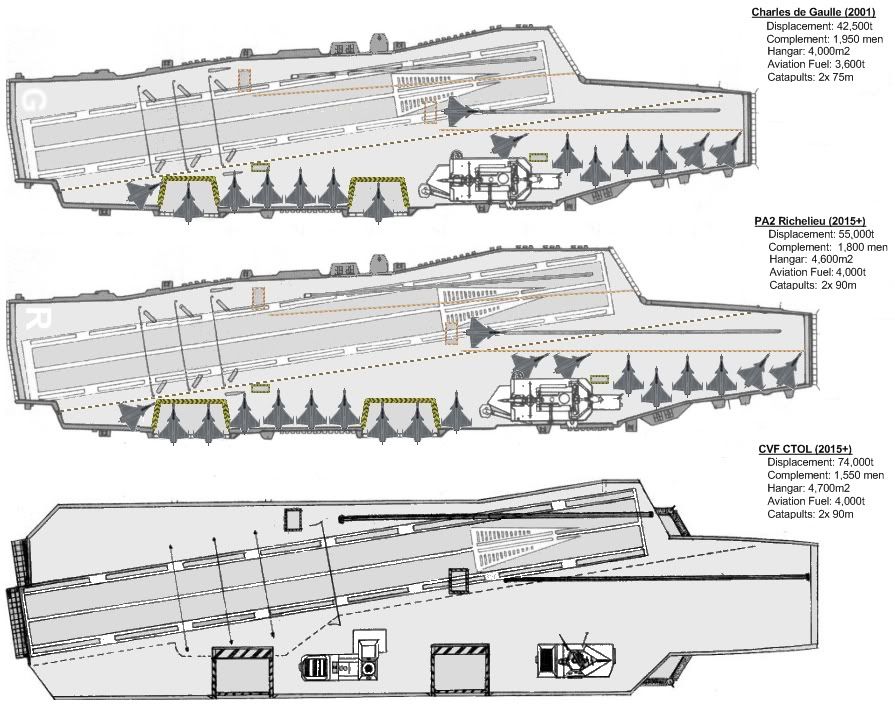
Here’s an interesting “what if”. It’s 2011 and with the world economy still in recession, the French decide to go ahead with PA2 to keep their strategic shipyards afloat. Due to lukewarm feelings about the CVF design and concerns about long-term oil prices, the French decide to play it safe and build a minimally modified “big brother” for CdG…
Design Goals
– Improve aircraft facilities vs. CdG
– Reuse CdG’s plans as much as possible, in order to cut costs and launch construction quickly (due to the economic crisis).
– Cost: 2.3b euros (versus 3b euros for the CVF design and 2b for an identical sistership for CdG)
Solution
– Add 20m hull “plug” forward of the hangar and nuclear reactors
– All other hull sections remain almost identical to CdG’s
Specfications (In parentheses, CdG)
– Length: 283m (262m)
– Displacement: 55,000t (42,500m)
– Airgroup: 40 fixed wing (32 fixed wing)
– Hangar: 4,600m2 (4,000m2)
– Deck size: 13,300m2 (12,000m2)
– Catapults: 90m (75m)
– Lifts for 2 Rafales each
– Aviation fuel: 4,000t (3,600t)
– Speed: 27kts (27 kts)
– Propulsion: 90,000shp (83,000shp)
– Crew: 1,800 (1,950)
Speed is maintained thanks to the higher length/beam ratio (less drag) and slightly boosted propulsion. In order to reduce the electricity generating burden for the 2 nuclear reactors and thus enable them to produce an extra 7,000shp, the existing diesel generators are boosted. The crew reductions are achieved without major design changes, thanks to improvements in ship systems compared to the 1980s.
The result is a much more traditional looking design than CVF…
H_KA400M desperately needed in Afghanistan
What worries me most about the A400M delays is what’s going on in Afghanistan. Not to overdramatize, but Afghanistan is potentially a new Dien Bien Phu if Pakistan disintegrates.
In such an event, the Taliban could get access to portable SAMs to shut down the main Afghan airports from strategic aircraft, as well as conventional weapons (artillery, armor) to cause losses among NATO’s light infantry. Reinforcements by land would be a huge problem, and the result would be 80,000 Western troops scattered in an enclave, with no tactical initiative and hundreds of kilometers from their logistical bases. The Europeans would be in serious trouble without new tactical transports such as the A400M.
To set the tone for what an Afghan Dien Bien Phu might feel like, here’s a short history lesson in music video format.
H_KGood point about the deck crews crossing and need for multiple fueling and arming points!
I say it benefits survivability. 😀
Yip, CdG could be 5.000ts larger. I think the sweet spot for a Rafale carrier is around 46/47.000ts, whereas Super Hornets I’d say around 55.000ts.
Reading Norman Friedman’s “US Aircraft Carriers”, CVV originally had its stern lift on starboard but it was moved to port to improve survivability, as you suggest. Note that nothing was mentioned about improving flow…
I’m also less sure that lift location matters as much these days, with saturating ASM attacks coming from different directions. Might be better to turn your port side to incoming attacks, to protect your vitals (island, hangar etc) on starboard as much as you can…
Option 3 was proposed for CVV, but she was much larger than CdG and closer to Midway/CVF. So it’s still not clear that anything less than 55,000 tons is enough to make a starboard lift and simultaneous launch & recovery truly viable…
H_KMy issue with Option 3 is that the fractions of a minute you gain in flow time for recovery & launching, you’ll then probably lose due to less efficient refueling & rearming. The smaller deck park means more aircraft movements, and deck parking on both port & starboard sides means more complex movements for personnel, munitions etc.
Also, remember that flow and recovery times are much less of an issue when you have only 35 fixed wing aircraft instead of 70 – so half as many recoveries, & easier to sequence launch & recovery rather than run them simultaneously.
You also probably need a bigger carrier (Midway or CVF sized) to implement Option 3 effectively.
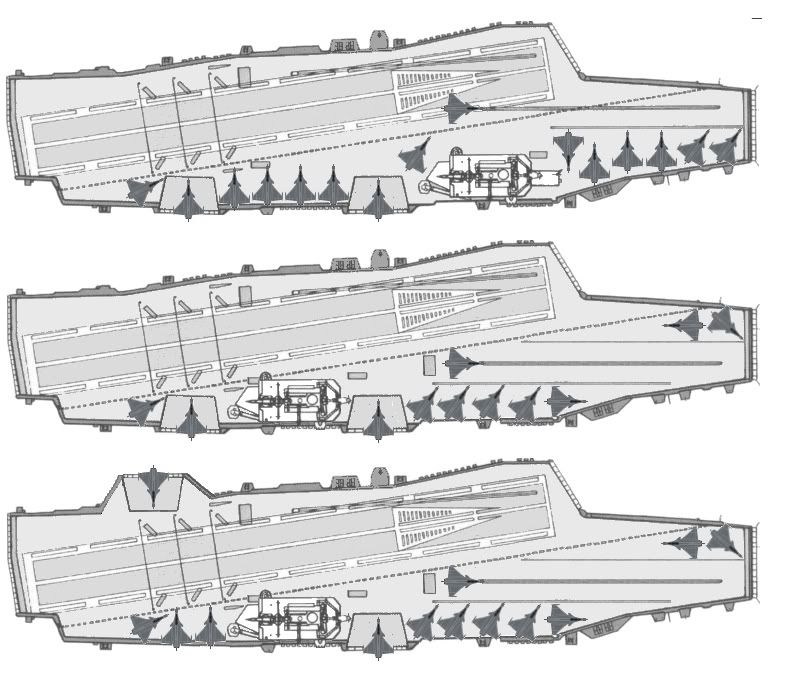
H_KContinuing on the topic of “flow”… I’ve drawn three options for deck layouts, to illustrate the discussion we’re having. My understanding is that Distiller is arguing for Option 3. I personally like Option 1.
Option 1: CdG layout with two lifts on starboard behind island and catapults on port. This has the advantage of clear separation between deck parking and launch & recovery areas, with maximum deck parking. The flow looks alright to me too, considering launch & recovery operations are sequenced.
Option 2: Bow catapult moved to starboard and one lift moved forward of the island. IIRC, this option was considered for CdG and had several merits, including simultaneous launch & recovery. However it has less deck parking and the flow could also be problematic since both recovering and launching aircraft will prefer to use the forward lift.
Option 3: Same as option 2, but with the stern lift moved to port. This would be a great option if the planes could be readied on the stern catapult during aircraft recovery, but CdG is too small for unconflicted use of the stern catapult. It also has the disadvantage of less clear separation between deck parking and launch & recovery areas.


 Sign In







