 H_K
H_KOnly 21 Mk82s? The F-111 could carry 50 so I guess this mythical Mirage isn’t an F-111 after all.
Ah, but show me a picture of an F-111 with more than 24 Mk-82s… 😉
The F-111’s operational loadouts seem to have been a lot less than it’s capabilities on paper,mainly because the 4 outboard pylons were almost never used. Probably because they couldn’t rotate – they would have added a lot of drag.
H_KOne thing we shouldn’t exclude either, is that the F-111 has much wider capabilities, especially in conventional warfare.
OK, one more response then I promise I’ll stop dreaming about the Mirage IV. 😉
The F-111 was certainly better equipped for conventional bombing than the Mirage IV, thanks to its laser designation capability. In terms of payload, it would have also been ahead, but by less than I expected. Basically 4 heavy pylons on the F-111 vs. 3 heavy & 2 medium pylons on the Mirage IV. (The F-111’s weapons bay appears to have always been used for fuel or jammers). So sample loadouts could be:
F-111: 4x heavy/medium stores (Fuel tanks, 2000lb GBUs, Harpoon etc), or 16x Mk-83s, or 24x Mk-82s
Mirage IV: 3x heavy stores (Fuel tanks, 2000lb GBUs), 4x medium stores (Martel/Exocet), or 16x 1000lb GPs, or 23x Mk-82s
This is purely hypothetical, of course, since the Mirage’s IV’s conventional capability was never used. I tried to draw out some Mirage loadouts, by guessing the fuselage hardpoint locations based on info from Janes, and the landing gear door and center of gravity constraints.
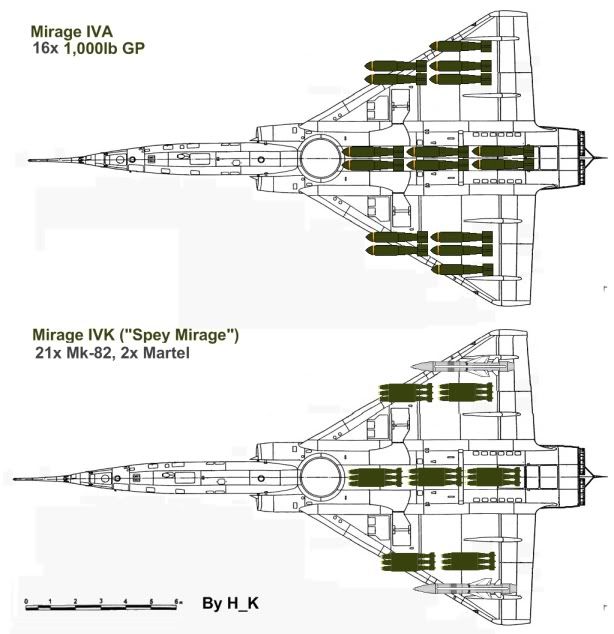
(I enlarged the Spey Mirage’s aft fuselage and intakes by about 8 inches and lengthened the fuselage by 2 feet forward. It’s barely noticeable due to the Mirage IV’s size.)
H_KThe theme of your entire send up is cherry-picking, if not flag-waving. The first sign is cobbling together numbers based on guesswork for a prototype Mirage IV with British engines.
You also avoided any sort of discussion about the F-111F, which was at a more comparable stage of development than the F-111A.
That brings us to another theme of your replies, you ignore facts when they are inconvenient.
That’s very uncharitable of you. I’ve scoured the net for as much data I could find on the Mirage IV, Spey Mirage, F-111A and FB-111. For the Spey Mirage, I had to make educated guesses for three numbers – increase in internal fuel, increase in structural weight, and ferry range clean. I made the most reasonable estimates I could using available data from the Mirage IV and Spey Mirage, and laid out the assumptions here for you to challenge. You’re welcome to do so if you want.
I don’t see why flags have anything to do with this. I’ve simply made the case that the Spey Mirage could have been a great aircraft, something which certain experts in both the UK and France believed at the time, and still believed in the 1980s. I’ve tried to keep it balanced by highlighting the Mirage IVA’s many shortcomings, especially in range and runway performance. I’ll add that the Mirage IV’s early 1960s electronics were no where near as advanced as what became available on the F-111 in the early 1970s. Happy?
I’ve ignored the F-111F because the whole point of my analysis is what was available to the RAF and RAAF when they were making their decisions in the mid 1960s, when the F-111F did not exist. It didn’t fly until May 1973. I don’t know if the F-111F is a much better performer than the F-111A – I’m tired of browsing the web for this kind of data, so if you’d like to, be my guest and report back on this thread. 😉
If you do decide on the F-111F as a basis for comparison, please keep in mind that you’ll run into other problems doing an apples-to-apples comparison. You’ll be comparing early 1970s engine technology to mid-1960s technology, and the 5th iteration of the F-111 to the 2nd iteration of the Mirage IV. Feel free to do so, but I prefer to compare the best of what was offered to the RAF and RAAF in the mid-1960s, with the technology available at the time.
I’ll admit to being an optimist as regards to avionics and engine integration on the Spey Mirage. Quality aerospace firms such as SAAB, Dassault and IAI have proven throughout the Cold War (and continue to do so today) that it’s possible to integrate foreign avionics and engines successfully if you have a small team of intelligent, experienced engineers who stick to realistic specifications and don’t let themselves be bossed around by their customers’ pie-in-the-sky wishlists.
H_KThe Crusader III had little in common with the original. It was an entirely new aircraft.
Agree. Similar aerodynamic configuration though. Which points to the fact that you can take a successful aerodynamic configuration and scale it up or down for a lot less risk than starting from scratch with a completely new configuration.
H_KYou’re funny! the whole point of the F-111 and TSR.2 was runway length!!!
Why don’t you get this?
For a state-of-the-art bomber for a long runway nobody had considered BLC or swing wings. It was all about field performance and having good range & good low-level speed at the same time.
I do get this quite well. My point is that IF you decide to compromise on field performance, then the F-111 becomes an expensive & rather average design. The reasons for such a compromise could be many: maybe you realize that your planes are still going to be vulnerable on the tarmac, or that you simply can’t afford the extra cost, or that you’ve already compromised for the rest of your airforce (F-4 Phantom & Buccaneer). The RAF ended up canning the entire requirement – but had they compromised, then they might have ended up with a good long-ranged supersonic bomber, instead of nothing at all.
The question is: what if the F-111 needs only to travel 4000km, I guess it can then get rid of its tanks with the according weight. And how is fuel consumption affected when the Mirage IV is pushed to 5300km.
The FB-111, a slightly modified type, is given with a 5000km ferry range on internal fuel only. It consumes 2.71 kg/km of fuel on that mission (data from the link sferrin provided).
Next thing you are missing quietly is the flying weight. That is, for the MIV something like 24t average (using 32t as take-off, and 16.5t as landing weight). The F-111 is 10t heavier.
When we discuss aerodynamic efficiency, that is a very important fact to consider, otherwise the kg/km figure is utter non-sense.We have to look at (kg of fuel)/(km traveled * t avg weight):
F-111: 18.9t/(5300km * 33t) = .108 kg/(km*t)
M-IV: 15.2t/(4000km * 24t) = .158 kg/(km*t)If you apply that to the FB-111A, where we have hard fact with actual fuel consumed (the example is for internal fuel only):
FB-111A: 15.2t/(5000km * 31.4t) = .086 kg/(km*t)So, your calculation is basically cherry picking and especially misses some important facts.
I acknowledge that it’s hard to find a good apples-to-apples comparison. I’ve been quite deliberate about my comparisons, and I haven’t been cherry picking at all. There are a number of issues to consider:
– Aircraft Weight
As you pointed out, the Mirage IV is much lighter. So it’s necessary to adjust for size, as you tried to do. However, a delta is also much lighter structurally than a VG wing. It has lower loads and fewer moving parts, and also allows for a smaller, lighter fuselage since more fuel can be stored in the wing. So it simply doesn’t need to be as heavy to achieve the same payload/range specifications. Therefore, the range per flying weight benchmark is misleading, because it ignores the fact that a VG aircraft’s more efficient range per flying weight is partly/wholly canceled out by it’s higher flying weight.
– Payload/Range
To guesstimate aerodynamic efficiency, it’s not very useful to compare an aircraft that has external fuel tanks with one that doesn’t. I prefer to compare two aircraft in similar same aerodynamic configurations (e.g. internal fuel only, or with an identical number of tanks). We’re not trying to figure out which aircraft is better for a given range, so I don’t mind if the ranges are slightly different. As long as the difference in range is only about 10-20%, I can assume that adding a small fuselage plug or conformal tanks would allow you to match the two aircraft’s range without fundamentally changing the aerodynamic efficiency.
– Engine efficiency
The Atar is a highly inefficient engine, with a dry SFC of 0.99kg/daN. The Spey has an SFC of 0.64, about 35% less. When comparing a vanilla Mirage IV to the F-111, you need to keep in mind this difference. That’s why I focus on the Spey Mirage, because it would benefit from this improved SFC, minus some efficiency losses due to the increased structural weight and higher drag in cruise.
– Use F-111A or FB-111 as a benchmark?
Going back to the issue of aircraft weight, the F-111A is closer to the Mirage IV in terms of weights and mission requirements. The FB-111 is basically an F-111A with a more cruise-optimized wing and more internal fuel in an enlarged fuselage. It’s much more efficient in cruise than an F-111A, but is it really an apples-to-apples comparison with the Mirage IV?
Now that all that being said, here are 4 sets of numbers. You’re welcome to cherry-pick the ones you like.
Empty Weight (T)
Mirage IVA: 14.5
Spey Mirage: 16 (Guess: +1.5T, knowing that Spey engines weigh +0.5T and fuselage has been lengthened by 2ft + new intakes, structural strengthening etc)
F-111A: 20.9
FB-111A: 21.6
Internal Fuel/External Fuel (T)
Mirage IVA: 11.2 / 4
Spey Mirage: 12.6 / 4 (12.6 is a guess: We know that take-off weight increases by 3T, and guessed that structural weight increased by 1.5T)
F-111A: 15.3 / 3.6
FB-111A: 16.6 / 10.7
Ferry range on Internal/External Fuel (km)
Mirage IVA: 3,200 / 4,000
Spey Mirage: 4,400 / 5,500 (4,400 is a guess – applied same % increase based on data for ferry range on external fuel)
F-111A: 4,400 / 5,300
FB-111A: 5,600 / 8,000
Kg Fuel Per Km – Internal Fuel/with External Fuel (Assume 1.5T unused reserves)
Mirage IVA: 3.03 / 3.43
Spey Mirage: 2.51 / 2.74
F-111A: 3.13 / 3.28
FB-111A: 2.69 / 3.23
Kg Fuel Per Km * Average Weight – Internal Fuel/with External Fuel (kg/km/T) (Assume 1.5T unused reserves)
Mirage IVA: 0.145 / 0.150
Spey Mirage: 0.109 / 0.109
F-111A: 0.107 / 0.106
FB-111A: 0.088 / 0.090
(Note that being more efficient per Km/Weight is useless if you have to lug around more weight to meet the same range/payload requirements, so this is not a great benchmark.)
For an apples-to-apples comparison you have to use the closest comparables in terms of range/weight/performance/payload, which IMHO are the Spey Mirage and F-111A. They are quite similar, except that the Spey Mirage gets to the same destination using ~20% less fuel. That supports my argument that the delta configuration is at least as efficient as the F-111’s VG configuration in cruise. Certainly nothing like the absolute disaster you painted. As a next step, it might be interesting to compare an F-111 with a SU-24 or F-14, because both were later, more efficient VG designs.
(To compare the Spey Mirage to the FB-111, I’d want to increase its size to make its payload & internal fuel match the FB-111 better, which is too hypothetical…)
H_KHere you gave some prominent examples, which did stay with their original engine for best performance.
The Gripen had to overcome some trouble with R12. The Gripen NG is something new and will stick to the F414.
The F-16 with F100/F110.
The F-8 with J57
The Mirage III with ATAR9.
The Kfir with J79 had some trouble to overcome.
The Su-27 with AL-31F.
There is a good reason, why most fighters did stay with the engine designed around.
Yes you’re right on most of these – there were significant structural changes but few all-out engine changes. By my count, there are at least 3 examples of successful engine changes:
F8–> Crusader III: J57 to J75
Mirage F1: Atar 9K-50 to M53
Mirage III – Kfir: Atar 9C to J79.
The Kfir was a very interesting engine change, and remarkably successful too. IAI had some trouble initially, but you have to remember how inexperienced they were and how much bigger the J79 was. The Atar 9C’s diameter was only 29.8″, versus 39.1″ for the J79, i.e. a 70% increase in cross-section. Engine weight also increased by 800lbs, quite a lot for such a small fighter. If IAI could do such a radical change on the smallest Mirage, then Dassault should have had a much easier time making a much less radical change on its biggest Mirage.
H_KFraud!
The F110-GE was specifically designed to fit where the F100-PW200 was installed. That is an odd comparison.
The J-75 powering the Crusader III was the final growth version of the J-57.
The J57 and J75 are both part of the same “family” of turbojets, but their dimensions are very different and the structural changes required in the Crusader III were significant. In fact, going from a J57 to a J75 was a slightly bigger leap than going from an Atar 9K-50 to a Spey Mk. 201. And it was quite a success!
Diameter (in)
J-57: 38.9
J-75: 43 (+4.1)
Atar 9K-50: 40.2
Spey Mk. 201: 44″ (+3.8)
Weight:
J-57: 5,200
J-75: 5,900 (+700)
Atar 9K-50: 3,500
Spey Mk. 201: 4,100 (+600)
Mass flow (lbs/s):
J-57:180
J-75: 250 (+70)
Atar 9K-50: 160
Spey Mk. 201: 210 (+50)
Another example of a successful re-enginning was the Mirage F1-M53. The M53 had a 25lb increase in mass flow and 1.3″ increase in diameter, requiring structural changes and an increase in inlet size. It’s also an example of a turbojet to turbofan conversion (albeit more of a “leaky turbojet”).
H_KSix Nifty,
Your argument seems to be that every new aircraft design or upgrade is doomed to miss its promised technical specifications and cost estimates by a large margin. I would strongly challenge that, based not on “feelings”, but on the historical track record. The facts are as follows:
1. If you have a basically sound aircraft design that still has growth margins, you can keep the same basic aerodynamic configuration and significantly upgrade/enlarge/re-engine it at very low risk. See Gripen –> Gripen NG, F-16A –> F-16C Block 60, F-8 Crusader –> Crusader III, Mirage III –> Kfir, or all the Su-27 variants.
2. Upgrades and redesigns usually go wrong when the original aircraft design is rather draggy before you even begin making any changes. See Hornet –> Super Hornet, Phantom –> Spey Phantom.
3. Aircraft that are designed around sound, rather minimalist specifications are usually low risk. See F-16, A-4, EE Lightning, Buccaneer, Rafale, A-6 (airframe only, electronics were a bit troublesome).
4. Aircraft that have significant cost/performance issues are actually few and far between. They almost always involve radically new technologies or highly contradictory requirements: see F-111 (Variable Geometry and carrier-capable), F-22 (Stealth), Harrier (STOVL), F-35 (STOVL, carrier capable AND stealth), Eurofighter Typhoon (high instability, which luckily was fixed via software, without requiring aerodynamic changes).
IMHO, it’s too easy to claim that a Spey Mirage IV would be a disaster, just because other much more ambitious projects met significant problems. There are plenty of designs that are “well bred”, which is often synonymous with “willing to accept some design compromises”). See all the ones I’ve listed above. The Mirage IV is one of those.
H_KUsing:
http://en.wikipedia.org/wiki/Rolls-Royce_Spey
I would agree if we talk about an A320. But you are praising the supersonic and transonic performance, not noticing, that you enhancements would have a substantial penalty just there.
By the way, using
http://en.wikipedia.org/wiki/SNECMA_Atar
http://en.wikipedia.org/wiki/General_Electric_J79
http://en.wikipedia.org/wiki/Rolls-Royce_Spey
The diameter of the Atar is 1m, whereas the diameter of a J79 is … 1m.
The increase in engine weight of 400kg, per engine.
Don’t use Wiki for diameters. :p Use Jane’s:
J79-GE-8/15 (F-4B/C/D/N): 973mm (38.3″)
J79-GE-10/17 (F-4E/F/G/J/S): 992mm (39.06″)
Atar 9K-50: 1020mm (40.2″)
I can’t find consistent info for the Spey RB.168-25R Mk 201 – either 43″ (1093mm) or 44″ (1118mm).
The relevant apples-to-apples comparison would be between the J79-GE-8 and Atar, since the enlarged J79-GE-10 must have used up some of the extra space margin in the F-4, a margin that would also exist in the Mirage IV. So going from the J79-GE-8 to Spey adds 145mm in diameter, while going Atar to Spey adds 98mm in diameter. That means the Spey Mirage requires one third less widening than the Spey Phantom – a small but helpful benefit in terms of drag. The Spey Mirage would be at an even greater advantage if you compared the required % increase in fuselage depth.
My general point is that the Spey Mirage IV would still have much better supersonic performance than the F-111, because at worst it would have similar inlet/engine drag penalties, but with a better fuselage and higher thrust/weight ratio. But I see your argument that the supersonic performance could be worse than the Atar Mirage IV. Given the significant increase in static thrust with the Spey, my hunch is that the Spey would still have enough “oomph” to overcome the drag penalty.
Deltas are a disaster in allowed CG range (which is very bad for a striker). The excessive shift of lift center causes massive trim counter, which cannot be generated as efficient as with all-movable tail planes. A swing wing flies most of the time with wings swept between most forward and middle position. Here the aerodynamic efficiency is twice as good as a Delta, especially with large payloads.
Using the F-106 aerodynamic data and applying it to a Mirage IV, I get an LoD of 5 to 7 for a M0.8 at cruise altitude. A forward swept aircraft like the F-111 achieves 12-14. That is all without external payload.
Might be true for an efficient VG wing. But the F-111 was the first of its kind and had significant trim drag and fat fuselage, leading to a drag penalties that were worse than a delta, even in cruise. Here’s a quick calculation:
Ferry range with 2x external tanks
Mirage IV: 4,000km
F-111A: 5,300km
Fuel Weight (Internal/External)
Mirage IV: 15.2T (11.2/4)
F-111A: 18,9T (15.3/3.6)
Fuel Consumption (Kg/Km)
Mirage IV: 3.8
F-111A: 3.57
–> F-111A: 6% lower fuel consumption
BUT: SFC Dry (kg/daN)
Atar: 0.99
TF30: 0.82
–> TF30: 17% lower SFC
So the F-111 has an “excess fuel consumption” of about 11% versus the Mirage IV, in the most favorable conditions for the F-111 (subsonic cruise with wings swept forward, no transonic/supersonic). The gap would be reduced somewhat for the Spey Mirage, because of the larger/draggier intakes & fuselage, but that increase would not be significant in cruise. Additionally, the Spey’s SFC dry would be 0.64 kg/daN, which would be better than the TF-30’s, which according to various sources is either 0.65, 0.69 or 0.82.
Versus the TSR.2, there are ups and downs of the F-111, but the Mirage IV didn’t even play in the same league.
I think you’re showing your bias. The Spey Mirage would have met all the same operational specifications as the TSR.2, except for the runway distance. Once in the air, it was squarely in the same league as the TSR.2, and based on what I’ve shown above, quite superior to the F-111 in supersonic/transonic and at least as good in cruise/low-altitude. The runway length was a big compromise, but could be justified if it helped avoid all the design, cost and delay issues that plagued the F-111, and would have plagued TSR2 had it not been abandoned. Remember that a year or two delay in the midst of the Cold War was a long time…
If the real Mirage IVA didn’t play in the same league, it was simply because it was a tad bit too small for its thirsty engines. That doesn’t make the fundamental design unsound – it proved to have great all-round flying characteristics and a very affordable cost, neither of which can truly be said about the F-111. The variable geometry wing didn’t really come of age until the 1970s and the F-14, which fixed a lot of the drag issues that plagued the F-111. But with the design limitations of the 1960s, a delta configuration was simpler, cleaner, and cheaper. And VG never really took off once people realized that there was no point in having better take-off/landing characteristics than your escort fighters and tankers.
H_KHow do you put engines with higher mass flow and lower exhaust velocity (= turbo-fan), yet higher static thrust into the same limited position? The Mirage would have needed considerable increase in diameter, it would need enlarged inlets, and in the end would suffer weight and drag penalties.
Look, I’m giving you facts about BAC/Dassault’s proposed specifications:
– 2 foot fuselage extension to maintain required Center of Gravity
– 3 inch increase in fuselage depth applied to all fuselage frames, but general fuselage shape would stay the same
– Larger intakes to accommodate the increased mass flow
– Same wing
You’re countering with blanket statements. Where’s the “considerable increase in diameter”? Where’s the evidence of substantial drag penalties? I’ve already explained that the Spey Phantom drag issues aren’t directly translatable to the Spey Mirage:
– Atar is wider than the Phantom’s J79s, requiring less fuselage widening
– The Mirage IV is a bigger plane and would be lengthened, meaning fewer problems with area ruling & therefore less impact on drag
– The Mirage IV’s intakes probably need less of an enlargement than the Phantom’s due to the fact that they should already be bigger (high altitude optimization)
Your concept of drag is funny. In cruise we are talking about lift induced and trim drag mostly, you Mirage is a very inefficient cruiser, especially when flying at higher weights at cruise altitude.
Deltas have less trim drag than variable geometry aircraft, due to larger Center of Gravity shifts for VG aircraft. On top of that the F-111 had unusually high drag due to its poor backend/exhaust configuration. So how exactly does that make the Mirage IV an “inefficient cruiser”? Sure it has some compromises, but compared to the F-111, it certainly wasn’t inefficient, which is why when combined with the Spey’s better SFC the Spey Mirage would have had a better tactical radius and ferry range than the F-111.
If your point of comparison is an A-6 or Buccaneer, then yes I’ll admit that the Mirage is an inefficient cruiser, but that’s not relevant to this discussion..
Please, try to stay serious and stop this wishful thinking. How should a similarly heavy aircraft with same power have the same field performance as a forward swept F-111 with slats and double-slotted flaps. The French deltas couldn’t use high lift devices as they had no possibility to trim the aircraft.
You didn’t get my point. Of course the F-111 has better field performance than the Mirage, but given the fact that both still have to operate from the same NATO standard runways because of logistical reasons (fuel/maintenance), it’s not clear how the F-111’s short field advantage translates into a real world advantage in a Cold War scenario.
Before falling into endless love with the Mirage IV, ask the Dassault people why they abandoned the concept with the F.1.
Your claims concerning the Mirage IV are in majority claims, and none of them was actually tested and proven. And you comparing that to a tested design, implying that all the things that didn’t work out for the F-111 (to the surprise of the engineers) would have worked perfectly with the Mirage IV?
Come on, that is bovine merde deluxe.
The Spey Mirage’s specs were never proven through a flying prototype , however Dassault had a solid experience in the 1960s of modifying existing designs & testing numerous engines. I’ve already explained why fitting the Spey in the Mirage was less of a challenge than fitting it in the Phantom.
In addition, Ithe F-111 was never an optimal design. Remember that the F-111 was not only the 1st VG aircraft, but also had to be carrier compatible (with few aerodynamic changes), and had a draggy side by side cockpit. Why is it so hard to imagine that an intrinsically lighter, less draggy design such as the Mirage IV could be slightly modified to perform better?
H_KI have the official flight manual.
It says 600 KEAS or M.92 at SL.
Discussion finished.
Just out of curiosity, do you have similar “official” data for other aircraft, especially strike aircraft? F-111, Tornado, F-15, Jaguar, Mirage? Otherwise those numbers don’t mean much in a vacuum.
H_KI call that mostly crap!
First: supersonic low-level penetration never was an issue. Fuel burn is excessive, I think the delta Mirage would have quite a problem getting through the barrier.
Second: better high altitude performance … no one cares.
Third: longer ferry range, who do I have a hard time to believe that a delta wing can beat the swing wing F-111 which carries up to 6 external fuel tanks and has higher bypass turbo-fans?
Fourth: probably, while a large proportion of the F-111’s maintenance pain was due to analogue/digital electronic mix, and the French didn’t have an better in the earl 1960ies.
Fifth: that is possibly true, the F-111 was very expensive.And the strong point: successfully operating in and out of a 6000ft runway with reasonable payload, something the Mirage IV would not achieve.
Of course, not an issue for training missions, but in real war it might make the difference between your bombers being assets or just targets.
If I wasn’t clear, the “Spey Mirage IV” was to have been powered by RR Speys, which had a similar bypass ratio and lower SFC than the TF30. The narrow-fusellaged Mirage IV was less draggy than the “fat” F-111 at all altitudes, and the F-111’s higher swept wings wouldn’t have made up for the fuselage drag. That’s why the British agreed that the “Spey Mirage IV” would meet all the requirements specified in OR 343 (except for airfield capability), while the F-111 would only “substantially” meet them (i.e. if you cut the dash distance/payload).
Similarly, the “Spey Mirage IV” would have had British electronics, which were being developed for the TSR2 and Buccaneer. I do agree that they would have had the same maintenance issues.
As for airfield capability, the Mirage IV operated from NATO-standard 7800ft runways, same as the F-111. The “Spey Mirage IV” would have continued to do so, but with a much higher payload, thanks to its 33% higher static power.
H_KUnder-delivered as compared to what else?
Well, for example, some of the key advantages that General Dynamics emphasized when selling the F-111A were its 4,000nm ferry range, rough field capability, and low cost. The range turned out to be 2,800nm, rough field capability was never used/usable because of the aircraft’s mechanical complexity and excessive weight, and costs exploded.
If you compare to the TSR2 and Spey Mirage IV, the F-111A ended up having less range. Of course, the TSR2 and Spey Mirage IV never went beyond the drawing board/prototype stage, however their specs were more reliable because they were fairly low risk. On the other hand, the F-111 had the misfortune of being the F-35 of its time, having to meet contradictory USN & USAF specifications.
Nice try, but entirely dishonest by omission.
Phantom pilots did not routinely fly in the weeds, over hills, mountain ranges, and other obstructions, in all kinds of weather, with TFR (terrain following radar) as the only salvation other than skill of the crew.
Thirteen losses with what kind of radar … how many hours did these Mirage IV aircraft fly TFR missions?
Sorry, I forgot to mention that obvious caveat. However, that’s why I included the Mirage IV, since it’s a more directly comparable aircraft. From 1966 onwards, the Mirage IV was modified for low-altitude nuclear strike and reconnaissance, and spent a lot of time at low altitudes. It also retained a high-altitude role, but then so did the F-111/EF-111.
H_KSounds like typical “not invented here syndrome”. And why you quoting an ancient article from the development phase? Apparently you missed what happened over the following 30 years which does not tally with his views or yours.
If the F-111 was an awful design, North Vietnamese air defense workers were among the first to disagree. They absolutely marvelled at the F-111 during air strikes in 1972, because it was not easy to bring one down.
Unlike the Tornado and the Harrier, the F-111 built itself a very impressive combat record in the ground attack role, and an impressive safety record as well.
I’m not disparaging the F-111’s combat role. It performed quite well.
However, IMHO it under-delivered compared to what had been promised. The problems from the development phase were never fully corrected, and as a result the F-111 never achieved its design range and speed goals. This is relevant because had the RAF and RAAF known this, perhaps they would have selected the TSR2 or Mirage IV instead, which both would have outperformed the F-111.
In terms of specific design weaknesses, I’d highlight excessive drag (side by side seating, poor inlets), unreliable engines (not General Dynamics’ fault), and excessive complexity which led to poor availability and contributed to aircrew losses (the capsule ejection system was not a great success, for example).
The F-111’s safety record was decent, but not amazing. Excluding combat losses, about 5.1 aircraft were destroyed per 100,000 flying hours, with a Class A mishap rate of 6.1 per 100,000 flying hours. By comparison, the F-4 Phantom had a Class A mishap rate of 4.6 in USAF service.
http://www.afsc.af.mil/shared/media/document/AFD-071016-013.pdf
As far as I can tell, 13 Mirage IVs were lost, which translated into 3.9 aircraft destroyed per 100,000 flying hours.
H_KHello, did you miss some infos here. Installed thrust has nothing to do with high altitude and high speed performance, because that work is done by the inlet- and outlet-system.
The F-4 with Spey were even slower.
The intakes on the Spey Phantom were limiting factors, so there was a significant thrust loss at high altitudes. The higher installed thrust was simply wasted. However, IMHO the Spey’s higher installed thrust would have produced superior high altitude performance than the Atar, as long as it was mated to the right intakes (with supersonic shock cones). The bypass ratios would have narrowed the thrust gap between the two engines somewhat, but not enough for the Atar to make up for its 33% lower static thrust.
Other engines with similar bypass ratios such as the TF30 and F110 did produce pretty good high altitude performers such as the F-14A and F-15A, so I’m ready to believe Rolls-Royce & Dassault’s claims…


 Sign In







