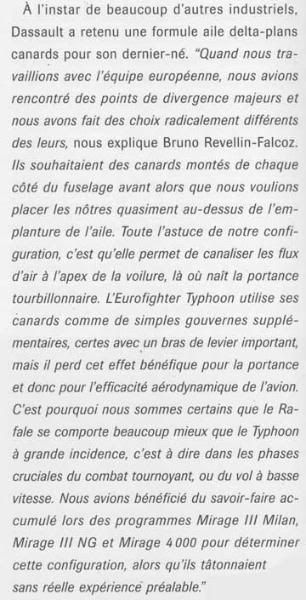
H_K
H_KDistiller,
I’m not sure I understand your “flow” comments. Is this what you’re talking about?
1. After recovery, planes flow from the angle deck directly to a forward lift on starboard (in front of the island)
2. Planes use the forward lift to enter the the hangar and then flow back towards the stern
3. Planes are brought up to deck through the stern lift (to port), from where they can be easily positioned on the stern catapult, without interrupting recovery operations
Although I agree this is “ideal”, I don’t think it’s very realistic.
First, I’m not sure planes “flow” through the hangar that way – that would require constant movements. Might be better to use a “back and forth” flow model, where planes enter and exit the hangar using the same lift. To keep plane movements to a minimum, you’d locate planes undergoing extensive maintenance furthest from the lift, and airplanes that are going to be turned around fast close to the lift.
Second, most two catapult carriers are going to be too small to position aircraft on the stern catapult without disrupting recovery operations. The only catapult that can be deconflicted is the bow catapult, and even then it has to be located on starboard, which reduces deck parking. If you decide to prioritize deck parking (as the French did), then you have to give up simultaneous launch & recovery operations, which makes a more sequential rather than linear flow OK.
H_KCompared to a USN carrier, how will the CVFs stack up when it comes to munitions and avfuel storage? Actually, how does the Cdg stack up also?
Fixed Wing planes
CVN-71: ~70-80 fixed wing
CDG: ~35 fixed wing
CVF: ~40 fixed wing
Aviation Fuel (JP-5)
CVN-71: 3,500,000 U.S. gallons
CDG: 3,000m3 to 4,500m3 –> 800,000 to 1,200,000 U.S. gallons
(depending on how much oil carried for escorts)
CVF: 5,000m3 –> 1,300,000 US gallons
Munitions Storage
CVN-71: 2,700t
CDG: 600 to 2,100t (figures probably vary according to type of munitions)
CVF: ?
H_KCdG is only just capable of operating Hawkeyes and Rafales, in reality she is too small. She raises steam from her nuclear plant. Her cost is as such that the French navy can only afford one of her and her availability is atrocious. She is a fantastic example of how not to build a carrier. CdG is the reason why the UK needs to keep the CVF programme cost down.
Just to correct a couple of misunderstandings. In absolute terms, CdG is a very successful ship – not too small to operate a good airwing, nor too expensive, nor a dock queen. 95% of the criticisms directed at CdG are pure tabloid media circus or schadenfreude (generally from across the Channel).
– First, she can operate a very effective air group of 24-30 Rafales plus 2-3 Hawkeyes, all with heavy payloads (including 12 tons of fuel & weapons for Rafale).
– Second, CdG was reasonably priced for a fully equipped, first-of-class, nuclear powered fleet carrier. She cost 1.9B euros ($2.3B) to build in the mid-1990s, plus an additional 1B euros ($1.2B) in development and infrastructure costs (using the average exchange rate of $1=5.5 francs between 1989-1995). By comparison, CVN-76 Ronald Reagan cost roughly twice as much to build for a mature design ($4.8B in FY 1995 dollars) and CVF will cost about the same as CdG when factoring in inflation and CdG’s superior equipment fit and nuclear propulsion (just under 2B pounds or $3B per CVF).
– CdG’s availability is on par with, and possibly better than, the UK’s smaller STOVL carriers and the USN’s larger CVNs. She sailed an average of 150 days/year for 6 years between commissioning in 2001 and going into her 15-month refit in 2007, which is an excellent sustained performance.
With all that said, CdG’s performance is not good enough relative to what the French Navy would now like. The French Navy wants 32+ Rafales. It wants to launch Rafales with 15+ ton payloads. It cannot afford to spend 2.5B euros on a new carrier – CdG or otherwise. It would love to have 300 days a year of availability, and one carrier will never deliver that. That doesn’t make CdG a bad design by any means – she’s a fantastic carrier, but not one that can meet the French Navy’s requirements which emerged after design had started and the Cold War was over.
H_KThe drawing of Victorious demonstrates one of the reasons i like that vessel so much. After her reconstruction she was a very modern and cleaning looking design and that comes out in the above image when compared to the likes of the Oriskany and Midway.
Victorious has very clean lines. A beautiful ship, but a bit too marginal for my liking. For me, Clemenceau and Oriskany come closest to the “ideal” 1960s medium carrier (Oriskany would have needed a steel deck, though).
Here’s an updated drawing. This time I’ve added Hermes, though IMHO it’s even more marginal than Victorious and shouldn’t really belong in this list. Compared to Victorious, Hermes has a few key shortcomings:
– Slower: 28kts vs. 31kts, with a realistic speed of 23.5kts during catapult launches (http://books.google.com/b…=hermes+carrier+catapult)
– Smaller, leading to less deck parking
– Only one “long” catapult
– Tons of equipment taken out to keep its top weight down (including almost all AA armament)
I’ve also added the deck safety line for Clemenceau.
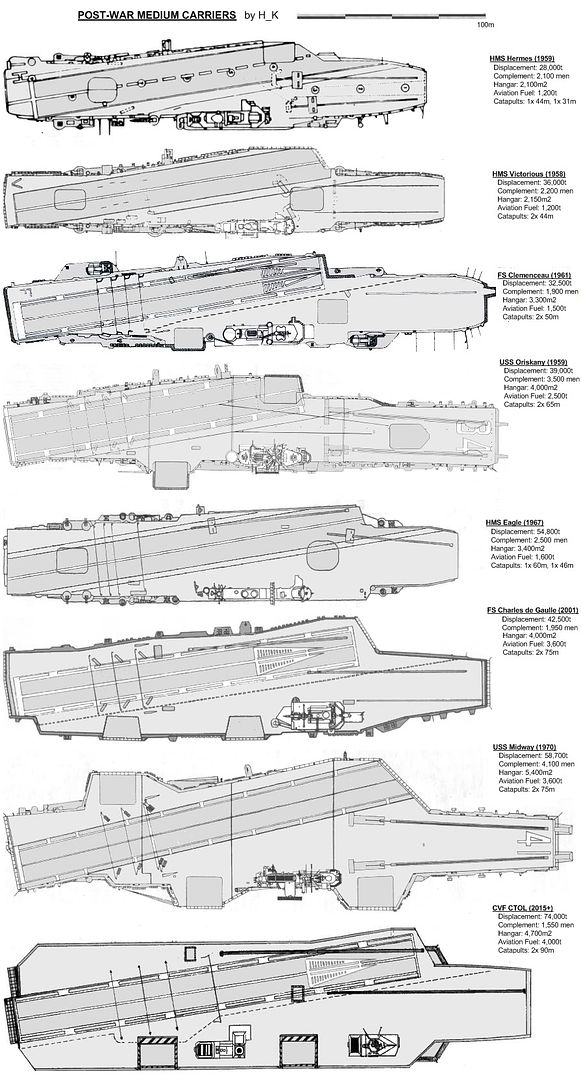
H_KI’m reposting the image, but in a larger size. This shows the details better. 🙂
H_KCdG follows this battle carrier doctrine but she is an unfortunate compromise that has resulted in a vessel that is really a bit to small and that suffers from poor availability that raises serious questions about the usefulness of a single carrier to a navy.
What’s interesting when you compare CdG to the other medium carriers is that it’s aviation capabilities are actually quite good. Certainly better than Ark Royal or an Essex – which is to be expected given that it’s a modern design.
So if Ark Royal and the Essexes could be considered viable battle carriers in the 1960s-70s, then CdG should still be a viable battle carrier today. IMHO CdG’s unflattering reputation is somewhat undeserved and has more to do with its poor airgroup (obsolescent Super Etendards + a smattering of Rafales without folding wings) rather than any inherent design flaws for CdG.
H_KBy necessity I had to draw the line somewhere. I admit that it may seem arbitrary, but IMHO there’s some logic to counting CVF and Midway as medium carriers – after all, they’re significantly smaller than the USN’s super-carriers.
Similarly, I chose to exclude Hermes on the low end of the scale, because IMHO it’s closer to a light carrier – even when comparing to Victorious.
H_KBut, and I would love to hear from French airmen or people that know them (or in the know), how was the French Navies experience on the US carrier? I just got Air Forces Monthly here, where they did a whole writeup on the subject, and it seemed as if everyone for lack of a better term, went “business as usual”.
I don’t know of any unofficial information from French sources. The official French storyline is very similar to the USN’s – everything went perfectly well, with some added rah-rah for the home front…
According to the French Defense Attache in Washington, Air Force General Jean-Luc Delon:
“The Rafale Marine performed particularly well against the USN’s most sophisticated aircraft, the F-18E Super Hornet. It is important that our pilots face the best, so that we know we are still first rate.”
And according to a usually well-informed French trade magazine:
The French aircraft operated without difficulty on the USS Theodore Roosevelt, thanks to previous exercises aboard USS Enterprise in 2007 and USS Harry Truman in 2008. The novelty this time was that 6 Rafale were based aboard a USN carrier. Initially, the USN was concerned about integrating these aircraft aboard and the constraints they would generate. “There was some apprehension on the American side. They were afraid that they’d have to freeze their operations, since they couldn’t imagine mixing in the French aircraft. But from day one, our team proved that we could adapt to the ship’s rythm and act like a USN squadron. Everyone immediately found their marks, and we aligned ourselves perfectly with USN operations. The Americans were actually quite surprised at the ease with which our teams integrated themselves. We caused none of the constraints and difficulties that they had been expecting” claims a source within French naval aviation headquarters.
Thus, the French fully demonstrated their ability to operate aboard USN carriers. This interoperability appears to have generated a lot of interest within the USN, which had never conducted such a cooperation, and since France is the only other country with modern, catapult launched aircraft. “The deployment was a total success. The results exceeded our expectations and increased the USN’s enthusiasm for cooperation.” While it is obviously out of the question for French aircraft to deploy aboard USN carriers for real operations, this interoperability allows both navies to use other carriers as diversionary airfields. Indeed, the French Navy would like to maintain this ability by intensifying exchanges with the Americans. For example, USN carriers transiting through Gibraltar towards the Gulf could deploy part of their airgroup to France, allowing Rafales to temporarily replace them until they cross the Suez Canal.
The French, at the same time, were able to take advantage of the USN’s huge training resources. French Navy personnel demonstrated great versatility, due to their need to constantly optimize their much more limited resources. “We have so few Hawkeyes, for example, that our crews are more energized, more perfectionist and versatile,” says a French sailor. (…)
As for the Rafale and its pilots, they were a revelation. Some Americans couldn’t imagine that another navy operates fighters at least as good as the Super Hornet. Building this new awareness was very important to the French.
http://www.meretmarine.com/article.cfm?id=108557
H_KSorry I made you go through so much work lol. So did you look up the dimensions of each plane and then apply them? Would each dash equal 10 feet?
The scale is 20 pixels to 1 meter.
H_KWow H K. Thanks for all that info. From what website did you get this? How did you find these to-scale drawings?
I googled the drawings and then scaled them. It took a lot more time than I expected…:o
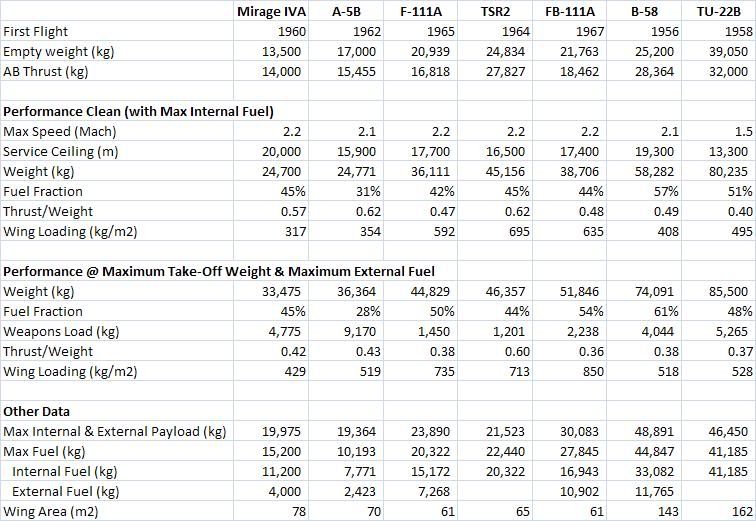
H_KHere’s a side by side comparison of the 5 bombers that I’ve prepared. As you can see, the Tu-22 and B-58 are not at all in the same category as the TSR2, F-111, A-5 and Mirage IV… 😮
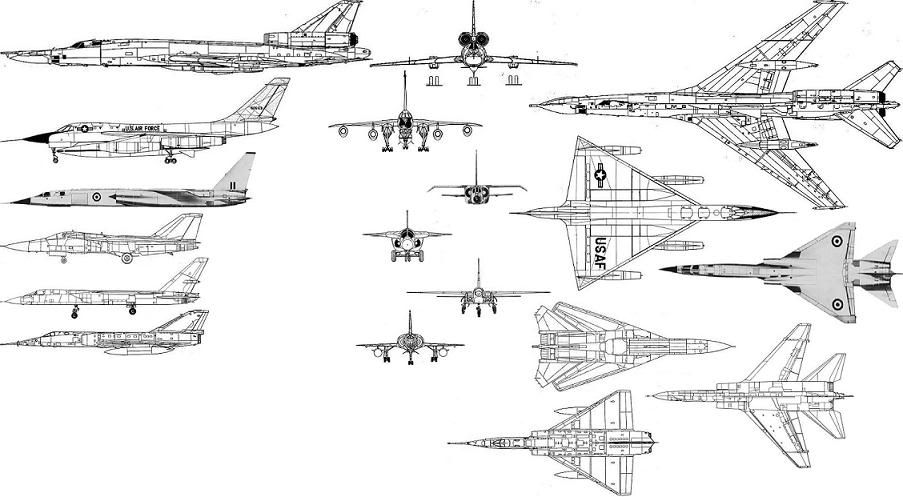
H_KI put the Mirage IV in the same class as small-medium bombers such as the TSR.2, F-111, B-58, Tu-22M, etc. How does the IV compare to those? Can it compete with them in range? speed? payload?
The Mirage IV is more of a small tactical bomber, in the same league as the US Navy’s A-5B Vigilante. It’s not in the same category as medium tactical bombers such as the F-111, TSR.2 and FB-111, or medium strategic bombers such as the B-58 and Tu-22. Dassault had a design in the cards for a true medium tactical bomber (the Mirage IVB), but it would have required foreign engines and would have been too expensive.
The Mirage IVA, equipped with standard fighter engines, was a fall-back option. But Dassault certainly did a good job, given the engine and tech limitations in the late 1950s. The Mirage IVA was not only a beautiful design – it also scores well in every respect: top speed, thrust/weight ratio, fuel fraction, service ceiling (due to low wing loading & good thrust/weight)… It was also a sound design, with fewer teething problems than every other supersonic bomber (the A-5, F-111, TSR-2, B-58, and Tu-22 all had numerous problems).
H_KH_K,
I don’t think that’s the only DA article I read about the Singapore contest, and it’s certainly not the only DA piece that examined Typhoon’s performance in technical evaluations.
You’re welcome to your opinion as to the usefulness or otherwise of my contributions, but telling me to s** off is just ignorant, rude and childish – which doesn’t seem to be your usual style.
You just did it again! “I don’t think XYZ…” Other posters here typically quote sources, and even when the source is an anonymous pilot, they include enough detail about the conversation, where and when it took place etc, to make their statements credible. You’re the only person who systematically uses heresay and insinuation, without bothering to include credible details about your sources or the rest of the conversation.
So excuse my rudeness, but honestly I’ve had enough. Is it too much to ask you to follow the same rules as other posters? Pull up those DA articles and prove me wrong – shouldn’t be very difficult for someone with your kinds of connections, right?
H_KNick,
In point of fact, the stories about the Singapore evaluation are not single source. There were references in all of the Show Dailies at Singapore, as well as the AFM piece to which you refer. I’m pretty sure that Francis Tusa wrote about it in Defence Analysis, too.
Jackonicko,
I don’t know if you’re John Lake, but I do agree with everything else Defexpo has to say about you. You add nothing to the Rafale threads except misinformation and put-me-downs towards any forumer who questions your unsubstantiatiable, and indeed often incorrect, claims.
To take just one example: the Singapore supercruise story comes from only one source, and you know it. Francis Tusa never wrote about it. What he did write was a vague criticism of Rafale’s hot & high performance. We all know that the Rafale has less oomph than the Typhoon (but still more than all other competing designs), so that’s not exactly news. And obviously, although he’s a respectable source he has a clear preference for the Typhoon, so you have to take his claims for what they are…
http://defence-data.com/current/pageda65.htm
The fact that you try to smeer Defexpo with LordArpad/Globalpress’ name is typical of your style of argument. For everyone else on this forum who’ve suffered LordArpad/Globalpress’ diatribes, it’s blindingly obvious that Defexpo is not the same person – you need go no further than his style and his command of the English language.
So, respectfully, s** off this thread, unless you can learn to contribute in a constructive way like Typhoon1 or Scorps. (The same applies to Globalpress, but unfortunately I think we lost him a long time ago…)
H_K
Courtesy of Kovy (?).
I’ll translate.
Like many other aircraft makers, Dassault has selected a delta-canard configuration for its latest design. “As we were working with the other Europeans, we started to diverge significantly on the design” explains Bruno Revellin-Falcoz [Director of Dassault’s Technical Department]. “Ultimately, we made some radically different choices. They wanted fuselage-mounted canards while we preferred to locate the canards almost above the wing-root. The key advantage of this configuration was that it would channel the air flow over the wing apex, which is where lift-generating vortices are formed. The Eurofighter Typhoon uses its canards as simple control surfaces. Although this creates a significant lever effect, it loses the positive impact on lift and therefore aerodynamic efficiency. That’s why we are certain that the Rafale can handle much better than the Typhoon at high angles of attack, such as during the crucial phases of dogfighting and low-speed flight. While they were groping around in the dark, we benefited from the know-how accumulated through the Mirage III Milan, Mirage III NG and Mirage 4000 programmes.


 Sign In