 H_K
H_KCompletely ignoring the rqnge and tanking issue ( more than competantly handled by Swerve :)) are people seriously considering sticking sone poor sod in a single seat fighter, expecting him to fly about 8000Ks conduct several A2A refuelings, then conduct a runway denial mission and repeat the inbound leg to go home.
A 1600KM round trip at a cruise speed of 500Kts thats a 20 hour round trip.
Q1) Can the Mirage run for 20 hours straight is there sufficient engine oïl or even MTBO/MTBF. (I believe the Rafale flight duration is limited by oïl consumption, but i accept this may be old news or wrong.
Q2 In this stressfull enviroment how are you intending to keep the pilot effective eg Hydrated and fed, 20 hours remember he will need water at least, which brings us to the other problem the limited facilities to expel waste water.
Q3 keeping him awake on the flight back.
Assuming he makes it home and lands safely i doubt the poor sod could walk, having driven 14 hours straight with only limited quick fuel stops at the end I was seriously fatigued with cramped extreemly stiff legs. I can only imagine the joys of 20 straight hours in a confined space.Q4 Was the Mirages Navigation system up to the task.
And just as an afterthought SAR, this is a single engine aircraft of an era where they reguarly fall out of the sky. The pilot will be wanting SAR cover, this will be difficult to achieve.
I think you’re confusing with the Mirage III???
The Mirage IV was a two-seat, two-engine strategic bomber, with even a urinal for each crewmember (!). It had a very comprehensive blind navigation/bombing suite, though it would probably rely on the C-135 tanker’s inertial navigation system for most of the trip.
The 7,400nm roundtrip would take just under 15 hours, which is less than the longest fighter mission in history (15.5 hours, by F-15Es over Afghanistan). The longest Mirage IV mission was about 11 hours historically, so there is a bit of a question mark around whether the onboard oil & oxygen capacity is sufficient.
H_KSwerve, you’re not thinking outside the box enough. 😉 Forget Port Stanley airfield. Forget 1,000lb bombs. Forget the crazily complicated “tankers refueling other tankers refueling other tankers” scheme. That’s way too RAF centric.
The French could have launched TWO Mirage IVs and simultaneously put out of commission BOTH main Argentinian airbases, with just FIVE C-135 tankers in support. Here’s how:.
Map of Argentinian airbases:
[ATTACH=CONFIG]220709[/ATTACH]
Roundtrip distance: 7,400nm from Muroroa.
In case of a fuel emergency, it was also possible to divert to Totegegie (1,700m runway), 200nm closer.
Hao airbase:
[ATTACH=CONFIG]220712[/ATTACH]
Mirage IV taking-off from Hao:
[ATTACH=CONFIG]220713[/ATTACH]
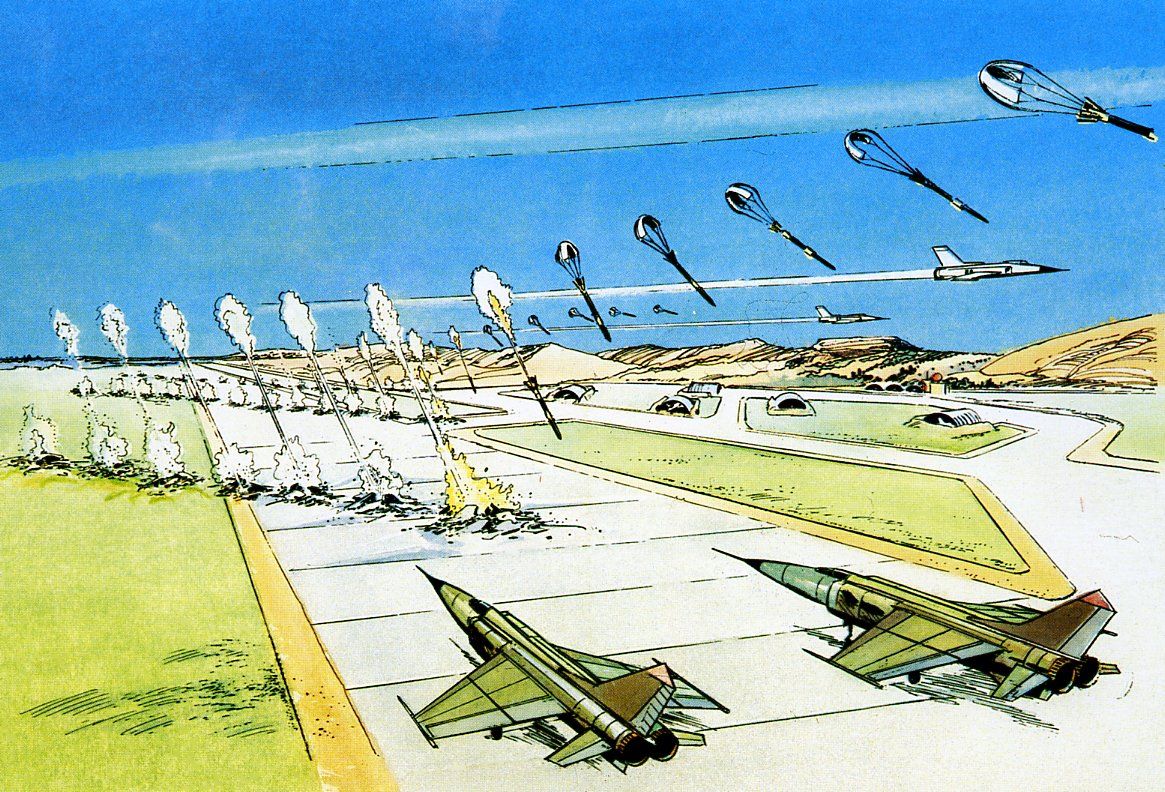
[ATTACH=CONFIG]220710[/ATTACH]
[ATTACH=CONFIG]220711[/ATTACH]
[ATTACH=CONFIG]220714[/ATTACH]
Tanker #1 could take two Mirage IVs out to ~1,800nm, then fill up their tanks (2x 15t)
Tankers 2 & 3 would continue to 3,000-3,200nm, and then each fill-up one Mirage IV (15t)
The two Mirage IVs would proceed separately to their targets 800-1,000nm away (1,600-2,000nm roundtrip)
Tankers 4 & 5 would meet the Mirage IVs on their return leg, 3,000-3,200nm out, and fill up their tanks (15t)
Tanker #1 would take-off again to meet the Mirage IVs ~1,800nm out and refuel both of them (30t)
H_KPredator/Guardian/Mariner is well within the envelope of EMKIT.
In fact, even Taranis/Neuron (and their scaled-up EJ200/M88-powered operational successors) are within the 12 ton envelope of EMKIT+.
Given the timeframes/investments involved, NOT navalising the future Anglo-French UCAV would indeed seem rather stupid.
H_KSeems the Ford will be way over budget and not as capable as hoped when delivered. http://www.dodbuzz.com/2013/09/06/gao-blasts-navys-ford-class-carrier-program/
Full report available here: http://www.gao.gov/assets/660/657412.pdf
This is the real scary part: EMALS currently has an MTBF of… 1. 😮 Yes, this means that EMALS experiences a “critical failure” after every launch.
Go straight to pages 37-38 for the gory details. Furthermore, even the USN doesn’t expect EMALS to reach its “minimum reliability requirement” (MTBF of ~90 launches*) until 2032… this according to a ‘projection’ that has already been rebaselined once and which EMALS is currently not even close to on track to meeting. And EMALS appears to be doing better reliability-wise than the new arresting gear and dual band radar…
* Note that C13 catapults had an MTBF of 900 launches… back in 1965.
H_KSo aside from the paranoid anti-globalization (?) rant, do you have anything constructive to add?
You do know that the “toys” we talk about on this forum (like “your” Rafale) aren’t designed to impress children at airshows…
H_KYes, Black Swan is also a relevant concept, though it suffers from a couple of fatal flaws (that it shares with LCS)…
Guess this helps to highlight a few critical capabilities that should be non-negotiable in a “mini-Absalon” frigate:
So there you go. The selling points of Absalon and the French & Italian proposals: decent speed, lots of comfortable accommodation, and ship-to-shore projection means.
H_KYep I got that idea re BATISMAR but it seems to have gone very quiet recently…I was wondering if it had been re-evaluated as a concept?. Has a design been down selected yet?. As I understood it BATISMAR was the eventual replacement for the Floreal’s…looks to me that the Floreal is a better foundation for BATISMAR than, at least, the CNM concept!.
Yes, BATISMAR has gone very quiet due to being pushed back beyond 2020 for financial reasons.
No, it’s not really a replacement for the Floreals, but for the much smaller P400 patrol boats (400 tons) and A69 avisos (1,300 tons). The goal is to buy a much more capable platform at only marginal extra cost compared to say an Armidale or FRC cutter. It must be oceanic and UAV/helicopter-capable.
I don’t know about CNM’s concept, but the French navy appears to be extremely satisfied with its experience so far with DCNS’ “l’Adroit.” She just wrapped up a >25,000nm (!) deployment and is spending 200+ days at sea and 270+ days away from her homeport on an annual basis. And despite her tiny 1,500 ton displacement, sea keeping is said to be excellent.
Some good sources on l’Adroit’s latest deployment:
http://www.meretmarine.com/fr/content/retour-sur-le-premier-grand-deploiement-de-ladroit-0
http://offshore-patrol-security.com/cms-assets/documents/112280-885674.05-sacha-bailly-day-2.pdf
H_KIs there any relevance to BATISMAR in this French concept H_K?. Last I saw of that was a 79m CMN design that looked a little modest for Biscay on an angry day?!.
BATISMAR is an OPV, i.e. a coast guard vessel. Small and cheap, since ~15 hulls are needed. Most similar to the defunct C3 concept, sized to carry a helicopter but without a combat role.
This new FTI (“Mid-sized frigate”) on the other hand does have a combat role. It’s better defended and has a much larger payload than an OPV, so that it can come close inshore to project power and deal with assymetric threats. So sort of like a European take on LCS. It will incorporate mixed civil-military construction standards – not clear how far they will go in terms of cost cutting.
The obvious assumption is that other assets will take care of enemy aircraft & submarines… assuming these even exist and that they are operational (not all that likely – in recent conflicts, the enemy’s high-end conventional weapons have rarely been more than paper tigers – it’s the assymetric threats that have have everyone worried).
H_KInteresting indeed……..the bow design in better suited to heavy sea correct???
Yes, among other things.
Seems like a trend among some designers these days, i.e. away from “short, fat” hull designs (which are very volumetrically efficient) and back to longer waterlines… The wavepiercing bow reduces pitching, improves efficiency in waves and at high speeds, and is stealthier. Probably more complex structurally, but that’s what computers are for!
H_KBack on topic, it seems like “light frigates” are making inroads with the French & Italians… almost a rebirth of the UK’s C2 “choke point escort” concept!
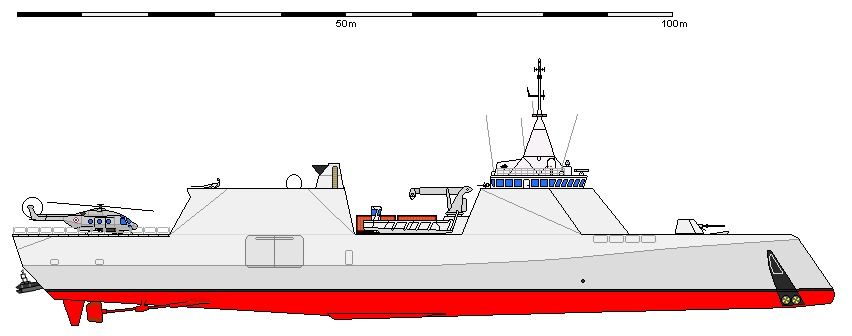
Both navies are looking at 3,500-4,500t “mini-Absalons” (or “large-LCSs” depending on how you see it), with an emphasis on modular payloads instead of kinetic weapons:
So basically optimized for sea control, special forces insertions, blockades, or prepositioned forces near failed states and disaster areas. Aside from a gun for NGFS, armament is limited or non-existant, but provisions exist for future add-ons.
The Italian concept – “Multirole Offshore Patrol” vessel

The French concept – “Mid-sized Frigate”
(Note: HIGHLY conjectural drawing, based on sparse info and extrapolating from DCNS’s Advansea concept)
All-in-all, the premise appears to be that there are many many conflicts involving low-tech, assymetric opponents. These “wars” are too intense for OPVs (what with the odd Grad rocket salvo, suicide attack, land-based missile launch, or low-end fighter-bomber…), but are a waste of a high-end frigate’s ASW or air defense capabilities. Some examples: Yougoslavia to Irak, Syria, Lebanon, Libya & Somalia. All failed states, border wars, terrorism, piracy or trafficking…
(Yes, there are many small countries with modern forces, including token numbers of jets and/or submarines, but they are rarely balanced, well-trained, AND dangerous. As for real “hot wars”, they can only be caused by a handful of usual suspects (China, Russia, India, Iran…), best handled by deterance, alliances and existing high-end warships.)
H_KFrom a Western perspective: Mig-25 and Mig-29.
Hugely influential, overblown threats, and sparked many a debate about whether the West had lost its edge.
H_KIs there any indications on the performance increase by switching to GaN?
5x greater power
Wider bandwidth
Better “efficiency” (probably meaning in terms of power consumption/cooling)
Also, will only SPECTRA benefit from the GaN? Will the RBE2 not make the switch?
Only speculation that GaN could be part of a future conformal radar upgrade. But that’s still very far over the horizon, somewhere in the 202X timeframe.
H_K@all_readers: the thread shld either end itself here as it is or be pursued around the relatives merits of the A400 (with stepped capabilities) and the C17.
I think you hve pinpointed the problem. The all-In wonder does not match fleet wide needs.
So TomcatViP, now you’d like to shut this thread after opening a can of worms with specious arguments that you can’t back up? Well, I’m still playing.:D
A400M vs. C-17
No air force thinks this way…. they think in terms of fleet mix, and the cost-benefit of owning vs. leasing capabilities. So it’d be a lot more interesting to discuss the merits of the following options. (Option C being preferred by a number of Euro countries)
Option A C-17 + C-130J/KC-390
Option B An-124 + A-400M
Option C A-400M + CN-235/295 (+ leased An-124/B747F/A340 as needed)
“All-in-wonder”
IMHO a more appropriate tag for the C-17 than the A400M… “Jet propelled tactical airlifter” and “strategic airlifter with tactical capabilities” are very difficult (and expensive) design compromises to pull off. On the other hand, the A400M is still very much a pure-bred tactical airlifter, only it gets to trade-off payload for near-strategic range (which the C-130 & C-160 couldn’t, because they were too small). But the A400M is NOT a strategic airlifter… which is fine, because that’s what the An-124 is for.
Reminds me of the old debate about whether it’s easier to turn a bomber into a fighter, or a fighter into a bomber… so far the Blackburn Skua, F-105 Thunderchief, F-111 and Tornado have shown that it’s a bad idea to build an over-sized aircraft optimized for payload/range and expect it to do well in missions that require high thrust/weight!
H_KBy comparison, the An-124 SALIS contract costs were:
Pre-2010: ~$35,000 per flight hour
2011 onwards: $~42,000 per flight hour
Those costs are all included (from French sources). And obviously an An-124 can carry more than a C-17 (2x more, roughly). For pallets to an established airport, a chartered 747 cargo will be even cheaper.
So all in all, buying C-17 is not a very cost-effective option. Of course it has other merits, like flexibility and keeping close ties with the US… but certainly offers nothing of interest for a country fully committed to the A400M.
H_KC-17 costs are very well known, thanks to NATO’s SAC program. And they don’t come cheap!
$385 MM for 1 C-17
+ $130 MM for initial spares
+ $35,000 per flight hour (Maintenance: $21,500, Fuel: $6,000, Crew & training: $7,500)
Add 10-15% for inflation since 2007. Also, these are FMS prices with maintenance and training done at US facilities. If the buyer wants his own simulators and maintenance, add more $$$.


 Sign In







