 H_K
H_KBaltic interceptions 2013… 2 beautiful birds and a very Cold War setting!
Full picture set: http://www.facebook.com/media/set/?set=a.539737329405330.1073741894.290726467639752&type=3

H_KNot only can they land with them… if the landing gear fails they can even land ON them (saves the airframe)!
There’s even a story of a Super Etendard doing a “touch & go” on its drop tanks. 😀 The pilot realized his mistake and was able to get back in the air… then did another circuit for a proper wheels down landing!
H_KSorry, let me clarify:
4,000-4,500hrs on each remaining F1M (6-8 aircraft flyable, delivered 1982-83).
+ 1,300hrs remaining until next overhaul (around the 5,500hr mark)
+ 1,500-2,000hrs potential after overhaul
= 7,000-7,500hrs potential airframe life, of which ~3,000hrs remaining
The beauty of this deal is that the Spanish aircraft are very well equipped for all-weather A2G missions (modern GPS+INS nav/attack system with <5m CCIP accuracy, cockpit with HOTAS, MFDs, NVGs and encrypted comms, state-of-the-art ECM, etc…) and they come with lots of spares. If BVR capability is required, upgrading them to ASTRAC level will be much cheaper than what the Moroccans paid.
They could even bring back some of the older airframes from storage, and operate a mixed squadron with 8-10 multirole F1Ms with ASTRAC, and 8-10 older F1Ms for training, reconnaissance & A2G.
H_K*CORRECTION*
The Spanish F-1Ms have a lot more life in them than I thought apparently… 1,300 hours/aircraft prior to overhaul (according to last week’s Spanish news reports). So they probably haven’t flown more than 4,000-4,500 hours. Add another 1,500 hours+ after overhaul (cost: ~1MEur) and the total life remaining is more like 2,800-3,000 hours per aircraft… suddenly makes a small BVR upgrade rather worth it.
P.S. The F1 remains a very dangerous fighter… in the right hands. Not that long ago it achieved kill ratios of 6-2 vs. Mirage 2000s and 8-0 vs. F-16 MLUs 😎 by playing to its strengths: high-speed slash & dash attacks, low-level terrain-masking escapes, excellent ECM jammer, low-speed vertical maneuvers pushing beyond opposing fly-by-wire aircrafts’ envelope limits etc. So add a new radar and MICA and it might cause even Chile’s F-16 Blk 50s some problems…
H_KDoes anybody know what sort of fatigue life the Mirage F1 was designed to have?
I’ve heard the original design life quoted as 4,000 hours, but this was overly conservative…
One F1 is known to have reached 7,319 hours (a French F1 CT) and the remaining F1 CRs will also be retired ‘early’ with around 7,000 hours. Their airframes are said to be in excellent condition, and only require 7-8 maintenance hours per flight hour… so who knows what’s the real fatigue limit!
The issue with the Spanish F1s is that they are fast approaching the 4,500-5,500 hour mark, which requires a major overhaul. If Argentina is willing to pay for the overhaul, they should be able to get another ~2,000 hours out of each F1… probably good enough to take them to 2025-2030.
H_KPlease don’t be so simplistic! If Argentina could get aircraft within range (note that they’d have to overfly parts of the Falklands to get within Apache release range, they’d take losses, & I don’t think Argentina currently has any aircraft which could carry it), they’d have a good chance of damaging the runways. How completely, & for how long, would depend on how many hits were achieved. Note that for local air defence operations, one runway, or even part of a runway, is enough.
You see? It’s a very useful weapon, but mere possession of it doesn’t guarantee victory.
There’s also the question of whether it would be sold. It falls foul of agreements regarding cluster munitions, which is why Sweden withdrew the DWS-24 from service (in storage, last I heard), so I doubt Germany would sell the proposed (but I think cancelled) dispenser version of Taurus, for example. Also, the British government’s lobbying to block it (on the grounds that its sole purpose would be to attack MPA) would probably be successful, even without the cluster munition ban.
My comment was tongue in cheek – looks like you missed that part!
I agree of course that no European government is likely to sell an anti-runway weapon to Argentina. It’s a quasi-strategic weapon – very hard to stop a surprise low-level attack. Even if you detect the launch aircraft before it reaches its release point (which probably requires an AEW platform), you won’t have time to vector in interceptors unless they’re already in the air… and AFAIK the RAF doesn’t keep a permanent CAP at MPA.
My point was just that when comparing aircraft types, we need to remember that some come with strategic capabilities (typically: standoff strike, SEAD, reconnaissance, and/or anti-shipping). Others don’t. And that’s often a bigger decision factor than the inherent performance of the aircraft itself.
(BTW, the cluster munitions ban doesn’t apply, since anti-runway submunitions – the French ones at least – are >20kg)
H_KGiven that airfield to the east of Argentina that belongs to you know who, this would settle the argument easily enough… if Apache was still in service! :p

H_KTF-306 was a custom TF30 turbofan for Dassault until the M53 flew. No different than Rafale using F404 until M88 flew.
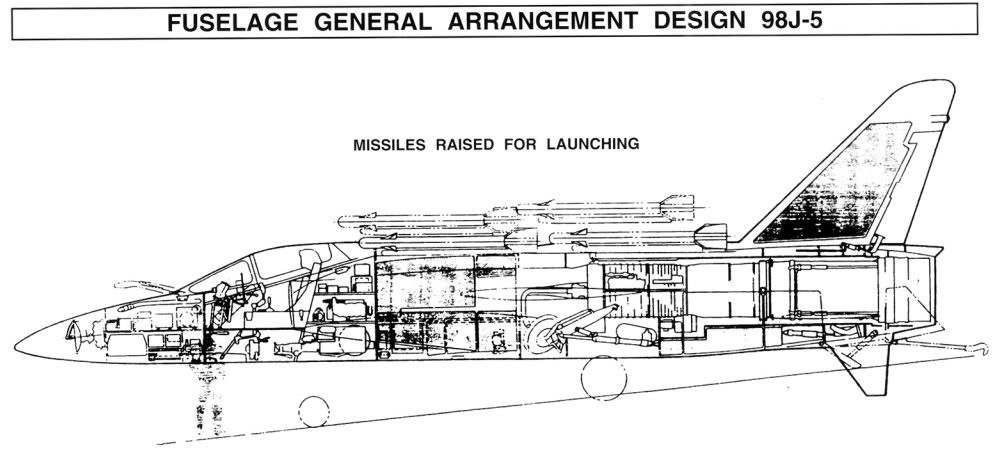
The plan was for a small run (50-odd) of the Mirage G8 as a reconn plane. It had no useful load and the only picture I found with an underwing load was the G4 prototype. There is no indication the underwing pylons were pivotable on wing sweep changes. No box glove pylons. No internal bay. It’s utility was pretty low potential-wise.
Not quite. You’ve got your details and versions mixed up… the Mirage G was FAR from an underarmed recon plane.
The Mirage G/G3 was originally designed as a follow-on to the the failed Anglo French AFVG, to meet the requirement for a carrier-capable, multirole strike/interceptor. The TF306 (TF30 with an uprated French afterburner) was perfect for this role and was favored by the French Navy, French MoD technical services, and Israel (involved as a potential launch customer). Why? Because it had the highest thrust and lowest fuel consumption of all Western engines at the time. No other engine allowed for a multirole strike/interceptor powerful enough to replace the F-8 Crusader/Mirage III, small-enough (10t empty) to operate from Clemenceau/Foch, and with long-enough legs at low-level for maritime strike/interdiction.
(Incidentally, one of the reasons AFVG failed was because the UK refused to accept the US-derived TF306, and kept pushing for a twin-Rolls-Royce solution too heavy for carriers and too slow for interception – guys, meet the Tornado! :applause:)
Only later did the Mirage G requirement evolve. The carrier capability was dropped, and the French Air Force was free to specify a larger, twin-engined aircraft for reconnaissance (Mirage G4 RAGEL) or nuclear strike/interception (Mirage G8). Both of these requirements could be met by French engines, without the TF-306’s problematic export and spare-parts restrictions (a major concern for a nuclear-capable aircraft).
As far as weapons load… pivoting pylons were in the pipeline and were in fact tested on the Mirage G8. There was also space under the fuselage for tandem or side-by-side charges. External tanks would not be required most of the time, with 4,900kg internal fuel for the Mirage G (originally 4,200kg, plus 2x 450l wing tanks added) and 40% lower fuel consumption for the TF306 vs. the Atar.
Pivoting pylons tested on the Mirage G8
H_KI don’t think the Mirage G in any version studied (G, G4, G8) offered much in the room for external loads. It was more or less built around a capability rather than a pragmatic design. The G8 would have been too expensive to justify in any role for the French and it was replaced by something much more practical.
No better or no worse than the Mig-23, it seems to me? With the large internal fuel capacity and low fuel consumption, it probably wouldn’t even need an external tank most of the time.
– Centerline pylon
– 2 wing pylons (which would have to pivot, as on F-14/Tornado)
– 2 Mig-23 style fuselage pylons could probably be added?
H_KHere are three questions for raising this topic:
1) Why there is no scaled models presented on-line while I searched google? If anyone made this model, I hope he would share photos when this thread would be seen.
2) Mirage G-8 vs MiG-23, I’m inviting your position and your reason.
3) Is is possible the Mirage G-8 became a same generation fighter as F-14 Tomcat?
1) Search in French, “Mirage G maquette.” Looks like there are 1/50 and 1/72 scale models.
2) The single-engine Mirage G is similar to the ground-attack Mig-23B/BN (i.e. lots of internal fuel, engine optimized for low fuel consumption). Compared to the fighter Mig-23M/ML, it has less thrust but is somewhat lighter and has a lot more range.
3) Same generation as the F-14 yes, but smaller airframe. In fact the Mirage G was tested by the US Navy when the F-14 was still being designed. But it obviously couldn’t fit the same electronics and radar.
Pics of the Mirage G 1/72 scale model: http://www.checksix-forums.com/showthread.php?t=178287
Mirage G vs. Mig-23
Mirage G vs. F-8 Crusader
Mirage G vs. larger brother Mirage G8
Mirage G vs. smaller brother Mirage F1
H_KBtw. people keep claiming that the Rafale programme cost has grown by 4% only and I understand that this has been stated by Mr. Edelstenne (IIRC). But how does this claim match the with real numbers? In 2006 it was stated that total programme costs would be 33 bln € incl. R&D plus production of 294 aircraft. The estimate has grown by about 10 bln € ever since, how is this explained? I understand that VAT may have increased a bit, but numbers have been altered as well, production run is further stretched out and there is of course inflation. Are the figures adjusted for inflation, is that known and does the latest estimates take upgrades into account that go beyond the definitive F3 standard? These might be possible explainations for the cost growth, but are they valid?
Yes, French program costs are always reported in “constant euros”, i.e. adjusting for inflation. But they keep moving the baseline year, to make it harder to figure out whether the costs have actually increased!
1996: €29.2 bln in 1996€ (Aircraft: €14.8 bln, R&D: €5.7 bln, Spares, Simulators & Industrialization: €8.6 bln)
2004: €35 bln in 2004€
2008: €39.6 bln in 2008€
2012: €44.2 bln in 2012€ (Aircraft: €20 bln)
Now adjusting for inflation (1.6% average), in 2012€:
1996: €37.3 bln (Aircraft: €18.9 bln, R&D: €7.3 bln, Spares, Simulators & Industrialization: €11 bln)
2004: €40.2 bln
2008: €41.3 bln
2012: €44.2 bln (Aircraft: €20 bln)
That’s a ~16% cost increase in 16 years… so a bit more than what the French MoD claims (+4.45% between 1996 and 2007), but they may have been using a higher % for defense-related inflation.
H_KI love this aircraft… It would have looked awesome in Canadian navy colors.
That’s an interesting what if… F11F Tigers (or Super Tigers) on Colossus-class carriers!
It would be very tight in terms of catapult & weight limits… the F11F is basically a supersonic Super Etendard (in terms of weight and stall speed). A couple of thousand lbs heavier and 5-10kts faster stall speed than the A-4…
AFAIK the Super Etendard was marginal on 25 de Mayo. But IF it could have been made to work, the Super Tiger in particular (with provisions for 2 Sparrow AAMs) would have been a much better interceptor than the Skyhawk. Passable strike aircraft too, but that would probably blow right past the catapult weight limits.
H_KExcellent source (with pics) on Grumman’s Super Tiger design:
http://www.scribd.com/doc/78713022/Naval-Fighters-44-Grumman-F11F-1F-Super-Tiger
H_KDrum roll… cue in the F11F-1F Super Tiger with J79 engine. 😉
…solved all the issues with the J65.
The Super Tiger could have had a massive production run, no, SHOULD have had a massive production run instead of the F-104 Starfighter and F-8 Crusader… On technical merits at least.
Possibly could also have bern an alternative to some of the thousands of A-4 Skyhawks and F-4 Phantoms built, using specialized ground attack and all-weather interceptor variants (like the Viggen… since there was in fact a Grumman proposal to fit the Super Crusader’s avionics on the Super Tiger)
Or so I argued in this hotly debated thread: http://forum.keypublishing.com/showthread.php?97615-Best-naval-fighter-of-the-mid-1960s/
H_KThanks, some REALLY interesting pics… including stuff that I thought was CLASSIFIED (!), such as the nuclear reactor and weapons magazine layout.
Must read for anyone interested in CVN design… should put to bed any misunderstandings that nuke propulsion is “compact”.
Also, the best drawing I’ve seen of CdG’s hangar layout. Cheers!
Deck layout
See the nuclear reactor spaces!

Flight deck & hangar arrangements

Flight plan (for a 2hr period)
1 Hawkeye
4 Rafale + Rafale buddy tanker
4 Super Etendard + Rafale buddy tanker
2 Super Etendard + Rafale buddy tanker
1 Hawkeye
… also including Rafale weights down to the kg! (which confirms that the Rafale M weighs 10,200-10,300kg empty)

Operations center
6 air controlers, 3 radar operators, 5 electronic warfare, 3 missile operators etc.



 Sign In







