 Jō Asakura
Mr. havaarla, are you referring to me? I was under the impression MiG-31 regiments had long-established ‘radar sweeps’ (since Soviet times), using the APD-518 data-link and a 200km gap. It says here “automatic coms to ground control” also:
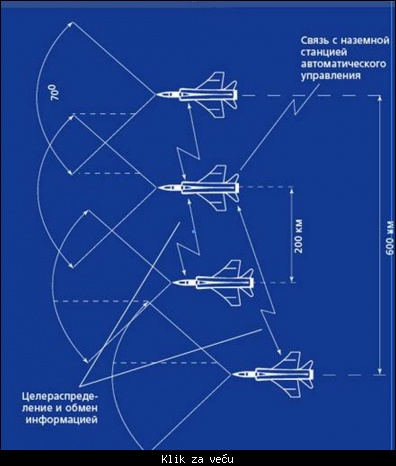
Anyways, has anyone seen Oooshiny or mig-31bm? They’ve got some explaining to do.
Jō AsakuraSo given the 3 decent sources presented showing that RCS increase is no-where near 100x going from 10Ghz down to 1Ghz being pushed by a few who were confused by some maths…
Nothing confusing about a B-2 plot of 100m^2 @ 1GHz, buddy (from your post btw):
‘Oh-oh-spaghettios’!!…and still at least 10x more reflective from the more discrete aspects!
Concurring quite well with the 18-20dBsm increase for 1GHz stated by industry academics & professionals (at least in the worst offending regions).
Also kinda runs riot with your attempts to portray a 10GHz plot that closely matches a 1 GHz plot for a (non-stealth) MiG-29 as directly extrapolating for the notional stealth bomber from your linked undergraduate ‘study’.
Another person said that no aircraft, whether legacy or stealth will ever fly in a wide formation. All engagements are tight format vs tight formation, no exceptions…
Not even the MiG-31? (I mean the plane, not the poster here who can’t tell the difference between 18 and 40dBsm).
Jō Asakura…
Jō Asakura
You clearly have serious problem in understanding and not answering my question at all.
1) Formulate system requirements for both passive and active (with incoherent illumination) radiometry for candidate high-performance mmW imaging systems based on thinned arrays for application to:…
Active millimeter wave imaging systems first illuminate the objects and subsequently detect the reflected millimeter waves. Many active imaging systems are essentially radar based. The millimeter wave and THz imaging research areas at the DMRC include:…
Jō AsakuraGood God. Do you really understand the means of Resolution ?
Long story short.. It is not whatever that paper you linked said.
Plus we are talking about ACTIVE mmwave seeker.
If you’re talking about radiometer then why you link IEEE paper which talks about ISAR ?
Only you are talking about a radiometer (n) – everyone else is talking about radiometric (adj.) [waveform].
Quite interesting.
So the first two can operate in both X-band than Ku? I suppose the two wavelengths have advantages and disadvantages against different target to be coupled in one seeker…
AfaIk, I think it’s either-or but not dual band (scroll down):
Jō AsakuraI don’t see correlation between resolution and counter stealth…

Growing in potential as a counterstealth technology is millimeter wave (MMW) imaging, which uses the radiometric signature naturally emitted by all objects. MMW penetrates clouds and low visibility. The waveform can also be transmitted by radar, which then receives and processes the return echo…
The Russian defense industry has developed MMW antiair missile seekers, and other countries are following suit…
Jō AsakuraIf the system L-150-16M RWR/ELINT could be able to get the bearing and coordinates from the target ( fighter) , then the Su 25SM3 should be capable to fire its R 77 missiles with ARH( Active Radar Homing), and in this case even such Su 25SM3 without air-mode radar could be able to fire this R 77 against the target.
While the target has been emitting signals that would be detected by this system L-150-16M RWR/ELINT, the target will be track by the launch aircraft , with the condition that aircraft would be is equipped with a X band datalink, then it will be capable to update the coordinates for the R 77 missile with ARH..
Just one curiosity AFAIK about the R 77 and R 37 missiles that both had been designed with digital active radar seeker in the X band, while the precursor from all ARH missiles as the former AIM 54A Phoenix and the all active service AIM 120 were operating in the Ka band.
Almost all experts in the West about active radar seekers has been claimed that Ka band will increase the precision or Pk from BVR missiles, once if it would be compared to X band that had been equipped the SARH( Semi Active Radar Homing) missiles.
Another advantage from Ka band in BVR missiles will increase the complexity from ECM devices in the adversary aircrafts, once the target should be capable to jamming both the radar in the X band from the launch aircraft, as well as the BVR missiles with Ka band seekers…
That would be a ground-breaking capability that not even the mighty AN/ALR-94, SPECTRA etc posses – and hence I think it highly unlikely for the L-150-16M. The L-150-35 on the Su-35S is a more complex and sophisticated piece of kit analogous to the AN/ALR-94, and even it uses Irbis in interferometer LPI mode to target active radar guided missiles.
The next generation AAMs will switch to Ka-band (MMW radar seekers) affording very high resolution for anti-stealth:
Millimeter wave (MMW) radar is booming in application to target seeker onboard the air-to-air missile (AAM), which has the capability to obtain all-weather radar images for auto target recognition (ATR) and intelligent active homing guidance…
AGAT’s Ka-band MMW seeker (centre):

Jō Asakura…Again I’m not being racist like SOME are trying to paint me. Im just stating the facts…
No amount of fancy math, and charts trying to judge RCS matter if the engine are not up to par.
…
…i.e. if you’re still around, drop in & say 您好.
Jō AsakuraThey may be related to fuel pressure problems.
A brand new fuel flow, pressure, monitoring and diagnostic system will be installed in T-50-6 (probably 6-2) and T-50-8:
ОАО ЭОКБ “Сигнал” им. А.И. Глухарева;
-изготовление опытных образцов ДСПДТ и СНПТ для объекта Т-50-6;
-изготовление опытных образцов ДСПДТ и СНПТ для объекта Т-50-8.
Jō AsakuraOf note is the operationalisation of the Thermo Infusion Automated Center (TIAC) whereby after automated placement of dry fibre tapes (in itself quite revolutionary), completed wing and wingbox structure layups are processed in the TIAC (pic 1).
It reportedly enables very precise process control, including temperature uniformity of ±2°C up to 270°C/518°F and porosity levels of less than 0.5 percent.
[ATTACH=CONFIG]240435[/ATTACH][ATTACH=CONFIG]240436[/ATTACH][ATTACH=CONFIG]240437[/ATTACH][ATTACH=CONFIG]240438[/ATTACH]
Jō AsakuraThe production & fabrication processes for the MS-21’s composite wing:
[ATTACH=CONFIG]240427[/ATTACH][ATTACH=CONFIG]240428[/ATTACH][ATTACH=CONFIG]240429[/ATTACH][ATTACH=CONFIG]240430[/ATTACH][ATTACH=CONFIG]240431[/ATTACH][ATTACH=CONFIG]240432[/ATTACH][ATTACH=CONFIG]240433[/ATTACH][ATTACH=CONFIG]240434[/ATTACH]
Jō AsakuraHere is the new L-150-16M RWR/ELINT (станции непосредственной радиотехнической разведки/СНРТР) due to be fitted to the Su-25SM3 and then later Su-27 derivatives and has the ability to passively target both air and ground based radar emitters.
Pic shows before & after strike on 36D6 ‘Tin Shield’ by Kh-31. Interestingly, the graphic shows a version of the R-77 and not the R-27P/EP which may indicate an upcoming passive seeker for the former.
[ATTACH=CONFIG]240414[/ATTACH][ATTACH=CONFIG]240415[/ATTACH][ATTACH=CONFIG]240416[/ATTACH]
Jō AsakuraStudio ‘Wings of Russia’ presents MAKS 2015:
T-50 footage from 14:00 including in-cockpit with S. Bogdan.
Jō AsakuraBite what exactly?! Since you missed it first time I’ll repeat: fighter engine development is a ‘black art’.
A case in point, we (the Japanese) are the most technologically advanced nation on Earth, yet have you seen the specs for IHI Corps. XF-5? Truly woeful.
As the rapprochement between Russia & China reaches new levels, though I don’t see a joint venture between them on a new fighter engine (since the Russkies simply will not share the secrets of this ‘black art’), I do think engines like Salyut’s AL-31F-M3 will get export clearances. This is a direct design counterpart to the F119-PW-100, with slightly less thrust.
TomcatVIP, how many of the 14 RD-180s on order by the US will end up being sold to the PRC?! :highly_amused:
Jō AsakuraThank you. So, nose moving left to right (in relation to the AC, not the picture)?
Yeah, correcting an anti-clockwise flat spin whilst free falling (you can see a near vertical vortex stream off the tip of its nose).
The fully deflected starboard LEVCON induces a pressure differential which counteracts the spin on its yaw axis (also the Cg) and in conjunction with TVC, drags the nose to starboard.
More pics:
http://russianplanes.net/id173412
http://russianplanes.net/id173192
http://russianplanes.net/id173134
http://russianplanes.net/id173085
http://russianplanes.net/id173056


 Sign In







